Old-fashioned Date Pudding

Date Pudding

I recently came across a cookbook published in 1923 called The Calorie Cook Book. In the Introduction it says:

This book has been made for the use of those people who wish to eat properly and really don’t know how. . .

We Americans have bolted and stuffed rich food for so long that it is amazing how very few of us know how to stop or what to do, when the family physician, treacherously upheld by our own inner selves, demands a change in the catch-as-catch-can style of eating we have so long enjoyed.

Based on the title and the book’s introduction, I assumed that the recipes would be for healthy low-calorie foods. But the first page I flipped to proved that my assumption was wrong:

Date Pudding Recipe
Source: The Calorie Book (1923) by Mary Dickerson Donahey

The recipe for Date Pudding said it was delicious, but that reducers should be beware. The recipe was not for them. I was intrigued. The author must think that a recipe is really good when deciding to put a high-calorie recipe in a low-calorie cookbook. So, before I knew it, I decided to ignore the warning and make Date Pudding.

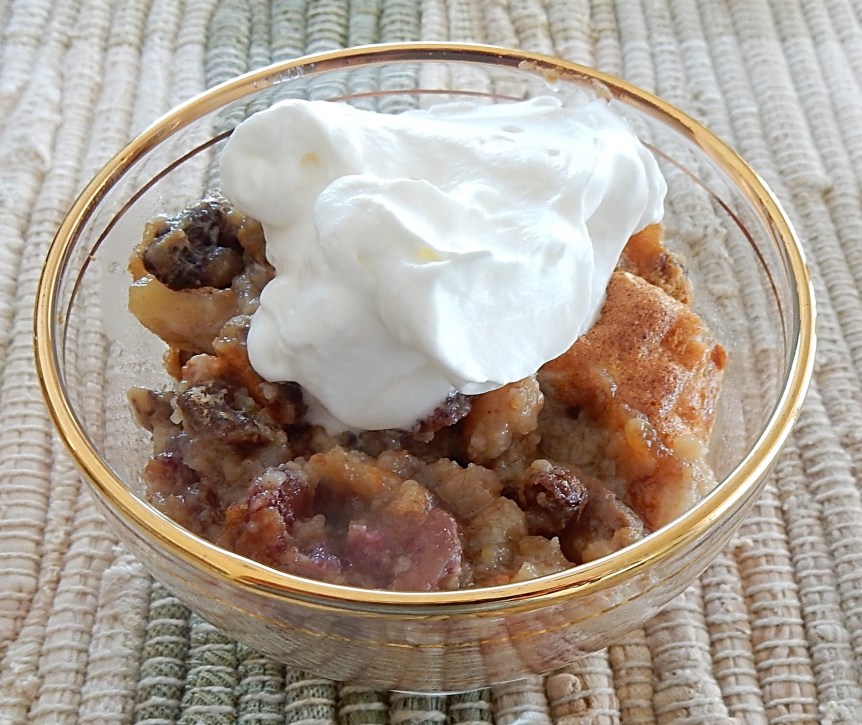
The Date Pudding was delightful. Beaten egg whites gave the pudding a nice texture, and the dates and walnuts blended nicely for just the right balance of sweetness and crunchiness. I served the Date Pudding with whipped cream, which made it even more delicious and decadent.

This recipe called for “English walnuts” to distinguish them from “black walnuts.” Today, English walnuts are generally just called walnuts.

Here’s the recipe updated for modern cooks:

Date Pudding

  • Servings: 6 - 8
  • Difficulty: moderate
  • Print

2 eggs, separated

1 cup walnuts, chopped

1 cup dates, chopped

1 cup sugar

2 tablespoons flour

1 teaspoon baking powder

1 teaspoon vanilla

2 cups milk

whipped cream, optional

Preheat oven to 350° F. Put egg whites in a mixing bowl; beat until soft peaks form. Set aside.

Put sugar, flour, baking powder, vanilla, egg yolks, and milk in a mixing bowl; beat until smooth. Fold in the beaten egg whites, and then gently stir in the chopped dates and walnuts. Put the mixture in an 8″ X 8″ square baking dish. Put in oven and bake until a knife inserted in the center comes out clean (approximately 50 minutes – 1 hour). Remove from oven. May be served warm or cold. If desired serve with whipped cream.

http://www.ahundredyearsago.com

Sour Cream Pie with Dates


slice of sour cream pie with dates on plateWhen I came across a hundred-year-old recipe for Sour Cream Pie with Dates, I decided to give it a try. This rich, custard-style pie has lots of embedded date pieces; and is a unique combination of old-fashioned goodness, and a sophisticated blend of sweet and sour.

Here is the original recipe:

Recipe for Sour Cream Pie with Dates
Source: Good Housekeeping’s Book of Recipes and Household Discoveries

And, here is the recipe updated for modern cooks:

Sour Cream Pie with Dates

  • Servings: 5 -7
  • Difficulty: moderate
  • Print

1 cup sour cream

1 cup sugar

1 egg

1 teaspoon flour

1/4 teaspoon salt

1 cup dates, chopped

8-inch (small) double-crust pie shell

Preheat oven to 425 degrees. Put sour cream, sugar, egg, flour, and salt in a mixing bowl; beat until smooth. Stir in dates. Place in pastry-lined pie pan. Cover with top crust. Seal and crimp. Cut slits in top crust (or poke top crust several times with a fork). If desired, brush with a small amount of milk; sprinkle with sugar. Bake in oven for 10 minutes; then reduce heat to 350 degrees. Bake an additional 30 to 40 minutes or until crust is browned and filling has set.

http://www.ahundredyearsago.com

Coachella Date Trees a Hundred Years Ago

date tree
Source: Farm Journal (April, 1919)

When I hear the word “Coachella” I think of the annual music festival at Indio, California, so I was surprised when I recently came across an article in the April, 1919 issue of Farm Journal about Coachella – but it wasn’t about the music festival. Instead it described how the Coachella Valley in California was the perfect spot for raising dates. Here are a few excerpts.

Now, thanks to our wise Government, it is possible to obtain home-grown dates. Our agricultural experimenters found a bit of real Sahara Desert in Southwestern California, the Coachella Valley, only eight miles wide and twenty miles long. This strange little valley is 250 feet below sea-level.

The Algerian tree was dug up and carried to the newly established agricultural station named Mecca, and of course, it felt itself quite at home there. In 1904 it was fifteen feet high; now it is thirty feet high and each year bears great quantities of splendid fruit. It has become the parent tree of a great date colony of 500 acres. The trees are flourishing, thanks to the irrigation system that supplies an abundance of water to their roots.

Four hundred pounds of fruit to a tree is possible each year, and the trees live to be 200 years old.

The U.S. Department of Agriculture is still doing research in Coachella. The Agricultural Research Service is conducting research on how to improve the productivity of “old” date trees in the valley. I don’t know whether any of these old trees are from the original Algerian date tree described in hundred-year-old Farm Journal article – but somehow I want to believe they are.

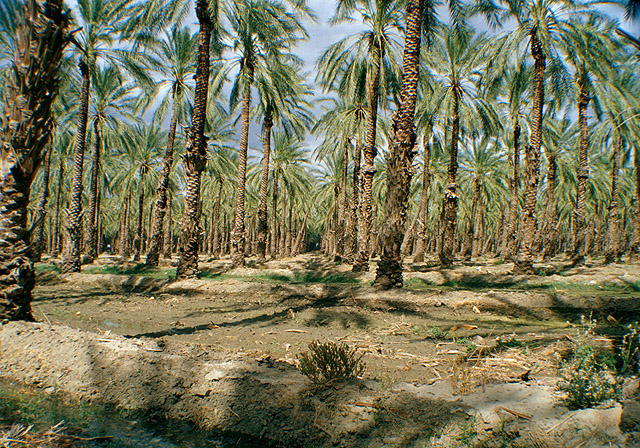
date orchard
Source: USDA ARS Online Magazine. Caption under the photo: Cover crops are being evaluated as an alternative to conventional tillage practices as a means to improve production of older orchards.

Old-fashioned Date and Apple Salad

Simple, tasty, attractive salads are the best. I recently found a hundred-year-old recipe that fits the bill. Date and Apple Salad has a light lemon and oil dressing. The apples and dates are cut into “match-stick” pieces which makes a lovely presentation; and the tart, crunchiness of the apples combines beautifully with the sweet, chewy dates. This recipe is a keeper.

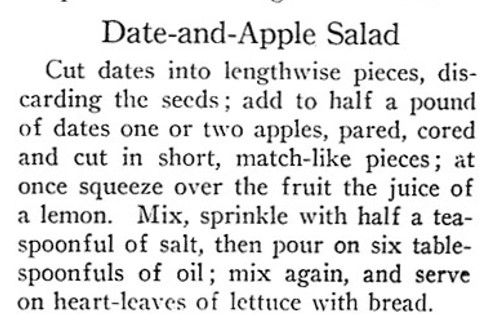
Here is the original recipe:sh

Source: American Cookery (January, 1918)

And, here’s the recipe updated for modern cooks:

Date and Apple Salad

  • Servings: 4 - 5
  • Difficulty: easy
  • Print

8 ounces pitted dates

2 apples

juice from  1 lemon

1/2 teaspoon salt

2 tablespoons vegetable oil (I used olive oil.)

lettuce leaves, optional

Cut dates into lengthwise into “match-stick” pieces, and put into a bowl. Peel and core apples, then cut into match-stick pieces. Dip apple pieces in lemon juice, then place in the bowl with the dates. Add salt and oil; then gently toss.  If desired, serve on lettuce leaves.

The hundred-year-old recipe called for six tablespoons of oil. This seemed excessive, so I used two tablespoons of oil.

Old-fashioned Chinese Chews Recipe

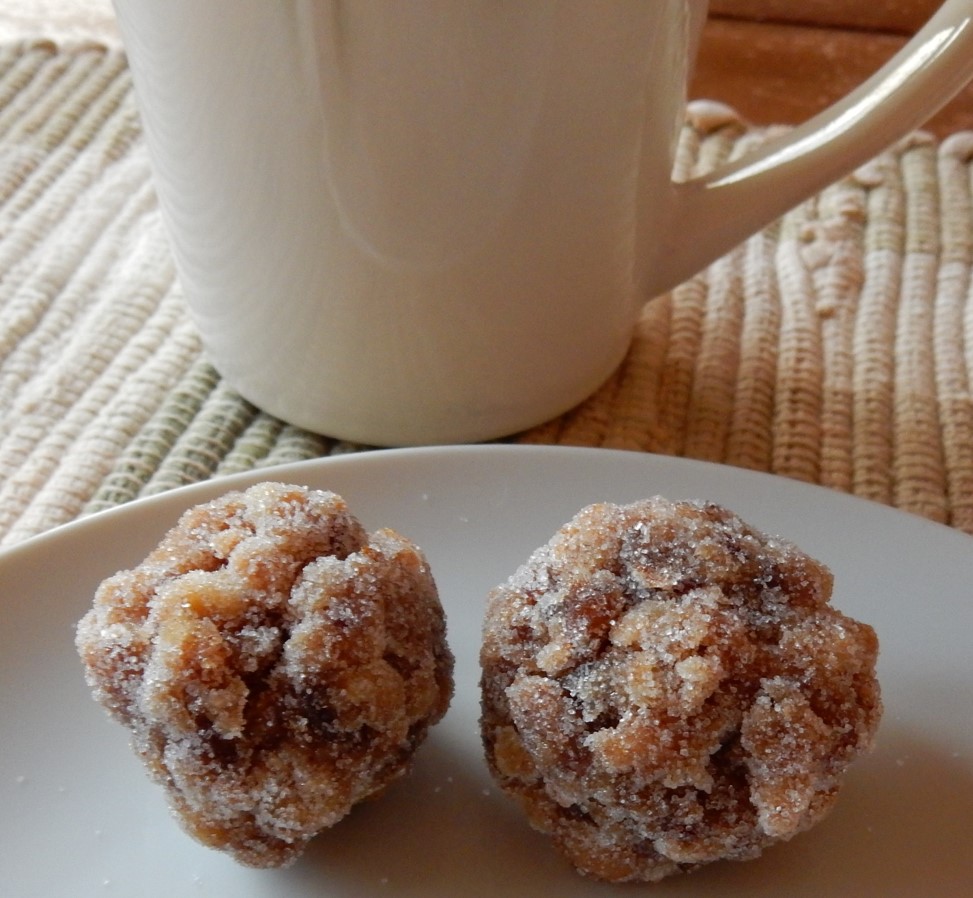
I recently came across a hundred-year-old recipe for Chinese Chews. The recipe was for walnut and date cookie balls. Why were they called Chinese? Were the balls supposed to seem special  because the name evoked thoughts of  exotic, far away places?  I think of the middle east when I think of dates – but not China.  That said, improbably named recipes inevitably intrigue me, so the next thing I knew I was making Chinese Chews.

Chinese Chews are a sweet chewy treat, and would make a nice addition to a holiday cookie tray.

They were fun to make. The dough is spread thinly in a pan or baking sheet, and then baked until it just begins to brown. The baked dough is then removed from the oven, cut into pieces, and rolled into balls which are then coated in granulated sugar.

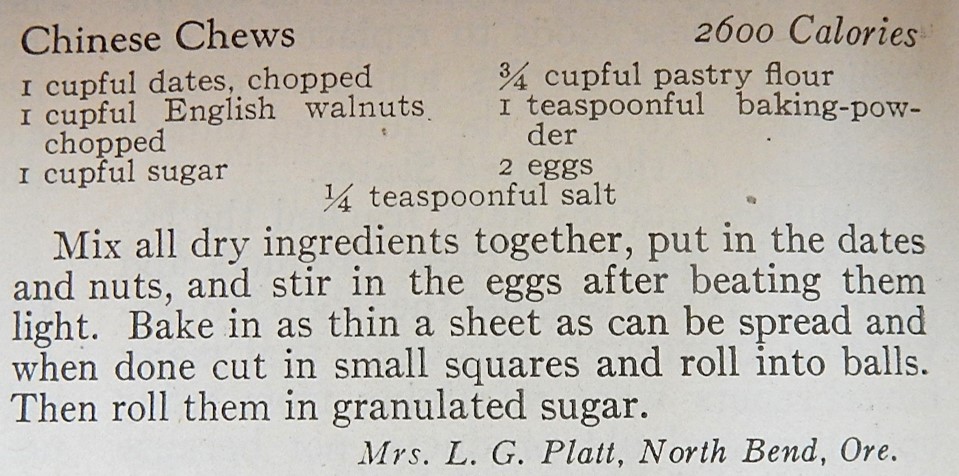
Here’s the original recipe:

Source: Good Housekeeping (June, 1917)

And, here’s the recipe updated for modern cooks:

Chinese Chews

  • Servings: 20-25 1-inch balls
  • Difficulty: moderate
  • Print

1 cup sugar

3/4 cup flour

1 teaspoon baking powder

1/4 teaspoon salt

2 eggs

1 cup dates, chopped

1 cup walnuts chopped

granulated sugar

Preheat oven to 350° F.  In a mixing bowl, combine the sugar, flour, baking powder, salt, and eggs. Then stir in the dates and walnuts. Spread thinly on a baking sheet. (There may not be enough to cover the entire sheet.) Place in the oven and bake until the dough sets and just begins to brown (about 15 minutes). The baked dough should look “not quite done.” Remove from oven and cool about five minutes.

Use a spatula to remove the baked dough from the pan  Take chunks of the baked dough and shape into 1-inch balls. (Don’t worry if baked dough comes out of the pan in odd-shaped pieces. I put all the pieces in a bowl, and intentionally combined some of the “crustier” portions from the edge of the pan with some of the softer portions from the center to make balls that had a nice consistency.)  Roll each ball in granulated sugar. Work quickly because the balls are easier to shape when the dough is still warm.

Cook’s note: The hundred-year-old recipe called for pastry flour. I used all-purpose flour and it worked fine.