Old-Fashioned Molasses Orange Cake

Molasses is an underutilized sweetener. According to Spruce Eats:

It was a very popular sweetener in the United States during the early 20th century, though it’s used less often today.

That’s a pity. Molasses can provide a delightful rich, earthy, sweetness, with hints of caramel, which enhance many foods.

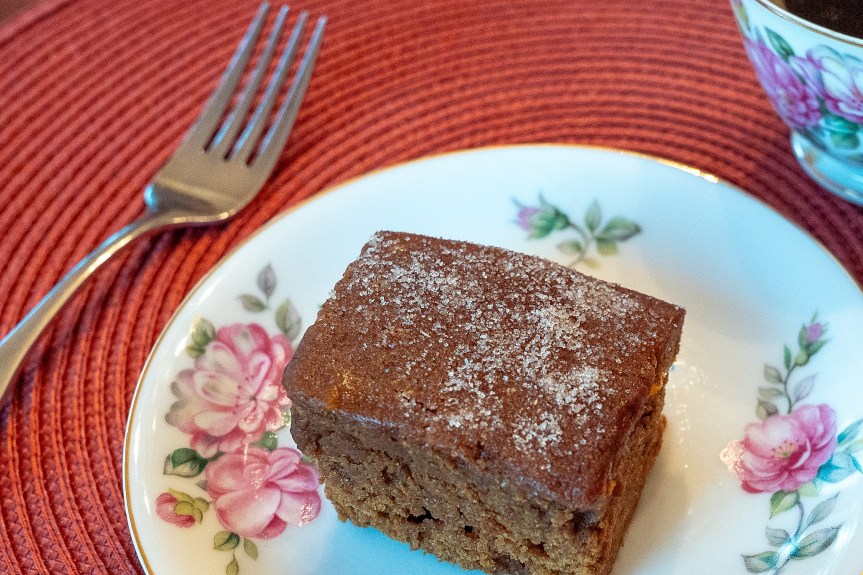
When browsing through hundred-year-old cookbooks and magazines, I often see recipes that call for molasses. I recently came across a recipe for Molasses Orange Cake embedded in a Brer Rabbit Molasses ad in the November, 1925 issue of Ladies Home Journal, and decided to give it a try.

I served this cake to a group of friends. I’m originally from Pennsylvania, and one person said, “Is this one of your Pennsylvania Dutch recipes?”

It’s not, but the cake has the delightful, satisfying, hearty, richness typical of Pennsylvania Dutch desserts.

The cake was moist and flavorful with a hint of orange and nuanced spicy undertones of allspice and ginger. The recipe calls for grated orange peel, which provides bold bursts of citrus. The cake is topped with a light dusting of sugar and cinnamon. This recipe makes an 8-inch square cake. Since the cake is rich, I cut the cake into fairly small pieces and it can easily provide 8 to 10 servings.

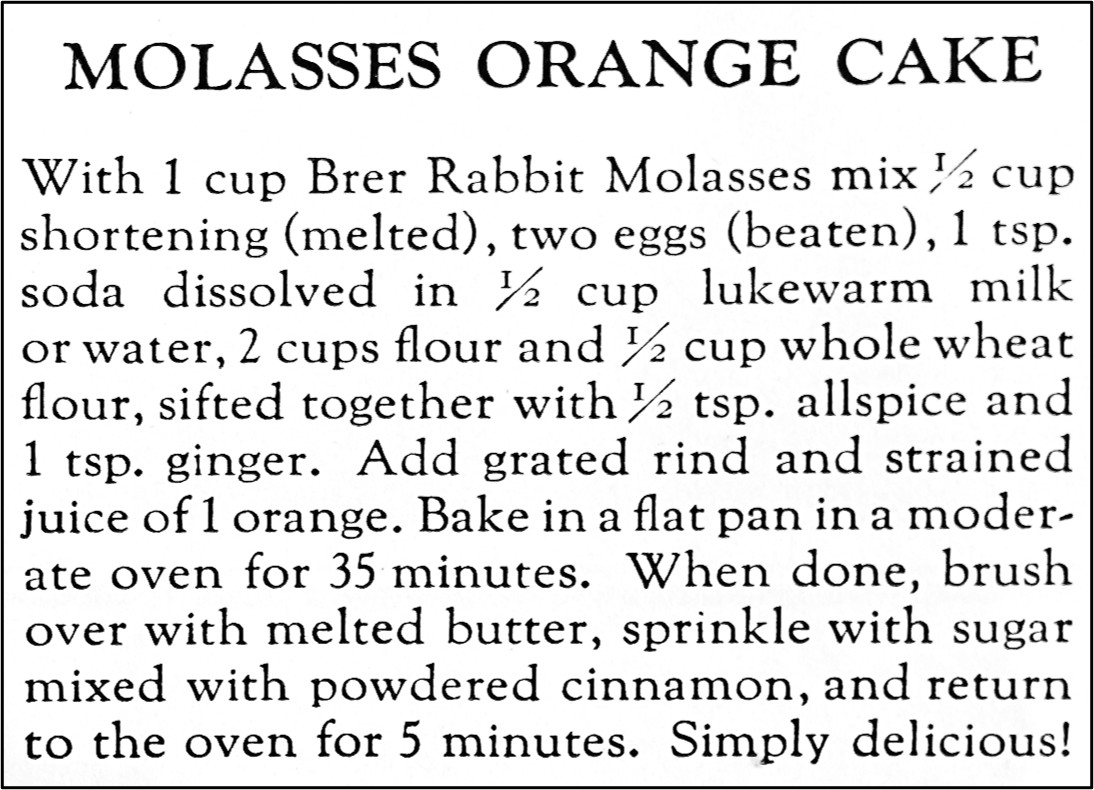
Here is the original recipe:

Recipe for Molasses Orange Cake
Source: Ladies Home Journal (November, 1925)

I used butter rather than shortening when making this recipe. I also did not dissolve the baking soda prior to adding it batter. And, I saw no need to strain the juice from the juiced orange, since it only had a small amount of pulp, and the grated orange peel already provided some texture, so a bit more was not an issue.

Here’s the recipe updated for modern cooks:

Molasses Orange Cake

  • Servings: 8 - 10
  • Difficulty: moderate
  • Print

1 orange

1 cup molasses

1/2 cup butter melted

2 eggs

1/2 cup milk

2 cups all-purpose flour

1/2 cup whole wheat flour

1 teaspoon baking soda

1/2 teaspoon allspice

1 teaspoon ground ginger

Topping

2 tablespoons sugar

1/4 teaspoon cinnamon

Preheat oven to 350° F. Grate the peel of the orange using a light touch to minimize the amount of white pith. (I used a box grater.) Set the grated peel aside. Then, cut the orange in half and juice.

Put the orange juice, molasses, melted butter, eggs, milk, all-purpose flour, whole wheat flour, baking soda, allspice, and ginger in a mixing bowl; beat until smooth. Stir in the grated orange peel.

Put the batter in a prepared 8-inch square pan, and put in oven to bake.

While the cake is baking, combine the sugar and cinnamon in a small bowl.

Bake cake for 35 minutes or until a wooden pick inserted in center comes out clean. Remove the cake from the oven and sprinkle the sugar and cinnamon mixture over the top of the cake. Return cake to oven and bake for an additional 5 minutes.

Cake can be served warm or cold.

http://www.ahundredyearsago.com

Old-Fashioned Coconut Cake

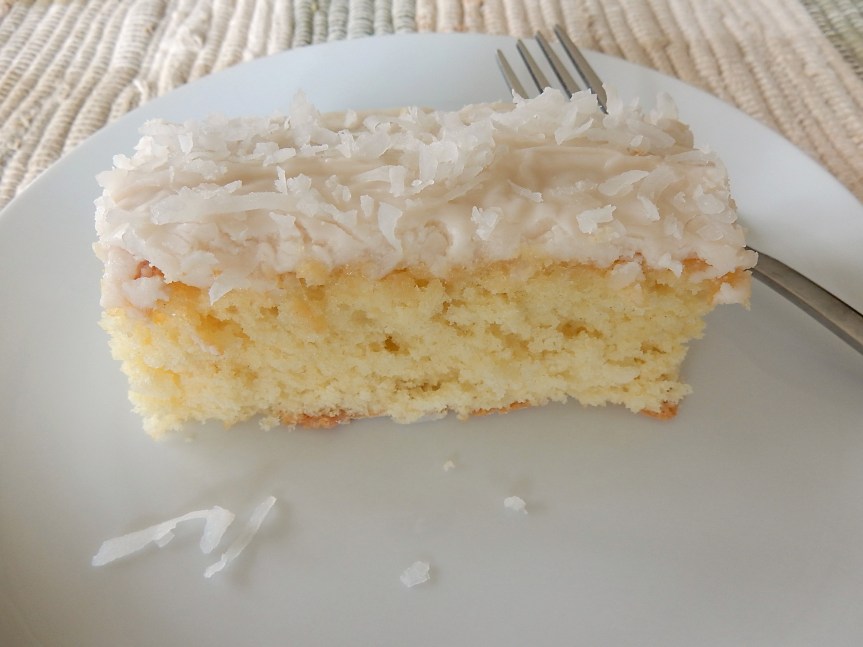
Summer is the season for picnics and reunions – and lots of good food. I have wonderful memories of lovely Coconut Cakes at family gatherings, so when I saw a Coconut Cake recipe in a hundred-year-old cookbook, I decided to give it a try. The cake was delightful, but recipe had two unique features which resulted in this cake being a little different than some Coconut Cake recipes. The recipe called for adding coconut to the cake batter (and not just sprinkling it on top of the frosting). It also called for  a teaspoon of orange extract. The cake is not very large, and works well in a 9-inch square baking pan.

The Coconut Cake was light and fluffy with a bold coconut flavor, and a subtle hint of orange. I definitely plan to make this cake again.

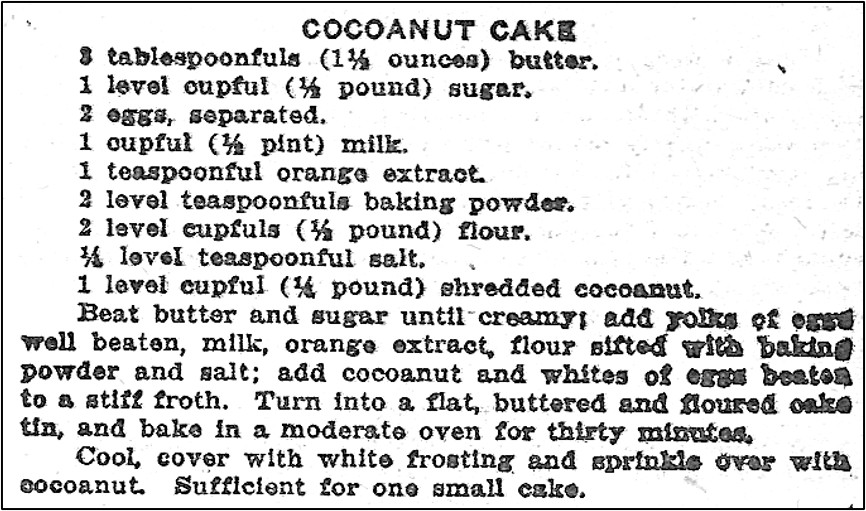
Here’s the original recipe:

Recipe for Coconut Cake
Source: The Daily Argus-Leader Home Economics and Cook Book (Newspaper Supplement), Sioux Falls, South Dakota (1925)

When I updated this recipe, I updated the spelling of “cocoanut” to “coconut.” Cocoanut is an archaic spelling that I often see in hundred-year-old cookbooks, but that is seldom used today.

Here’s the recipe updated for modern cooks:

Coconut

  • Servings: 8 - 10
  • Difficulty: moderate
  • Print

2 eggs, separated

3 tablespoons butter

1 cup sugar

1 cup milk

2 cups flour

2 teaspoons baking powder

1/4 teaspoon salt

1 teaspoon orange extract

1 cup shredded coconut

white icing (I used a buttercream icing.)

additional coconut

Preheat oven to 350° F.  Put egg whites into a mixing bowl, and beat until peaks form. Set aside.

Put butter and sugar in mixing bowl, then beat to cream. Add egg yolks, milk, flour, baking powder, orange extract, and salt. Beat until well-mixed.  Stir in the coconut, then gently fold in the beaten egg whites. Put the batter in a prepared 9-inch square pan. Bake for 30 – 35 minutes or until a wooden pick inserted in center comes out clean. Remove from oven and cool. Frost with white icing, then sprinkle coconut on top of the frosting.

http://www.ahundredyearsago.com

Old-Fashioned White Layer Cake with Caramel Nut Filling


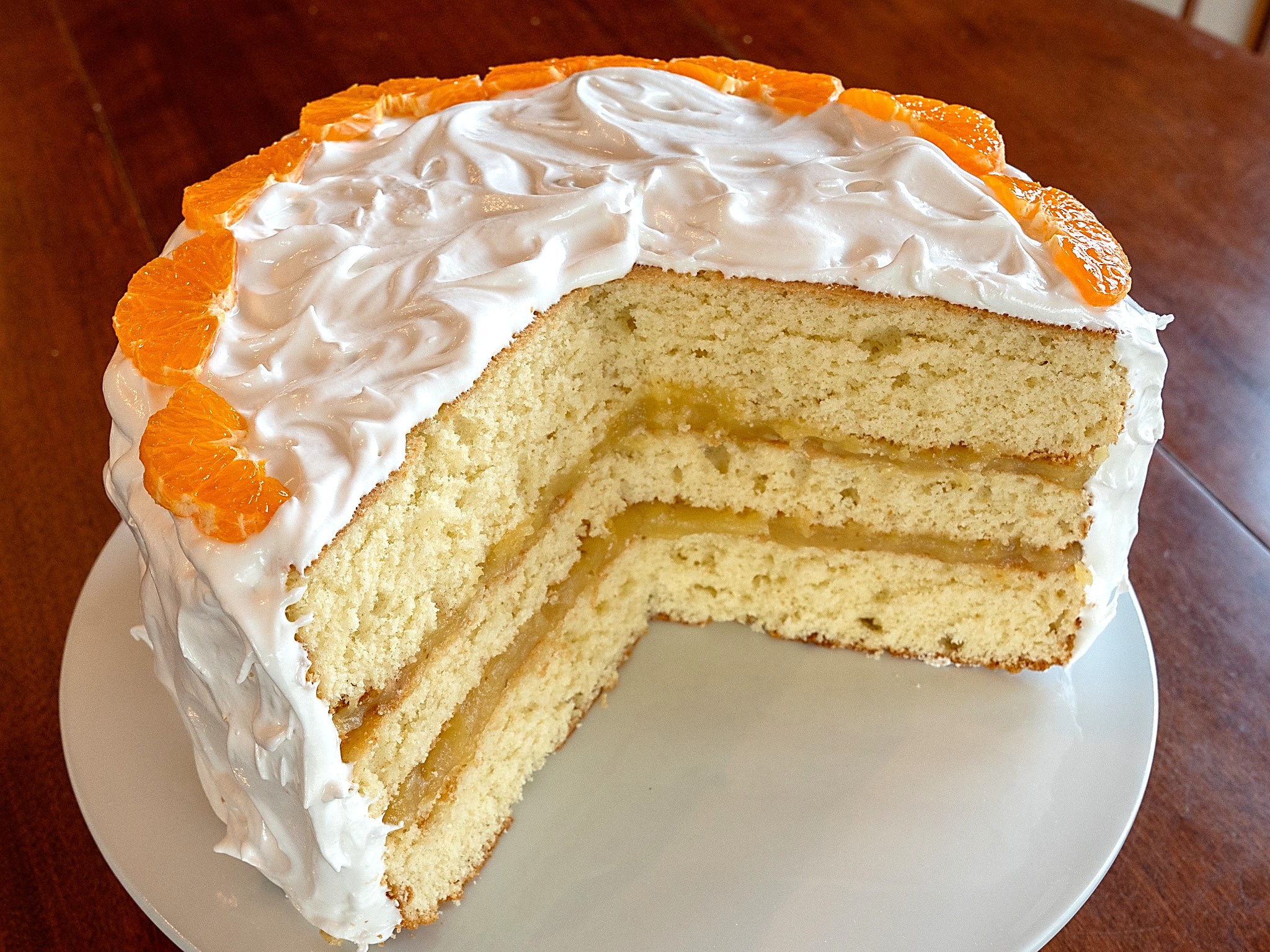
slice of white cake with caramel nut filling

Layer cakes with a filling between the layers were very popular a hundred years ago. Modern cookbooks often have a few frosting recipes and maybe one or two cake filling recipes at the end of the Cake chapter, but some old cookbooks have so many filling and frosting recipes that they have a separate chapter for them. For example, a 1925 cookbook, the Rumford Complete Cookbook, has a chapter titled Cake Fillings, Frostings, and Icings. There are eleven cake filling recipes including Fig Filling, Maple Filling, Orange and Walnut Filling, Orange and Coconut Filling, Mocha Filling, Marshmallow Filling, Prune Almond Filling, and Caramel Nut Filling.

All the fillings looked either intriguing or tasty, but I only wanted to make one cake, so I had to pick one. Some of the fruit fillings tempted me, but in the end I decided to make Caramel Nut Filling. I thought that a white cake would work well with this filling, so I flipped back to the Cake chapter and found a recipe for White Layer Cake.

After I assembled the cake with the filling in the middle, I iced it with a Buttercream Frosting. There were no Buttercream Frosting recipes in the Rumford Complete Cookbook. I guess that the author assumed that cooks knew how to make it without a recipe.

The cake was excellent. The cake itself was moist, light, and tender with a delicate vanilla flavor. The filling was a lovely fusion of a rich caramel and crunchy nuts. (I used walnuts.)

Here’s the original cake recipe:

Recipe for White Layer Cake
Source: Rumford Complete Cook Book (1925)

The recipe does not specify which type of “flavoring extract” should be used. I used vanilla. The old recipe says to bake the cake for about twenty minutes. I baked the cake at 350° F. and it actually took about 25-30 minutes until a wooden pick inserted in the center came out clean.

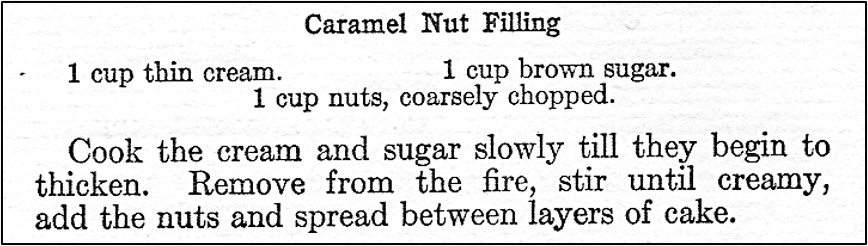
Here’s the original Caramel Nut Filling recipe:

Recipe for Caramel Nut Filling
Source: Rumford Complete Cook Book (1925)

When I read the Caramel Nut Filling recipe, I was not sure what it meant when it said to cook the cream and sugar “till they begin to thicken.” I interpreted it to mean to cook it until it reached the soft ball stage (235° F.). This worked fine, and the filling turned out well.

Here are the recipes updated for modern cooks:

White Layer Cake with Caramel Nut Filling

  • Servings: 10 - 12
  • Difficulty: moderate
  • Print

White Layer Cake

4 egg whites

1/2 cup butter, softened

1 1/2 cups sugar

1/2 cup milk

1 teaspoon vanilla

2 teaspoons baking powder

1/3 teaspoon salt

1 1/2 cups flour

Preheat oven to 350° F. Grease two 9-inch round cake pans; line with waxed paper or parchment paper, then grease again and lightly flour.

Put egg whites into a mixing bowl, and beat until peaks form. Set aside.

Put butter and sugar in a large mixing bowl, then beat to cream. Add milk and vanilla, then add the baking powder, salt, and flour. Beat until well-mixed. Gently fold in the beaten egg whites. Pour half of the batter into each of the two cake pans.

Bake the layers for 25 to 30 minutes or until a wooden pick inserted in center comes out clean. Cool 10 minutes. Remove from pans. Cool the layers before assembling the cake.

Trim cake layers if needed to make even, then put a cake layer on a plate. Spread with the Caramel Nut Filling, and then top with the other layer. If desired, frost the cake. (I used a Buttercream Icing.)

Caramel Nut Filling

1 cup half and half

1 cup brown sugar

1 cup nuts, coarsely chopped (I used walnuts.)

Put the half and half and the brown sugar in a saucepan. Stir to combine, bring to a boil using medium heat. Reduce heat and simmer gently until the mixture reaches the soft ball stage (235° F.). Remove from the heat and stir in the chopped nuts. Spread between the layers of cake.

http://www.ahundredyearsago.com

Old-Fashioned Maraschino Cherry Cake


Slice of Maraschino Cherry Cake on PlateI recently had some friends over and wanted to serve a nice dessert (and, of course, I wanted to make a hundred-year-old recipe), so I pulled out my 1925 recipe books and found a lovely recipe for Maraschino Cherry Cake.
The cake was colorful with cherry fragments throughout that gave it a delightful sweet, yet tart, flavor.

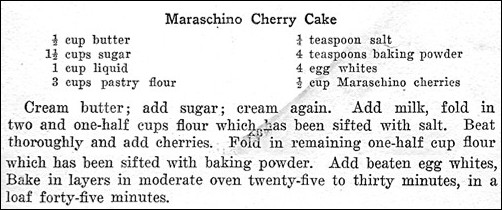
Here’s the original recipe:

Recipe for Maraschino Cherry Cake
Source: The Home Makers’ Cooking School Cook Book (1925)

This recipe calls for 1 cup of liquid. When, I made it, I used 1/4 cup of liquid from a jar of Maraschino cherries and 3/4 cup of milk.

The stores where I shop do not carry pastry flour, so I used all-purpose flour. It worked fine.

When I updated this recipe, I reduced the amount of baking powder from 4 teaspoons to 3 teaspoons. Four teaspoons seems like a lot, and I had a little difficulty with the cake falling. A possible cause is the use of too much baking powder, so I decided to reduce the amount.

Here’s the recipe updated for modern cooks:

Maraschino Cherry Cake

  • Servings: 12-15
  • Difficulty: moderate
  • Print

4 egg whites

1/2 cup butter, softened

1 1/2 cups sugar

1/4 cup liquid from jar of Maraschino cherries

3/4 milk

1/4 teaspoon salt

3 teaspoons baking powder

3 cups pastry (or all-purpose) flour

1/2 cup Maraschino cherries, chopped

Preheat oven to 350◦ F. Beat egg whites until stiff, then set aside.

Put butter and sugar in a mixing bowl, then cream. Stir in Maraschino cherry liquid and milk. Add salt, baking powder, and flour; beat until smooth. Stir in the chopped Maraschino cherries, then fold in the beaten egg whites. Put into prepared pans. A large loaf pan, round layer cake pans, or a rectangular cake pan may be used. Bake until a wooden pick inserted in the center comes out clean (about 35 minutes for cake pans or 45 minutes for a loaf pan).   If desired, ice. (I iced the cake with a buttercream frosting. I substitute liquid from a jar of Maraschino cherries for some of the milk when making the frosting.)

http://www.ahundredyearsago.com

Old-Fashioned Clove Cake

Slices of Clove Cake

I love Spice Cakes, so when I saw a recipe for Clove Cake in a hundred-year-old cookbook I was intrigued. Was it similar to Spice Cake or quite different? I decided to give it a try and see what it was like.

The verdict– The recipe makes a small loaf cake. I have mixed feelings about this cake. It was tasty, but not very aesthetically pleasing.  The cake had an old-fashioned goodness with the warm, sweet, spiciness of cloves. The flavor is more intense than the typical spice cake, but it was good. My husband said that the worst thing about the cake was that there was not enough of it. The texture of the cake was nice, however, the cake fell when I took it out of the oven, so it did not look that great. The recipe called for a really high ratio of sugar to flour, and I think that this might be the issue.

Here’s the original recipe:

Recipe for Clove Cake
Source: The Home Makers’ Cooking School Cook Book (1925)

I am unclear why the recipe calls for adding the raisins before adding the baking soda and some of the flour. It’s difficult to get a well-mixed batter when there are chunky raisins in the mixing bowl, so I updated the recipe to add the raisins last.

When I made this recipe, the chopped raisins sank to the bottom. In hindsight I realized that I probably should have tossed them in flour prior to stirring them into the batter. This probably would have helped keep them dispersed throughout the cake. When I updated the recipe, I indicated that the raisins should be floured.

Sweet milk is just regular milk. In the days before pasteurized milk, some cake recipes called for sour milk. I’m not sure why the recipe author felt the need to clarify that milk that had not soured should be used.

Here’s the recipe updated for modern cooks:

Clove Cake

  • Servings: 5 - 7
  • Difficulty: moderate
  • Print

1/2 cup butter

1 cup brown sugar

2 eggs

1/4 cup milk

1/2 cup flour + 2 tablespoons flour

1/2 teaspoon baking soda

1 teaspoon ground cloves

3/4 cup chopped raisins

Preheat oven to 350◦ F. Grease and flour a loaf pan (bread pan). In a small bowl, toss the raisins with two tablespoons to flour. (This will help keep them from sinking to the bottom). Set aside.

Put butter and sugar in a mixing bowl and cream. Add  the eggs, milk, 1/2 cup flour, baking soda and cloves; beat until combined. Stir in the chopped raisins.  Pour into prepared pan.

Bake 35 minutes, or until wooden pick inserted in center comes out clean. If desired, glaze or frost cake after it has cooled.

http://www.ahundredyearsago.com

Old-Fashioned Witches’ Layer Cake

Witches' Cake

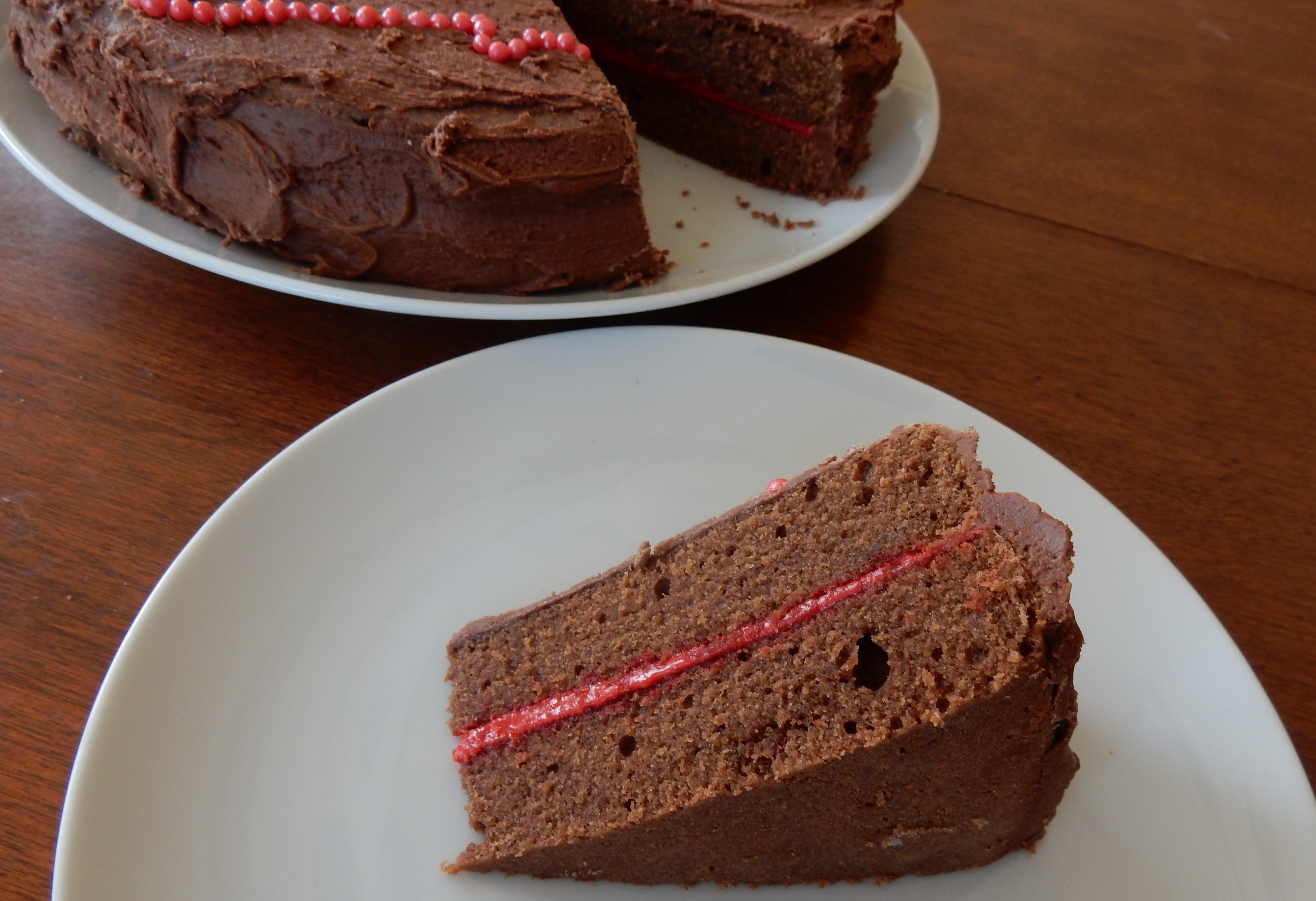
Bakers have been making spooky Halloween Cakes for at least a hundred years. The October, 1924 issue of American Cookery magazine had a recipe for Witches’ Cake. The recipe intrigued me. It called for making a chocolate layer cake, and decorating it by putting the two parts of the cake together with a red frosting, then icing it with chocolate frosting, and decorating with small red candies that are arranged to make an outline of a witch.

This was a fun recipe to make. The cake was a rich and fudgy cake with an almost brownie-like texture.

Witches' Cake

Witches' Cake

Here’s the original recipe:

Recipe for Witches' Cake
Source: American Cookery (October, 1924)

The old recipe called for tinting some of the frosting red with cochineal. I wasn’t familiar with cochineal so I did an online search. According to an article in Smithsonian Magazine, cochineal is a crimson dye made from an insect.

An average trip to the grocery store can yield a cartful of colorful foods. Bright among the rainbow are the reds, lending hues to products such as raspberry jam, canned cherries, strawberry licorice and red velvet cake. Often, their source is a certain small insect.

Cochineal bugs — oval-shaped scale insects around 0.2 inches long — are harvested and turned into the natural dyes cochineal extract, carmine and the pure pigment carminic acid. They have been used to color food, textiles and cosmetics for centuries.

Smithsonian Magazine (March 29, 2022)

I had no idea where I could buy cochineal, so I used dark red food coloring to tint the icing for the filling.

I didn’t find any small red wintergreen candies at the store where I shop, so I bought small red “sugar pearls” in the cake and cookie decorating section.

Squares of unsweetened baking chocolate have gotten smaller over the last hundred years. Back then a square was an ounce in size; today a square of a popular baking chocolate is 1/2 ounce.

This recipe doesn’t call for any baking powder or baking soda. The beaten egg whites provided the leavening.

I used 2/3 cup of milk, and I substituted all-purpose flour for the pastry flour.

I found recipes for Plain Frosting and Chocolate Frosting in a hundred-year-old cookbook:

Recipe for Plain Frosting
Source: Modern Priscilla Cook Book (1924)
Recipe for Chocolate Frosting
Source: Modern Priscilla Cook Book (1924)

I quadrupled the Plain Frosting recipe so that I’d have enough frosting to ice the cake. I did not use any water when making the Chocolate Frosting. I just used milk to get it to the right consistency. I used less chocolate than called for in the old recipe, since a square of chocolate was 1-ounce a hundred-years ago and the squares are smaller today- but it still was very chocolatey.

Here’s the recipe updated for modern cooks:

Witches' Layer Cake

  • Servings: 8 - 10
  • Difficulty: moderate
  • Print

Cake

4 eggs, separated

1 1/3 cups butter, softened

2 ounces unsweetened baking chocolate, melted (4 1/2-ounce squares)

3/4 cup sugar

2 1/2 cups all purpose or pastry flour

1/2 teaspoon salt

1 teaspoon cinnamon

2/3 cup milk

small red candies (can use wintergreen candies or sugar pearls)

Preheat oven to 350° F. Grease two 9-inch round cake pans; line with waxed paper or parchment paper, then grease again and lightly flour.

Put egg whites into a mixing bowl, and beat until peaks form. Set aside.

Cream 1/3 cup butter, then add the remaining 1 cup butter and the melted chocolate; beat until smooth. Stir in egg yolks and sugar. Sift together flour, salt, and cinnamon, then stir  into the chocolate mixture alternately with the milk; continue stirring until thoroughly combined. Fold in the beaten egg whites. Pour the 1/2 of the batter into each of the cake pans.

Bake the layers for 30 to 35 minutes or until a toothpick inserted in center comes out clean. Cool 5 minutes. Remove from pans. Cool 1 hour or until completely cooled.

Make frosting (see below).

To assemble cake, trim cake layers if needed to make even, then put a layer on a plate. Spread with red frosting, and then put the other layer on top of it. Ice with the chocolate frosting, then decorate with red candies. I used a template of a witch as a guide when arranging the candies to make an outline of the witch.

Frosting

4 cups flour confectioners’ sugar

1/3 – 1/2 cup milk

2 teaspoons vanilla

red food coloring (I used “dark red” food coloring)

2 ounces unsweetened chocolate (4 1/2-ounce squares)

Combine confectioners’ sugar and 1/3 cup milk in a mixing bowl; beat until smooth. Add vanilla, and beat until combined.   If the mixture to too thick add additional milk.

Red Filling: Put about 3/4 cup of the frosting into a small bowl. Add enough red food coloring to make the filling a bright red. Stir to combine.

Chocolate Frosting; Stir the melted chocolate into the remaining frosting.

http://www.ahundredyearsago.com

Old-Fashioned Variety Marble Cake (Marble Cocoa Cake)

Marble Cocoa Cake

Marble Cake has always been one of my favorite types of cake, so when I saw a hundred-year-old recipe for Variety Marble Cake, I decided to give it a try. The old recipe had lots of options, including options for Marble Cocoa Cake and Marble Spice Cake. I went with the Marble Cocoa Cake option.

The cake was easy to make and tasty. This recipe makes a small 8″ X 8″ cake, which is perfect for a small family.

Here’s the original recipe:

Recipes for Variety Marble Cake
Modern Priscilla Cook Book (1924)

When I made this recipe, I needed to add about 2 tablespoons of melted butter to the eggs to get 1/2 cup. I used vanilla for the flavoring.

The recipe says to alternate putting spoonfuls of light and dark batter into the pan. I followed this direction – though if I made the cake again, I’d also lightly swirl the batters using a knife to get a more even marbleing.

The recipe says to bake the cake for 45 minutes. When I made this cake, it took significantly less time (more like 35 minutes).

Here’s the recipe updated for modern cooks:

Marble Cocoa Cake

  • Servings: 6 - 8
  • Difficulty: moderate
  • Print

1 1/4 cups flour

1 cup sugar

1 1/4 teaspoon baking powder

1/2 teaspoon salt

2 eggs

2 tablespoons butter, melted

1/2 cup milk

1 teaspoon vanilla

2 tablespoons cocoa

Preheat oven to 350° F. Grease and flour an 8-inch square baking pan. Put all ingredients (except for the cocoa) in a mixing bowl. Beat until well blended.

Put 1/3 of the batter into another bowl; then add the cocoa to this batter. Beat until well-blended. Alternate putting the light and dark batters into the prepared pan, then lightly swirl with a knife.

Bake 30 to 40 minutes, or until wooden pick inserted in center comes out clean. Frost, if desired.

http://www.ahundredyearsago.com