
Old Squash Muffins Recipe

17-year-old Helena Muffly wrote exactly 100 years ago today: 

Wednesday, November 13, 1912:  Nothing of any account seems to be happening around here, so I can’t write much.

Here are the squash muffins I made.

Her middle-aged granddaughter’s comments 100 years later:

Another slow day for Grandma—the total opposite from my life.

I’m bustling around getting ready for Thanksgiving—cleaning the house and planning the menu for the big day.

I recently flipped through the November, 1912 issue of Ladies Home Journal looking for recipes that might be good this Thanksgiving.

Here’s a keeper I found for Squash Muffins. I tested them yesterday—and plan to make them again for Thanksgiving.

They’re delicious served warm with butter—and have a lovely, delicate taste. However, they are less sweet and heavier than many modern muffins, so I had to set aside my preconceived notions and just enjoy their old-fashioned goodness.
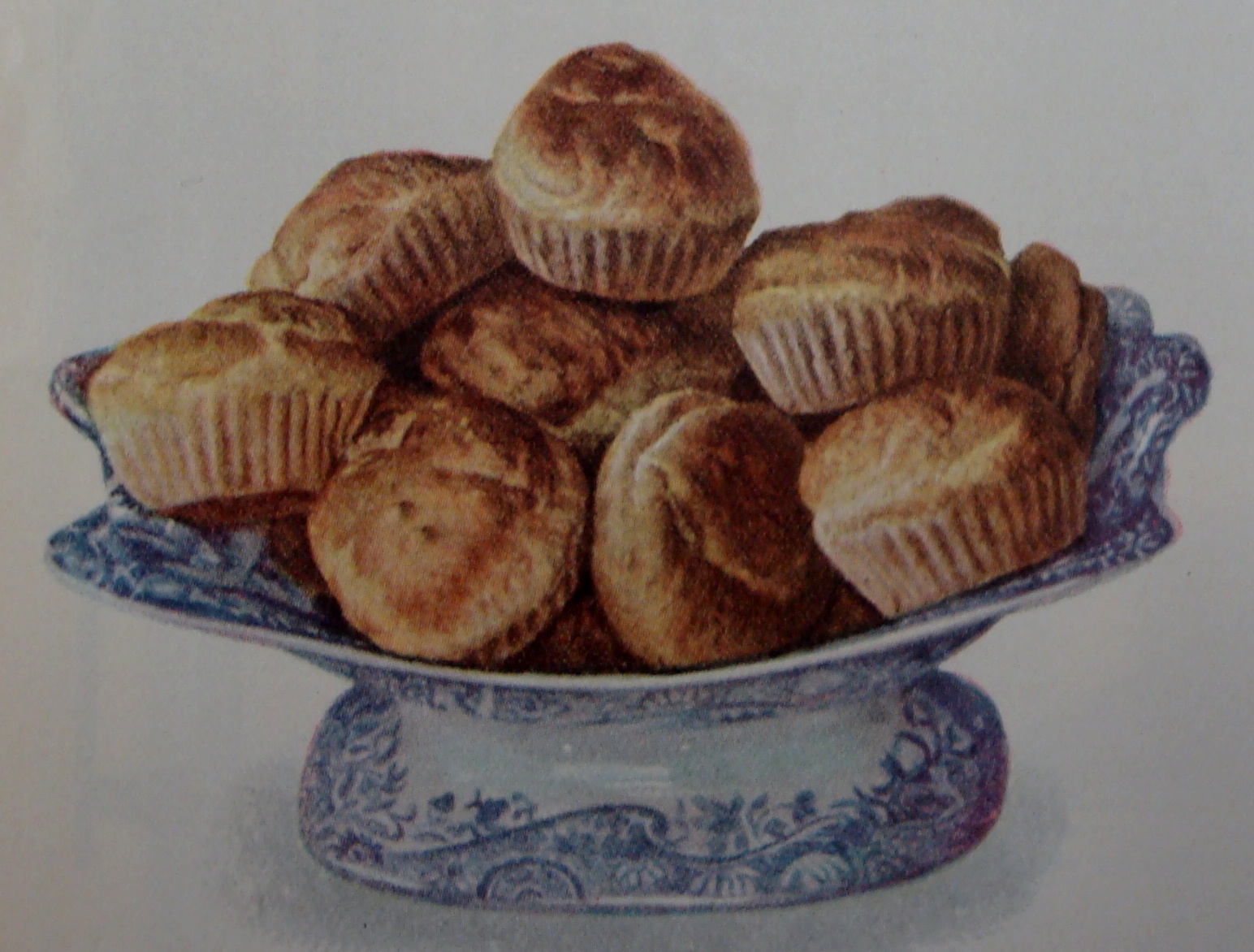
And, here is the picture of Squash Muffins in the November, 1912 issue of Ladies Home Journal.

Here’s the recipe—slightly adapted for modern stoves and ingredients.

Squash Muffins

Preheat oven to 400 degrees. Put two-thirds of a cupful of cooked squash into a bowl, then add a quarter of a cupful of sugar, two well-beaten eggs, two cupfuls  of flour, half a teaspoonful of salt, three teaspoonfuls of baking powder and three tablespoonsfuls of melted butter. Mix well and bake in well-greased muffin pans for approximately twenty minutes. If these muffins are intended for a luncheon or a tea, a quarter of a teaspoonful of powdered ginger may be added.

Makes approximately 18 muffins

I added ginger—even though we ate the muffins at dinner.

I used hubbard squash, but butternut or other winter squash (or canned/frozen squash) would also work. I peeled and cubed about 1 1/2 cups of squash and boiled in water in a pan on the stove for about 15 minutes. I then drained the squash, mashed and measured out two-thirds of a cup to use in the recipe.

Buckwheat Pancakes (Griddle Cakes)

15-year-old Helena wrote a hundred years ago today:

Monday, January 23, 1911. Here’s Monday, another school day. It’s so hard to get up awful early, when you feel nice and sleepy.

Her middle-aged grand-daughter’s comments 100 years later:

Sometimes I wish that Grandma provided more detail when she wrote. For example, I wonder what Grandma ate for breakfast.  I imagine that it was similar to what I ate two generations later when I was growing up on another farm near McEwensville—but I might be totally wrong.

Buckwheat Griddle Cakes with Current Conserve

In January we generally ate pancakes (griddle cakes) for breakfast. We often ate pancakes made from a mix, but occasionally had the more traditional buckwheat griddle cakes that I envision would have been eaten when Grandma was young.  After the pancakes were cooked I’d put maple syrup or jam on mine—but my father always put old-fashioned liverwurst on his. We only had pancakes when liverwurst was available, and that was only during the winter months when my family or a neighbor butchered a hog.

___________________

I love to go to flea markets in central Pennsylvania with my father—

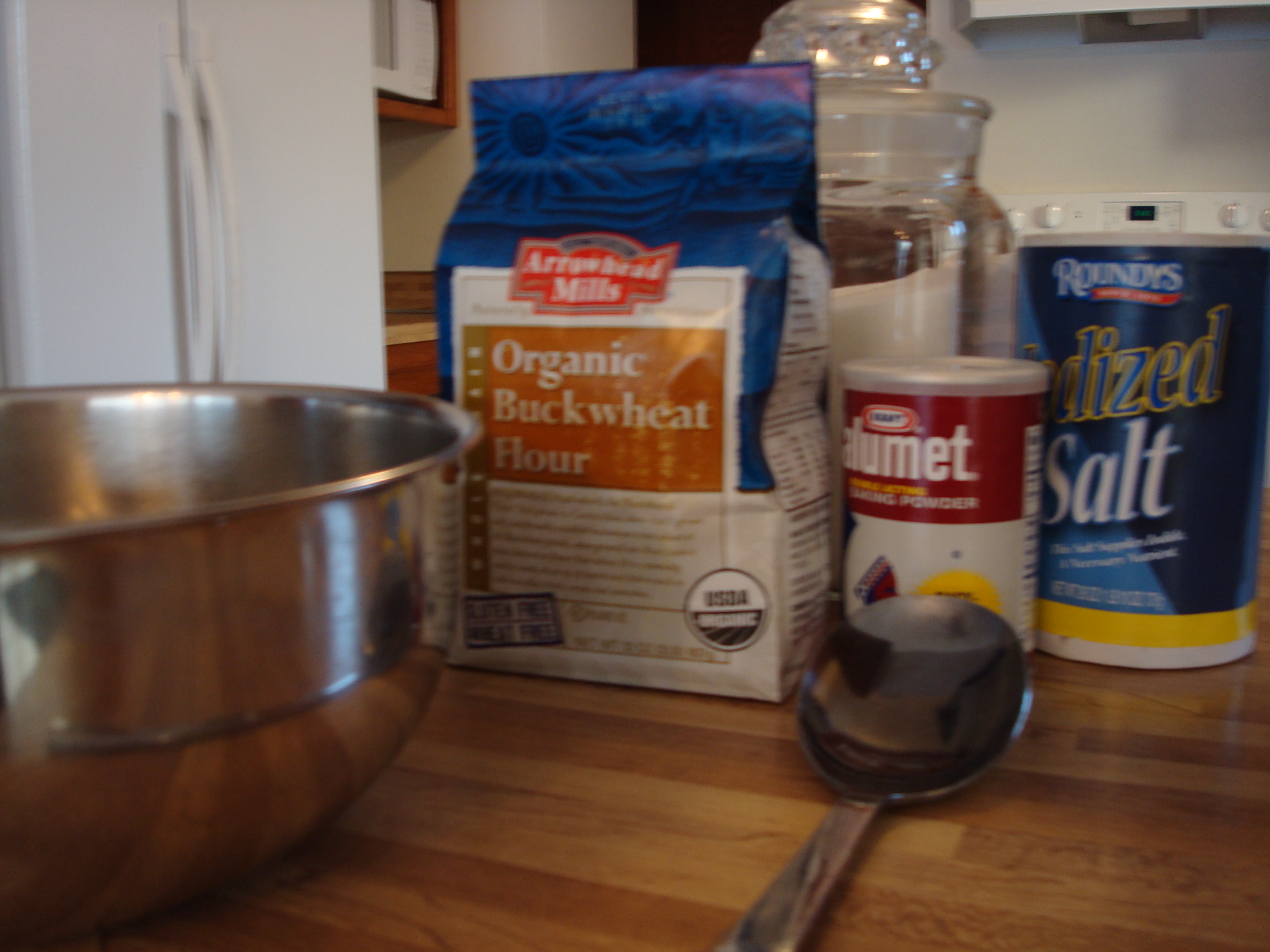
One find was a promotional cookbook published by KC Baking Powder in 1911 that contains a recipe for Buckwheat Griddle Cakes. I decided to make the recipe to see if they were like the buckwheat cakes I remembered.

 KC Buckwheat Griddle Cakes

1 cup buckwheat flour

1 tablespoonful sugar

3 level teaspoons baking powder

1 ¼ cups cold water

1/3 teaspoonsful salt

Sift together, three times, the flour, sugar, salt, and baking powder*; stir the water in all at once and bake immediately on a hot well-oiled griddle. Buckwheat flour calls for a generous measure of baking powder. Part milk may be used to mix the cakes but water give quite as good results.

 The Cook’s Book: KC Baking Powder (1911)

*I just stirred the ingredients together and didn’t sift anything. I’m not sure why old-time cookbook authors were obsessed with sifting.

 I was surprised how few ingredients there were, but from looking through the cookbook I realized that most recipes a hundred years ago had very few ingredients. I guess that since people cooked from scratch every day that they gravitated toward simple recipes.

After I’d cooked the griddle cakes—I poured some maple syrup on them and took a bite. They were very good though the robust taste of the buckwheat was a prominent undertone.

I then remembered that I had a jar of homemade current conserve  that a friend of my daughter’s had given me. (An aside–I think that it’s really cool how some young people care enough about what they eat to revive traditional cooking and food preservation).  I spooned a little conserve on the griddle cakes and took a bite—and the taste was awesome. The tartness of the conserve wonderfully complemented the robustness of the griddle cakes—and I almost felt like I had drifted back to Grandma’s day.