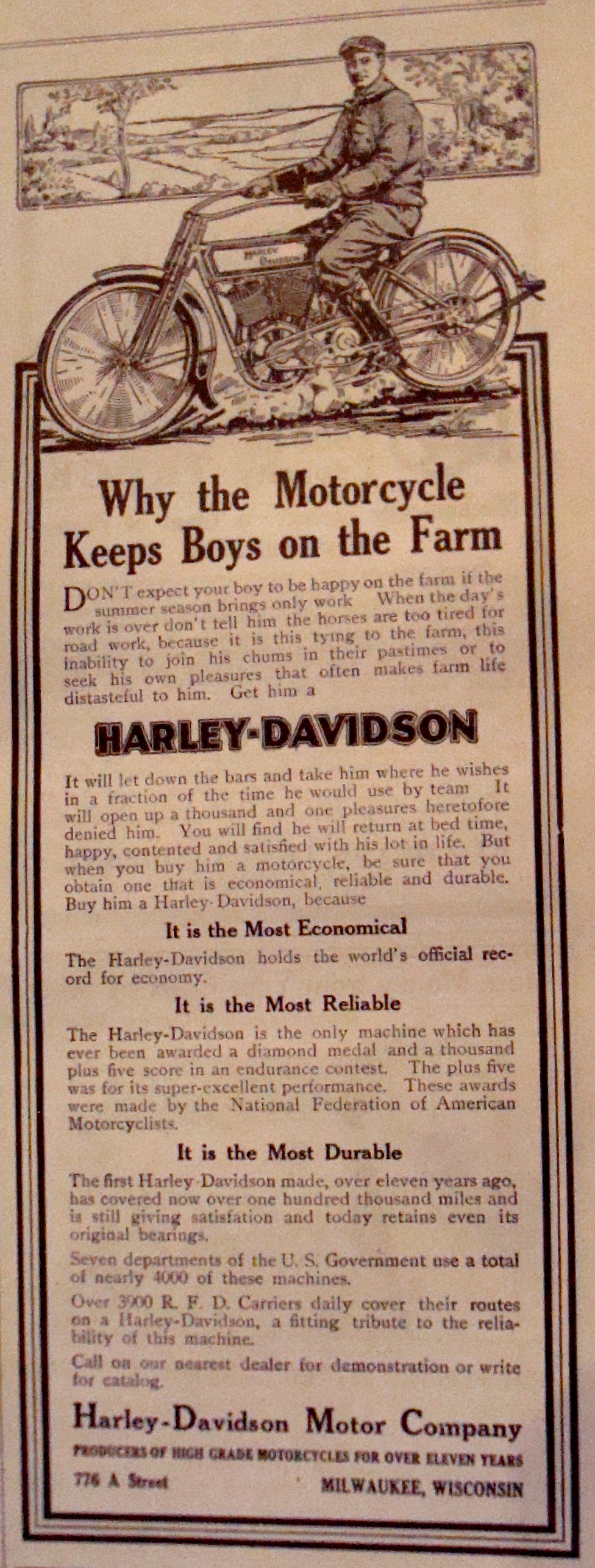
1913 Harley-Davidson Motorcycle Advertisement

18-year-old Helena Muffly wrote exactly 100 years ago today: 

Friday, May 16, 1913:  Doing nothing of any account.

1913 Harely Davidson Adversitement

Why The Motorcycle Keeps Boys on the Farm

Don’t expect your boy to be happy on the farm if the summer season brings only work. When the day’s works is over don’t tell him, the horses are too tired for road work, because it is this tying to the farm, this inability to join his chums in their pastimes or to seek his own pleasures that often makes farm life distasteful to him.  Get him a

HARLEY-DAVIDSON

It will let down the bars and take him where he wishes in a fraction of the time he would use by team. It will open up a thousand and one pleasures heretofore denied him. You will find he will return at bed time, happy, contented and satisfied with his lot in life. But when you buy him a motorcycle, be sure that you obtain one that is economical, reliable and durable. Buy him a Harley-Davidson, because

It is the Most Economical

The Harley-Davidson holds the world’s official record for economy.

It is the Most Reliable

The Harley-Davidson is the only machine which has ever been awarded a diamond medal and a thousand plus five score in an endurance contest. The plus five was for its super-excellent performance. These awards were made by the National Federation of American Motorcycles.

It is the Most Durable

The first Harley-Davidson made, over eleven years ago, has covered now over one hundred thousand miles and is still giving satisfaction and today retains even its original bearings.

Seven departments of the U.S. Government use a total of nearly 4000 of these machines.

Over 3000 R.F. D. Carriers daily cover their routes on a Harley-Davidson, a fitting tribute to the reliability of this machine.

Call on our nearest dealer for demonstration or write for catalog.

Harley-Davidson Motor Company

PRODUCERS OF HIGH GRADE MOTORCYCLES FOR OVER ELEVEN YEARS

776 A Street   MILWAUKEE, WISCONSIN
Her middle-aged granddaughter’s comments 100 years later:

Grandma wrote little, but probably was working very hard.—doing housecleaning, cooking, farm chores, etc.

The sons of farmers also worked hard—and this June 15, 1913 advertisement in Kimball’s Dairy Farmer magazine played on the fear that they might leave the farm for the city.

You also might enjoy these previous posts that contained other ads that played on similar fears.

Old Billard Table Advertisement

1913 Victor-Victrola Advertisement

Most Popular Baby Names, 1913 and 2013

18-year-old Helena Muffly wrote exactly 100 years ago today: 

Thursday, May 15, 1913:  Doing nothing of any account.

baby.names

Her middle-aged granddaughter’s comments 100 years later:

Since Grandma didn’t have much to say a hundred years ago today, I’m going to follow-up on some comments I got several days ago—

On May 10, I did a post about whether Grandma’s name was really Helena or Helen. The post got lots of comments—and several people mentioned that their grandmother’s or great-grandmother’s name also was Helena or Helen.

This got me thinking about popular baby names in 1913—and popular names a hundred years later in 2013.

According the Baby Center website, none of the ten most popular baby names in 1913 were in the top ten in 2013.

Lysol Advertising, 1913 and 2013

18-year-old Helena Muffly wrote exactly 100 years ago today: 

Wednesday, May 14, 1913:  Nothing much doing, but the doing of rubbing, scrubbing, etc.

Her middle-aged granddaughter’s comments 100 years later:

The previous day Grandma wrote that she hoped to finish washing the kitchen ceiling “by tomorrow.”  Hopefully she finished washing the kitchen ceiling and moved on to other tasks.

Did Grandma use Lysol? It’s amazing that it’s been around for more than 100 years.

1913-03-43.cThe Way to get Real Lysol is to buy it in one of these three packages—never in bulk

By merely insisting on these original sealed bottles, you are sure of getting the real antiseptic and germicide, Lysol, itself.

Your physician will tell you it is important to get real Lysol, because imitations sold as Lysol and for Lysol, but which are not Lysol, may be crudely made, uncertain and unsafe in action, even positively dangerous—you can’t tell. But you can tell this—Only Lysol itself has the unique antiseptic, disinfectant and germicidal quality that have made it the standard product for over 20 years.

Three Sizes

25¢, 50¢, $.100

Sold by druggists everywhere

Look for Signature of LEHN & FINK on the Label

The value of the genuine Lysol is proved by its use as an antiseptic and disinfectant in practically every hospital in America. Nothing so completely destroys disease-germs, prevents infections, removes odors and makes the whole house sweet and clean. Your druggist has Lysol in original bottles (with full directions) which protect you against substitution and make Lysol’s use easy and convenient.

Write for Interesting Lysol Booklet

Full of helpful hints and listing the many uses of Lysol in the home.

Address

LEHN & FINK

Manufacturing Chemists

103 William Street, New York

The small words in the logo underneath Lysol say “better than carbolic acid.”

2013 Lysol Website

I compared the information on the current Lysol website with the hundred-year-old ad. Some of the ad lingo is similar—and some different. The  website headlines say:

Lysol—kills 99.9% of bacteria

Introducing Healthing

Cleaning is hoping you’re killing germs, Healthing is knowing it. Stop just CLEANING. Start HEALTHING.

SPRING INTO ACTION. SPRING INTO HEALTH.

Washing the Kitchen Ceiling

18-year-old Helena Muffly wrote exactly 100 years ago today: 

Tuesday, May 13, 1913:  Started to earn my dollar washing off the kitchen ceiling. Want to get it finished by tomorrow. The Bryson girls were down.  

DSC03888.Blanche.BrysonBlanche Bryson (Source: “Cut” from picture in History of the McEwensville Schools by Thomas Kramm. Used with permission.)

Her middle-aged granddaughter’s comments 100 years later:

Really??  Washing the kitchen ceiling?? Why?? I’ve knocked a few spider webs down from ceilings, but I’ve never washed a ceiling in my life.

Whew, it must have been a lot of work, if it was going to take two days.  At least Grandma got paid for doing it.  $1 back then would be worth about $24 today.

The Bryson Girls

One of the Bryson girls would have been Blanche. She was a friend and Grandma’s and her sister Ruth, and is mentioned several places in the diary.  Blanche was a teacher at the Keefertown School, a one-room school house, near McEwensville. Both Blanche and Ruth went to the Sunbury teachers’ meeting that I showed a picture of a few days ago. I’m not sure what the other Bryson girl’s name was.

1913 Gift Suggestions

18-year-old Helena Muffly wrote exactly 100 years ago today: 

Sunday, May 4, 1913:  Went to Sunday School this afternoon. Although it is over a week since commencement, I received a present today. Making eighteen in all.

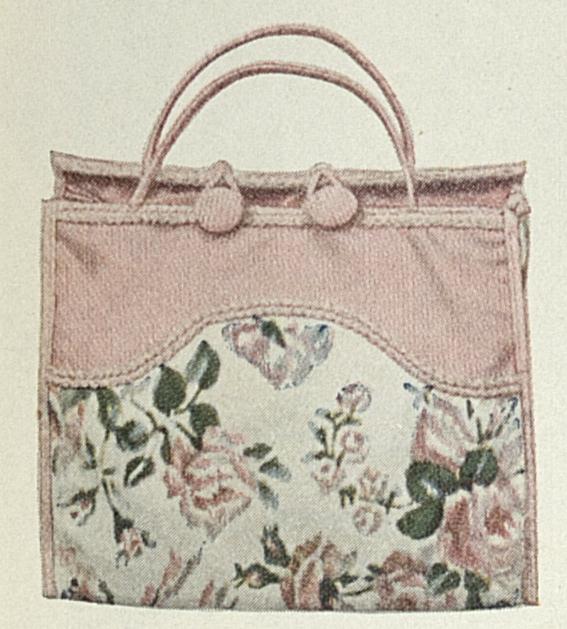
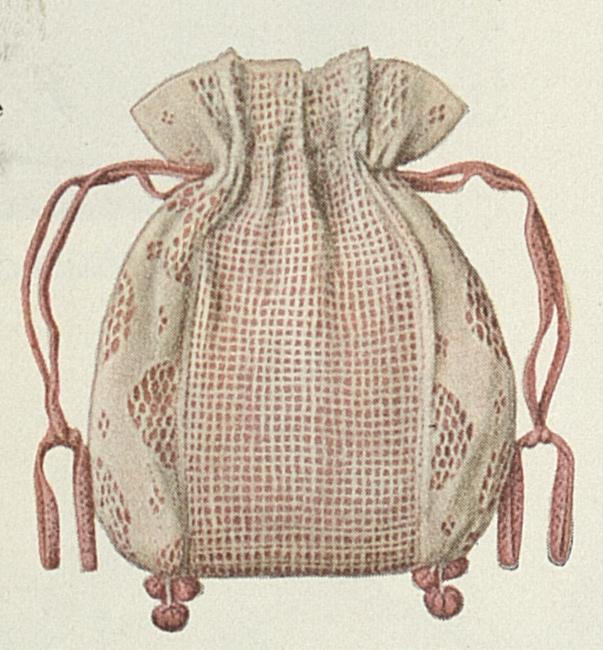
Sewing bag (Source: Ladies Home Journal, November, 1913)
sewing bag (source: Ladies Home Journal, November, 1913)

Her middle-aged granddaughter’s comments 100 years later:

Hmm. . . What present did Grandma receive? . .

It probably was a small gift from her Sunday School teacher or another church member. . . maybe something  handmade.

Grandma previously mentioned getting a hat pin, a handkerchief, a $2 bill, and a dress.

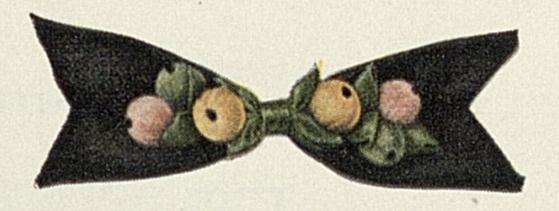
The November, 1913 issue of  Ladies Home Journal suggested a few small gifts that could be made for 25¢ to $1. The magazine probably was thinking about Christmas when they published the article, but many of the gifts would have been equally appropriate as graduation gifts.

hair bow
hair bow
handbag
handbag
Book cover
book cover

1913 Sunbury Teachers’ Meeting

18-year-old Helena Muffly wrote exactly 100 years ago today: 

Friday, May 2, 1913:  Dear old Ruthie went to Sunbury this morning and isn’t coming home until tomorrow night. Rather miss the kid, too. I’m afraid I’ll soon have to begin to watch cows for that time is now at hand.

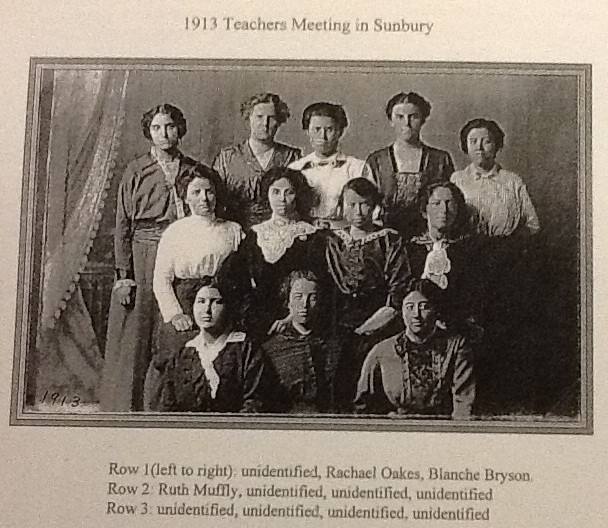
Source: The History of McEwensville Schools by Thomas Kramm (Used with permission)
Row 1: Rachel Oakes (middle), Blanche Bryson (right). Row 2: Ruth Muffly (left) Source: The History of McEwensville Schools by Thomas Kramm (Used with permission)

Her middle-aged granddaughter’s comments 100 years later:

I can’t believe it, but I may know why Grandma’s sister Ruth went to Sunbury. I think it was to attend a teachers’ meeting.

Sometimes I’m amazed how the pieces fit together. There is a photo in The History of the McEwensville Schools 1800-1958 of 12 women who attended a teachers meeting in Sunbury in 1913. One of them is Ruth Muffly—so I’m speculating that the reason she went to Sunbury on this date was to attend that meeting.

Ruth was a teacher at a nearby one-room school-house. The other two women who were identified in the photo were Rachel Oakes and Blanche Bryson. Both are mentioned in the diary. They were friends of Grandma and Ruth—as well as teachers.

Sunbury is about 15 miles from McEwensville, and it is the county seat of Northumberland county. The meeting probably was held to provide information and professional development for the teachers at many small schools scattered across the county.

Ruth wasn’t exactly a kid–she was 21 and three years older than Grandma.

Grandma often got annoyed with Ruth—but almost immediately missed her when she was gone. Was it because she had to do more work—or was it because she missed the companionship?

Maybe Grandma wished that Ruth was at home to help watch the cows. During previous summers Grandma often mentioned needing to watch the cows so that they didn’t escape from the pasture and get into the crops.

Weather Station Data for April, 1913

18-year-old Helena Muffly wrote exactly 100 years ago today: 

Monday, April 28, 1913:  I hardly knew what to do today. I guess I’ll have to blame it on the rain.

williamsport.weather.April.1913For the complete data sheet for Williamsport click on April 1913.

Her middle-aged granddaughter’s comments 100 years later:

April showers bring May flowers, but Grandma makes the weather sound dreadful. This was the second day in the row that she mentioned rain.

The previous day, she wrote,

Today is a very rainy day.

I decided to check the April, 1913 weather station report for the nearby town of Williamsport. Williamsport is about 20 miles from McEwensville and on the other side of a mountain—so I’m sure that the weather was somewhat different—but it still provides a sense of what it was like.

On both the 27th and 28th there were thunderstorms—with 0.24 inch of rain on the 27th and 0.47 inch of rain on the 28th. It looks like the rainy weather continued into the following day (and got worse)—with 0.66 inches of rain.

The temperature also fell like a rock across the three days—with a high of 80° on the 27th, a high of 67° on the 28th, and 54° on the 29th.

For details about how to find original weather station data on the National Climatic Data Center website, see a previous post:

How to Find the Temperature on Any Date in Any City in US