Hundred-Year-Old Advice About the Use of Candy in the Diet

pieces of Mint Chocolate Fudge on plateCandy is tasty, though it probably isn’t the healthiest food. Here’s what a 1920 home economics textbook said about candy:

The Use of Candy in Diet

Candy, is an energy-giving food, but unfortunately perhaps, it is not (at all times) a most desirable energy-giving food. Sugar exists in candy in concentrated form. Such sugar is irritating to the organs of digestion.

Sugar is contained in large quantity in some fruits, especially in dried fruits: figs, dates, prunes, etc. These fruits are a much better source of sweets for children than is candy, because they do not contain as much sugar, and have, in addition, valuable food materials in the form of ash. Note the large quantity of carbohydrates and ash in raisins.

Candy should never be used to excess or at the wrong time. A little eaten at the end of a meal is not harmful to the normal person. At that time the sugar is diluted because it is mixed with other foods. When diluted it does not irritate the digestive tract to the extent that it would if eaten between meals with no other foods. It is well to drink a generous quantity of water when eating candy or other sweets. Since molasses, honey, and maple syrup are not so concentrated as is sugar, they are desirable sweets for children – provided they are used moderately at the right time, and are mixed with other foods.

School and Home Cooking (1920) by Carlotta C. Greer

The old book mentions the role of “ash” in the diet. Today ash would be called minerals.
Chocolate Animals (Chocolate Animal Crackers)

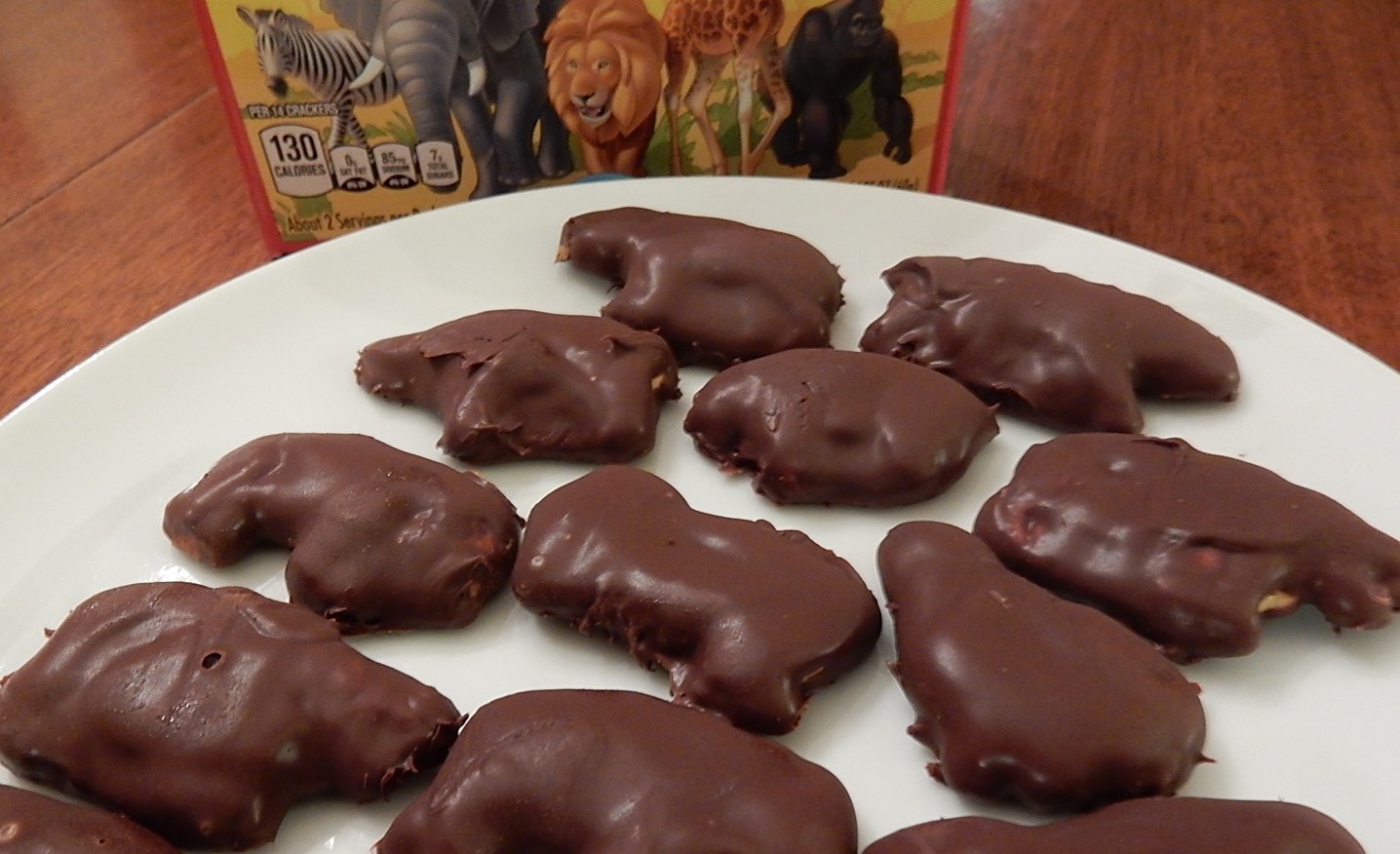
Chocolate-covered animal crackers on plateWhen were animal crackers invented? Until I saw a recipe for Chocolate Animals (Chocolate Animal Crackers) in a hundred-year-old cookbook, I’d never given it any thought.

I knew that animal crackers have been around for a long time (or in other words, since I was a child), but I would have guessed that they were invented mid-century. However, the recipe in the 1920 cookbook suggests that they have been around much longer.

This led me to check what it said in Wikipedia. I was surprised to discover that animal crackers have been around since the late 1800’s. It also said:

Animal biscuit crackers were made and distributed under the National Biscuit Company banner. In 1902, animal crackers officially became known as “Barnum’s Animals” and evoked the familiar circus theme of the Barnum and Bailey Circus. Later in 1902, the now-familiar box was designed for the Christmas season with the innovative idea of attaching a string to hang from the Christmas tree.

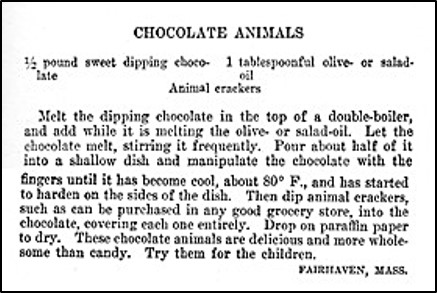
Here’s the original recipe:

Recipe for Chocolate Animals
Source: Good Housekeeping’s Book of Recipes and Household Discoveries (1920)

I used a small (2.125 ounce box) of animal crackers when I made this recipe, so I only needed a little chocolate. If I’d made more Chocolate Animal Crackers I would have need to use more. chocolate.

The old recipe describes a process for making tempered chocolate. This is necessary to get a smooth, glossy coating – or chocolate melting wafers or chocolate candy coating can be used. I generally try to be true to old recipes – but ended up deciding that making a small batch of a fun recipe was the time to make an exception – so I went with the melting chocolate waters.

Here’s the recipe updated for modern cooks:

Here’s the recipe updated for modern cooks:

Chocolate Animals (Chocolate Animal Crackers)

animal crackers

chocolate melting wafers / chocolate coating

Put a piece of waxed paper on a plate. Set aside.

Using the microwave or low heat on the stove, melt enough chocolate to coat the animal crackers. (If a small 2.125 ounce box of crackers is used, melt about 1/2 cup of chocolate.) Dip the animal crackers in the melted chocolate, and then place on the waxed paper-covered plate.

Let the chocolate thoroughly cool and harden before serving. (I put the plate of chocolate-covered crackers in the refrigerator for a few minutes to quickly harden the chocolate.)

http://www.ahundredyearsago.com

Hundred-year-old Food-related Math Problems

Basket with apples

Word math problems are a great way to engage students in learning how to apply the skills they have learned. Interesting problems encourage students to think creatively about how to solve problems that have applications in the real world.

Both in 2020 and 1920, there were many word problems that are based on food-related topics. However, there are major differences in the problems. Based on a quick scan of food-related problems on Pinterest, restaurant menu, food truck, pizza fraction, and food cost problems are currently popular. Food-related math problems in a 1920 home economics textbook also addressed cost, but with a slight twist. The focus of these hundred-year-old problems was on how to get a given number of calories for the least cost.

Problems

  1. A quart of milk gives 675 calories; a pound of lamb chops, 1600; a pound of eggs (eight or nine), according to size, 670 calories. With milk at 17 cents a quart, lamb chops at 48 cents a pound, and eggs at 60 cents a dozen, which food is the cheapest per 100-calorie portion?
  2. Cream of wheat has a fuel value of about 1600 calories and costs 15 cents a pound. Compare the cost of a 100-calorie portion of cereal with that of chops, milk, or eggs.
  3. Large oranges cost 60 cents per dozen. What is the cost of a standard portion?
  4. A good juicy apple yields about 100 calories. Dried apples give about 1320 calories per pound Find the difference in cost of 100-calorie portions, if fresh apples sell at the rate of 3 for 10 cents and dried apples cost 15 cents a pound.

Household Arts for Home and School (Vol. II) (1920) by Anna M. Cooley and Wilhelmina H. Spohr


Old-fashioned Tomato Fritters

3 tomato fritters on plateThe tomatoes are rapidly ripening in the garden (and I’m getting close to having excess tomatoes, if such a thing is possible), so I looked for a hundred-year-old tomato recipe. And, I think that found a winner. Old-fashioned Tomato Fritters make a tasty appetizer or side dish.  The fritters are crispy and take only a few minutes to make.

Here’s the original recipe:

tomato fritter recipe
Source: American Cookery (March, 1920)

Here’s the recipe updated for modern cooks:

Tomato Fritters

  • Servings: 4 - 6
  • Difficulty: moderate
  • Print

2 cups flour

3 teaspoons baking powder

1/2 teaspoon salt

1/4 teaspoon pepper

1 egg

1/2 cup water or meat/vegetable stock (I used water.)

1 tablespoon parsley, finely chopped

2 – 3 medium tomatoes, finely chopped (or use 1 1/2 cups canned tomatoes)

1 tablespoons grated cheese (I used Parmesan cheese.)

Shortening or cooking oil

Put flour, baking powder, salt, pepper, egg, and water or stock in a mixing bowl; beat until thoroughly combined. Stir in parsley and tomatoes. Add grated cheese and continue stirring until combined.

Melt shortening or cooking oil in a skillet. Using a tablespoon, drop mixture by spoonfuls into the hot shortening or oil. Fry until lightly browned; flip and cook other side. Drain on paper towels.

If desired, serve with a tomato sauce dip.

http://www.ahundredyearsago.com

Old-fashioned Pineapple Bavarian Cream

Molded Pineapply Bavarian Cream on Plate

During these hot August days, I love light, refreshing desserts. And, I found a wonderful hundred-year-old recipe that fits the bill. Pineapple Bavarian Cream is delicious, and has just the right balance of sweetness and tartness,

Here is the original recipe:

Recipe for Pineapple Bavarian Cream
Source: School and Home Cooking (1920) by Carlotta C. Greer

When I made the recipe, I used a little less water than called for in the original recipe because, when I make molded gelatin-based desserts, I tend to have problems with the mixture not getting firm enough.

Here’s the recipe updated for modern cooks:

Pineapple Bavarian Cream

  • Servings: 4 - 5
  • Difficulty: moderate
  • Print

Note: This recipe makes about 3 cups. I doubled this recipe when I made it because I wanted to use a 6-cup mold.

1 packet (0.25 ounce) of unflavored gelatin

1/4 cup cold water

1 small can (8 ounce) can of crushed pineapple

water

1/2 cup sugar

dash salt

2 tablespoons lemon juice

1/2 cup whipping cream

Place the cold water in a small bowl; then sprinkle the gelatin over the water. Let the gelatin absorb the water and soften for a few minutes.

In the meantime, drain the juice from the pineapple. Place the juice in a measuring cup, and add enough water to make it 1 cup. Place the pineapple juice and water mixture in a saucepan, and heat to boiling using medium high heat. Reduce heat to low. Add the softened gelatin, and stir until dissolved. Add the sugar and salt and continue stirring until the sugar is dissolved. Remove from heat, then stir in the lemon juice.  Chill until the mixture just begins to thicken.

In the meantime, put the whipping cream in a bowl, and beat until soft peaks form.

Once the gelatin mixture has begun to thicken, stir in the crushed pineapple and then fold the whipped cream into the mixture.

Spoon into a 3-4 cup mold (or spoon into individual serving dishes or cups), and chill until firm (at least 4 hours).

To serve (if molded): Quickly dip the mold in hot water, then unmold onto serving plate.

http://www.ahundredyearsago.com

1920 Tip: Use Paper Cups to Hold Picnic Salads

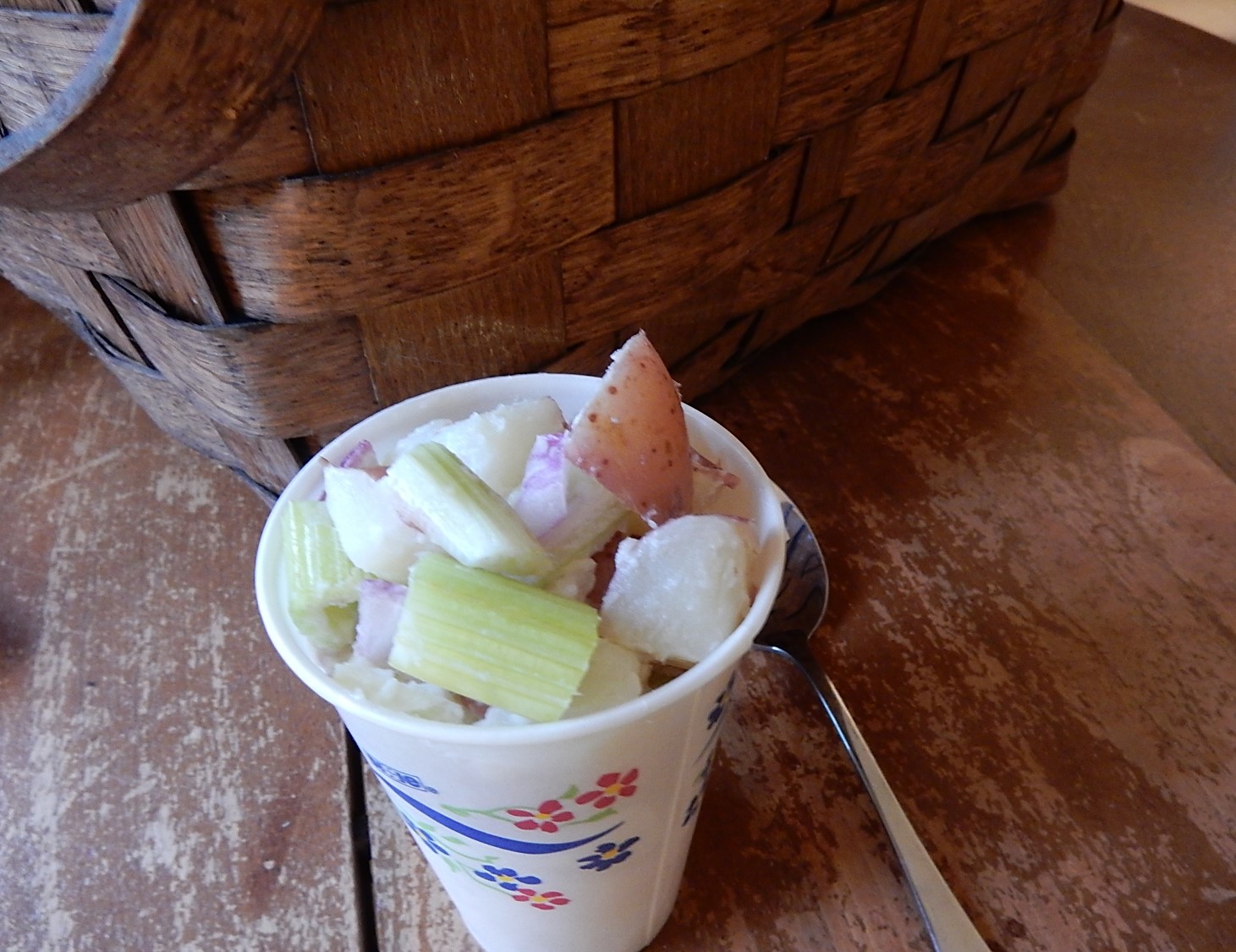
potato salad in a paper cupCooks have shared tips across the years. A hundred years ago Good Housekeeping magazine had a tips column called Discoveries. Readers could submit tips, and were paid one dollar for each tip that was used.

Here’s a tip for how to serve salads at a picnic:

Picnic Salad

When going on little picnic suppers – especially in a machine, where one eats by the roadside or in the car seat – individual paper drinking cups are most satisfactory as containers for salads. The salad may be packed in the individual paper cups and garnished attractively with a sprig of parsley in one side. They always call forth favorable comments and are not messy to handle and each person has his own portion easily handed out.  – Mrs. R.H., D.C.

Good Housekeeping (June, 1920)