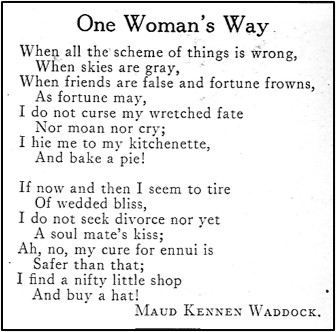
Sometimes nothing seems to go quite right. Here’s a hundred-year-old poem that offers a couple suggestions for those times.

Sometimes nothing seems to go quite right. Here’s a hundred-year-old poem that offers a couple suggestions for those times.

Memorial Day doesn’t seem complete without Potato Salad – and the best Potato Salads contain hard-boiled eggs, so I was thrilled to find a hundred-year-old recipe for Potato and Egg Salad.
The Potato and Egg Salad was delightful with crunchy celery and chopped pickles – but what made the salad really special was the dressing. The dressing was made with whipped cream and vinegar – and was amazingly light compared to the usual mayonnaise dressing. The whipped cream dressing takes a little longer to make than mayonnainse dressing, but it was well worth the extra effort
Here’s the original recipe:

I didn’t have any onion juice, so substituted 1 tablespoon chopped onions.
Here’s the recipe updated for modern cooks:
2 cups cold boiled potatoes, cut into 1/2 inch cubes 1 cup celery or cabbage, chopped (I used celery.) 2 or 3 hard-boiled eggs, chopped (I used 2 large hard-boiled eggs.) 2 tablespoons pickle, chopped (I chopped several Bread and Butter Pickle slices.) 2 tablespoons green pepper or pimento, chopped (I used green pepper.) 1 tablespoon parsley, chopped 1 tablespoon onions, chopped cream dressing, see below If desired, lettuce or cabbage leaves Put the cubed potatoes, celery or cabbage, chopped eggs, chopped pickle,, green pepper or pimento, parsley, and onions in a mixing bowl and gently stir to combine. Chill in refrigerator. Just before serving, add Cream Dressing and gently stir until the potatoes and other ingredients are evenly coated with the dressing. If desired, serve on lettuce or cabbage leaves. Cream Dressing 2 teaspoons flour 1 teaspoon salt 1 teaspoon mustard 1 1/2 teaspoons powdered sugar dash cayenne (red) pepper 1 teaspoon butter 1/3 cup vinegar 1 egg yolk, beaten 1/2 cup whipping cream Put the flour, salt, mustard, powdered sugar, cayenne pepper, and butter n a saucepan or double boiler, and gradually add vinegar while stirring constantly. Using medium heat, cook until thickens while stirring constantly. Put a a spoonful of the hot mixture in the bowl with the egg yolk, and immediately stir rapidly; then add the mixture to the mixture in the saucepan or double boiler while stirring rapidly. Continue stirring and cook for 1 minute. The mixture will be very stiff. Put in a small bowl and cool in refrigerator. Shortly before serving, whip the cream until it is stiff. Add the cooled vinegar mixture, and beat until smooth. http://www.ahundredyearsago.comPotato and Egg Salad
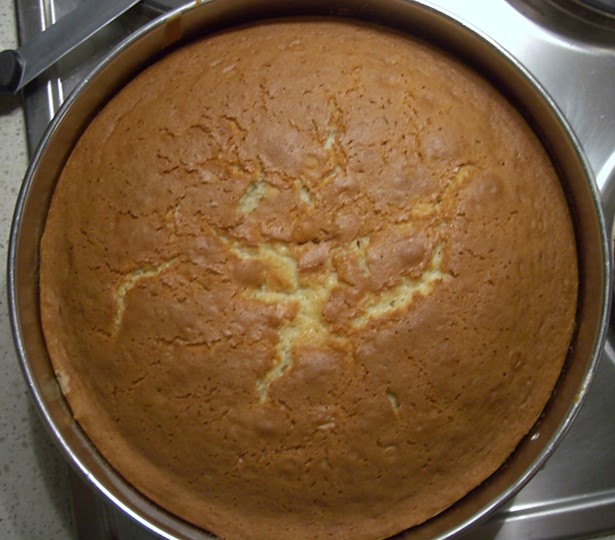
Sometimes when I make a cake it rises very unevenly. A hundred-year-old cookbook gave me a clue about what might cause the problem:
A moderate oven will give the best results for nearly all cakes.
If the batter rises in a cone in the center you are using too hot an oven, and a crust has formed before the mixture has had time to rise; or too much flour has been used.
Mrs. DeGraf’s Cook Book (1922)
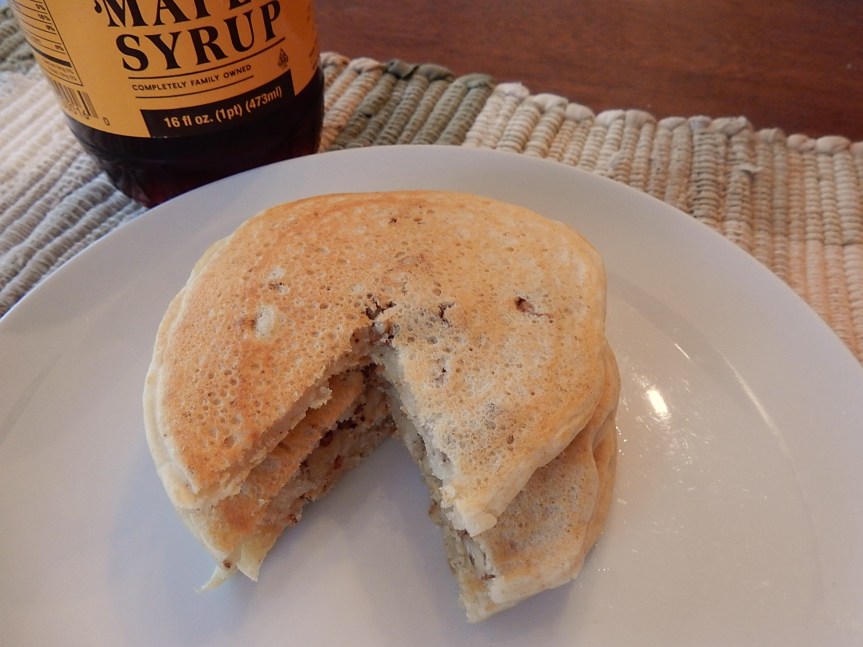
Sometimes it seems like I get into a rut when making breakfast foods – and tend to just make the same two or three foods over and over. So I’m always looking for easy-to-make recipes for breakfast foods. I recently saw a hundred-year-old recipe for Nut Pancakes, and decided to give it a try.
This recipe is a keeper. The pancakes contained lots of chopped walnuts, and had a lovely texture and flavor.
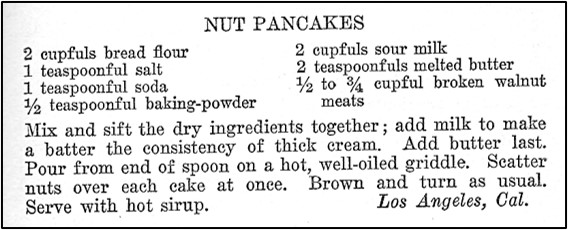
Here’s the original recipe:
A hundred-years-ago many families still lived on farms and drank non-pasteurized milk; and, even in towns, much of the milk that was sold was not pasteurized. Back then, if the non-pasteurized milk was not used quickly, the “good” bacteria in the milk would turn it into a sour milk suitable for use in recipes. When making old recipes that call for sour milk, today’s pasteurized milk can be turned into a sour milk by adding a little vinegar or lemon juice to create a slightly curdled acidic milk.
Here’s the recipe updated for modern cooks:
2 cups milk
1 tablespoon vinegar or lemon juice (I used vinegar.)
2 cups bread flour
1 teaspoon salt
1 teaspoon baking soda
1/2 teaspoon baking powder
2 teaspoons butter, melted
3/4 cup walnuts chopped
Put the milk in a cup or bowl, then stir in the vinegar or lemon juice. Set aside for at least 2 minutes.
Put the bread flour, salt, baking soda, baking powder,, melted butter, and milk that has been combined with the vinegar or lemon juice in a mixing bowl; beat until smooth. Stir in the chopped walnuts.
Heat a lightly greased griddle or skillet to a medium temperature, then pour or scoop batter onto the hot surface to make individual pancakes. Cook until the top surface is hot and bubbly, and then flip and cook other side.
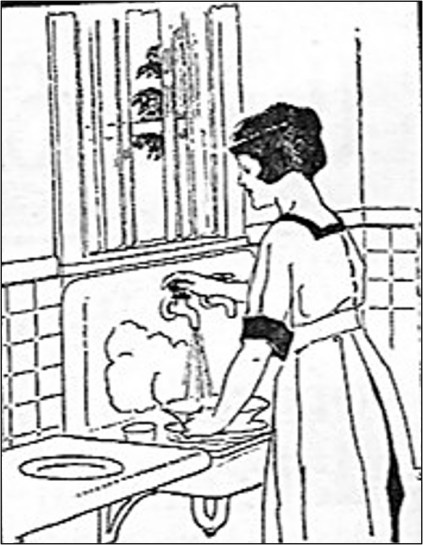
Decorating styles seem like they are constantly changing and evolving. Here is some 1922 advice for how to decorate your kitchen:
We come to realize what a big part color has to play in the attractiveness of the kitchen. Anyone who has both practical and theoretical knowledge of color, as well as of kitchens, knows that the pure white kitchen is a long way from perfection in either looks or cleanliness. The whiteness, no matter how clean it really is, takes on, after a time, a darkening and stained appearance, as though it got tired of being dazzling, with nothing for contrast. So if we want a kitchen to look as clean as it should be, let us give it contrasts of both color and tone. This will need to be done with the advice of someone who really know the technical properties of color combinations, but most of us can make a pretty satisfactory effect, if we use our eyes and copy the tones in nature, which seem to give a particularly clean and clear-cut impression – the beach against blue water, for instance, or a wet tree trunk against green leaves. Is it sensible to try to bring nature into the kitchen? Why not if it is to make life in the kitchen more worth living?
American Cookery (March, 1922)

Bananas are tasty, convenient, and inexpensive. They are also a very healthy fruit with fiber and protein, and potassium and other nutrients. However, they can also be boring. So when I saw a recipe for Raisins and Bananas in a hundred-year-old cookbook, I decided to give it a try.
The bananas are baked with raisins in a light sugar syrup. The Raisins and Bananas were tasty, and would make a lovely fruit dessert or snack (or could be served at breakfast of another meal).
Here’s the original recipe:

Here’s the recipe updated for modern cooks:
1/2 cup sugar
1 1/2 cups water
1 cup raisins
6 bananas
juice from 1 lemon
Preheat oven to 375° F. Put sugar, water, and raisins in a saucepan; stir. Using medium heat bring to a boil, then reduce heat and simmer for 5 minutes. Remove from heat, and cool until lukewarm.
In the meantime, peel bananas and remove any stringy fibers. If desired cut the bananas in half. Arrange in a baking dish, then pour the raisins and syrup over the bananas. Put in oven and bake until the syrup is hot and bubbly, and the bananas tender. Remove from oven. May be served either hot or cold.

Sometimes I’m surprised how modern things were in 1922. Until I saw this ad for a water heater in a 1922 church cookbook, I never would have guessed that homes had water heaters a hundred years ago.
