Planting Popcorn

16-year-old Helena Muffly wrote exactly 100 years ago today: 

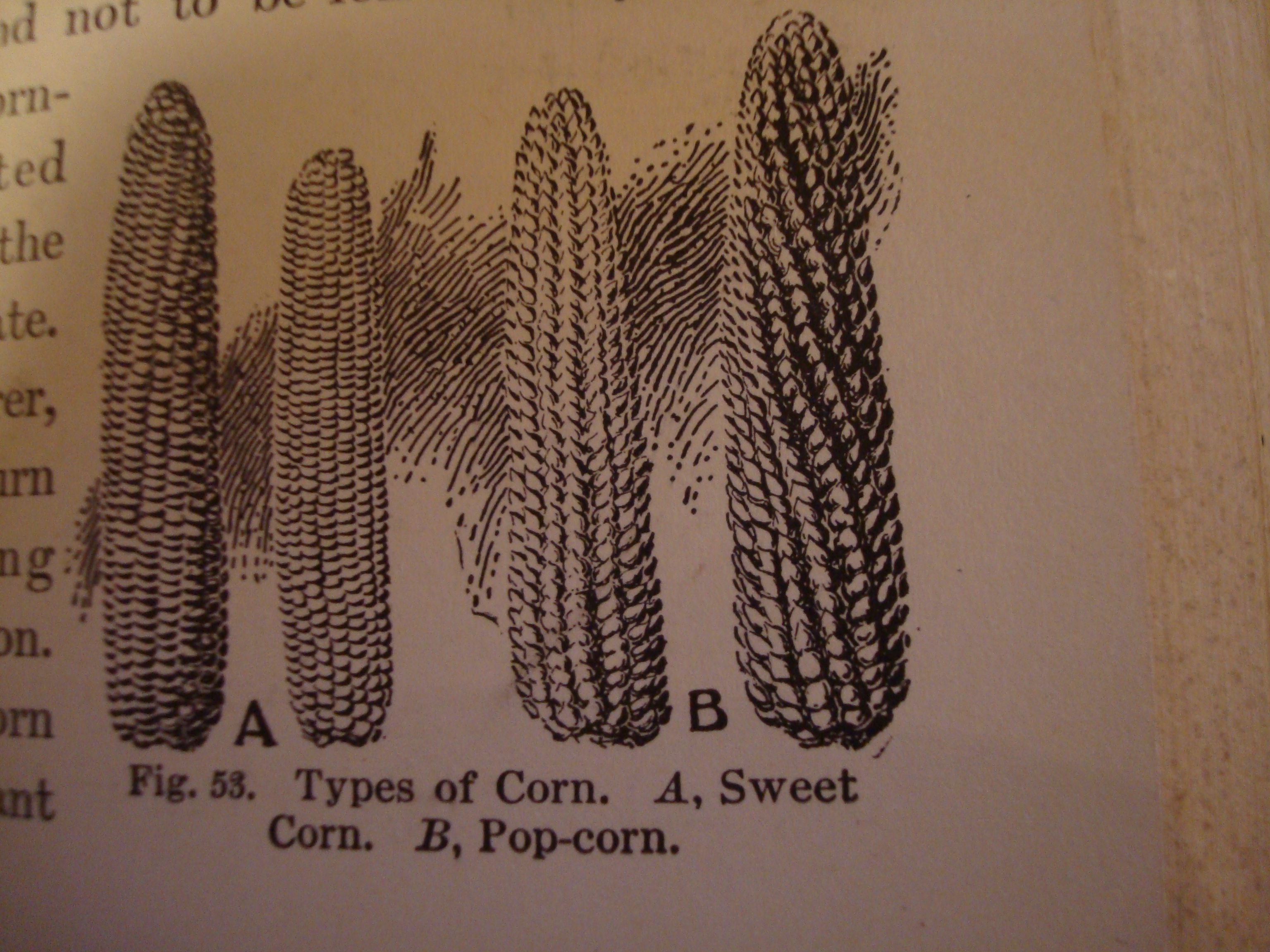
Saturday, May 20, 1911: Oh psh aw, this is hardly worth writing. I planted some popcorn this morning, and was kept busy nearly all afternoon.

Photo source: How to Grow Vegetables (1911)

Her middle-aged granddaughter’s comments 100 years later:

A 1911  book called How to Grow Vegetables by Allen French describes how popcorn (and sweetcorn) were grown a hundred years ago.  The book says that the same methods were used for both types of corn. According to the book :

Being very tender it is not planted till all danger of frost is over. The warmest and “quickest” of all soils should be chosen. The ground should be rich, and well supplied with quickly available fertilizers.

 Sow— If the ground is cold or wet, sow thickly in the rows.

 Thin—Twelve to eighteen inches apart, according to height of variety.

Culture—Preserve the surface mulch, and keep down the weeds.

Fertilizer—Any good general fertilizer, liberally applied, as corn is an exhaustive crop; should be rich in nitrogen for a sandy soil. Dress once with nitrate of soda or liquid manure when the plants are up.

Planting Potatoes

16-year-old Helena Muffly wrote exactly 100 years ago today: 

Friday, May 19, 1911:  I had to drop potatoes this afternoon. I’m so glad it only comes once in a year. I got so fatigued, but that isn’t rare.

Her middle-aged granddaughter’s comments 100 years later:

A hundred years ago potatoes were a winter staple, so the family probably planted lots of potatoes. Also, many families raised more potatoes than they needed so they could sell the excess to people living in nearby towns. No wonder Grandma was tired after dropping (planting) seed potato pieces in the furrows.

A 1911 book by Allen French called How to Grow Vegetables explains how potatoes were planted when Grandma was young:

The seed piece—It has been proven that the size of the piece rather than the number of eyes on it, is of importance in giving good results.  . . . All pieces should be chunky and not thin; pieces the size of hens’ eggs are proper, weighing about three ounces. If they have to be stored after cutting, keep them in a cool place with wet clothes laid over the box to keep them from wilting.

Cutting Potato Seed Pieces

Distances—Rows apart, for hand culture, twenty-four to thirty inches; for horse culture, three feet or more. Plant in the row, twelve to eighteen inches apart; the richer the soil and the better prepared the closer they may stand. . . Distances are also a matter of variety: plant strong-growing or large-yielding kinds farther apart.

Depth—In heavy clayey soils three inches may be allowed. But generally speaking, it is not wise to plant less than four inches deep; if planted shallower the tubers may be sunburnt.

Culture–Cultivate once or twice before the potatoes break ground, to kill the weeds and preserve the mulch. . . The early cultivations may be deep, but once the plants are growing well, cultivation should be shallow on account of the surface-feeding roots.

Fertilizer—The soil should be rich. Humus, if supplied in the year the potatoes are grown, may come from good compost or very well-rotted manure. If fresh, the manure may cause scab. For safety, the manure is best supplied in the fall, and ploughed in; or it could be heavily fed to the previous crop. Or in farm operations green manure (leguminous crops), ploughed in, will both give humus and help to open up the subsoil. Chemical fertilizers may previously be applied at the rate of about fifteen hundred pounds per acre.

Gathering Lilacs

16-year-old Helena Muffly wrote exactly 100 years ago today: 

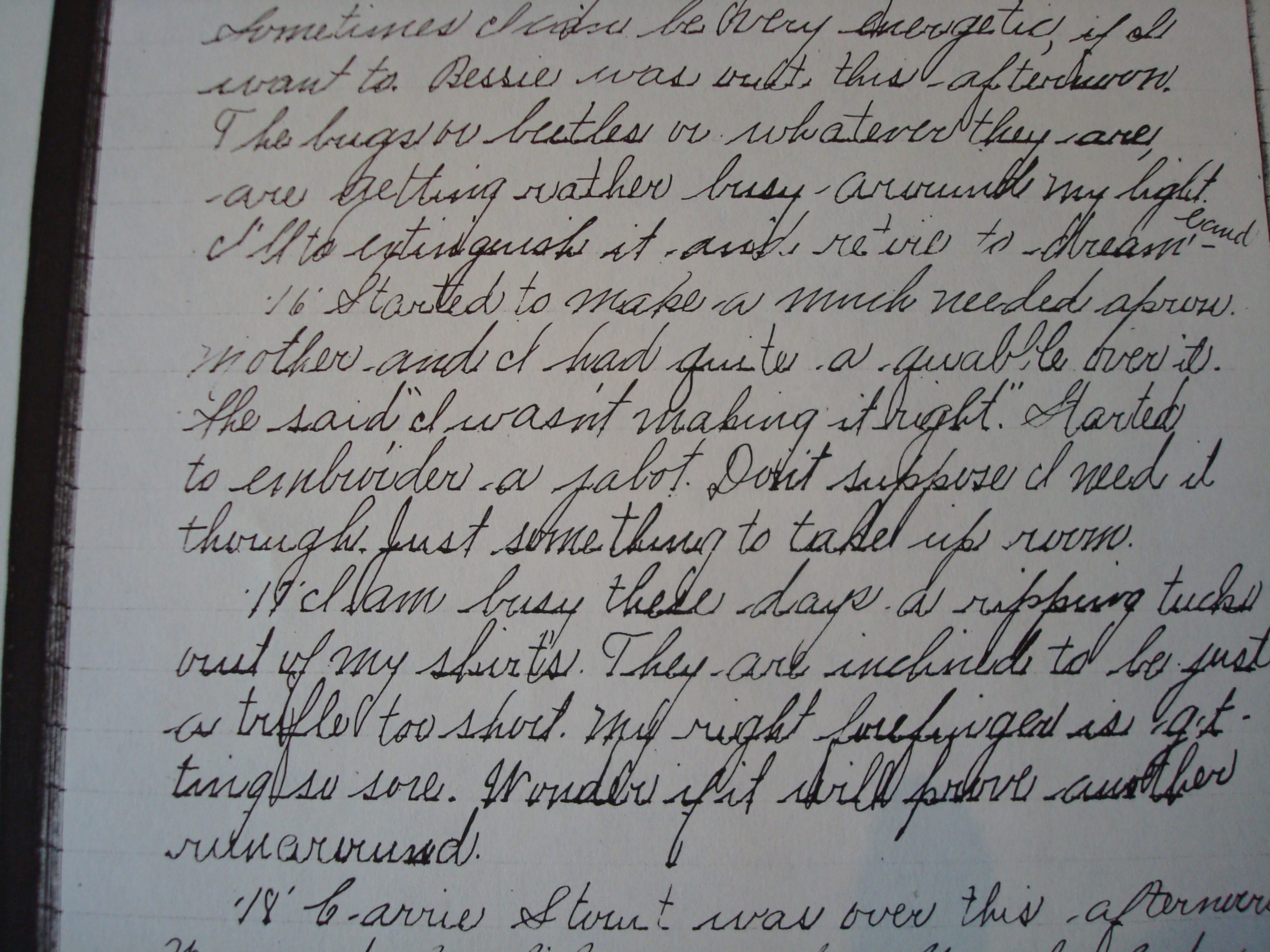
Thursday, May 18, 1911:  Carrie Stout was over this afternoon. We went for lilacs and after she had a big bouquet, she became afraid of the bumble bees.

Her middle-aged granddaughter’s comments 100 years later:

Sounds like two friends having fun on a pleasant spring day while doing simple things together—gathering lilacs while goofing around as they worried about bumble bees. Ah, the joys of being young and carefree.

Remodeling Clothes

16-year-old Helena Muffly wrote exactly 100 years ago today: 

Wednesday, May 17, 1911: I am busy these days ripping tucks out of my skirts. They are inclined to be just a trifle too short. My right forefinger is getting so sore. Wonder if it will prove another runaround. 

Her middle-aged granddaughter’s comments 100 years later:

I wonder why the skirts didn’t fit right. Had Grandma gained a little weight?—or maybe styles were a little longer than they’d been the previous spring? A hundred years ago clothes were worn until they wore out, yet they remained stylish because they were regularly remade.

Today we buy new clothes each season in the latest colors and styles. Our closets are stuffed to the gills with seldom worn clothes from last year and the year before.

I’m annoyed with myself when I buy a new brown pencil skirt because my navy pleated skirt is hopelessly out of style—yet I won’t be caught dead wearing the pleated skirt. Sometimes I long for the good old days when clothes were regularly remodeled (though I’m all thumbs when it comes to sewing).

A book published by the Butterick Company in 1911 called The Dressmaker: A Complete Book on All Matters Connected with Sewing and Dressmaking from the Simplest Stitches to the Cutting, Making, Altering, Mending and Caring for the Clothes has a chapter on remodeling clothes:

Nothing accumulates so fast in every household as half-worn clothing, and the dead capital that it represents is apt to make the thoughtful ones draw a deep breath.  . .

One ought, at the very beginning of each season, to set to work to take a critical survey of last year’s wardrobe. It is the easiest way to find out exactly what new clothes are needed and exactly how far one can go with the old ones. Coats, suits, and dresses that are still in sound physical condition, but which have grown out of style, should be remade. The remodeling of a pair of sleeves, the recutting of a skirt, will almost always give a new lease of life to a suit.

Decide first what clothes are worth remaking. When the materials are badly worn it is hardly worth while going to any amount of trouble in the way of renovations. But when the material is sound and whole it is little short of criminal not to take advantage of the possibilities. . . .

A Jabot

16-year-old Helena Muffly wrote exactly 100 years ago today: 

Tuesday, May 16, 1911: Started to make a much needed apron. Mother and I had quite a squabble over it. She said I wasn’t making it right. Started to embroider a jabot. Don’t suppose I need it though. Just something to take up room.

Jabot

Her middle-aged granddaughter’s comments 100 years later:

A jabot is a decorative ruffle on the front of a shirt or dress. A hundred years ago they were considered a stylish accessory.  Currently female supreme court judges often wear them.

And, today I learned how to pronounce a new word. Jabot is pronounced zhab-oh or jab-oh  I was telling my son that I needed to write an entry about  jabots–and we ended up discussing how to pronounce it. I had pronounced it “ja-bot.” But according to the dictionary the “t”  is silent.

I wonder what Grandma was doing incorrectly when she was making the apron. Old-time apron directions are in a previous post.

The Break-up of Standard Oil

16-year-old Helena Muffly wrote exactly 100 years ago today: 

Monday, May 15, 1911:  I was so very busy this forenoon. Sometimes I can be very energetic, if I want to. Bessie was out this afternoon.

Her middle-aged granddaughter’s comments 100 years later:

Grandma probably was unaware of a major event that occurred on this date a hundred years ago.  If you look in a history book, there generally are two events mentioned that occurred in 1911—one was the Triangle Shirtwaist Factory fire and the other was the U.S. Supreme Court decision that broke up Standard Oil.

The Court ruled a hundred years ago today that Standard Oil was a monopoly and that it must be broken up because it violated the Sherman Anti-trust Act.

John Rockefeller founded—and then led Standard Oil as it grew into one of the largest firms in the nation. According to Wikipedia, in 1904 Standard Oil controlled 91% of oil production and 85% of final sales in the US.

Investigative journalists called muckrakers highlighted the problems and inequities caused by monopolies, corporate greed, and the robber barons.

Rockefeller and his associates did not build the Standard Oil Co. in the board rooms of Wall Street banks. They fought their way to control by rebate and drawback, bribe and blackmail, espionage and price cutting.

Ida Turnball

The Supreme Court decision symbolized the end of the robber baron era in the US.

Mothers Day

16-year-old Helena Muffly wrote exactly 100 years ago today: 

Sunday, May 14, 1911:   Went to Sunday school this morning. I went over to Stout’s this afternoon. Carrie and I were going to take a walk and visit some other girls. Just as I expected we didn’t do. What a shame.

 Her middle-aged granddaughter’s comments 100 years later:

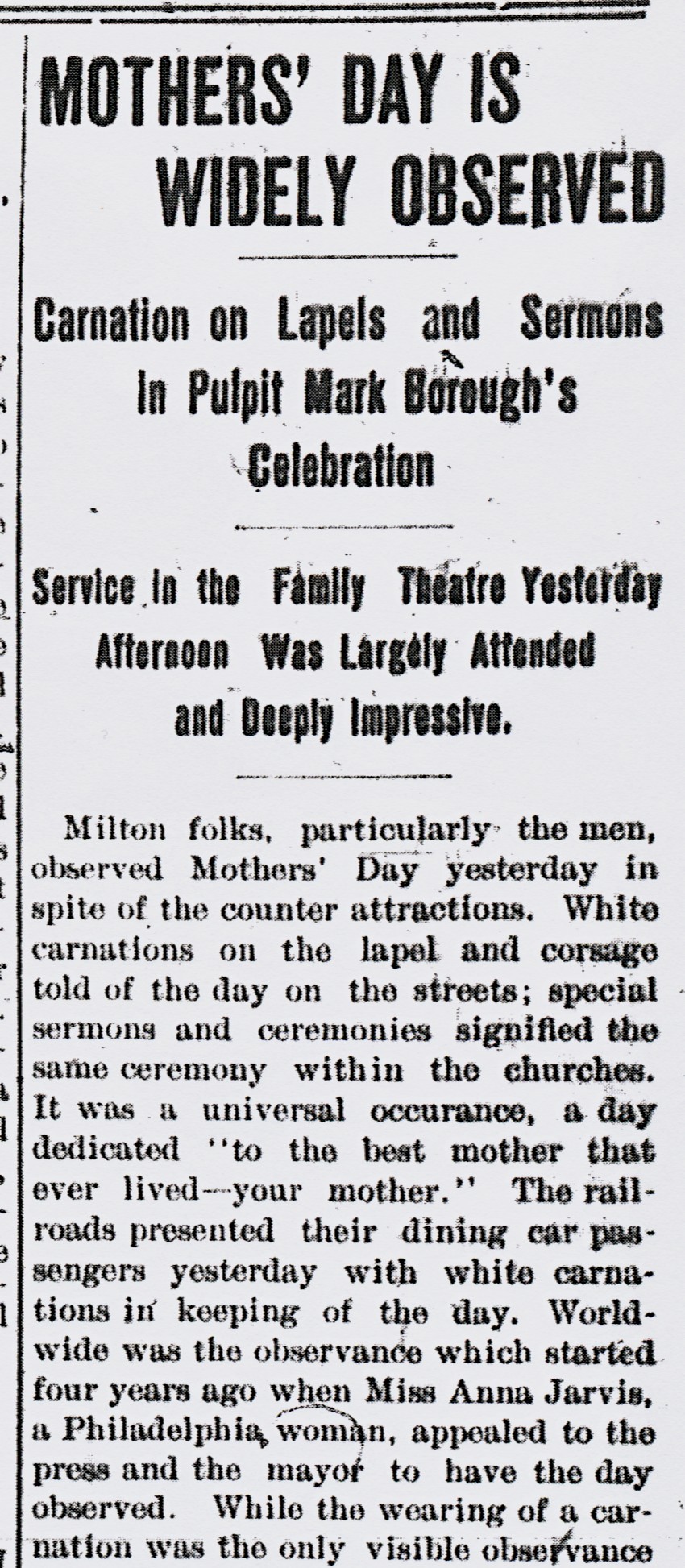
Article in Milton Evening Standard, May 15, 1911

This date was Mothers Day a hundred years ago. I wonder if the Muffly family celebrated it. The holiday had been founded only four years previously—yet people in central Pennsylvania apparently were aware of Mothers Day since there was an article about it in the May 13, 1911 issue of the Milton Evening Standard.

The article discussed how people should wear a white flower if their mother was deceased; and a colored flower if their mother was living. I wonder if anyone still does that. I know that the white and colored flower tradition lasted at least until the 1960s.

When I was a child I can remember going out into the garden before church on Mothers Day to pick a colored flower that I’d pin on my dress.

When I’d get to church most of the other women and girls would be wearing flowers (as well as a few men wearing boutonnieres). I can remember sitting in the pew during the church service and being surprised how many of the adults wore white flowers.