A Whole Half Year Has Just Leaped By

16-year-old Helena Muffly wrote exactly 100 years ago today: 

Friday, July 1, 1911:

A whole half year has just leaped by,

And all can now witness the approach of July.

With all its plenty of frolic and fuss,

But beware and be cautious of the sun.

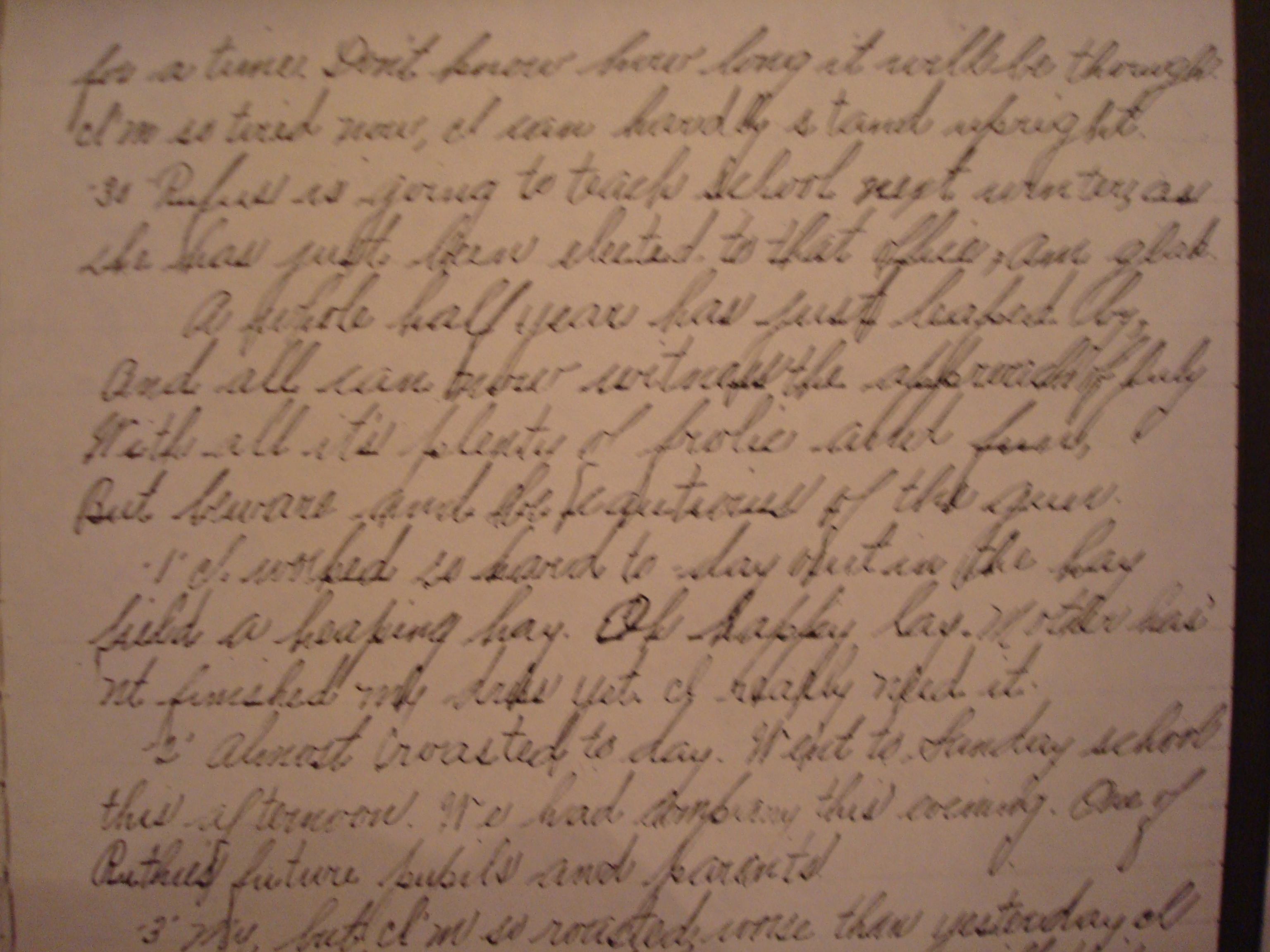
I worked so hard today out in the hay field a heaping hay. Oh happy day. Mother hasn’t finished my dress yet. I really need it.
Her middle-aged granddaughter’s comments 100 years later:

Whew, it’s hard to believe ‘a whole half year has just leaped by’ since I began posting the diary entries. Today, it seems appropriate to ponder the past 180 days and reflect a bit.

I’ve really enjoyed reconnecting with family and old friends as a result of the diary. I’ve also had the opportunity to meet some wonderful new people.

To all of you have very generously shared family history, memories of Grandma, and information and materials about the history of central Pennsylvania— Thank you!!   I couldn’t do this blog without you!

I’ve been very surprised how many people enjoy reading about Grandma and her times. Over the past several months two newspapers contacted me about this blog and then wrote wonderful stories. Also the blog was featured on a genealogy website. If you haven’t seen the stories you can click on the links below:

Geneabloggers (June 6, 2011): May I Introduce . . . Sheryl Lazarus

Milton Standard Journal (May 21 2011) Blog Connects Former Resident to Central PA  (.pdf. Reprinted with permission)

Williamsport Sun Gazette (May 15, 2011): 100 Years Ago. .. Woman Creates McEwensville Blog to Honor Her Grandmother

I constantly see connections between what happened a hundred years ago and now. My husband and kids might occasionally roll their eyes when I begin a sentence with, “Well, a hundred years ago. . . “ but I think they enjoy learning about Grandma and her times almost as much as I do.

Some things haven’t changed—for example one hundred years ago Grandma worried about final exams; last spring my daughter also worried about finals.

Other things are incredibly different—a hundred years ago horses were used for farming, and the Muffly’s had neither electricity nor a telephone. (Grandma used a phone for the first time in her life during May 1911.)

When I started this blog last January I wasn’t sure if I’d still be doing it in July, but I still am and having a lot of fun researching the entries—and I now anticipate that I’ll still be posting entries on the day the diary ends: December 31, 1914 (or in current terms December 31, 2014).

Have a wonderful July!
Ruth’s Going to be a Teacher

16-year-old Helena Muffly wrote exactly 100 years ago today: 

Friday, June 30, 1911: Rufus is going to teach school next winter, as she has just been elected to that office. Am glad.

Her middle-aged granddaughter’s comments 100 years later:

I haven’t been able to figure out where Grandma’s sister Ruth taught school during the 1911-12 school year, but it apparently was at a nearby one-room school house.

Ruth had just graduated from high school in May 191. A hundred years ago teachers were only required to have a high school diploma—though there was a movement toward encouraging teachers to complete a program of study at a normal school. At that time teacher preparatory schools were called normal schools, and the program of study was typically 2 years.

Since Ruth did not go to normal school she must have passed a examination that qualified here to become a teacher. She would have been a “provisional” teacher and paid at the lowest level.

In 1911 schools were primarily controlled by school boards and other local governments. There was a lot of tension over how much control the state should have over schools—though the state was beginning to regulate teacher licensure.

The state of Pennsylvania adopted teacher certification requirements on May 18, 1911:

Provisional—passed exam in spelling, reading physiology and hygiene, English grammar, arithmetic, elementary algebra, history of the US and PA, civil government including state and local government, school management, and methods of teaching.  One year duration—could be renewed 4 times.

Professional—Two years successful teaching. Passed two additional exam from the list of: vocal music, drawing, English literature, plane geometry, general history, physical geography, elementary botany, elementary zoology, or elementary physics. Must have “carefully and intelligently read” two books on pedagogy on approved list from state Superintendent of Public Instruction.

State normal school certificate: Issued to graduation of state normal schools. After 2 years teaching teacher receives permanent state certificate.

Permanent state certificate: Hold professional certificate, 2 years experience, passed all exams, read 4 books on pedagogy,  Passed exam in all subject areas listed for provisional and professional certificates—Exams held once a year by Examining Board appointed by state superintendent.

Jack Williams in A Historical Study of Education in Milton Pennsylvania

Private Room: Moved Sister’s Belongings to Another Room

16-year-old Helena Muffly wrote exactly 100 years ago today: 

Thursday, June 29, 1911:  I moved Ruthie’s belongings into another apartment and she herself is going to occupy that room for a time. Don’t know how long it will be though. I’m so tired now, I can hardly stand upright.

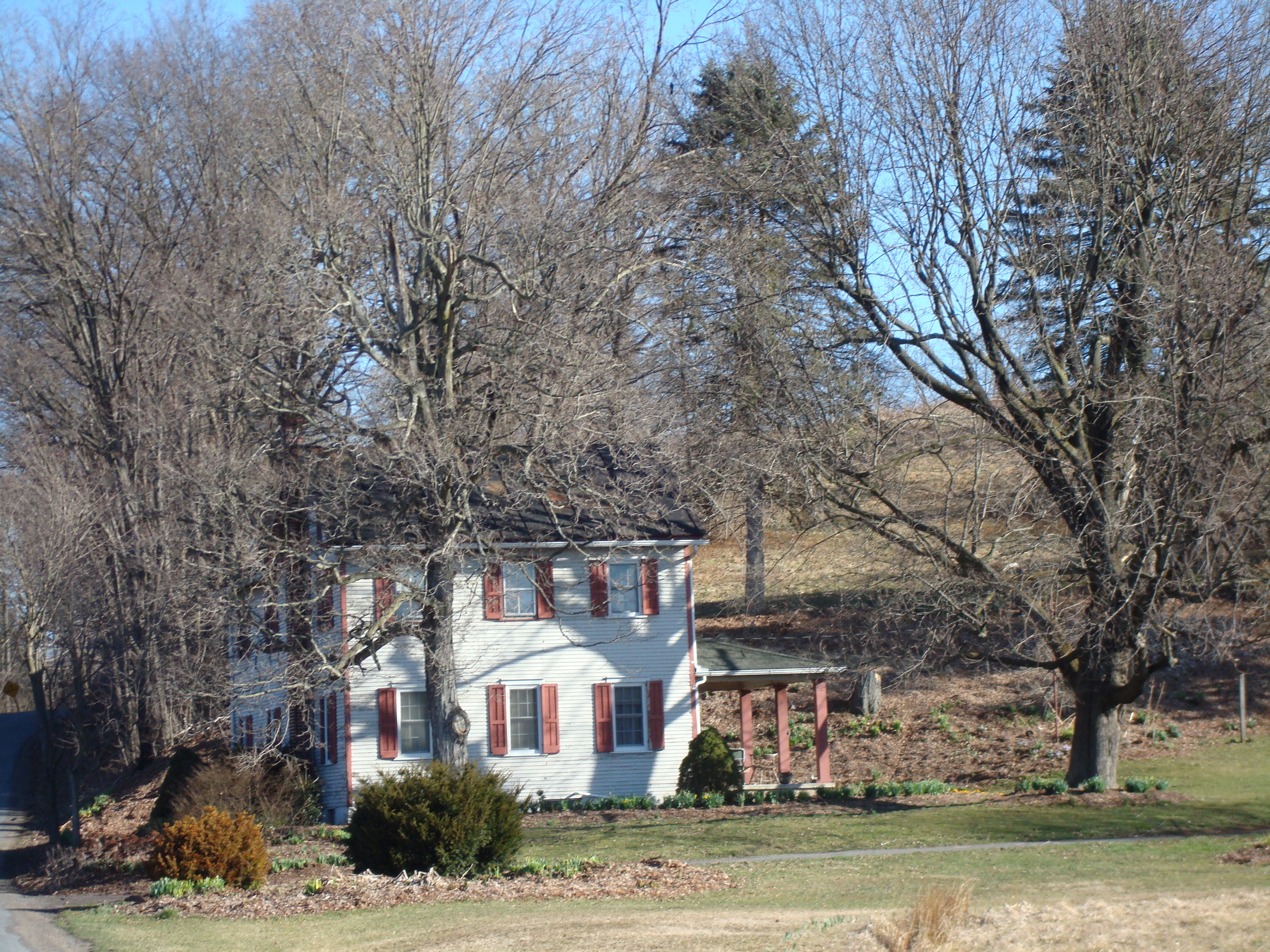
Recent photo of the house Grandma lived in when she was a teen writing the diary.

Her middle-aged granddaughter’s comments 100 years later:

The meaning of this entry isn’t real clear, but my best guess is that Grandma and her sister Ruth normally shared a bedroom—but that for some reason (maybe a disagreement between the two) her sister moved to another room.  Old farmhouses often had lots of bedrooms so there probably was a spare (or guest) room available.

I’m surprised that this entry uses the pronoun “I”. I would have thought that carrying things to the other room would have been a joint effort (or that maybe Ruth would have moved herself). Instead it sounds as if Grandma was upset, so she moved her sister’s possessions when Ruth wasn’t there. It’s amazing that Ruth accepted the situation and didn’t immediately start moving things back.

Reading between the lines, I think that Grandma was pleased with the outcome and how she’d handled the situation.

How to Live 100 Years

16-year-old Helena Muffly wrote exactly 100 years ago today: 

Wednesday, June 28, 1911: Nothing much to write about unless it would be that I was an exceedingly industrious girl today.

Her middle-aged granddaughter’s comments 100 years later:

Since Grandma didn’t write  much today, I’m going to post some century-old advice by Eugene V. Brewster, the author of What’s What in America, about how to live to be a hundred years old:

How to Live 100 Years

I expect to live one hundred years. It is very simple when you know how.

Here’s how:

1. Keep clean. All disease is caused by uncleanliness—principally internal.

2. Drink nearly a gallon of fluid a day—pure water and milk are best.

3. Eat not more than two meals a day of wholesome food. Overeating kills more people than tuberculosis and pneumonia combined.

4. Let all food remain in the mouth twice as long as most people do. It you don’t it will be worse than wasted.

5. Sleep winter and summer with the head of your bed under an open window. Colds are impossible if Rule 1 is followed.

6. Get busy—not merely exercise, but useful work. Walking will do though.

7. Eat sparingly of meat. Three or four times a week is enough.

8. Be extremely moderate with such poison as tobacco, liquor, tea and coffee.

9. Make better friends of nuts, fruits and grains, and cut down your supply of cooked foods. Fire destroys life and many of the nutritive qualities of food.

10. Breath and speak low. Subdue your emotions and keep an even poise.

If I die before 1969 you will know that I fell down on one of these rules.

Eugene V. Brewster, Pure Foods Magazine (June, 1910)

Note: Mr. Brewster died in 1939, so I guess that he fell down on one of these rules.

Storm Coming: Brother Missing

16-year-old Helena Muffly wrote exactly 100 years ago today: 

Thursday, June 27, 1911: We had a thrilling search for Jimmie this afternoon who had hid himself in a chicken coop just before a rainstorm to escape getting wet.

Storm Clouds (Source: C. Johnson, Wikepedia Commons)

Her middle-aged granddaughter’s comments 100 years later:

Grandma’s brother Jimmie would have been 5-years-old.

This entry make me think of Aunt Em searching for Dorothy right before the storm at the beginning of the Wizard of Oz. A lot of things have changed over the last 100 years—but some things never change. A missing child then and now sets off so many emotions and fears—and then there is the utter sense of relief, mixed with anger at the child for hiding or wandering off,  when he or she is found.

Old-fashioned Cherry Pudding Recipe

16-year-old Helena Muffly wrote exactly 100 years ago today: 

Monday, June 26, 1911:  Felt so terrible this morning, so did Ruth. Picked cherries nearly all afternoon! There were sour ones, so there was no danger of spoiling my hands to any considerable extent.

Her middle-aged granddaughter’s comments 100 years later:

How did the Muffly family use the sour cherries? In pies? . . . jam?. . . fruit compote? . . . cherry pudding?

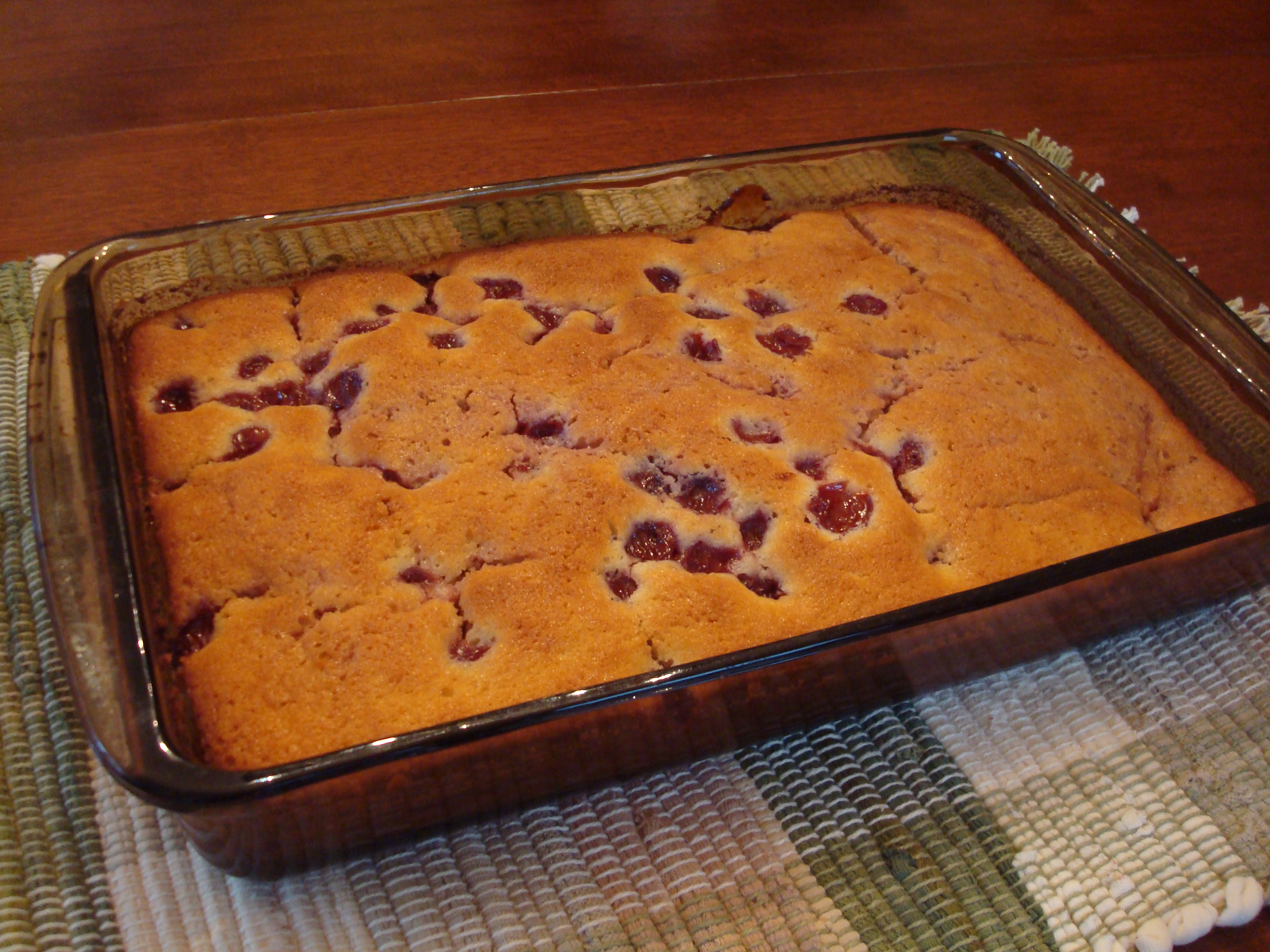
I can remember cherry pudding tasting awesome on hot summer evenings after a hard day of making hay.  Here’s the old family recipe that I use to  make Cherry Pudding.

Cherry Pudding

1/2 cup butter, melted

1 cup sugar

1 1/2 teaspoon baking powder

1/4 teaspoon salt

1 egg

1 cup milk

1 1/2 cups all-purpose flour

1 teaspoon vanilla

3/4 cup sugar

2 1/2 cups pitted sour cherries*

1/2 cup water

Preheat oven to 350 degrees. Put into a mixing bowl: butter, sugar, baking powder, salt, egg, milk, flour, and vanilla; beat until smooth. Pour into a 7 1/2  X  12  X  2 inch rectangular casserole dish, or similarly sized dish.

Make sauce by heating the 3/4 cup of sugar, cherries (including any juice), and water. Bring to a boil; then spoon the cherry sauce over the batter to distribute the cherries and the liquid across the top of the batter.  Place in oven and bake for 35 to 45 minutes, or until pudding just begins to shrink from sides of dish, and the top is golden brown. When baked, cherries and sauce will be on the bottom. Serve warm. If desired, may be served with milk.

*Frozen or canned cherries may be used. Do not drain frozen or canned cherries; and include juice when measuring cherries. It works okay to use a 1 pound can of cherries—there just will be somewhat fewer cherries in the dish than if fresh or frozen cherries were used. Reduce amount of sugar, if using cherries canned or frozen in sugar syrup.

1911 Magazines

16-year-old Helena Muffly wrote exactly 100 years ago today: 

Sunday, June 25, 1911: Went to Sunday school this morning. Didn’t go any place this afternoon. Had to entertain myself.

Her middle-aged granddaughter’s comments 100 years later:

Hmm—I wonder what Grandma did on this quiet Sunday afternoon a hundred years ago. Did she go for a walk, play solitaire, read . . or . . .?

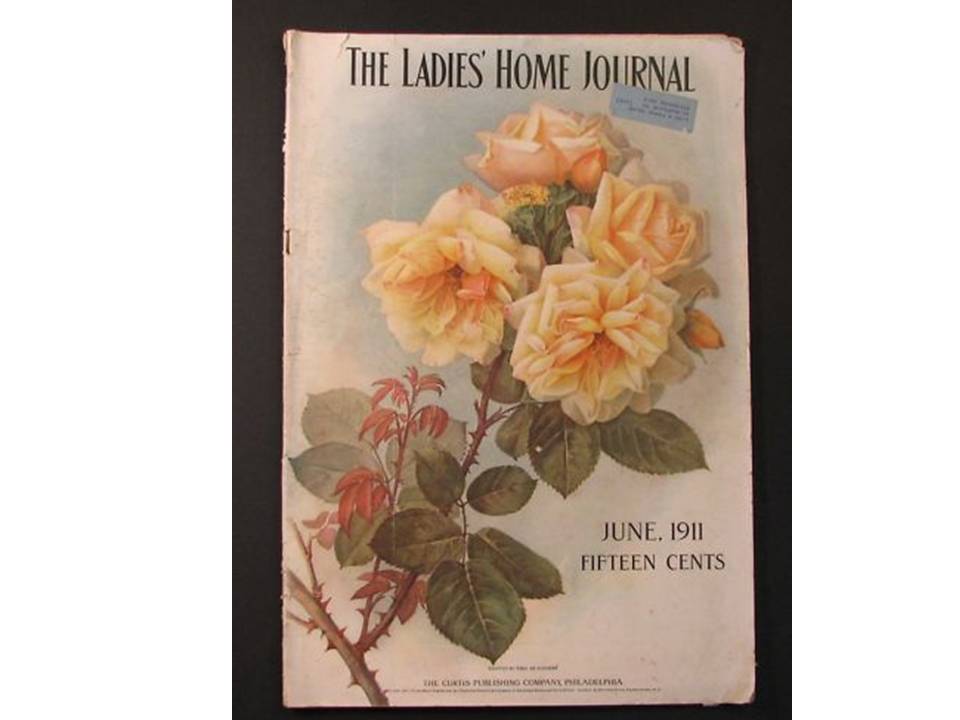
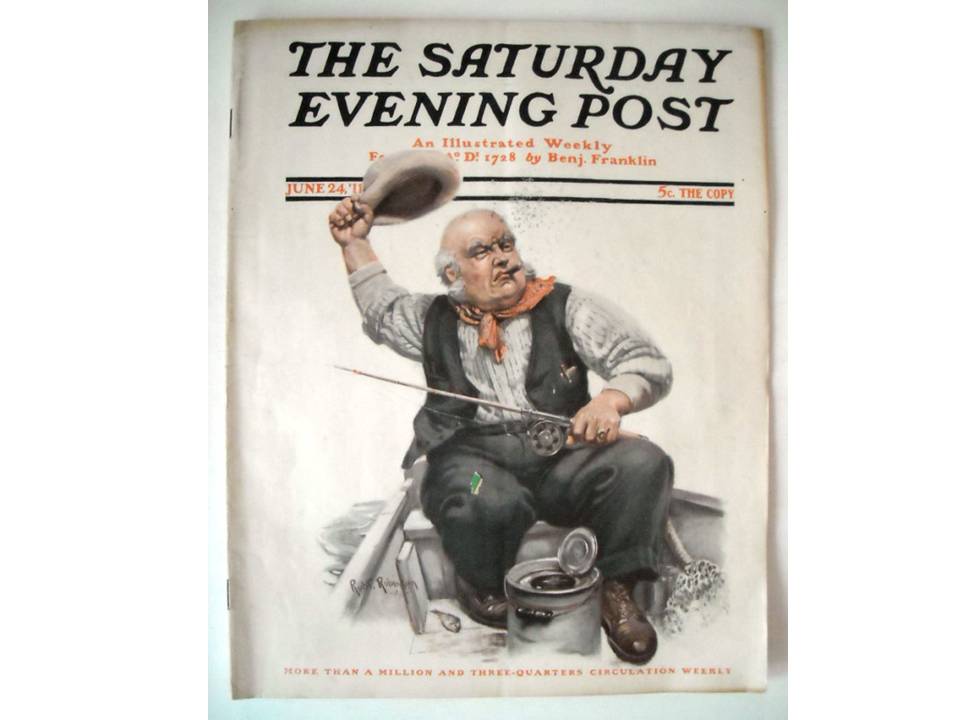
Maybe she read a popular magazine. As transportation improved and consumer culture began to grow and develop in the early years of the 20th century, magazines became very popular. For example, the circulation of the Saturday Evening Post grew from 200,000 in 1900 to 1.75 million in 1911. And during the same period the circulation of the Ladies Home Journal went from 800,000 to 1.4 million.

Ladies Home Journal was aimed at working class women—Saturday Evening Post at the working class of both genders. Curtis Publishing, the publisher of both magazines, was an early user of market research; and in 1911 the company created a Market Research Department  to get information about their customers. They then provided the information to their advertisers to help them target goods to specific demographics and successfully gauge public opinion.

These magazines reflected the predominate culture of the time while simultaneously creating a more commercialized consumer culture than had previously existed.