16-year-old Helena Muffly wrote exactly 100 years ago today:
Saturday, July 8, 1911: Went to Watsontown this afternoon. Got stung by a bee coming home. Went up to Oakes on an errand as soon as I got home from town.
Her middle-aged granddaughter’s comments 100 years later:
This is the second time that Grandma has been stung by a bee in less than a month. When I was a child my family always treated bee stings with a baking soda paste. But another old-time remedy for bee stings is described in the Compendium of Every Day Wants (1908):
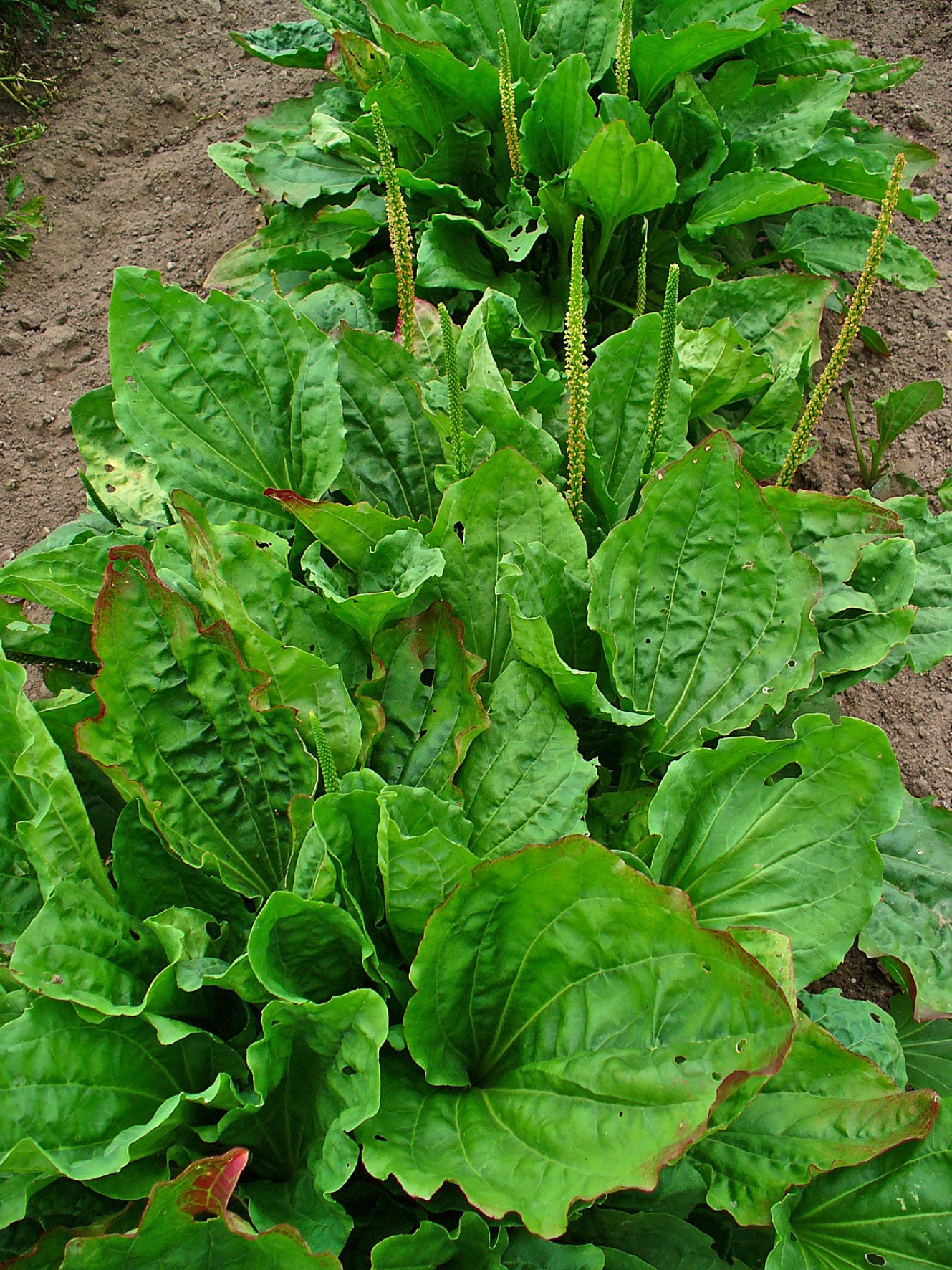
BEE STINGS.—Common plantain leaves mashed and tied on the part stung will at once draw out the swelling and take away all pain. This is a simple and easily gotten remedy and one that I have tried myself. One summer when I was helping to hive bees, my eyes were stung that they swelled shit, and this took the swelling out in an hour.
Luther Minter in Compendium of Every Day Wants (1908)
Common Plantain (Photo Source: H. Zell, Wikemedia Commons)
The Compendium is referring to a weed sometimes called common plantain (and not to the cooking banana). Some alternative medicine websites indicate that plantain helps relieve bee stings because the leaves contain tannins which act as an astringent and reduces swelling. The leaves may also reduce pain because they contain salicylic acid (which is the active ingredient in aspirin)
16-year-old Helena Muffly wrote exactly 100 years ago today:
Friday, July 7, 1911: Nothing much at all to write about.
Her middle-aged granddaughter’s comments 100 years later:
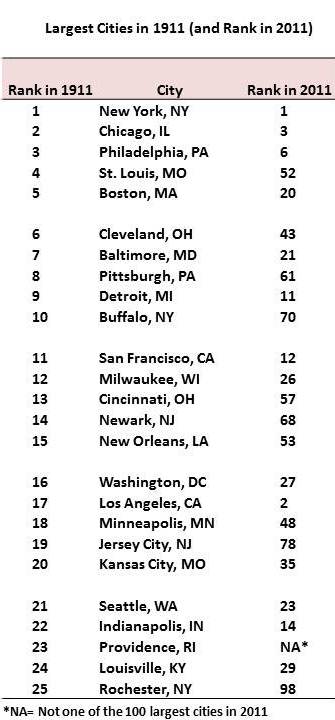
Four days ago, I posted the high temperature in 25 cities for July 3, 1911. At that time I wondered which cities were the largest cities in the US in 1911. Since Grandma didn’t have much to say a hundred years ago today, I’ll tell you what I found.
The 25 largest cities in 1911 were:
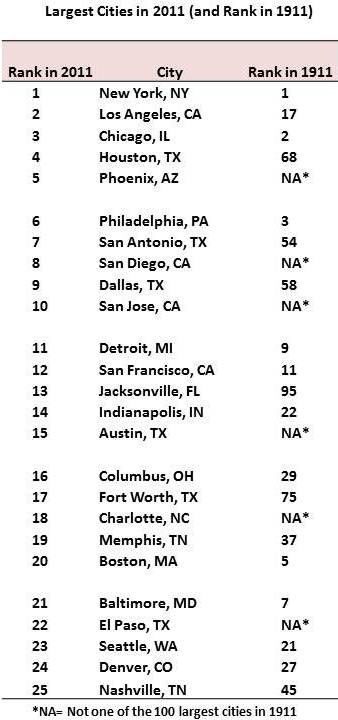
And, then I wondered which cities are the largest now—and what their rank had been in 1911:
One thing that really surprised me about these lists is that the rank of Detroit was about the same in both 1911 and 2011 (9th in 1911 and 11th in 2011), so I looked at the rank in some of the intervening years. Detroit apparently grew rapidly as the auto industry took off—and it was the 4th largest city in the US by 1920.
For those who care about the details: I used US Census Bureau data for the ranks. The 1911 numbers are based on the 1910 census; the 2011 ranks are based on 2009 estimates. There may be some minor changes in the rank when detailed data become available from the 2010 census.
16-year-old Helena Muffly wrote exactly 100 years ago today:
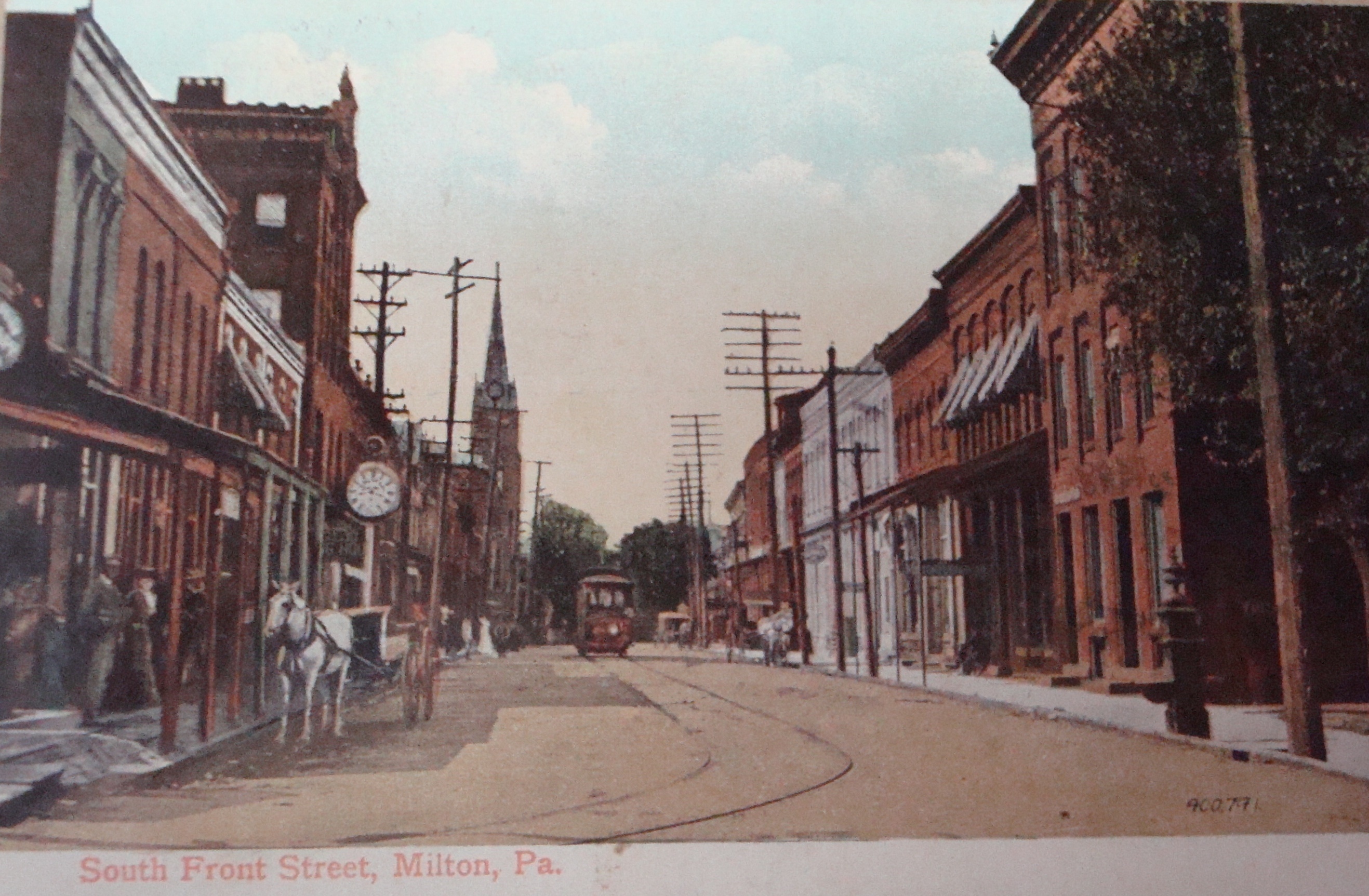
Thursday, July 6, 1911: Went to Milton this morning. Got that bothersome tooth that ached in the spring filled and several other ones. Went to the extravaganza of buying a five dollar ring today. I am busted now.
Old postcard of South Front Street, Milton. Grandma probably walked to Watsontown and then took the trolley to Milton when she visited the dentist. (Source: Milton Historical Society)Recent photo of South Front Street, Milton
Her middle-aged granddaughter’s comments 100 years later:
Yeah! Hip Hip Hooray! Thank goodness! Grandma finally got her tooth filled!
It took Grandma almost three months to get her tooth fixed after it started hurting. She first mentioned that she had a toothache on April 11, and again complained about it on April 15 and April 18. She then tried to visit the dentist in Milton on May 6 and again May 13 but he wasn’t in his office when she got there.
As a mother I can’t imagine one of my children having a tooth ache for months—and wonder why Grandma’s parents let this health problem linger for so long. I guess that times were just different.
I know that this entry was written a hundred years ago, and that all of the problems and concerns that Grandma wrote about resolved themselves one way or the other long, long ago—and that it is irrational for me to be concerned about problems mentioned in the diary–but I must admit that I’ve worried about Grandma’s health when she couldn’t get her tooth fixed for months on end.
The Ring
I’m amazed that Grandma bought herself a $5 ring. In past entries Grandma’s always worried about wasting money, but maybe she decided to reward herself for finally getting her tooth fixed. The ring must have been really nice. In today’s dollars it would be worth about $140. In June Grandma earned $2.65 from picking strawberries—I wonder where she got the remaining money for the ring.
16-year-old Helena Muffly wrote exactly 100 years ago today:
Wednesday, July 5, 1911: No news for today, not the smallest pinch, excepting that I got drenched during a rain storm.
Her middle-aged granddaughter’s comments 100 years later:
Grandma doesn’t give many clues about what she did a hundred years ago today. I wish that she’d written more about mundane events. For example–Which vegetables were ripe in the garden? . . . Which fruits?
This past week-end my husband, daughter, and I picked some red currants at a u-pick farm. I wonder if Grandma’s family had currant bushes and if they made currant jelly.
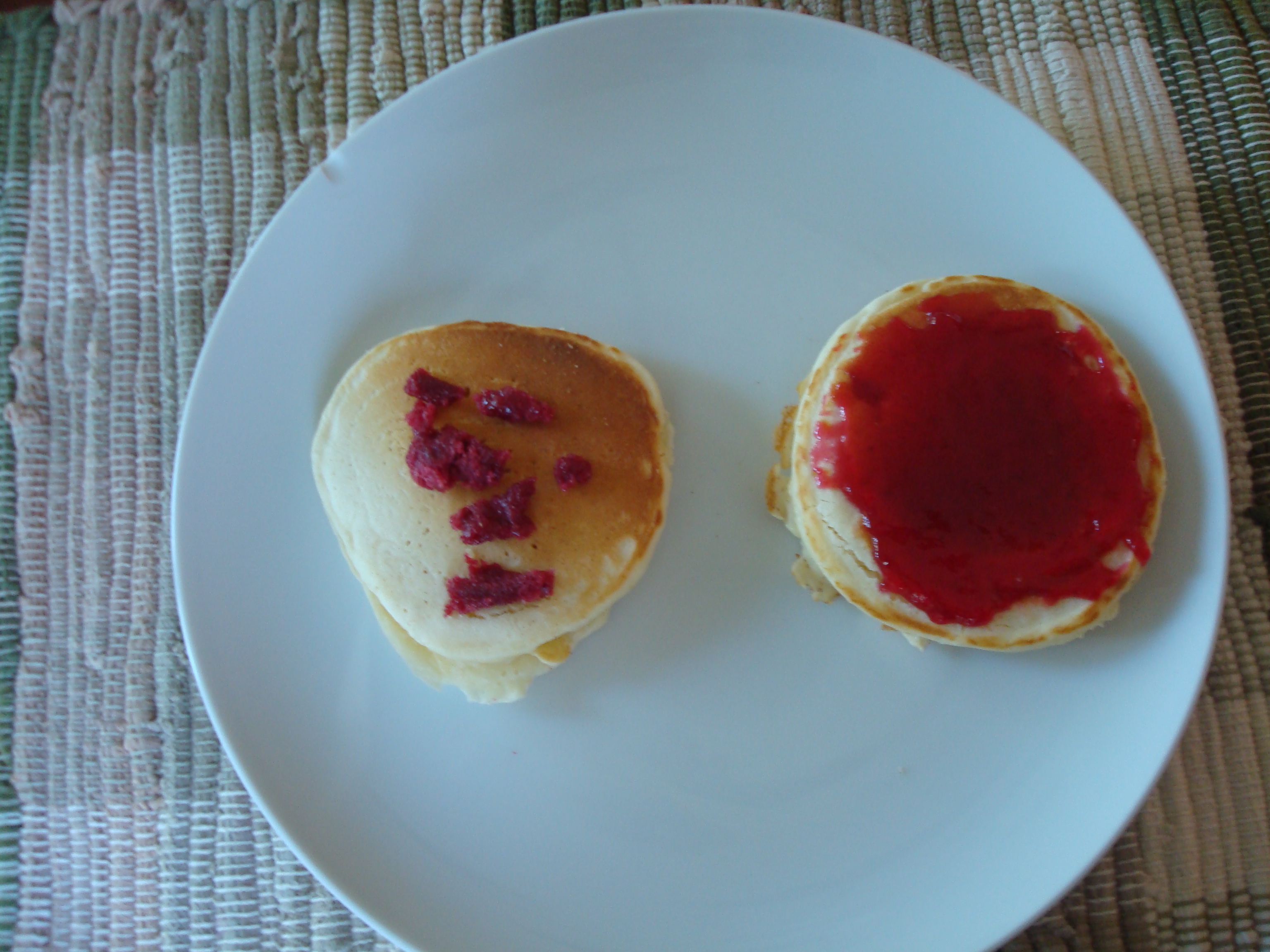
The jar on the left contains the currant jelly made with the old-time recipe. The jelly on the right was made using the modern recipe.
Bottom line: My daughter’s currant jelly turned out fantastic. Mine ended up being more like fruit leather than jelly. I obviously didn’t interpret and adapt the recipe for use with a modern range, but my jelly had more wonderfully complex flavors than the modern recipe I think that I learned from my mistakes and hope to pick some more currants next week-end—and try again to get the consistency right.
The old recipe is below:
Currant Jelly
Wash and drain currants thoroughly. Do not remove stems. Mash a few in the bottom of the kettle. Cook until the juice seems to be extracted from the currants and the currents look white. Press through a coarse colander, then drip through a jelly bag, but do not squeeze.
Allow one pound of sugar for each pint of juice. Boil juice twenty minutes. Add hot sugar and boil hard three minutes; skim when necessary. Strain into hot glasses.
Lowney’s Cook Book (1907)
I obviously over-cooked the juice—and substantially less cooking time was needed. I think it’s one of those things where with practice—or advice from a more experienced cook—you just learn how thick the boiling juice should be when the sugar is added.
Don't laugh, but here's a photo of the jelly made with the old recipe (left) and the modern recipe (right). The consistency is obviously much better with the modern recipe--but the intense fruit taste of the old recipe was awesome. (I really want to do some more experimenting with old pre--commercial pectin era jelly recipes and try to figure out how to make them properly.)
The cooking process reminded me of boiling maple syrup—and the juice naturally thickened as some of the water evaporated. I just boiled it way too long.
Another old cookbook that I have says that slightly under-ripe currants should be used because they naturally contain more pectin.
The recipe calls for adding hot sugar. Elsewhere in the cookbook it indicates that sugar should be heated in the oven prior to adding to the boiling juice. I guess this reduces the amount of time needed for the liquid to return to a boil after the sugar is added.
An aside: Currants were a popular berry in the US in the early 20th century. A few years after this diary entry was written currant plants were banned in the US. From 1916-1966 Federal laws restricted currant plants because they were an alternate host for a tree fungus called the White Pine Blister Rust. Some states still have laws restricting currants, but they generally are not enforced because there are varieties that aren’t very susceptible to the fungus.
16-year-old Helena Muffly wrote exactly 100 years ago today:
Tuesday, July 4, 1911: The fourth of July is almost over and I have barely given it a thought. That shows that I am not given to celebration on this day having nothing to shoot up in the air. A good reason.
Her middle-aged granddaughter’s comments 100 years later:
A hundred years ago the national media was highlighting the dangers of fireworks. The following is an excerpt of an article in the Ladies Home Journal.
The Killing of Children: 131 More Little Ones Added to the Fearful List
A FOREWORD: The figures given here can be accepted as authoritative. They are figures collated by “The Journal of the American Medical Association” of Chicago from returns sent to it by health officers, hospital superintendents, physicians, and other reliable sources in every part of the country.
The Editor of The Ladies Home Journal
One hundred and thirty-one children were killed either by fireworks or as the result of fireworks in the celebration of the last Fourth of July. This is a lower total than we have had since 1903, due to the rapidly growing feeling among the sensible part of the American people for a radical change of celebrating the day.
Wherever common-sense has ruled and fireworks have been actually and entirely forbidden the results were certainly splendid.
Trenton, New Jersey, for instance, prohibited all fireworks for the first time last year. Not a child was killed nor an injury reported. The year before 58 injuries were reported and 1 killed.
Cleveland, Ohio, where fireworks have been prohibited for two years, had only 1 injury last year, 4 the year before, while 93 were injured and 12 were killed the previous year when fireworks were permitted. . . .
The third city in America, Philadelphia, leads all the cities of the country with the blackest record for 1910: 409 children were killed or maimed in Philadelphia last Fourth of July. A creditable record the the city that is supposed to be the cradle of American liberty and patriotism! A conscientious effort made by a score of the leading citizens of Philadelphia last year to enact a prohibitive fireworks ordinance was met by the comment from the Mayor that he could see no reason why children should not be allowed their fireworks and their fun. “Their fun”! And this in the face of the fact that , during the short period of only four Fourths of July, THERE HAVE BEEN KILLED AND MAIMED IN PHILADELPHIA ALONE ONE THOUSNAD SIX HUNDRED AND THIRTEEN CHILDREN
A humane record in order that children may have “their fun”! Just how long the people of Philadelphia will permit their city to show the blackest Fourth of July record of any city it is difficult to say.
There are other cities too, whose people sadly need an awakening on this barbarous Fourth of July method of celebration. Pittsburg, Pennsylvania, for example, is co-equal with New York in presenting the largest number of children killed. . . .
There is but one way for a city to stop this fearful increasing roll of little ones killed and maimed each year. The responsibility clearly rests with city governments, since the employment of death-dealing methods of celebration is subject to their regulation. It is, therefore, up to the city governments to decide whether or not the maiming of thousands, the agonizing deaths from lockjaw, and the burning to death of little children by fire from fireworks are to be continued. And that a prohibitory ordinance is the only effective and permanent method is shown by the results in Baltimore, Washington, Cleveland, and Trenton.
But the people of every community must ask for such an ordinance and insist that it shall be passed. And now, before we get too close to another Fourth of July, is the time to act.
16-year-old Helena Muffly wrote exactly 100 years ago today:
Monday, July 3, 1911: My, but I’m so roasted, worse than yesterday, I guess. Made an errand up to McEwensville this evening in behalf of my popper.
This is a recent view of the buildings Grandma would have seen as she walked into McEwensville. A hundred years ago the road would have been dirt.
Her middle-aged granddaughter’s comments 100 years later:
A hundred years ago today the horrible heat wave continued across most of the country. The effects were devastating in this era before electric fans or air conditioning. This is the second day in a row that Grandma said she was roasted.
The Minneapolis Morning Tribune reported the July 3, 1911 temperatures for 25 cities across the nation
HOT WAVE CONTINUES TO EXACT HEAVY TOLL
Scores Throughout Country Succumb and Hundreds Are Overcome
Mercury Officially Climbs to 104 in Four Places Far Apart.
People Seeking Relief in Big Cities Sleep in Parks and Roofs.
High Temperatures in Many Cities on Monday
Louisville, Ky . . . 104
St. Joseph, Mo . . . 104
Davenport, IA . . . 104
Yuma, Ariz. . . . 104
Boston . . . 102
Albany. . .102
Kansas City. . .102
Columbus, O. . . .102
Dubuque, Ia. . . . 102
Fresno, Cal. . . 102
Chicago. . .100
Harrisburg . . . 100
Fort Wayne . . . 100
Cincinnati. . . 100
Springfield . . . 100
St. Louis . . . 100
Indianapolis . . .100
Wash’ton, D.C. . . 99
New York City . . . 98
Philadelphia. . . 98
Northfield, Vt. . . 98
Pittsburg. . . 98
Lynchburg, Va. . . 98
Wichita, Kan. . . 98
Minneapolis Morning Tribune (July 4, 1911)
An aside: It’s interesting to see which cities were included in the list, as well which cities were considered to be so major that they didn’t need state names after them. It’s also interesting to see how some state names were abbreviated in 1911. For example, Ohio was abbreviated with an O. (I wonder what the abbreviation was for Oklahoma in 1911.)
16-year-old Helena Muffly wrote exactly 100 years ago today:
Sunday, July 2, 1911: Almost roasted today. Went to Sunday school this afternoon. We had company this evening. One of Ruthie’s future pupil’s and parents.
Her middle-aged granddaughter’s comments 100 years later:
July 2, 1911 was an extremely hot day across the Eastern and Midwestern US. The New York Times reported that on July 2 in New York City it was:
. . . the hottest day here in twelve years. Mercury up to 94.5, with 72 per cent. humidity, and next to no breeze.
The paper also reported that:
HARRISBURG, Penn, July 2—The temperature today reached 98.2, the hottest recorded since July 1, 1901, when 100 was the maximum. The intense heat caused much sickness.