The Creek is Out of Its Banks!

16-year-old Helena Muffly wrote exactly 100 years ago today: 

Friday, March 15, 1912:  It was out of the ordinary walking to school this morning. It rained so last night that my morning, water was plainly visible everywhere. It was about the same height tonight. I thought this morning I might not get to school after all.

Recent photo of Warrior Run Creek.

Her middle-aged granddaughter’s comments 100 years later:

Grandma needed to cross Warrior Run Creek to get to school.

It sounds like the creek had flooded and was out of its banks.  However, the water apparently had not covered the road and the bridge so Grandma could get to school.

Though not visible, the creek is in the valley in the center of this photo. Probably the field next to the railroad tracks and low lands were flooded a hundred years ago today.

Shift From Classical High Schools to Modern 4-Year Ones

16-year-old Helena Muffly wrote exactly 100 years ago today: 

Thursday, March 14, 1912: I wrote out the meaning of that wonderful poem today. I hope I have it as it should be. Am coming to some terrible hard propositions in geometry. The one we have for tomorrow seems so hard for me.

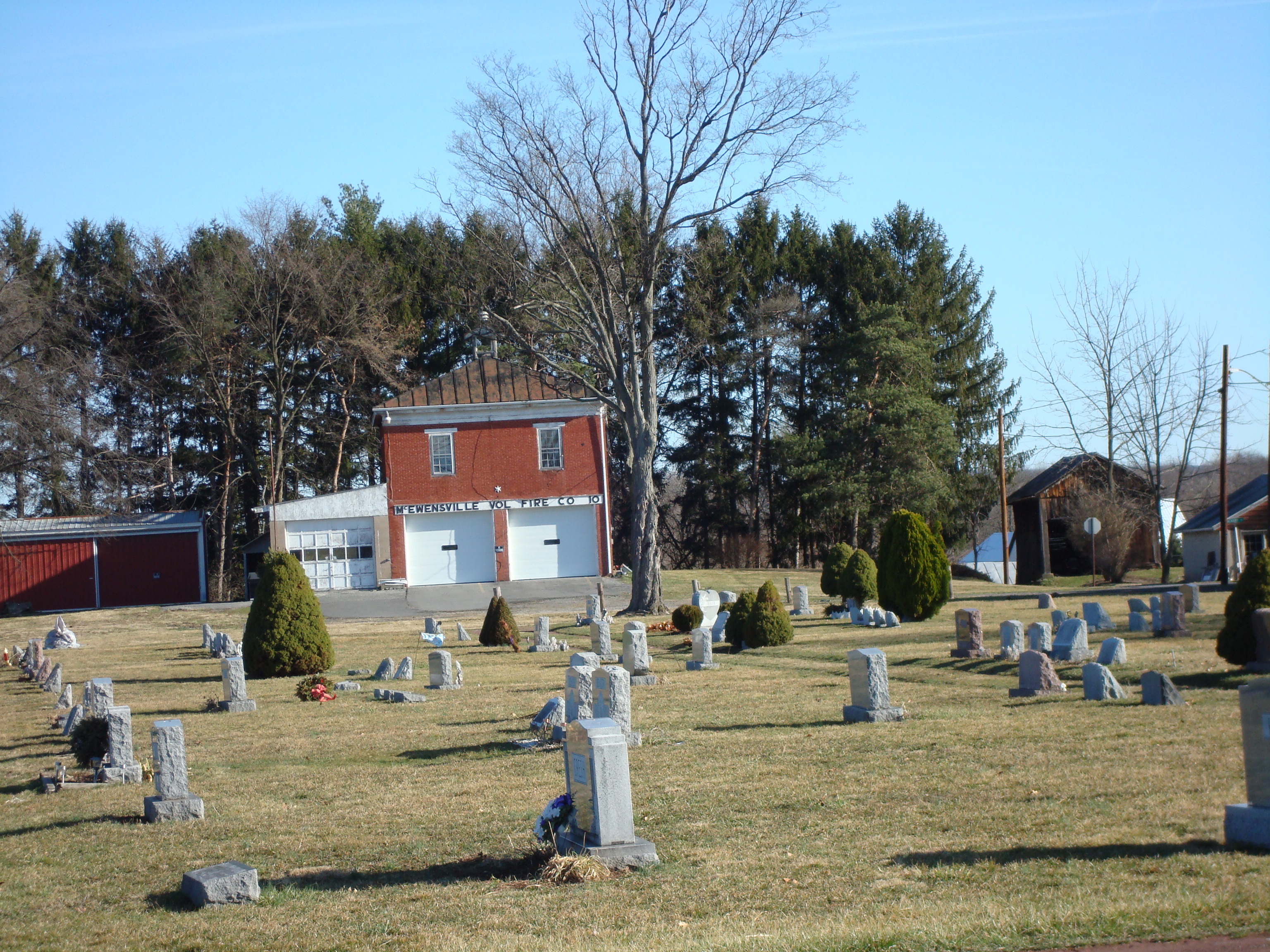
Recent photo of building that once housed McEwensville High School.

Her middle-aged granddaughter’s comments 100 years later:

Did Grandma’s high school courses prepare her for the life she lived?

Grandma attended McEwensville High School—a small classical 3- year high school.  She studied geometry (and Latin)—and literature. Grandma did not go to college—and never had a career.

In the early 1900’s there was a lot of discussion about whether a classical high school education met the needs of some students.

About five miles from McEwensville a modern high school was being built in Milton. There was a movement towards larger 4-year general high schools that offered a wider range of courses and different tracks (commercial, home economics, etc.).

Over the next few years, more students from McEwensville attended the more modern high school in Milton (as well as the high school in Watsontown). And, in 1921, McEwensville high school closed because of lack of students.

(The building continued to house an elementary school until 1958.)

Old-fashioned Potato Cakes

16-year-old Helena Muffly wrote exactly 100 years ago today: 

Wednesday, March 13, 1912:  Nothing of much account did I do today.
Her middle-aged granddaughter’s comments 100 years later:

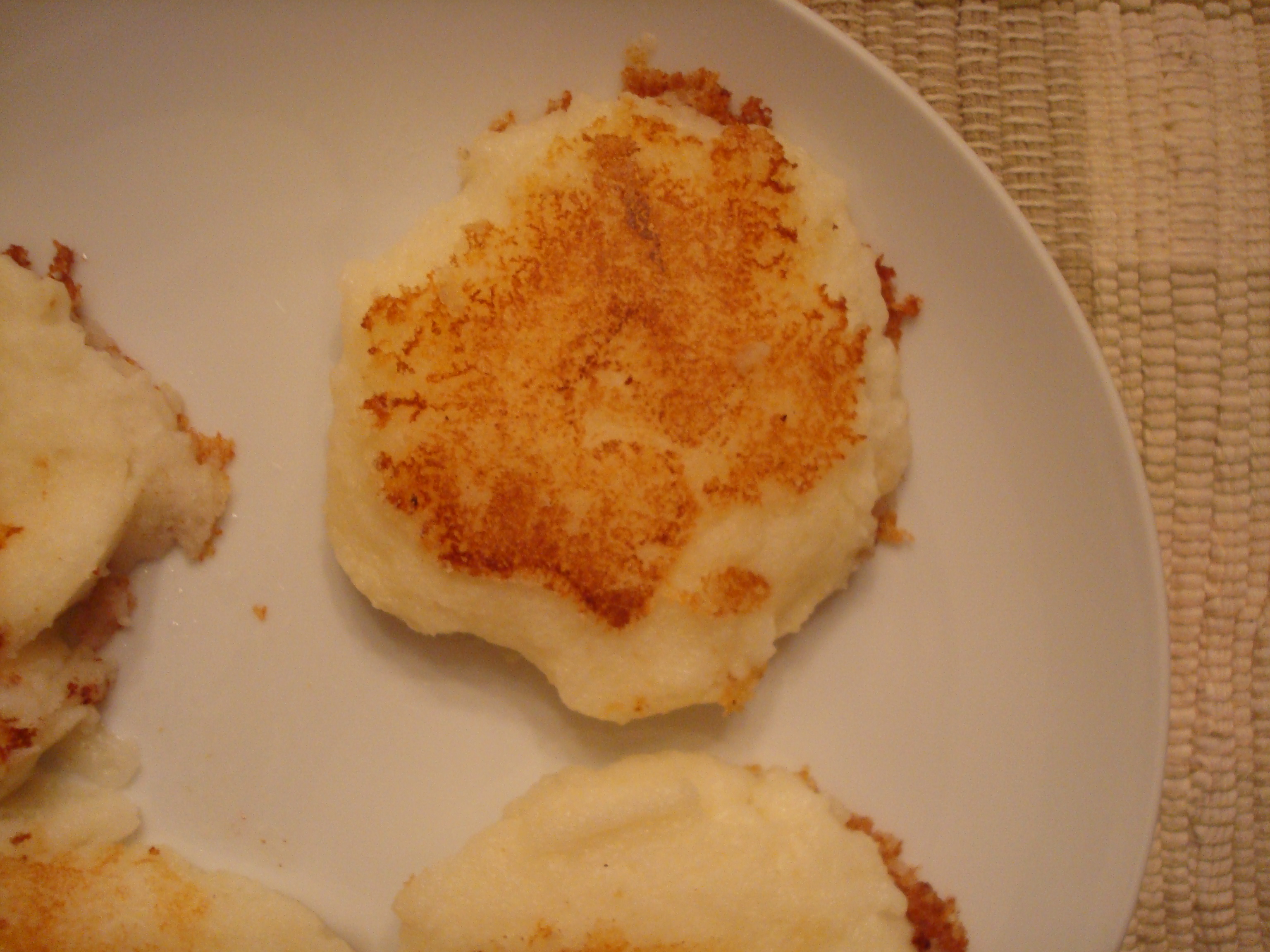
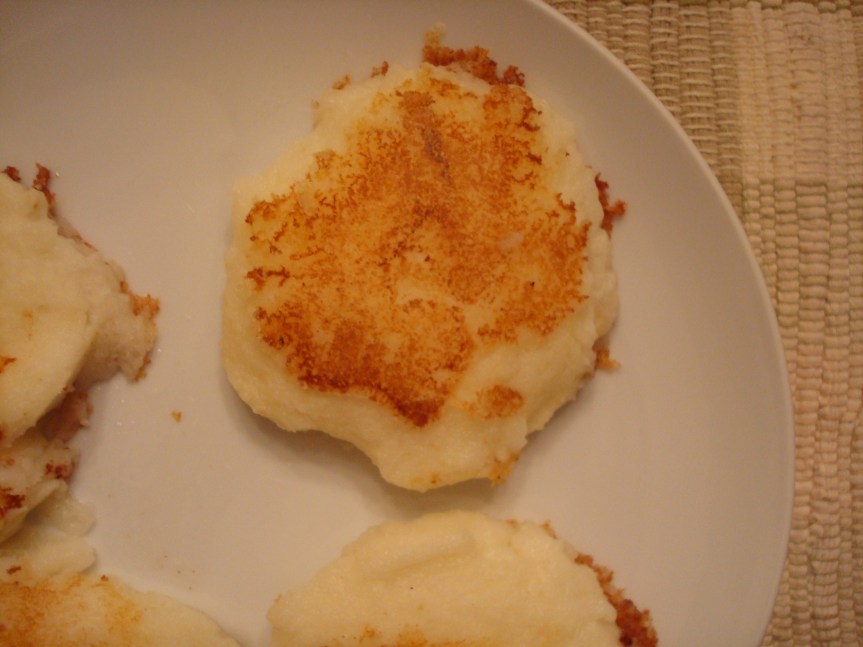
Since Grandma didn’t write much a hundred years ago today, I’m going to give you another old recipe. This one is for Potato Cakes, and it’s a great way to use left-over mashed potatoes.

When I was a child we frequently ate Potato Cakes. My memory is that they were a very traditional Pennsylvania food—and I can picture Grandma eating them when she was a teen.

I hadn’t made Potato Cakes in years until I decided to make them for this post. I don’t have a written recipe—but this is how I made them.

Old-Fashioned Potato Cakes

left-over mashed potatoes

shortening or lard

After the meal where the mashed potatoes were served, take the left-over potatoes, shape into flat patties and press firmly. Put on a plate, cover and refrigerate. Will keep for several days.

When ready to make the Potato Cakes, melt enough shortening in a heavy frying pan to cover the pan to a depth of about 1/8 inch. Slip the patties into the hot shortening. Fry until golden brown; flip and fry on the other side. Remove from pan and drain on paper towels. Serve immediately.

The amounts are very flexible. When I made the mashed potatoes, I made more than I typically would—and then I just used all of the left-over potatoes to make the potato cakes.

The Potato Cakes turned out great. My husband and I enjoyed eating them, and I’m planning to make them again in the near future.
Tramps in the Early 1900s

16-year-old Helena Muffly wrote exactly 100 years ago today: 

Sunday, March 3, 1912:  I don’t believe we are going to get our papers back. I wouldn’t mind knowing what some of my marks are. Perhaps not very satisfactory any way.

Source: Wikipedia

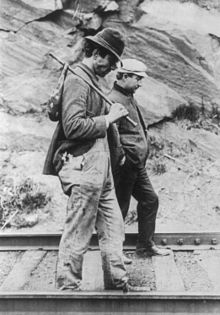
Had to walk home from school behind a tramp. I walked slow enough you can bet.

Her middle-aged granddaughter’s comments 100 years later:

Sounds a little scary—

A tramp walking down a rural road—and a a teen-aged girl needing to walk the same road  to get home from school.

Grandma would have walked down this road to get home from school. Probably each farm-house along the way represented a safe haven.

There were lots of tramps in US in the early 1900s. Many men found it very difficult to find jobs as the country industrialized. According to Wikipedia:

In 1906, Professor Layal Shafee, after an exhaustive study, put the number of tramps in America at 500,000 (about 0.6% of the U.S. population). The article citing this figure, What Tramps Cost the Nation, was published by The New York Telegraph in 1911 and estimated the number had surged to 700,000.

Geometry: Definition of a Point

16-year-old Helena Muffly wrote exactly 100 years ago today: 

Monday, March 11, 1912:  I heave a sigh of relief when I think examinations are past for this month. I have my doubts about what I will get in geometry.

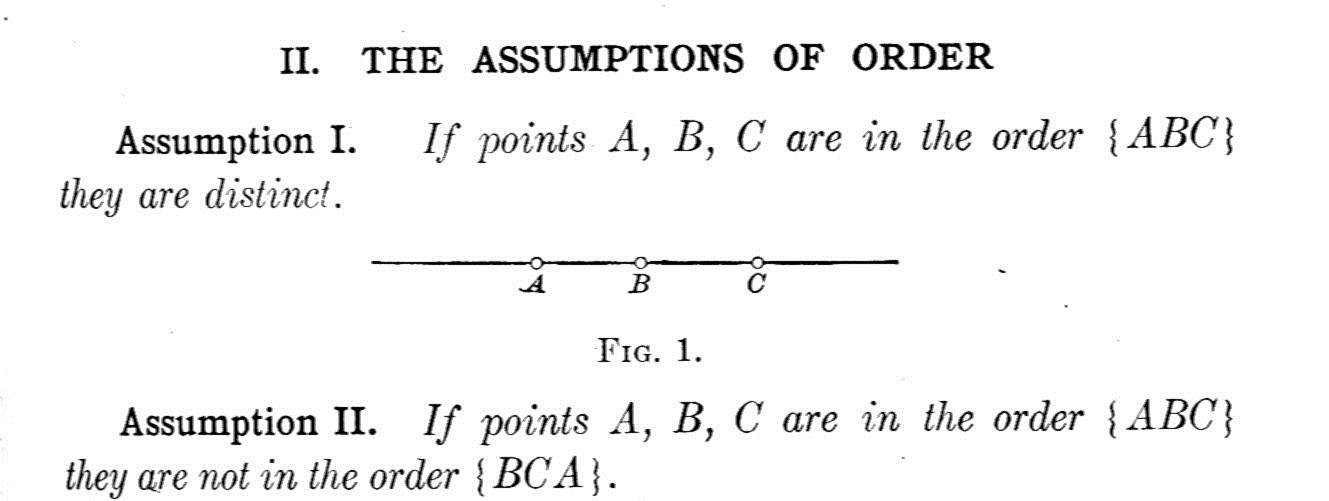
II. THE ASSUMPTIONS OF ORDER

Assumption I. If point A, B, C are in the order {ABD} they are distinct.

Assumption II. If points A, B, C are in the order {ABC} they are not in order {BCA}.

Modern Mathematics (1911), Edited by J.W.A. Young

Her middle-aged granddaughter’s comments 100 years later:

I suppose that Grandma had to do some proofs in geometry. Do students do proofs any more in high school? I get a head-ache just thinking about them.

Here’s the definition of a point in a hundred –year-old mathematics book. It was the first term defined in the book. (I assume that Grandma’s examination was on something more complicated—but I enjoyed reading this definition.)

In geometry a great many technical terms are defined, and each is defined in terms of others. Hence at the beginning of a book on geometry at least one term must be undefined; otherwise the book would have no beginning. We have to leave the undefined term point.

This implies that the reader is free to carry in his mind any image of a point which he can reconcile with what is said about it. We may try to import a notion of our image of a point by saying it has no length, breadth, or thickness, or by like phrases, but these are no part of our book on geometry; they have nothing to do with the logical steps by which the theorems are derived.

Modern Mathematics (1911), Edited by J.W.A. Young

A Sleepover

16-year-old Helena Muffly wrote exactly 100 years ago today: 

Sunday, March 9, 1912:  Blanche slept with Ruth and me. I slept on the rail part of the time. Made me kind of stiff. Went to Sunday School this afternoon. B. was there. Hat blew off coming home, but by luck didn’t land in the mud.

Her middle-aged granddaughter’s comments 100 years later:

Grandma had a crush on B. in the diary but doesn’t use the complete name. I think that B. refers to Bill Gauger.  Grandma’s sister Ruth married Bill several years after the diary ended.

Blanche Bryson was a friend of Grandma  and Ruth. The previous day’s entry indicated that their friend had arrived by train.

I assume that rail refers to the edge of a wooden bed frame. A hundred years ago, people didn’t have nearly the amount of privacy or space that they do today. Grandma and her sister Ruth shared a double bed—and it sounds like when they had an overnight guest they managed to squeeze a third person in.

I wonder how late they stayed awake talking. What did they talk about? Did their parents tire of the noise and tell them to go to sleep?

Old-time Cough Remedies

16-year-old Helena Muffly wrote exactly 100 years ago today: 

Saturday, March 9, 1912:  Ruthie’s friend, Miss Bryson, arrived here on the train. I had to do my sister’s milking. They went to a play in Watsontown this evening. I coughed so today that Ma said I might be getting the whooping cough. It did scare me some.

Recent photo of downtown Watsontown. Where were plays once held?

Her middle-aged granddaughter’s comments 100 years later:

Grandma’s cough sounds bad. Hopefully she didn’t have whooping cough.

Maybe Grandma tried some home remedies. Here are some old-time cough remedies in the Compendium of Everyday Wants (1908):

COUGH – Below will be found a number of cough cures and syrups that are unfailing and will relieve the worst forms.

Treatment No. 1—One of the most simple remedies is flaxseed lemonade, made by adding two or three tablespoons of flax seed to a lemonade made of two lemons, two tablespoonful’s of sugar and about a quart of water; boil it.

Treatment No. 2—COUGH SYRUP—Mix together one-half pint of honey, 1/2 pint of gin, 1/2 oz. of oil of tar, 1/2 oz. of balsam fir. Take a teaspoonful three times a day. This is one of the most effective and valuable remedies known for coughs and will break up a cold where other remedies fail.

Treatment No. 3—An efficacious remedy for continued cough is found in chewing the bark gotten from the root of sumac. Chew the bark. Several kinds of sumac are poisonous, but use the common upland sumac, having cone-shaped bunches of berries and from which a milky fluid comes when leaves are broken.

I don’t know where to get all of the ingredients for any of these remedies. And, even if I could find Sumac bark—I won’t want to risk something that requires warnings about avoiding the poisonous types.

Miss Bryson refers to Blanche Bryson. She was mentioned several times in the dairy during during 1911. At that time it seemed like she lived in either in or near McEwensville. She apparently had moved somewhere more distant by 1912.