Why is it so Difficult to Find Graham Flour?

Definition of graham flour
Source: The New Butterick Cook Book (1924)

Graham flour is a coarsely ground whole wheat flour that contains the endosperm, the bran, and the wheat germ. Year ago it was considered a health food. Graham flour is named after its inventor Sylvester Graham. He began making graham flour in the 1830s, and promoted it as part of a health movement which encouraged eating vegetarian meals and unseasoned foods.

A hundred years ago graham flour was a popular type of flour, and cookbooks contained recipes for graham bread, graham muffins, graham pudding, and other graham foods.  Several years ago I bought graham flour at my local store and made a couple old recipes that used graham flour for this blog:

Graham Nut Muffins

Steamed Graham Pudding with Lemon Sauce

Orange Nut Bread

Graham Popovers

However, when I recently wanted to make a recipe from a 1924 cookbook that called for graham flour, I looked for it at half a dozen stores and couldn’t find it. I eventually bought some (at an outrageous price) off the internet.  Each of those stores probably sold at least two dozen other types of flour, some of which sounded very exotic to me. But, why no graham flour? Have tastes changed so much across the past hundred years that a food that once was a common staple is now extremely difficult to find?

While searching for information on graham flour, I learned that modern graham flours sometimes have most of the wheat germ removed to prolong shelf life and to help keep it from going rancid. Some websites say that coarsely ground whole wheat flour can be substituted for graham flour, though as with modern graham flours, most of the wheat germ may have been removed. I guess that even if I follow an old recipe calling for graham flour exactly that I’m probably not accurately replicating it. Sigh. . .

Old-Fashioned Rice and Peas

Rice and Peas in bowl

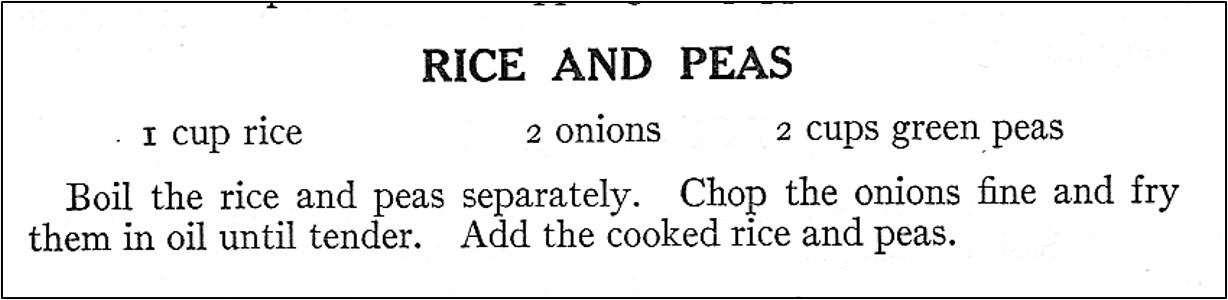
When browsing through a hundred-year-old cookbook, I came across a recipe for Rice and Peas, and decided to give it a try. This recipe is easy to make, and was very tasty. I served it as a side dish, though it would also work well as a meatless entree.

Here’s the original recipe:

Rice and Peas recipe
The New Butterick Cook Book (1924)

Here’s the recipe updated for modern cooks:

Rice and Peas

  • Servings: 4 - 6
  • Difficulty: easy
  • Print

1 cup rice

2 cups green peas

2 onions, finely chopped

1 tablespoon butter or cooking oil

Prepare rice following the directions on the package.

In the meantime, cook the peas.

Also, heat the butter or oil in a skillet, then add the chopped onions and sauté until the onions are tender and translucent. Add the cooked rice and peas; gently stir.

http://www.ahundredyearsago.com

Hundred-year-old Suggestions for Using Leftover Pancakes

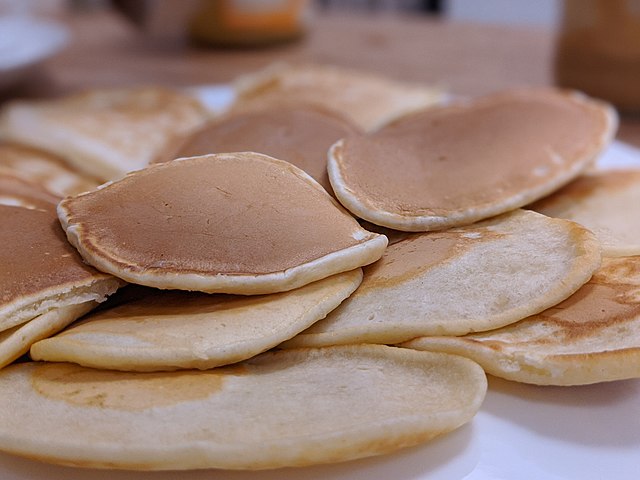
pancakes

Ever struggle to use left-over pancakes? They tend to just languish in my refrigerator (if I don’t immediately toss them).  There actually are lots of ways to use them. Here’s two suggestions in a hundred-year-old magazine:

Other Ways to Use Cold Pancakes

“I use them,” writes our correspondent, “in two ways. First, after they are quite cold I cut them into very thick strips, like noodles, with a very sharp knife, put them in the soup tureen, and pour over them a well-seasoned beef broth. This makes, when served at once, a very good soup. My second way is to make them into a dessert. The cold cakes are spread with a mixture of sugar, ground cinnamon, and raisins, each pancake is rolled with the mixture inside, and they are placed in a baking dish in a row, and quite close to one another, milk is poured over almost to cover them, and then they are put in the oven and baked. This makes a very good pudding, not unlike a bread pudding.”

American Cookery (June/July, 1924)


Old-Fashioned Prune Souffle

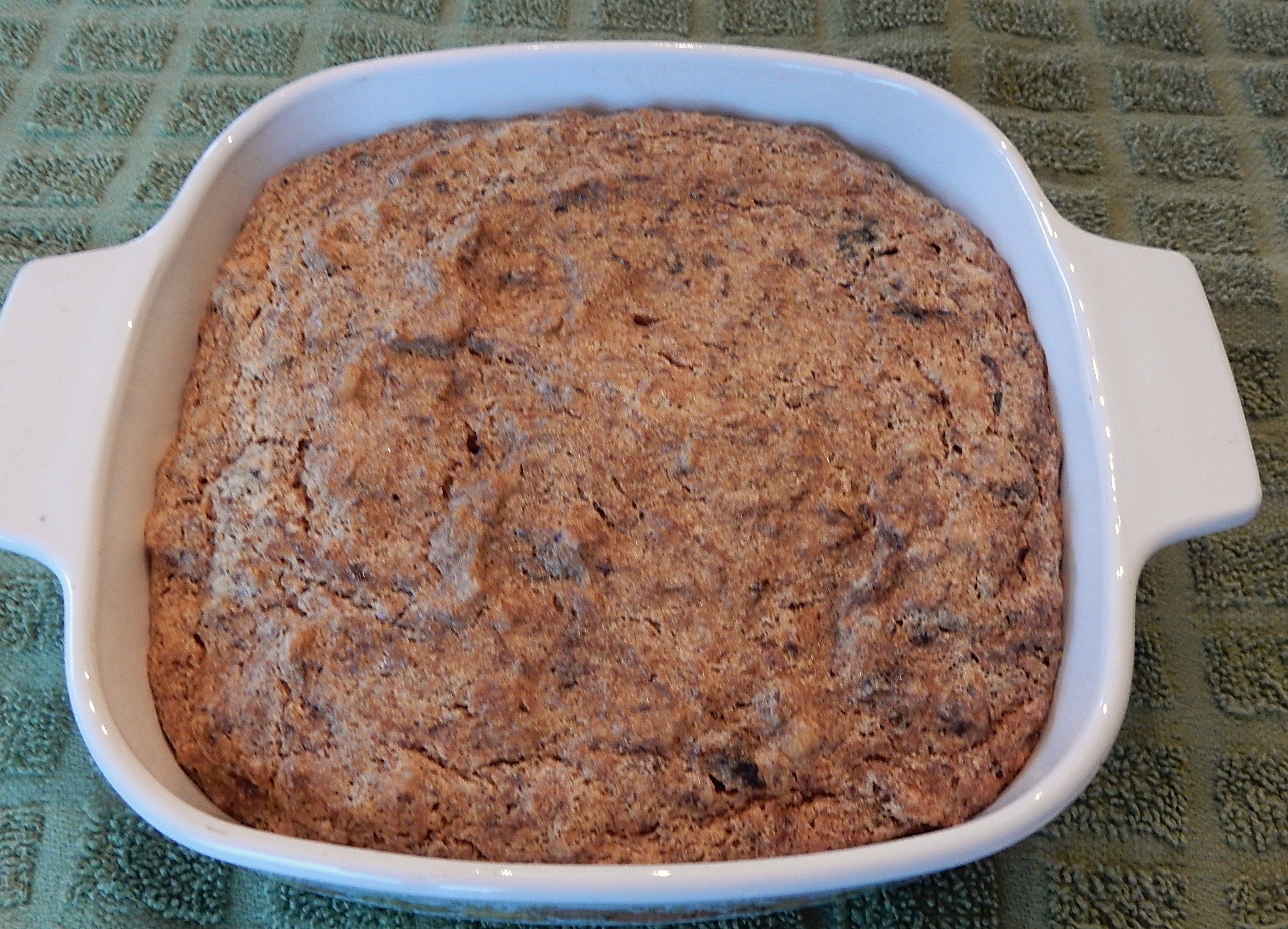
Prune Souffle

There are lots of food trends and fads. Some foods become more popular over time; other decrease in popularity. Prunes are a food that were much more popular a hundred years ago than what they are now – though personally, I like them. So when I saw a recipe for Prune Souffle in a 1924 cookbook, I decided to give it a try while recognizing that prunes are not trendy.

The Prune Souffle didn’t puff up like the typical souffle. It was very rich, and contained chopped walnuts which added a nice crunch. The dominant flavor was the prunes, though there was a hint of cinnamon. I’m not sure exactly how I’d rate this dessert. It’s definitely different than what I expected, and it’s richer than I’d like; but in an old-fashioned way, it was tasty.

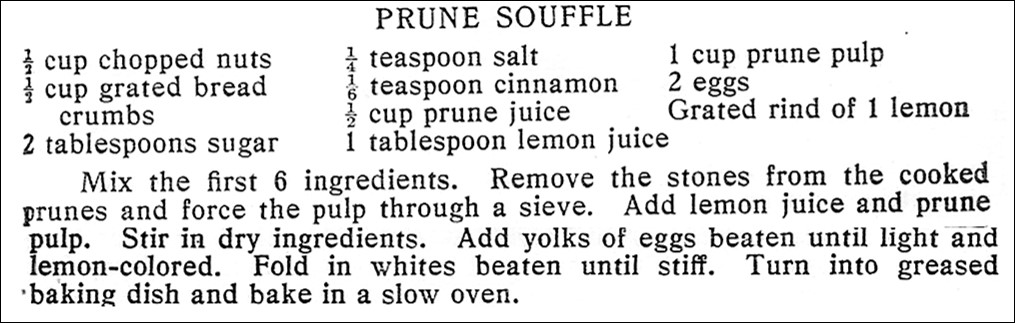
Here’s the original recipe:

Recipe for Prune Souffle
Source: The Metropolitan Cook Book (Published by Metropolitan Life Insurance Company, 1924)

I’m not sure why the souffle did not puff up. It called for several fairly heavy ingredients – the chopped nuts and prune puree which may have weighted it down. Also, since the old recipe calls for a “slow oven,” I baked the souffle at 325° F.  but maybe it would have worked better if it had been baked at a higher temperature.

When I made this recipe I wasn’t sure how many prunes were needed to get 1 cup of pulp, but I estimated that I’d need about 1/2 pound of prunes.  I cooked the prunes for about 30 minutes get them nice and soft, and then put them through a Foley Mill. (Another option would be to puree them.) I ended up with a little less than 1 cup of pulp, but went with it.

Here is the recipe updated for modern cooks:

Prune Souffle

  • Servings: 4 - 6
  • Difficulty: moderate
  • Print

1/2 pound prunes

water

2 eggs, separated

1/2 cup chopped nuts (I used walnuts.)

1/2 cup grated bread crumbs (I grated 1 slice of bread.)

2 tablespoons sugar

1/4 teaspoon salt

1/6 teaspoon cinnamon

1 tablespoon lemon juice

grated rind of 1 lemon

Preheat oven to 325° F. Put prunes in a saucepan and cover with water; bring to a boil then reduce heat and gently simmer until soft. Remove from heat and drain; reserve 1/2 cup of the prune juice. (If there is less than 1/2 cup of prune juice, add water to make 1/2 cup.) Puree the prunes or use a Foley Mill to press through a sieve. Set aside.

Beat egg whites until fluffy and stiff. Set aside.

Put the chopped nuts, bread crumbs, sugar, salt, cinnamon, lemon juice, grated lemon rind, pureed prunes, 1/2 cup of prune juice, and egg yolks in a mixing bowl; stir to combine. Fold in the beaten egg whites. Put in a 1-quart baking dish, and bake until the top is lightly browned and starting to crack (30-40 minutes). Can be served warm or cold.

http://www.ahundredyearsago.com

1924 Poem About Pies

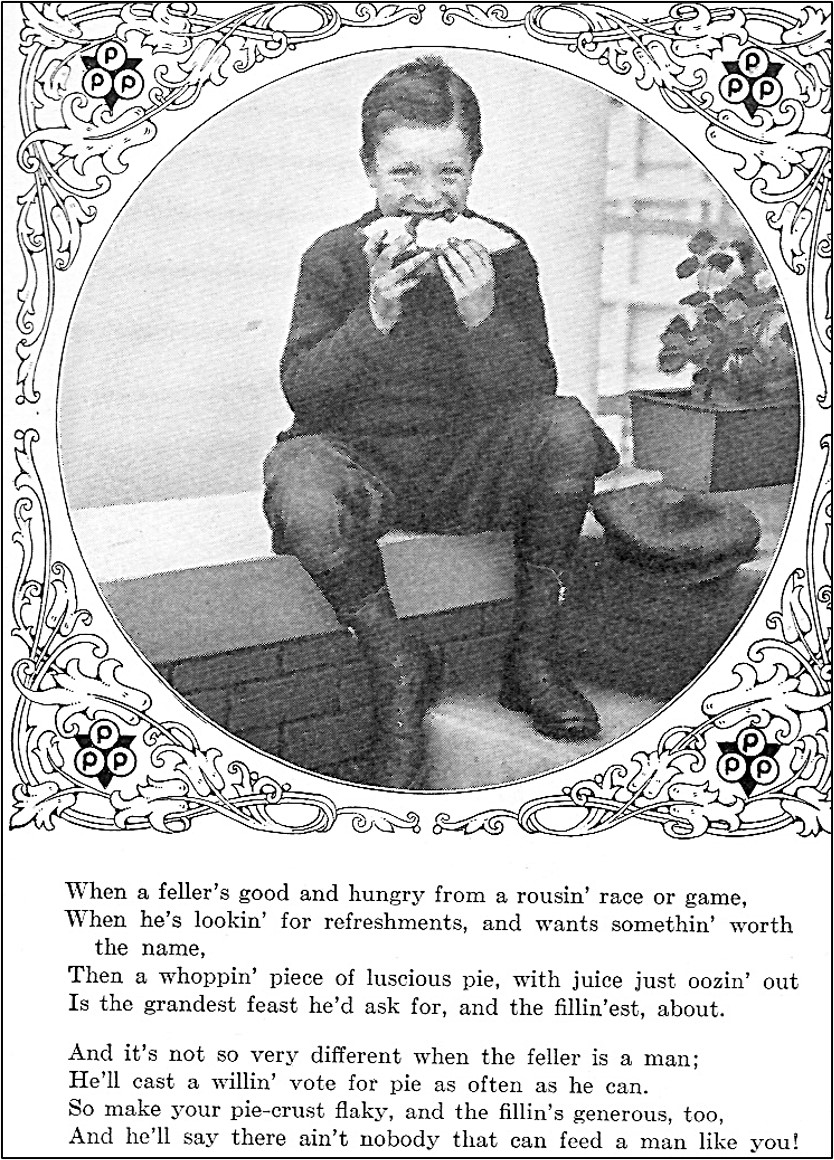
Poem about pies
Source: Modern Priscilla Cook Book (1924)

A hundred-years-ago men’s roles and women’s roles were defined very differently. Women were responsible for cooking, and their culinary skills were considered a measure their success. This poem in a 1924 cookbook reminds me of the old saying that “food is the way to a man’s heart.”

Old-Fashioned Variety Marble Cake (Marble Cocoa Cake)

Marble Cocoa Cake

Marble Cake has always been one of my favorite types of cake, so when I saw a hundred-year-old recipe for Variety Marble Cake, I decided to give it a try. The old recipe had lots of options, including options for Marble Cocoa Cake and Marble Spice Cake. I went with the Marble Cocoa Cake option.

The cake was easy to make and tasty. This recipe makes a small 8″ X 8″ cake, which is perfect for a small family.

Here’s the original recipe:

Recipes for Variety Marble Cake
Modern Priscilla Cook Book (1924)

When I made this recipe, I needed to add about 2 tablespoons of melted butter to the eggs to get 1/2 cup. I used vanilla for the flavoring.

The recipe says to alternate putting spoonfuls of light and dark batter into the pan. I followed this direction – though if I made the cake again, I’d also lightly swirl the batters using a knife to get a more even marbleing.

The recipe says to bake the cake for 45 minutes. When I made this cake, it took significantly less time (more like 35 minutes).

Here’s the recipe updated for modern cooks:

Marble Cocoa Cake

  • Servings: 6 - 8
  • Difficulty: moderate
  • Print

1 1/4 cups flour

1 cup sugar

1 1/4 teaspoon baking powder

1/2 teaspoon salt

2 eggs

2 tablespoons butter, melted

1/2 cup milk

1 teaspoon vanilla

2 tablespoons cocoa

Preheat oven to 350° F. Grease and flour an 8-inch square baking pan. Put all ingredients (except for the cocoa) in a mixing bowl. Beat until well blended.

Put 1/3 of the batter into another bowl; then add the cocoa to this batter. Beat until well-blended. Alternate putting the light and dark batters into the prepared pan, then lightly swirl with a knife.

Bake 30 to 40 minutes, or until wooden pick inserted in center comes out clean. Frost, if desired.

http://www.ahundredyearsago.com

Hundred-Year-Old Tips for Keeping Grated Cocoanut Fresh

Tips for keeping grated cocoanut fresh
Source: American Cookery (March, 1924)

I enjoy reading household tips in hundred-year-old magazines and cookbooks. Often the advice is good, and has stood the test of time. However, occasionally an old tip leaves me scratching my head. Like this tip about how to store grated cocoanut. Is it really a tip when the author says that the advice given is guesswork, and that she does not really know how it is done?

And, by the way, what is currently considered the correct spelling for “cocoanut”? I tend to think that “cocoanut” is an archaic spelling, and that it is usually is now spelled “coconut,” but am not sure.