Did Students Memorize Dates in History a Hundred Years Ago?

17-year-old Helena Muffly wrote exactly 100 years ago today: 

Tuesday, February 4, 1913: We had an exam in General History this morning. It was a review of all we had gone over this year. I was so afraid I’d make a sorry mark, so I began to review but I didn’t get over it all. I got some things wrong, but then I know I got more right. At least I think so.

Picture on page 155 of the hundred-year-old textbook
Roman Fleet (Source: Outlines of General History by V.A. Renouf)

Her middle-aged granddaughter’s comments 100 years later:

Did Grandma need to memorize dates for the exam?

Here’s what the Suggestions for Teachers section of a hundred-year-old text-book had to say about memorizing dates:

In conclusion, I will touch on the question of learning dates. These should be memorized by all students. It is well to bring as many events as possible into relation with a memorized date. The few students who have a ready memory for dates can be encouraged to remember most or all of them; but the majority of the class should not be burdened with more than are necessary for a correct general perspective of the centuries.

Outlines of General History (1909)  by V.A Renouf

Would a history teacher today agree or disagree with this suggestion?

The book also included some sample questions that teachers might use. I did a previous post that included a few of the sample questions:

History Test Questions a Hundred Years Ago

Hundred-Year-Old Recipe for Vanilla Ice Cream and Chocolate Sauce

17-year-old Helena Muffly wrote exactly 100 years ago today: 

Monday, February 3, 1913: It was simply enchanting this morning. The snow came down in fluffy flakes. It was an unusual sight. Had a pain this morning. Guess four dishes of ice cream was most too much for my capacity.

van.ice.cream
Caption: Vanilla Ice Cream with Chocolate Sauce Plate XX. For Receipt see pages 247 and 299. Source: Lowney’s Cook Book (1912)

Her middle-aged granddaughter’s comments 100 years later:

The previous day the Muffly’s made ice cream. It must have tasted really, really good if Grandma ate four dishes (even if she’s paying for her indulgence).  Maybe she ate it with warm chocolate sauce.

Here is a hundred-year-old recipe for vanilla ice cream and chocolate sauce:

Vanilla Ice Cream

4 cups milk

1 cup sugar

3 eggs

1 tablespoon vanilla

1/3 teaspoon salt

This is the simplest and cheapest ice cream made. One pint of cream added is an improvement.

Scald the milk in double boiler. Mix eggs, sugar and salt; added scalded milk to them; return to double boiler and cook until mixture thickens and is of a smooth and creamy consistency.

Strain into a cold dish. Add vanilla and cool before putting mixture in ice cream freezer.

Chocolate Sauce

2 ounces Lowney’s  Premium Chocolate

1 cup sugar

1/4 teaspoon salt

1 teaspoon vanilla

Cook all the ingredients except vanilla twelve minutes; add vanilla, and serve hot. This sauce is especially good served with Vanilla Ice Cream.

Lowney’s Cook Book (1912)

Lowney’s Cook Book was published by a company that made baking chocolate. I assume that any brand of unsweetened chocolate could be substituted for the Lowney’s Premium Chocolate in the chocolate sauce recipe.

For more old ice cream recipes and related information see:

Old-time Vanilla Ice Cream Recipes (These recipes are different than the one above. It’s interesting to see the variation in the old recipes.)

Hundred-year-old Chocolate and Fruit Ice Cream Recipes

Old Lemon Water Ice Recipe

Old Ice Cream Freezer Advertisement

Hundred-Year-Old Directions for Freezing Ice Cream

17-year-old Helena Muffly wrote exactly 100 years ago today: 

Sunday, February 2, 1913:  It was a very tight fit. The girls slept with me. It was very nice, especially where one must cling to the very edge for fear

Went to Sunday School this morning. Besse was out. We had ice cream today. Second time. Rufus took Helen home this evening, that is they both went to Christian Endeavor, but I stayed to studying General History. It’s awfully cold here, so I’m going to be. Good-night.

Picture source: National Food Magazine (June, 1910)

Her middle-aged granddaughter’s comments 100 years later:

Based on the diary, I think that Grandma and her sister Ruth (called Rufus in this entry) shared a double bed during the winter months since the second floor of  homes were cold back in the days of wood and coal stoves.

The previous day Grandma wrote that a friend, Tweet (Helen) Wesner, came to visit.  Probably the three girls squeezed into the double bed.

A hundred years ago making homemade ice cream was often winter activity rather than a summer one. The Muffly’s did not have electricity and lived on a farm. Ice was more readily available in the winter—and it would be easier to store the ice cream.

Here are the directions in a hundred-year-old cookbook for making ice cream:

Directions for Freezing

Select a reliable freezer and one which runs easily. Keep the gearing well oiled.

Adjust the freezing can in the freezer, making sure that all parts fit and that the crank turns readily. Place ice in bag made of ticking or strong sacking, and with a wooden mallet, pound until very fine. Surround the freezing can with ice and rock salt, using three measures of ice and one of salt, for ice cream and sherbets; two measures of ice and one of salt for sorbets, frappes, etc.; equal measures of ice and of salt for molding and for freezing mousses, bombes, and parfaits.

For freezing ice cream, when the freezing can is cold, pour in mixture to be frozen, let stand five minutes, then turn the crank slowly for eight or ten minutes, then more rapidly until mixture is frozen. Remove dasher, scrape cream from sides of freezing can to the middle and press down so as to have the cream one solid mass; let stand to season, or if to be molded, pack in the mold.

Lowney’s Cook Book (1912)

Tired of Winter

17-year-old Helena Muffly wrote exactly 100 years ago today: 

Saturday, February 1, 1913:

                       February

 A hope of the coming spring time,

When all the trees are in bloom

When the cold of the Winter has vanished

Onto the gathering gloom.

I guess I spent today at home doing a little bit of work for the benefit of someone other than myself. Tweetie arrived about four o’clock.

DSC05178

Her middle-aged granddaughter’s comments 100 years later:

Grandma began each month with a poem.  This poem accurately expresses how I feel. I’m tired of the gloom and ready for spring!

(I’m keeping my fingers crossed that the groundhog doesn’t see his shadow tomorrow.)

What work did Grandma have to do? Was it housework for her mother . . . or farmwork for her father?

At least it sounds like the day got better as it progressed. Tweetie was a nickname for Helen Wesner. She was a friend of Grandma’s.

Played Cards After Play Practice

17-year-old Helena Muffly wrote exactly 100 years ago today: 

Friday, January 31, 1913: We went to practice again this evening. I don’t know any more of my part than the first time we practiced. Ruth had to stay in turn after it was over to spend a few hours in card playing. I’m not much of a card player but I did learn to play one game.

Her middle-aged granddaughter’s comments 100 years later:

Recent photo of the McEwensville Community Hall and picnic grove. The festival probably was held in this small park.

The play practice probably was held at the McEwensville Community Center. The building has been a community center for more than 100 years–and it had a wonderful stage. In recent years part of the stage has been converted into a storage area, but when I was a child I can remember it being a regular stage with lots of rows of curtains.  I took these pictures in 2011 when I attended a community pot luck picnic.

DSC04338

DSC04340

It sounds like Grandma’s sister Ruth went along to the play practice.  Based upon a previous diary entry, I thought that the play was a class play and that the cast members were students who would be graduating in the spring.  On January 20, Grandma wrote:

Our class expects to have a swell blow-out one of these days. We’re going to give a play. . .

Ruth was two years older than Grandma—and a teacher at a one-room school house.  This entry makes it sound like Ruth was also in the play. Maybe it really was a community play rather than a class play—or maybe Ruth just accompanied Grandma so that Grandma wouldn’t need to walk to town in the dark by herself.

In any case, it sounds like the girls had fun socializing after play practice. It probably was an almost perfect Friday night.

Studied Russo-Japanese War in History Classes a Hundred Years Ago

17-year-old Helena Muffly wrote exactly 100 years ago today: 

Thursday, January 30, 1913: Am commencing to worry about a certain general history examination that comes next week. It includes over seven hundred pages. I hope to review it all.

Port.Arthur
Caption: Port Arthur Harbor After the Surrender. Source: Outlines of General History (1909)

Her middle-aged granddaughter’s comments 100 years later:

At Grandma’s school some classes were less than a year long.  Since the exam  was going to cover more than 700 pages, it probably was the final exam for general history.

A general history textbook published  in 1909, called Outlines of General History, probably covers material similar to what Grandma learned.

The last chapter of the book begins with a picture taken after the surrender of Port Arthur. This siege occurred during the Russo-Japanese War.

The Russo-Japanese War took place during 1904 and 1905. Russia controlled Port Arthur and had rail lines from Siberia to the port. It was an ice-free port and could operate during the winter months.

Japan wanted to control the harbor and there were several battles at Port Arthur which the Japanese won.

The Russo-Japanese War ended when a  peace  treaty was signed at Portsmouth New Hampshire on September 5, 1905. It was mediated by President Theodore Roosevelt .

The last two paragraphs in the hundred-year-old general history textbook say:

. .  . the treaty of Portsmouth has guaranteed for China a period of security. The Manchurian question, to be sure is not yet definitely settled. Article V of the Portsmouth treaty says: “The Russian and Japanese Governments engage themselves reciprocally not to put any obstacles in the way of the general measures, which shall be alike for all nations, that China may take for the development of commerce and industry of Manchuria.”

The interpretation of this article is still an open question. It may develop into an unconditional restoration of China’s sovereign rights in Manchuria, or it may also be nullified by the economic interests of Russia and Japan.

Outlines of General History (1909) by V.A. Renouf

Old-fashioned Celery Chowder Recipe

17-year-old Helena Muffly wrote exactly 100 years ago today: 

Wednesday, January 29, 1913: <<no entry>>

DSC07174

Her middle-aged granddaughter’s comments 100 years later:

This is one of the few days between January, 1911 and December, 1914 when Grandma wrote nothing. The previous day she wrote that a friend, Margaret G., was visiting and planned to stay overnight. Maybe the girls stayed up all night talking and Grandma was too tired to write anything.

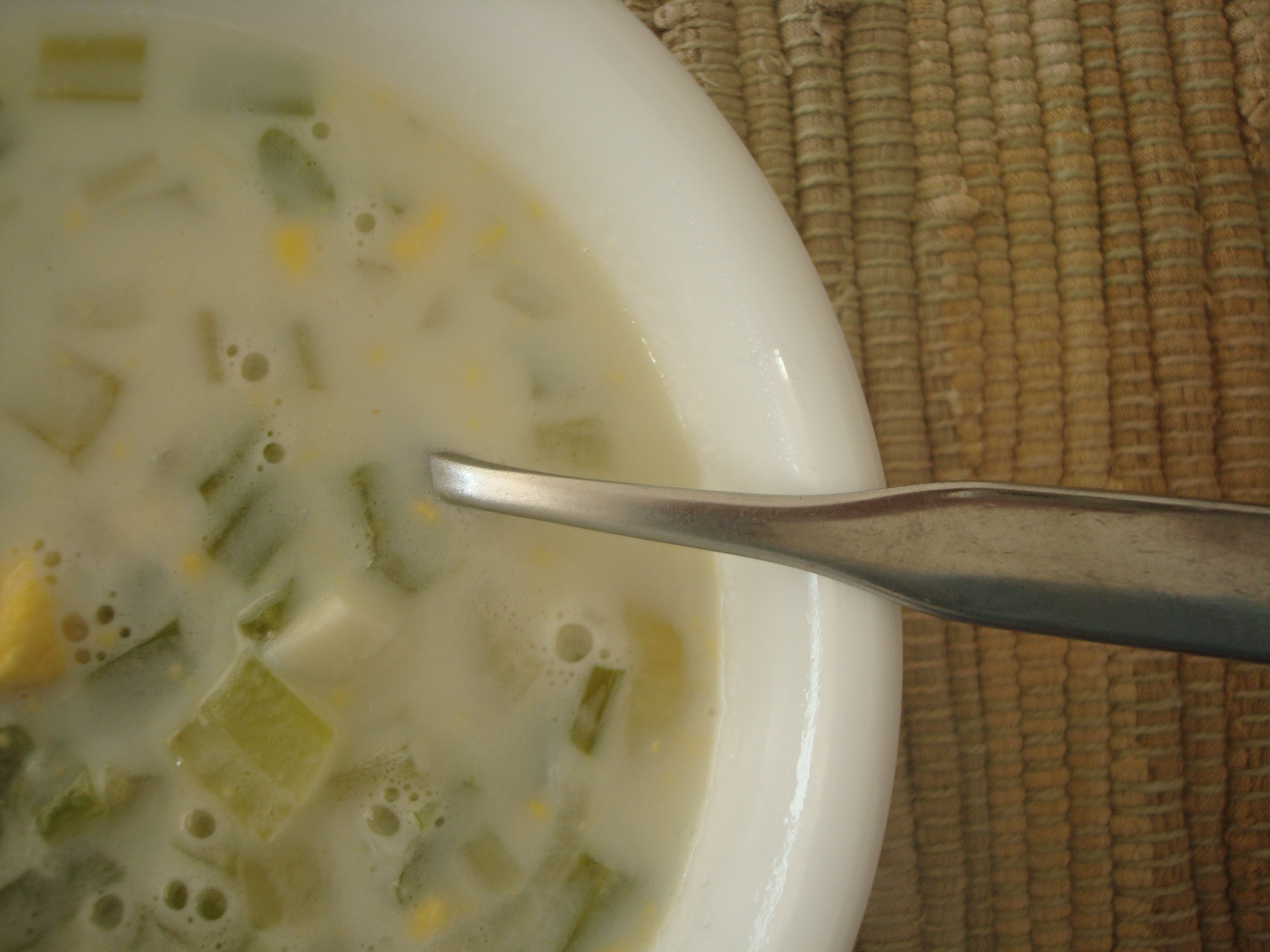
Since there’s no diary entry to guide the direction this post takes, I’ll share a recipe for an old-time winter food—Celery Chowder.

It’s an excellent celery soup and I make it one or twice each winter.

 Old-fashioned Celery Chowder

1 tablespoon butter

1 large onion, chopped

3 cups celery, chopped

2 medium potatoes, diced

water

4 cups milk

2 hard-boiled eggs, chopped

1 teaspoon salt

1/4 teaspoon pepper

Melt butter in large saucepan; add onion and cook until tender. Add chopped celery and potatoes; just barely cover with water. Bring to a boil and reduce heat; then simmer (15-20 minutes) until vegetables are soft. Add milk and chopped eggs; season with salt and pepper. Reheat until hot; serve.