17-year-old Helena Muffly wrote exactly 100 years ago today:
Sunday, March 16, 1913: Went to Sunday School this morning. Was over to Carrie’s this afternoon.
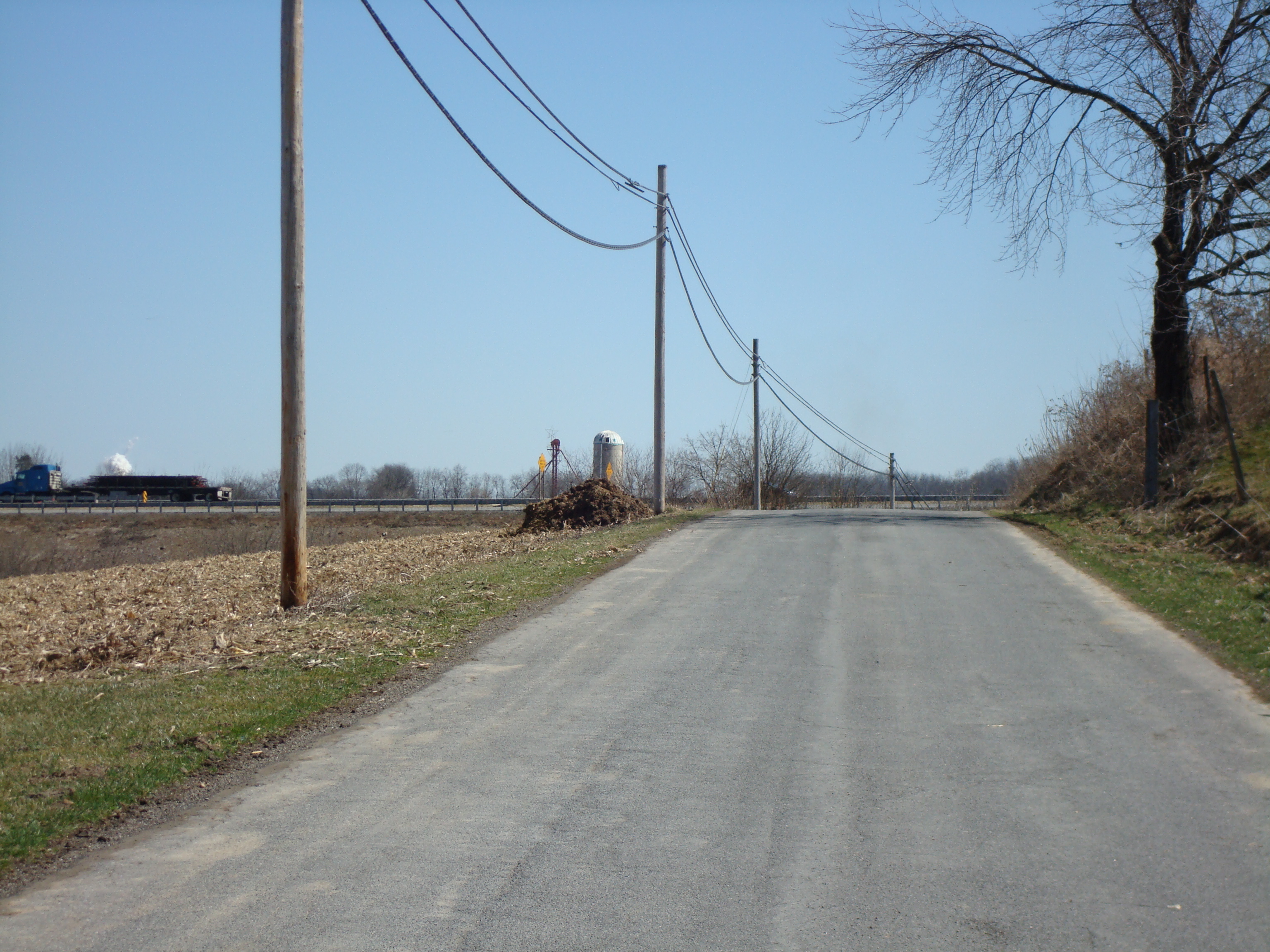
Grandma would have walked over this hill toward McEwensville to reach Carrie’s home.
Her middle-aged granddaughter’s comments 100 years later:
Carrie Stout was a friend of Grandma’s who was often mentioned in the diary.
Here’s what a hundred-year-old book had to say about the choice of friends:
The Choice of Friends
All of our greatest intellectual leaders, from time immemorial have been unanimous in their teachings that one of the most important elements in the molding of the mind and character was the nature of our friendships.
Tennyson says, “I am a part of all that I have met.” The immortal bard puts it, “It is certain that either wise bearing or ignorant carriage is caught, as men take disease from one another; therefore let men take heed of their company.”
A friend should be congenial, with similar tastes, opportunities, and training: frank in criticism, yet sympathetic in spirit; loyal and staunch in adversity, and one who disseminates an atmosphere which is broadening, elevating, and uplifting. Such a friend is to be desired and to be sought after.
Physical Hygiene and Physical Training for Women (1911) by Anna M. Galbraith
17-year-old Helena Muffly wrote exactly 100 years ago today:
Saturday, March 15, 1913: We had company today. Didn’t think at first they’d come, for it was so rainy.
Her middle-aged granddaughter’s comments 100 years later:
I wonder who visited the Muffly’s. Does company refer to one person, a couple, or a family with children? Did any of the children wear Bestyette rain capes or slicker coats to stay dry?
Does company refer to one person, a couple, or a family with children? Did any children wear Bestyette rain capes or coats to stay dry?
Source: Ladies Home Journal (October, 1913)
Bestyette Rain Coats
Yes, it is difficult to tell a good rain garment from a poor one. The eyes or fingers cannot tell whether the garment is waterproof or not. That is why you should buy Bestyette raincoats that are made by an old established concern, the New York Mackintosh Company, and sold with the famous
Bestyette Guarantee: “Satisfaction or a new garment free.”
The Bestyette process of waterproofing is a secret way of treating and applying live new rubber to the fabric so that it is absolutely waterproof and won’t dry or crack from age or usage.
Bestyette Garments are strikingly stylish, correctly cut, and well-tailored. They cost but little more than the inferior, unknown, unguaranteed kinds. Made for men, women, and children. Here we illustrate two of our “hits” for the little folks. Every child should have one. Cheaper than doctors’ bills—better than umbrellas which break or get lost.
The Famous Bestyette Storm Cape $3.00 up
The famous Bestyette Storm Cape is made of genuinely good rubberized material of a soft, silky finish—fitted with a roomy plaid-lined silk hood, and tied at the neck with dainty silk ribbons. It envelops the child from head to feet. In tailoring, fit, and all the finer points of finishing, the Bestyette is far superior to cheap, unguaranteed imitations. Colors guaranteed fast: cardinal, navy, golden brown and tan. Sizes 4 to 15. Price with free School bag, $3.00 up.
For Boys and Girls Bestyette Slicker Coat $3.50 up
The Bestyette Slicker coat is a great favorite with boys and girls. It is made on mannish lines and affords perfect protection against driving rain and piercing winds. It is absolutely waterproof and wonderfully durable—made of special double material, treated by the Bestyette process. It won’t dry, creak, or leak. Sizes 4 to 14 years. Price $3.50 up. (Sou’ Wester Hats, 50 cents up.)
If your dealer cannot supply you with Bestyette garments, we will. Write for Booklet.
NEW YORK MACKINTOSH CO.
39 2. 32 Street New York City
School bag free with each Bestyette storm cape.
This bag is waterproof and contains two compartments, one for carrying school books, the other for carrying the Bestyette storm cape.
17-year-old Helena Muffly wrote exactly 100 years ago today:
Friday, March 14, 1913: Nothing doing.
Her middle-aged granddaughter’s comments 100 years later:
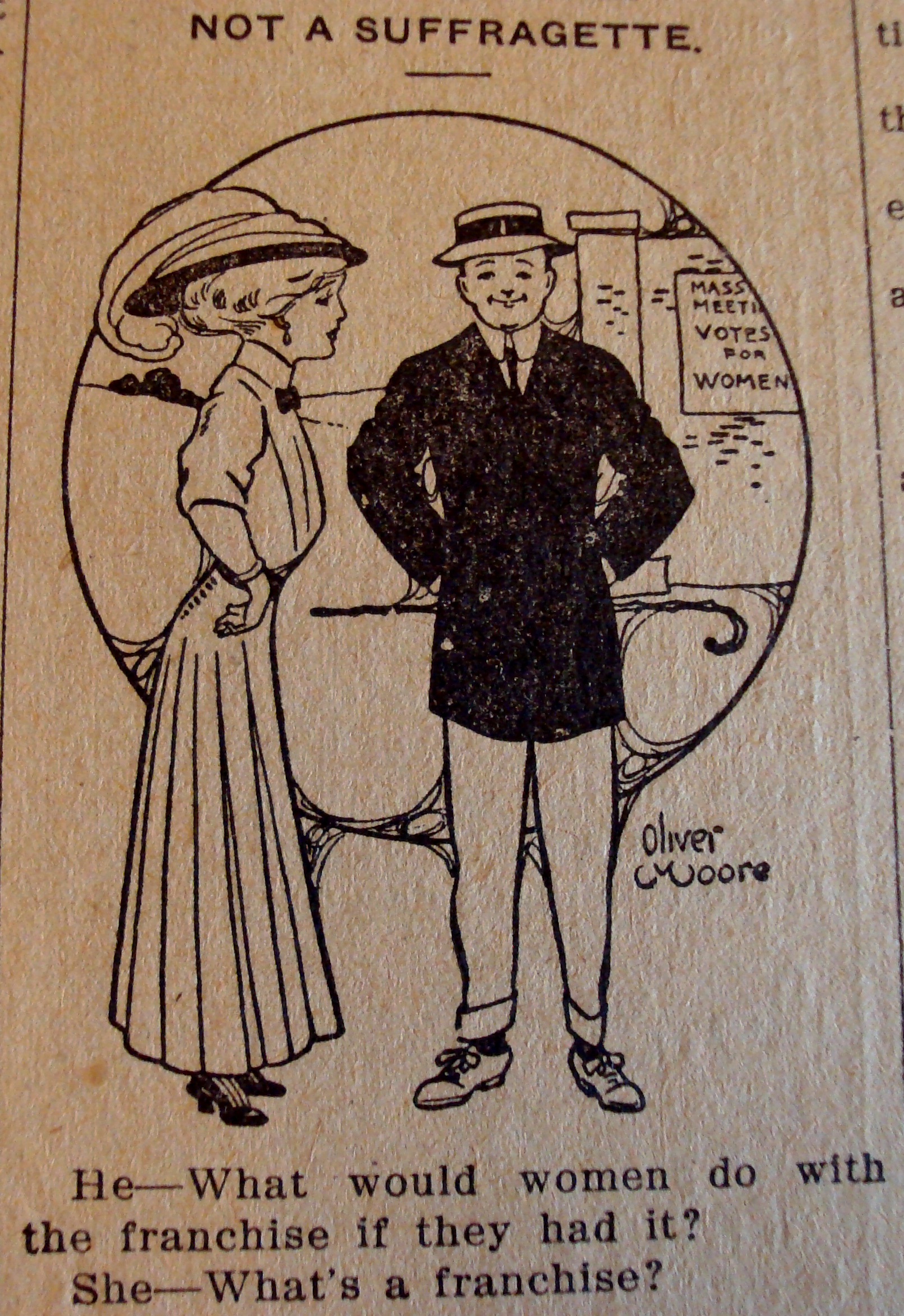
Since Grandma didn’t write much a hundred years ago today, I’ll share an old cartoon about suffragettes that appeared in the April 4, 1914 issue of the Watsontown Record and Star.
Today it’s hard to perceive why anyone would think that women shouldn’t have the right the vote—it’s interesting to get a sense of the opposite perspective from this cartoon.
The Watsontown Record and Star is a long defunct newspaper from a town very near to where Grandma lived. I’ve only ever seen a few issues of it. But it probably was a newspaper that Grandma regularly read, and it probably reflected commonly held opinions in her community.
17-year-old Helena Muffly wrote exactly 100 years ago today:
Thursday, March 13, 1913: Nothing doing.
Her middle-aged granddaughter’s comments 100 years later:
Since Grandma didn’t write much a hundred years ago today, I’ll go off on another tangent–
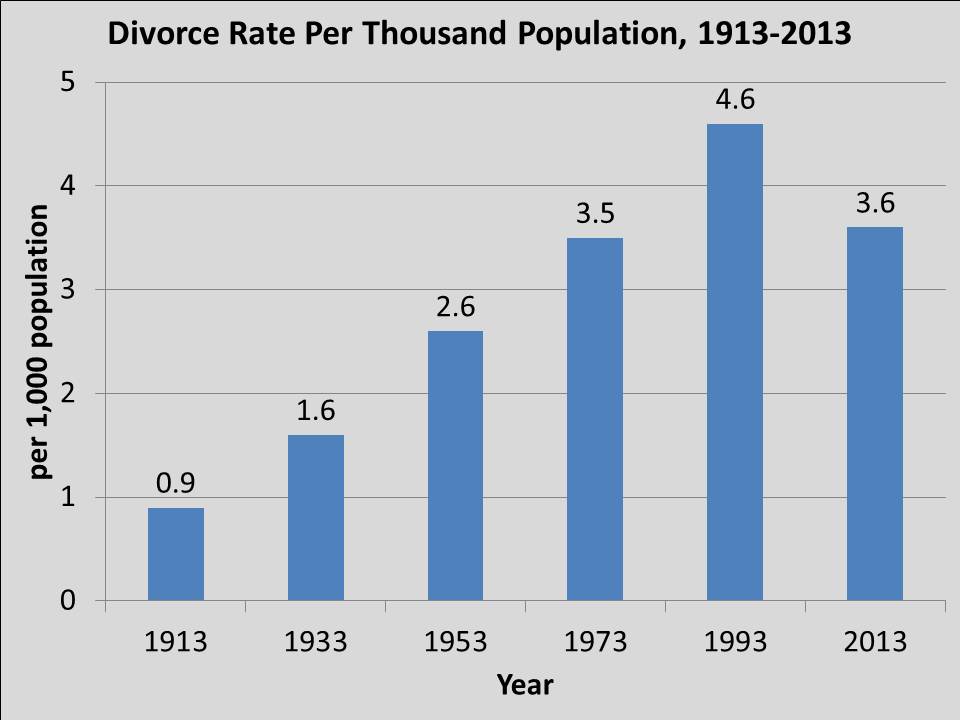
I’ve been reading some Edith Wharton books from the early 20th century—and one of the themes in her writing is unhappy marriages and the role of divorce. This made me wonder if divorce rates have changed much across the years.
The divorce rate was 0.9 per thousand population in 1913. It peaked at 4.6 in 1993; and decreased to 3.6 in 2013.
For those of you who care about the source of the data–The historic data is from Infoplease, and the data for the current year is from the Centers for Disease Control and Prevention. If data for the exact year were not available, I used data from the nearest available year (typically the first year of the decade–for example, I used 1910 data for 1913).
Here are links to some previous posts on statistics that you might enjoy:
17-year-old Helena Muffly wrote exactly 100 years ago today:
Wednesday, March 12, 1913: Am trying to write my essay.
Lewis Hine’s picture of child coal miners (Source: Wikimedia Commons)
Her middle-aged granddaughter’s comments 100 years later:
Hmm… Did Grandma have to write another essay?
During much of February she was working on an essay about the Revolutionary War. Her teacher was going to give the student who wrote the best Revolutionary War essay a two and a half dollar gold piece. . . Grandma hasn’t mentioned it in the diary in quite awhile. I suppose she didn’t win the coin.
What was this essay about? . . .
I find that I want to ask myself: If I lived a hundred years ago, what would I have enjoyed writing an essay about? I know that the lens is all wrong, but here are some topic ideas that I think would have been interesting.
Should child labor be banned? — Child labor was very controversial in 1913. There were many coal mines in the southeastern part of the county where Grandma lived that used a lot of child labor, so this might have made a good essay topic.
The reasons why women should have the right to vote—It seems obvious today, but women’s suffrage was an arguable point in 1913.
The problem of adulterated foods—This was just a few years after the publication of Upton Sinclair’s book, The Jungle—and many people were very worried about the chemicals put into processed foods.
Should alcohol be prohibited? The prohibition movement was gathering steam in 1913, and taking either side of this issue would have made a good essay topic.
Planting trees on clear-cut land to improve the environment. People were worried about the environment in 1913. One concern was all of the erosion that was occurring due to the clear-cutting of old-time forests.
17-year-old Helena Muffly wrote exactly 100 years ago today:
Tuesday, March 11, 1913: We decided tonight to have our play on the fifth of April.
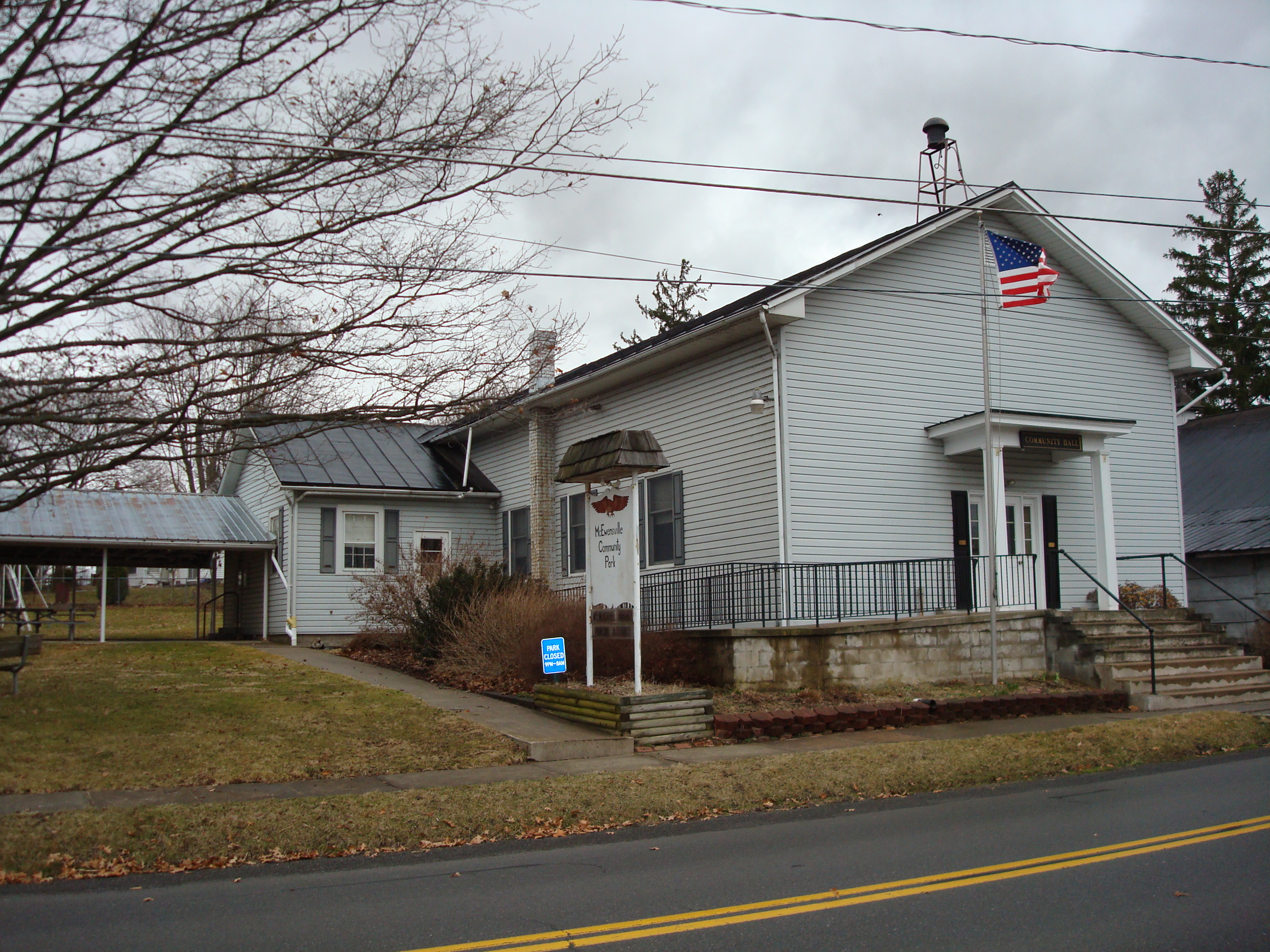
The play was probably was held at the McEwensville Community Hall. The same building has served as the town’s community hall for more than 100 years.
Her middle-aged granddaughter’s comments 100 years later:
The previous evening Grandma did not go to play practice because it was raining. Probably the practice was canceled on the 10th and moved to the 11th due to the inclement weather. In general it seemed play practice only took place once—or maybe twice–a week.
Grandma had been going to play practices since January 27. She had the role of Chloe, the servant. It seems somewhat surprising that the date of the play was only now selected. The cast probably wanted to be confident that they knew their lines and were ready for the play before choosing a date.
I suppose there was no need to rush to select the date since the play was probably the only upcoming event in the small town of McEwensville–and nothing else was vying for the venue.
17-year-old Helena Muffly wrote exactly 100 years ago today:
Monday, March 10, 1913: It rained tonight so we didn’t go up to practice.
A recent rainy day in McEwensville
Her middle-aged granddaughter’s comments 100 years later:
Grandma was in the class play. Did some of the cast members show up for practice? . . or did everyone independently decide that the weather was too bad?
Today we’d text, email, or call if we couldn’t get to a play practice or meeting. A hundred years ago, did people just use their own judgment to determine whether an event was probably canceled due to weather?