A dollar in 1925 is worth about $18.58 today. This suggests that cooks who successfully completed the Cooking for Profit course might make a salary of $1,858 a week and profits of $185,800 a year in today’s dollars. Sound good to me. Sign me up for the course.
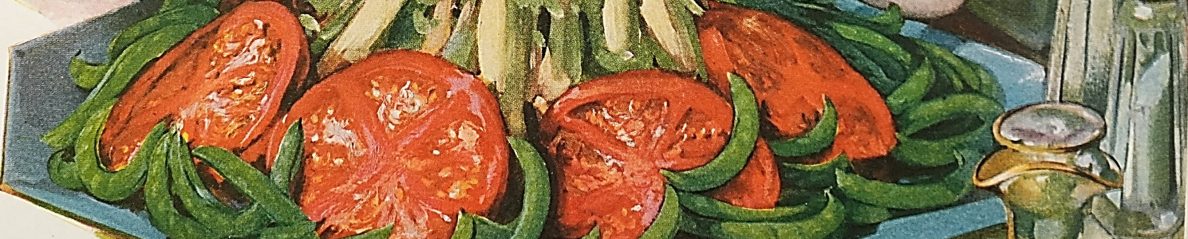
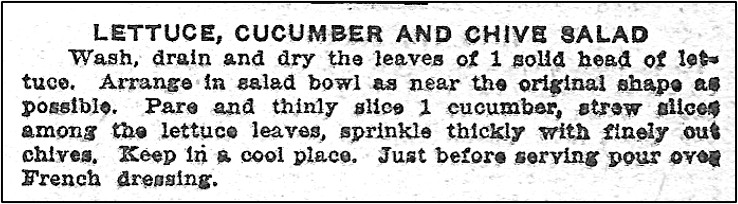
I’m enjoying making various summer salads, so when I saw a recipe in a hundred-year-old cookbook for Lettuce, Cucumber, and Chive salad, I decided to give it a try. The salad had a light vinaigrette-style dressing on it and was lovely.
Here’s the original recipe:
Source: The Daily Argus-Leader Home Economics and Cook Book, Sioux Falls, South Dakota (1925)
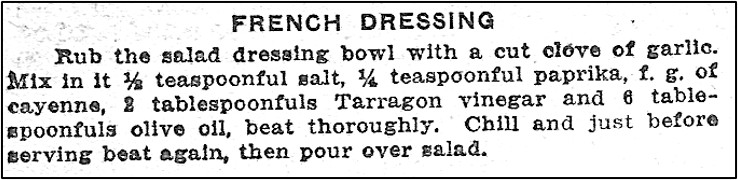
And, here is the original recipe for French Dressing:
Source: The Daily Argus-Leader Home Economics and Cook Book, Sioux Falls, South Dakota (1925)
I had a lovely bunch of leaf lettuce that I used to make this recipe. I’m not sure what type of lettuce the recipe author anticipated cooks using, but I did not try very hard to arrange the leaves as near as possible to the original shape. I thought that it was more important to have the lettuce in bite-size pieces than to worry about the shape.
The recipe called for serving this salad with French Dressing. I used a French Dressing recipe that was in the same cookbook as the salad recipe. It is a vinaigrette-style recipe and is quite different from the modern commercially-produced, orange-colored French Dressing. I’ve seen many French Dressing recipes in various hundred-year-old cookbooks over the years, and they have all have been vinaigrettes. I’m not sure when the shift occurred to the orange-colored type of French Dressing.
The French Dressing recipe called for a f.g. of cayenne (red pepper). I have no idea what unit of measure an “f.g.” is, but assumed that it wasn’t calling for much, so I interpreted it to mean a dash.
Wash and dry the lettuce, then tear into pieces and arrange on plates or in a bowl. Put the chopped chives on top of the cucumber slices. Just before serving, top with the dressing.
To make dressing, cut the garlic clove in half, then rub a small bowl with the cut garlic. Put the salt, paprika, cayenne pepper, tarragon vinegar and olive oil in bowl and stir vigorously to combine.
Whew, prices have gone up a lot recently. Every time I go to the supermarket, I’m shocked how high my grocery bill is. But cooks a hundred years ago had some expenses that I don’t have, such as the purchase of ice. Here’s what it said in the April, 1925 issue of American Cookery magazine:
Keeping the Ice Bill Down
Exit the coalman; enter the iceman! That is how a well-known cartoonist typifies the coming of summer and the end of winter. And he means, of course, that no sooner is the item of fuel expense cancelled than the cost of ice begins boring a hole in the budget. Truly, a philosophical way of expressing a common truth.
The lengthy article contained advice for both icebox and refrigerator owners. Tips for icebox owners included:
Keep your ice chamber filled. It saves the ice and preserves the food.
A small piece of ice may seem more economical, but is it? When it melts, the food spoils and the walls of the ice chamber grow warm.
Remove or place all the food at one time, as quickly as possible, opening and shutting the door but once.
The article also addressed electric refrigerators:
With the rapid development of electricity, ice machines are being installed in the most modern refrigerators. . . Mechanical ice refrigeration has come and is here to stay.
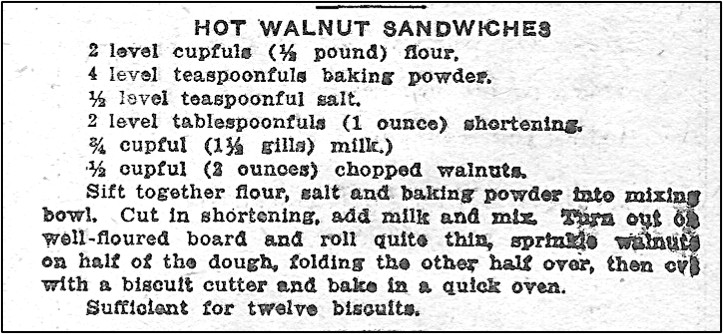
I was intrigued by a recipe in a hundred-year-old newspaper recipe supplement. The recipe title was Hot Walnut Sandwiches, but it was labeled as a biscuit recipe. The recipe called for making baking powder biscuit dough, then putting chopped walnuts between two biscuit rounds, and baking.
This recipe does not call for any sugar, so the Hot Walnut Sandwiches were not sweet and definitely tasted like a baking powder biscuit, but the walnuts were a nice twist and a fun addition. The Hot Walnut Sandwiches were tasty. I especially liked them when I smeared a little butter on them.
Here’s the original recipe:
Source: The Daily Argus-Leader Home Economics and Cook Book, Sioux Falls, South Dakota (1925)
The recipe calls for putting the chopped walnuts on top of half of the dough, then folding the other half over it, and cutting with a biscuit cutter. This results in a lot of scraps of dough embedded with walnuts. I found that it worked better to cut all the circles first (and re-roll the dough as needed), then put the walnuts on half of the circles and top with the remaining circles of dough.
It’s interesting that the recipe indicated that 3/4 cup of milk should be used, but that it also stated in parentheses that this is 1 1/2 gills of milk. Gills are more commonly used today as a measure for alcohol when making mixed drinks, but apparently a hundred years ago it also was still occasionally used when measuring other ingredients.
Preheat oven to 425° F. Sift together flour, baking powder, and salt in a mixing bowl. Cut in the shortening, then stir in the milk until combined. On a lightly floured surface, roll the dough until 1/4-inch thick. Cut with a round biscuit cutter. (I used a drinking glass as the cutter.) Sprinkle chopped walnuts on half of the circles, then put the remaining circles on top of the walnuts. Lightly press together. Place on a baking sheet, and bake for 10-12 minutes, or until lightly browned. Serve warm.
Source: School and Home Cooking (1925) by Carlotta C. Greer
Sometimes I learn bits of cooking trivia when browsing through hundred-year-old books. For example, a 1925 home economics textbook explains that when there is pressure (such as when the lid is on a pan), the steam is hotter than if there is no pressure.
Steam Under Pressure
Which is hotter, – the “steam” (i.e., water vapor) coming from boiling water in an uncovered saucepan or teakettle or the “steam” which has been held underneath the lid of a covered saucepan or teakettle? Steam confined in a small space or held under pressure may reach a temperature higher than that of boiling water.
School and Home Cooking by Carlotta C. Greer (1925)
Since seafood is very healthy, I try to make it several times a week, but I tend to get into a rut and make the same few recipes over and over. So when I came across a hundred-year-old recipe for Parsley Sauce, I immediately thought about making it to serve over some perch that I had in my refrigerator.
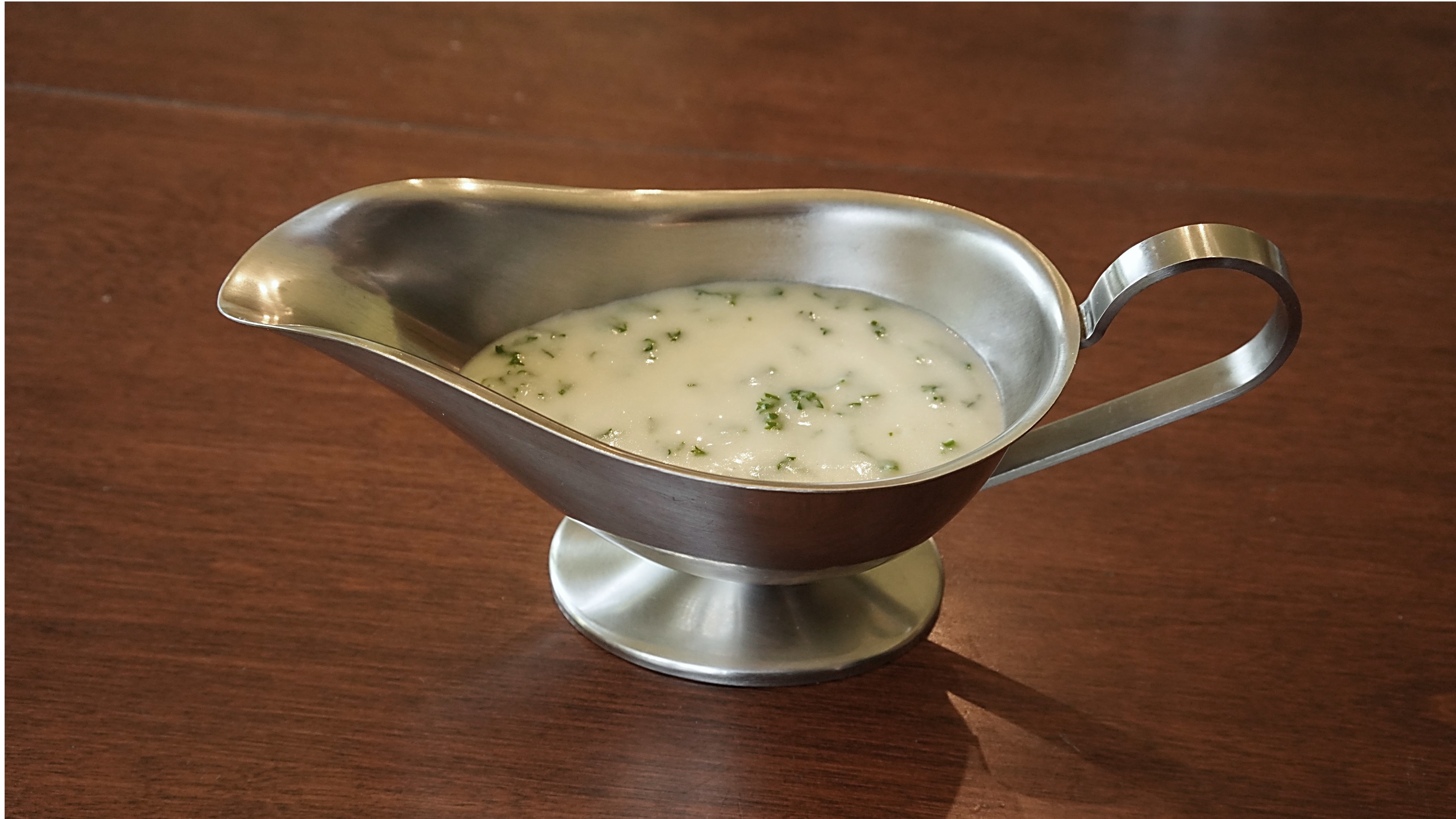
The Parsley Sauce turned out well, and was delightful when served with the fish. It only took a few minutes to make. It is basically white sauce with chopped fresh parsley and a bit of lemon juice added. Parsley Sauce would also be tasty on meat or other foods.
My daughter called while I was working on this post, and she asked what recipe I made. I told her, “Parsley Sauce.”
She said, “Oh, that sounds so good. I went to a fancy restaurant last week and had a similar sauce on my steak.”
I said, “Really? I didn’t think that white sauce-type sauces were very popular now.”
She said, “They’re very popular. Many dishes use white sauce as a basis.”
I clearly am behind the times (which I guess shouldn’t be a surprise), but it’s good to hear that some of the foods that were common a hundred years ago are once again popular.
Here’s the original recipe:
Source: Rumford Complete Cook Book (1925)
I thought that the sauce would get too thick if I boiled it for five minutes, so I removed it from the heat just as it came to a boil and began to thicken.
I used 1/2 teaspoon of salt and a dash of pepper, and that worked well.
The old recipe gave lots of details about how to prepare the chopped parsley to ensure that any green liquid created by the chopping process was removed so that the sauce would not be discolored. The recipe called for putting the chopped parsley in a cloth and then holding it under a water faucet. Instead, I put the chopped parsley in a tea strainer and ran water over it; I then dried the parsley by putting on paper towels that I rolled and squeezed.
2 tablespoons chopped parsley (Stems and stalks should be removed before chopping.)
2 tablespoons butter
2 tablespoons flour
1 cup milk
1 teaspoon lemon juice
1/2 teaspoon salt
dash pepper
Put the chopped parsley in a strainer (I used a tea strainer.), then run water over it to wash away the green liquid created during the chopping process. Gently press the parsley to remove some of the water, then put the washed, chopped parsley on paper towels. Roll the paper towels then squeeze to remove the water. Set aside.
Melt butter in a saucepan, then stir in the flour. Gradually, add the milk while stirring constantly. Continue stirring until the white sauce begins to thicken. Stir in the lemon juice, salt, and pepper. Remove from heat and stir in the parsley.
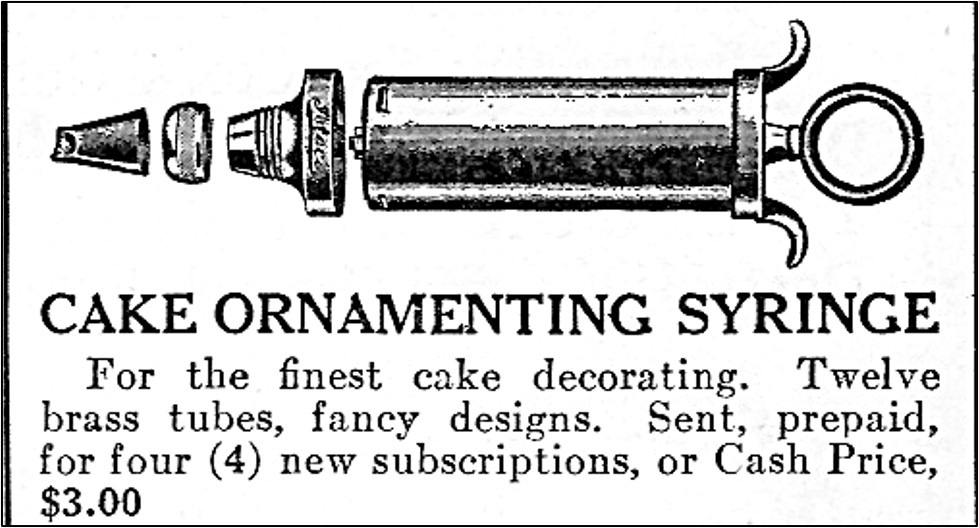
A hundred years ago, American Cookery magazine encouraged readers to get their friends to subscribe to the magazine. The magazine offered premiums for securing new subscribers.
Source: American Cookery (May, 1925)
A premium offered in the May, 1925 issue for getting four new subscribers was a cake ornamenting syringe.
Maybe cooks a hundred years ago considered this a wonderful gift; but, in my opinion, the premium doesn’t seem like a very large reward for all the effort that would be involved in getting four people to subscribe to the magazine.
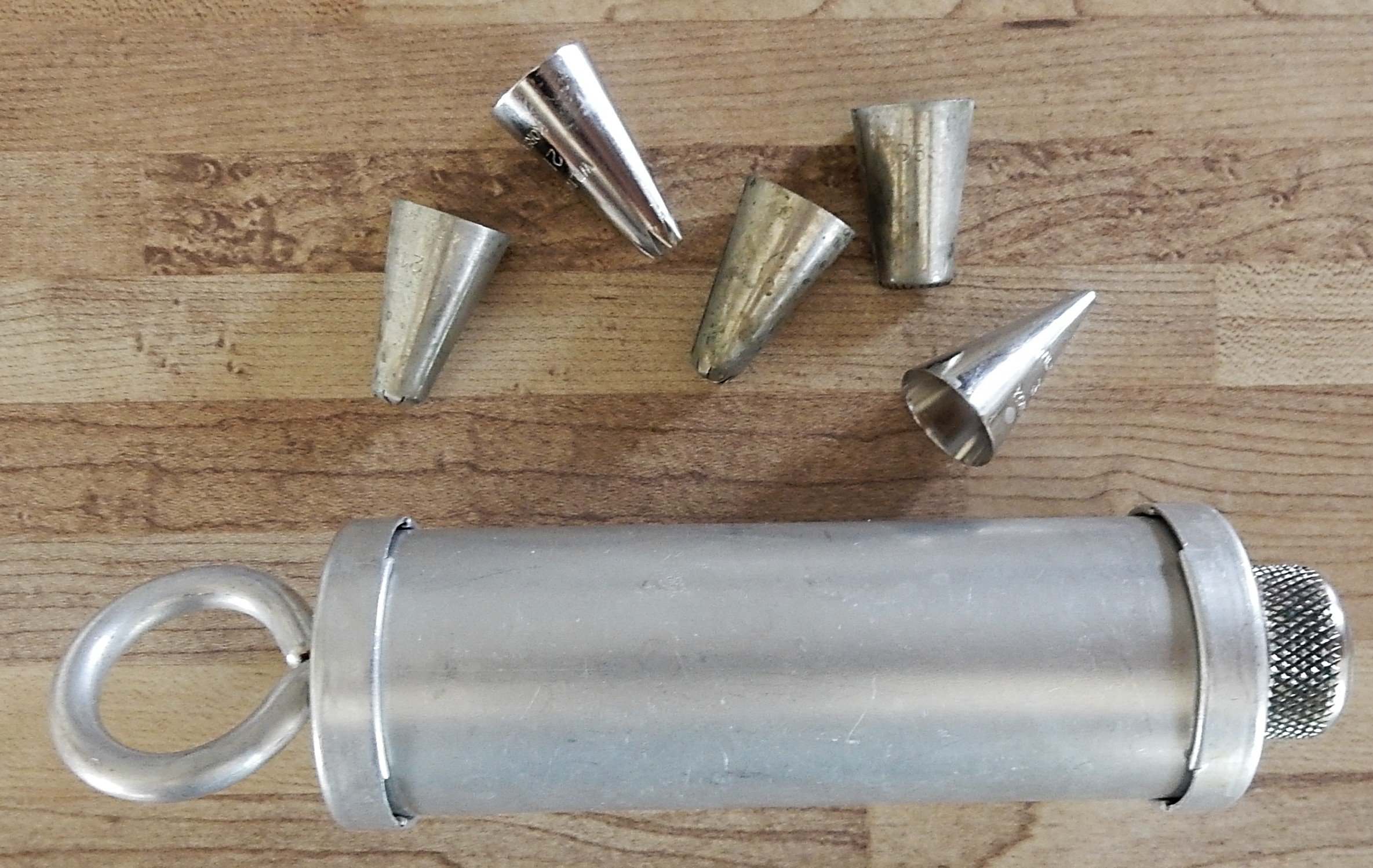
When I saw the cake decorating syringe, I immediately thought of a very similar one that I have – though I’ve always called it a “cake decorator.”
My cake ornamenting syringe once was my mother’s, and she had it for as long as I can remember. I’m now wondering if it is older than I thought, and if my mother got it from her mother.
The decorating tips for my syringe are a little beat up, but it still works great. I used it frequently to decorate cakes when my children lived at home, and I still occasionally use it to pipe frosting, whipped cream, or other similar foods. It brings back wonderful memories of the various themed birthday cakes we made over the years. There was a spaceman cake, a teddy bear cake, and a clown cake, as well as the lamb cake we made every Easter.


 Whew, prices have gone up a lot recently. Every time I go to the supermarket, I’m shocked how high my grocery bill is. But cooks a hundred years ago had some expenses that I don’t have, such as the purchase of ice. Here’s what it said in the April, 1925 issue of American Cookery magazine: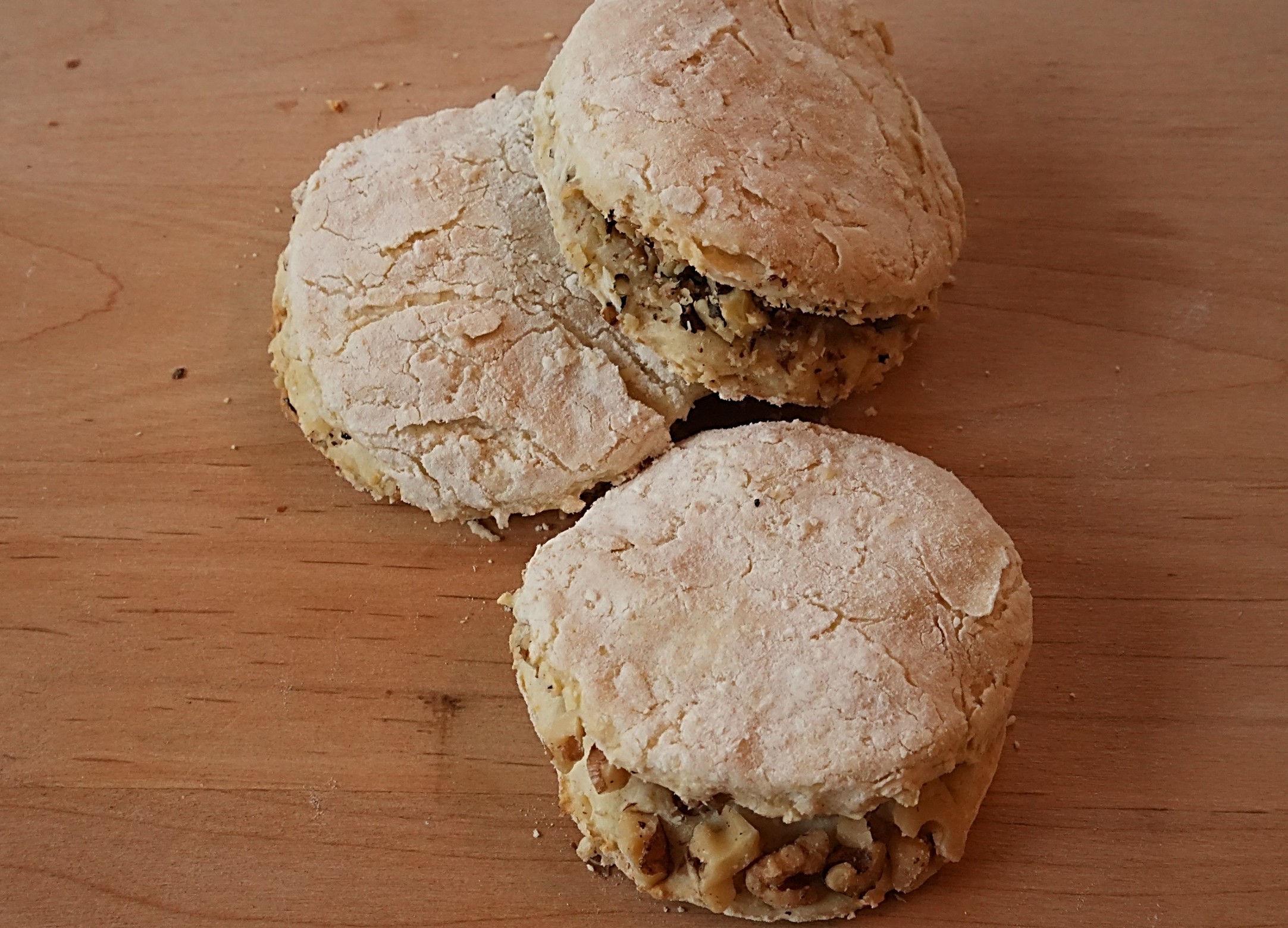

 Since seafood is very healthy, I try to make it several times a week, but I tend to get into a rut and make the same few recipes over and over. So when I came across a hundred-year-old recipe for Parsley Sauce, I immediately thought about making it to serve over some perch that I had in my refrigerator.