
If you are planning a Valentine’s Day party you might like these “holiday spread” suggestions.
Come back on Sunday if you’d like to see the recipe for Valentine Salad. I’m going to make it, and I’ll let you know how it turned out.

If you are planning a Valentine’s Day party you might like these “holiday spread” suggestions.
Come back on Sunday if you’d like to see the recipe for Valentine Salad. I’m going to make it, and I’ll let you know how it turned out.

It is so important to communicate information clearly. Today when people use the term data visualization they are generally referring to computer software that creates easily-to-understand graphics.
But, sometimes I’m blown away by the creativity of the graphics in old books. I absolutely love a picture in a hundred-year-old home economics book that compares 100 calorie portion sizes for milk and cream.
I knew that skim milk has fewer calories than whole milk— but I’ve never been quite sure how to use that information to answer practical questions like: If I switch from whole milk to skim milk, how much more skim milk can I drink without gaining weight?
Now I know the answer–about 1/2 cup more. Of course, this picture has limitations–Where’s the 1% and 2% milk?

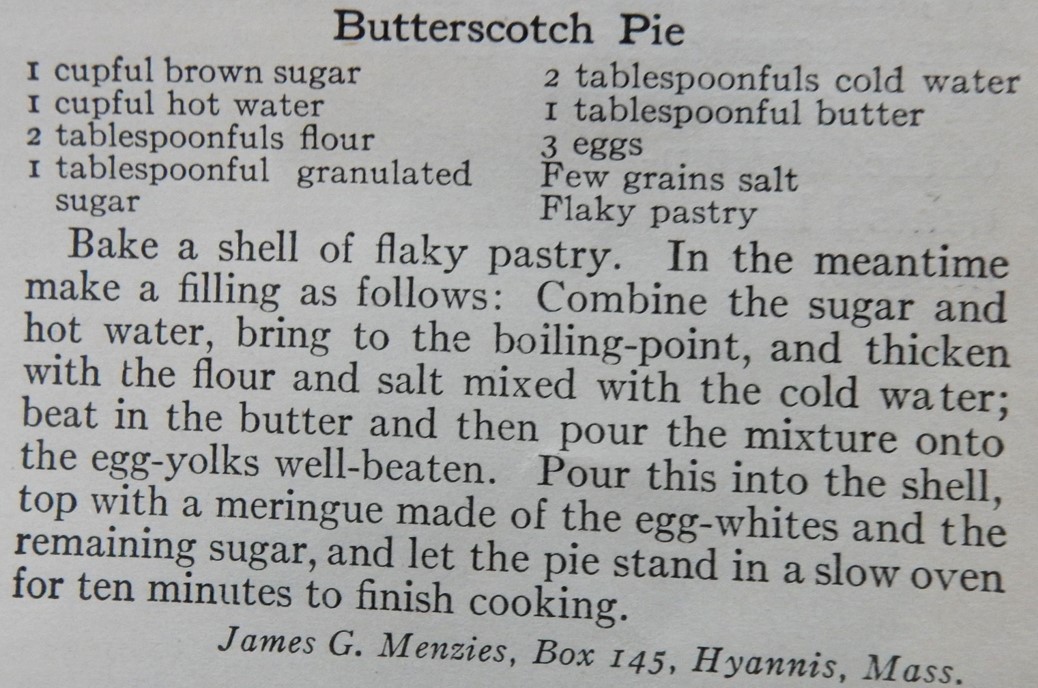
People knew how to make lovely pies a hundred years ago. An old-time winter favorite was Butterscotch Pie with Meringue Topping. I found this classic recipe in the February, 1916 issue of Good Housekeeping.
The Butterscotch Pie is irresistible with a smooth, buttery pudding and a light, delightful meringue. Here’s my adaptation of the recipe for modern cooks:
1 cup brown sugar
1 cup hot water
2 tablespoons flour
1/8 teaspoon salt
1 tablespoons cold water
3 egg yolks, beaten
1 tablespoon butter
1 8-inch (small) baked pie shell
3 egg whites
1 tablespoon granulated sugar
Preheat oven to 325° F. Combine brown sugar and hot water in a saucepan, bring to a boil. In the meantime, in a small bowl combine the flour and salt. Gradually stir the cold water into the flour mixture to create a smooth paste; then stir in the beaten egg yolks. Add one tablespoon of the hot sugar liquid to flour and egg yolk mixture and stir to combine; then add several additional tablespoons of the hot sugar liquid while stirring constantly. When enough liquid has been added to make a thin paste, stir the flour and egg yolk mixture into the remaining hot sugar mixture in the saucepan. Using medium heat, bring to a boil while stirring constantly; reduce heat and simmer while continuing to stir until the mixture thickens. Remove from the heat and stir in the butter. When the butter is melted, pour into the pie shell.
To prepare the meringue, put the egg whites into a mixing bowl. Beat until peaks form, then beat in the granulated sugar. Spoon the meringue onto the top of the pie, and then swirl. Use care to get the meringue spread all the way to the edge of the pie. Bake in the oven for approximately 10 minutes or until the meringue is a light brown.
Here is the original recipe:
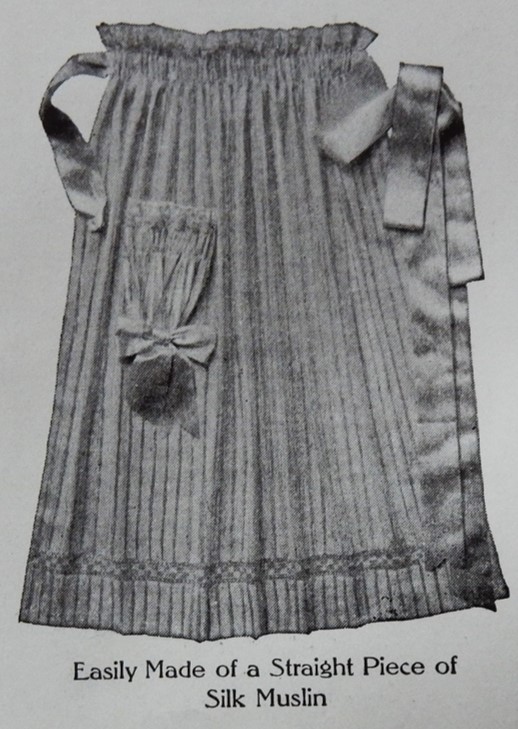
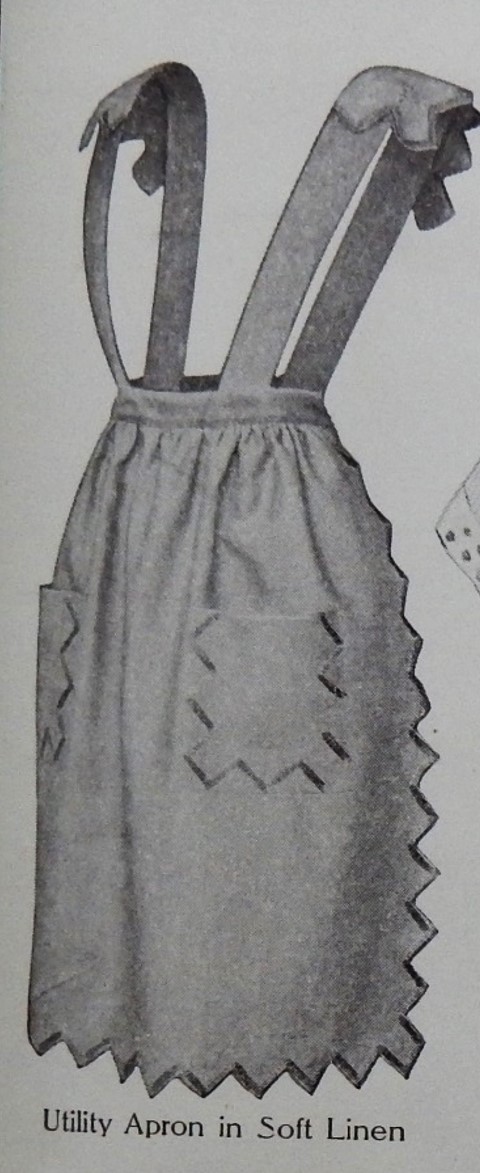
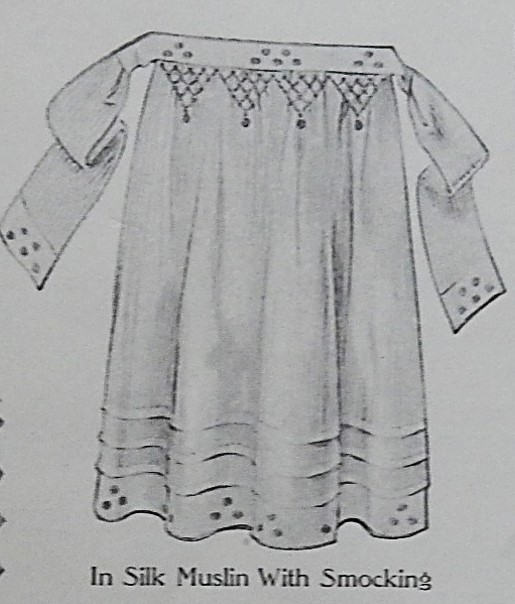
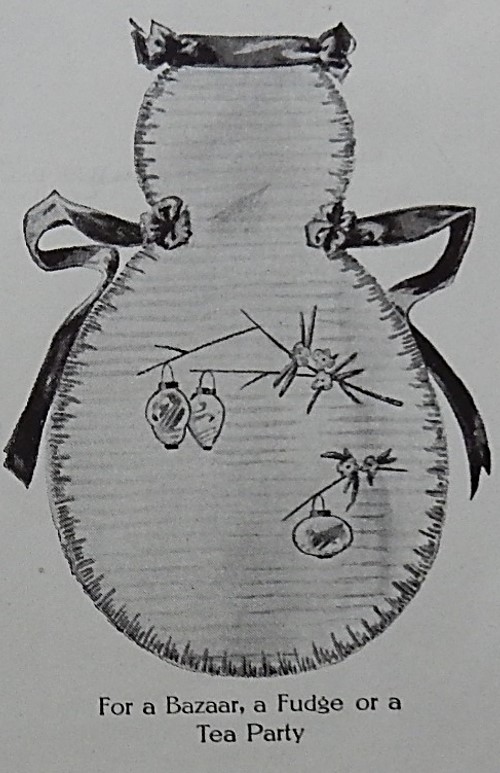
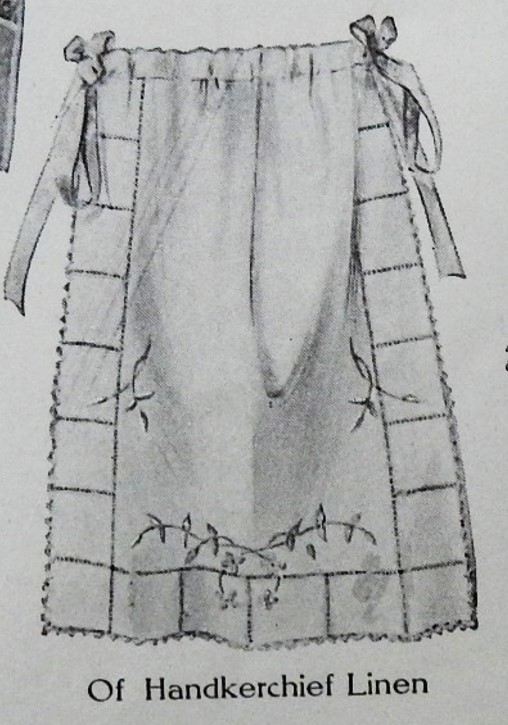
Are some aprons more stylish and youthful-looking than others? I never thought about it until I saw an article in the March, 1916 issue of Ladies Home Journal titled, “The New Girlish Apron: Daintily Made in Handwork.”
I always think that I look like my grandmother when I wear an apron – but perhaps my aprons are just dowdy.
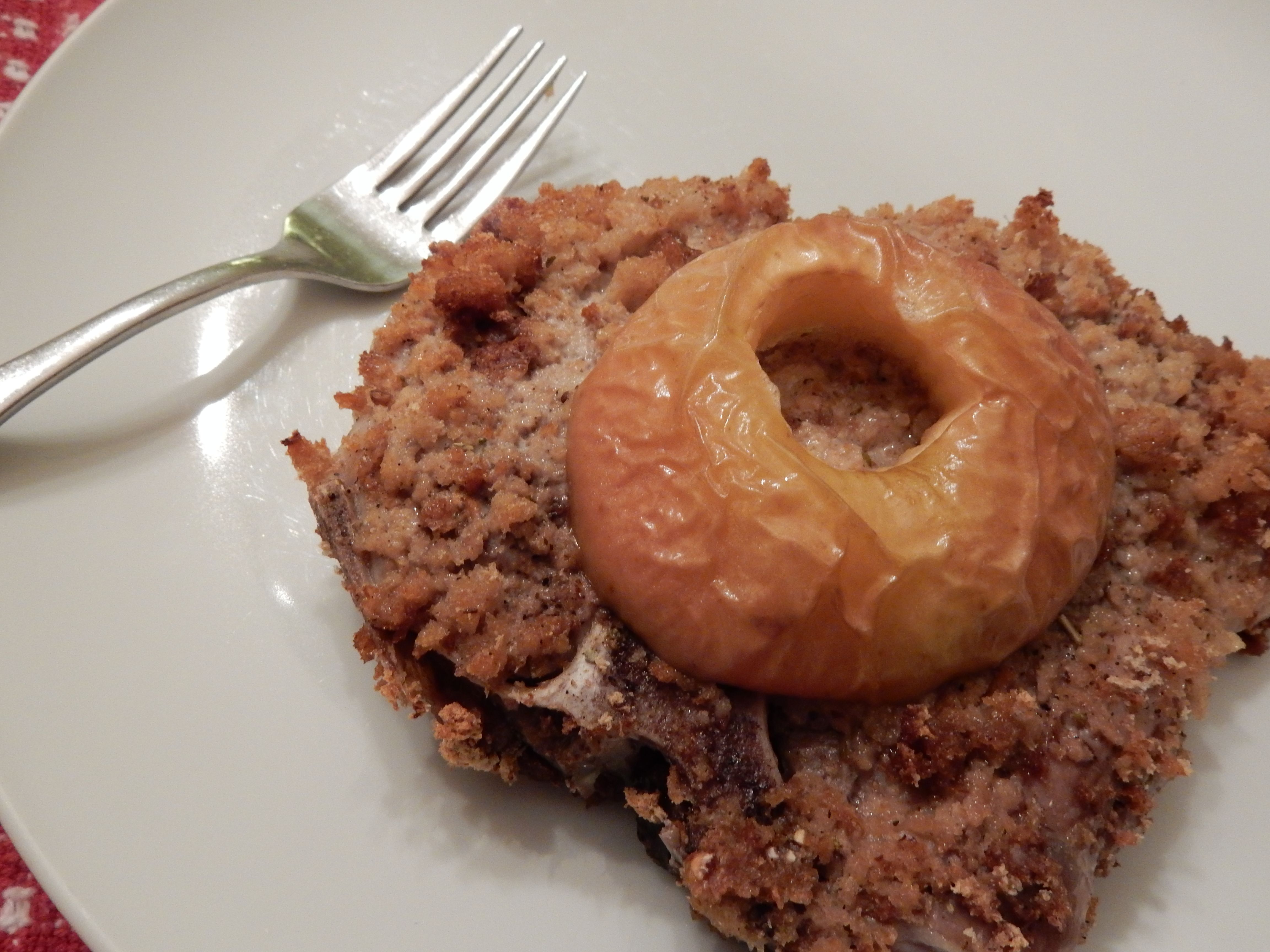
Pork chops are a food that I crave in mid-winter, but would seldom think about eating in July. Maybe it brings back vague memories of eating freshly butchered pork in January when I was a child. When I saw an intriguing recipe in the January, 1916 issue of Good Housekeeping for Baked Pork Chops with Apples, I immediately knew that I wanted to try it. The old magazine featured the recipe–and even included a picture.

The top of a baked apple showily topped each pork chop for a lovely, yet decidedly old-fashioned, presentation. The pork chops had a nice, slightly crispy, bread crumb coating with sage undertones that blended nicely with the tanginess of the baked apples.
Here’s how I adapted the recipe for modern cooks:
1/2 cup bread crumbs (fine)
1/4 teaspoon salt
1/8 teaspoon pepper
1/4 teaspoon rubbed sage
3 pork chops
3 apples
1 tablespoon (3 teaspoons) butter
Preheat oven to 375° F. Combine bread crumbs, salt, pepper, and sage. Coat the pork chops with the bread crumb mixture and put in a baking dish or oven-proof skillet. Cut the top 1 1/2 inch off the apples and core. (Reserve the remainder of apple for use in another recipe.) Center a cored apple top on each pork chop; place 1 teaspoon of butter in the center of each apple. Bake for 45 minutes or until the pork chop is thoroughly cooked.
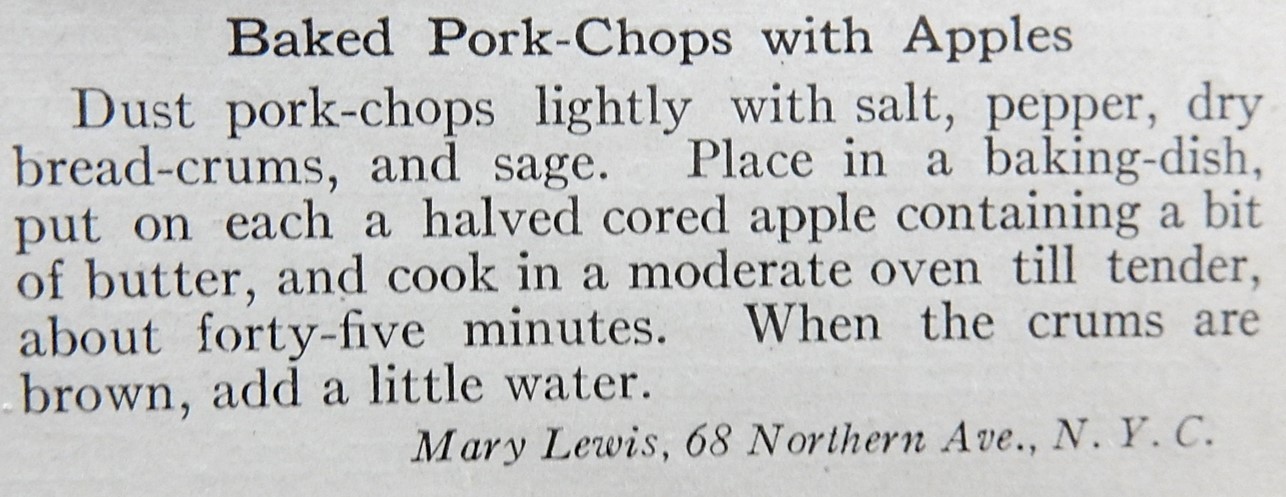
And, here is the original recipe:

A hundred-years-ago, Good Housekeeping had a monthly feature on “Tested Helps for Housekeepers” which showcased new kitchen gadgets and appliances that had received the Good Housekeeping seal of approval.
One item that got the seal of approval was the Sharpless Bread-Mixer:
This machine will make bread of uniformly excellent quality in inexperienced hands. The principle of operation is radically different from other machines or from that used in making bread by hand. The liquid ingredients and softened yeast are placed in the lower section and the flour above, separated by a sifting-screen. Turning the crank sifts through just as much flour at one stroke as the beating paddles can thoroughly mix with the liquid.
Thus, as soon as all the flour is sifted through the bread is “mixed” and ready for its first raising. The whole process requires less than a minute for five pounds of bread, and when raised the can be immediately molded into loaves for baking.
Many housekeepers ask if machine-made bread is better than that made by hand. It is invariably better when compared with that made by inexperienced cooks. . . It is therefore safe to say that home-made machine bread will be an improvement over the hand-made variety in ninety percent of homes. . .
The price is $8.00 delivered.
Good Housekeeping (March, 1916)
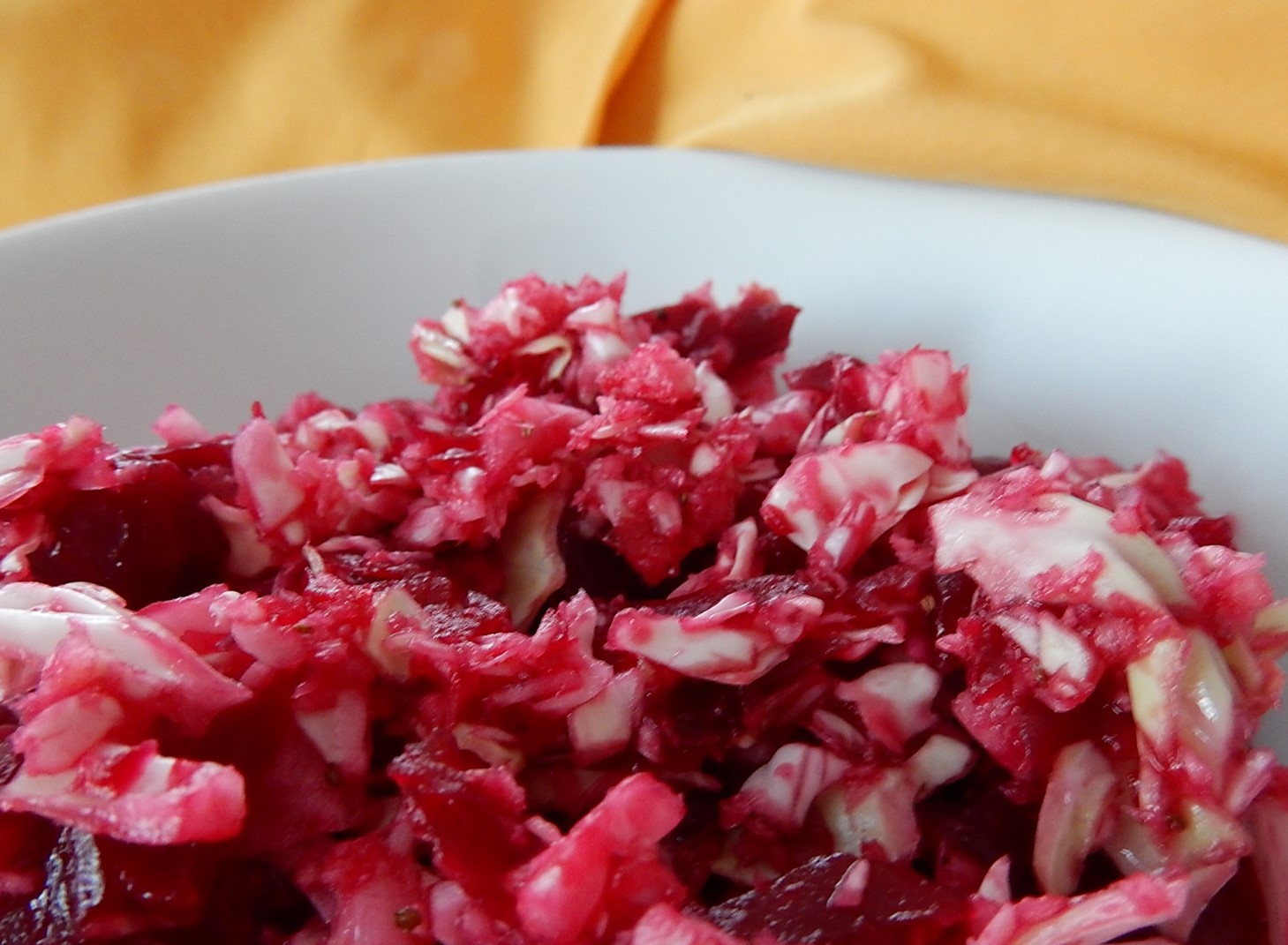
I’m always on the outlook for salads and relishes that use seasonal ingredients. When browsing through the January, 1916 issue of Good Housekeeping, I came across an intriguing recipe for Beet Relish. Of course, I had to try it.
The Beet Relish contains chopped beets and cabbage in a tangy vinegar dressing that has a fun horseradish kick. This recipe makes an absolutely beautiful, slightly flashy, sweet- sour side dish.
1 cups sugar
1 cups vinegar
1 tablespoon salt
1 tablespoon dry mustard
1 tablespoons celery seed
2 cups cooked beets, chopped
1/2 small head of cabbage, chopped
1/8 cup to 1/2 cup horseradish, grated
Combine sugar, vinegar, salt, dry mustard, and celery seed in a bowl. Add chopped beets and chopped cabbage; stir to combine. Add horseradish to taste. Refrigerate for at least 24 hours before serving. Will keep in the refrigerator for several weeks.
Here is the original recipe:
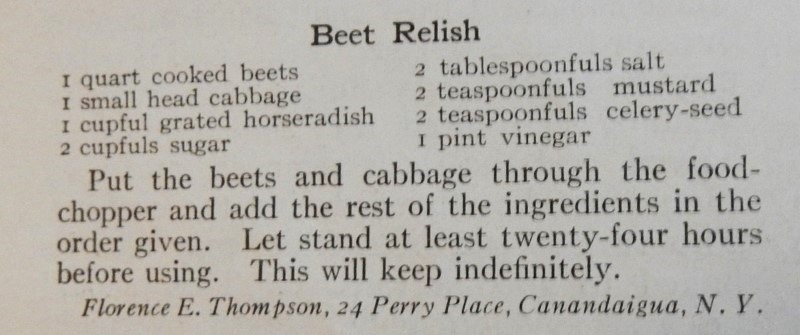
I halved the recipe when I made it. I also used much less horseradish than called for in the original recipe. A little horseradish adds a nice peppery flavor to this dish–but too much can easily overwhelm the other flavors.
