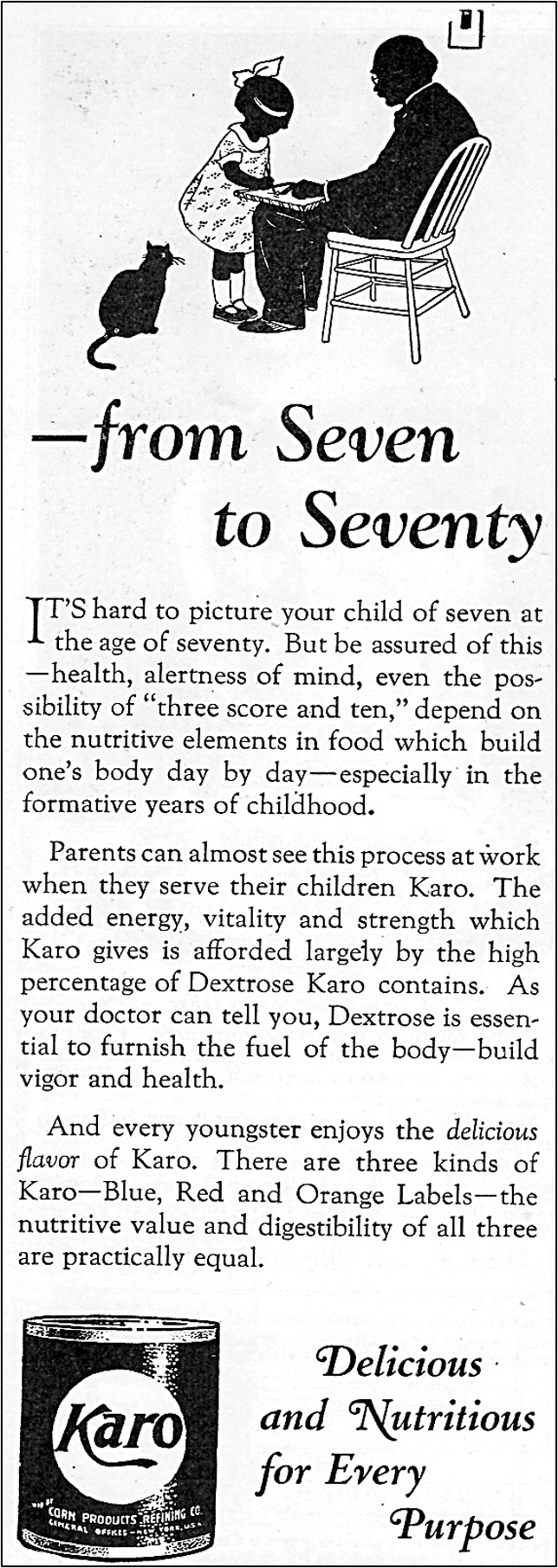
Whew! It’s fascinating that this 1925 Karo advertisement focuses on the supposed health benefits of the product.

Whew! It’s fascinating that this 1925 Karo advertisement focuses on the supposed health benefits of the product.
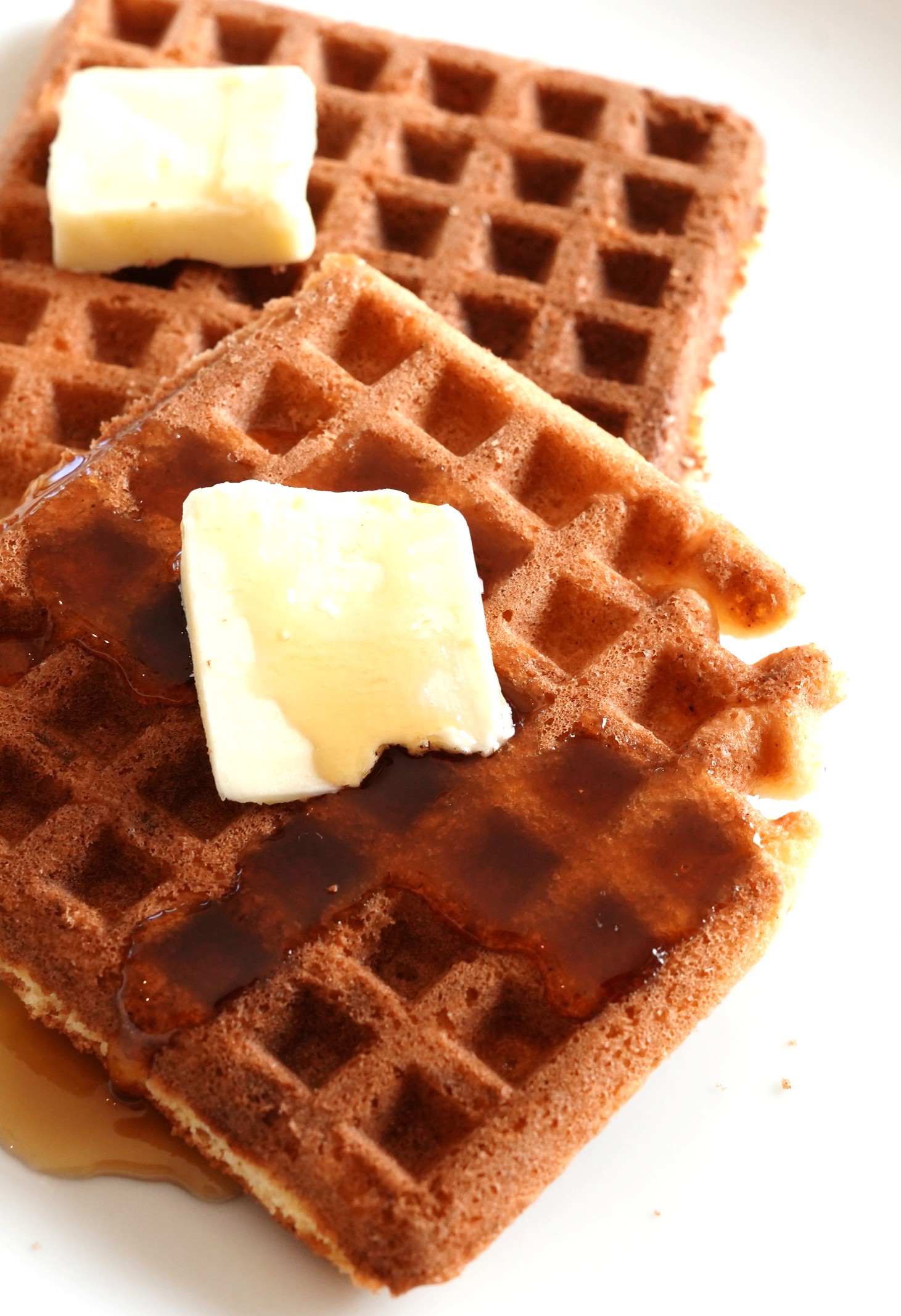
When browsing through hundred-year-old cookbooks, I came across a recipe for Pound Cake Waffles. The title intrigued me. The recipe called for lots of butter and sugar, and was very similar to actual Pound Cake recipes. I decided to give it a try. The recipe indicated that either lemon or vanilla flavoring could be used in the recipe. I went with lemon extract.
The waffles were lovely with a sunny lemon flavor that worked nicely with the maple syrup that I put on the waffles.
Here’s the original recipe:
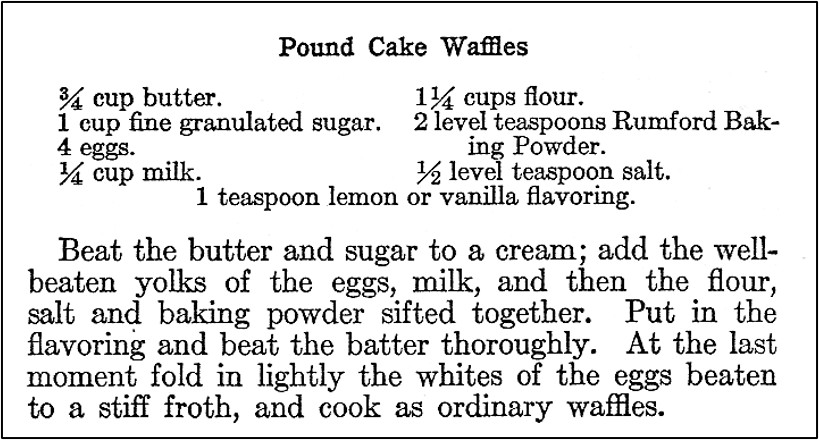
Here’s the recipe updated for modern cooks:
3/4 cup butter
1 cup sugar
4 eggs, separated
1/4 cup milk
1 1/4 cups flour
2 teaspoons baking powder
1/2 teaspoon salt
1 teaspoon lemon extract or vanilla (I used lemon extract.)
Beat egg whites, then set aside. Put butter and sugar in a mixing bowl, then beat until creamed. Add the egg yolks and milk, then beat. Add the flour, baking powder, salt, and lemon extract or vanilla; beat until combined. Gently fold in the beaten egg whites. Ladle batter onto a hot waffle iron and cook, following the waffle iron directions.

A 1925 home economics textbook provides recommendations for how to divide each dollar spent on food across the various food groups.
How Much to Spend on Food
Whether one is purchasing food for all the meals of a family or is only selecting a luncheon or one meal, it is desirable to spend money wisely.
The five food groups may serve as a basis for the purchase of foods. It has been suggested that each dollar used in buying foods be divided into 5 parts of 20 cents each.
Out of each dollar use:
- 20 cents, more or less, for vegetables and fruits
- 20 cents, more or less, for milk and cheese
- 20 cents, more or less, for meat, fish, eggs, etc.
- 20 cents, more or less, for bread and cereals
- 20 cents, more or less, for sugar, fat, tea, coffee, chocolate, flavoring
(A footnote indicates that this is from the United States Thrift Leaflet #15.)
School and Home Cooking by Carlotta C. Greer (1925)
Sometimes I wonder if I spend too much on food, but I’ve never really thought about how it should be divided across food groups. I wonder if the hundred-year-old breakdown still holds, or if the division across food groups should be different now.
 I recently had some friends over and wanted to serve a nice dessert (and, of course, I wanted to make a hundred-year-old recipe), so I pulled out my 1925 recipe books and found a lovely recipe for Maraschino Cherry Cake.
The cake was colorful with cherry fragments throughout that gave it a delightful sweet, yet tart, flavor.
Here’s the original recipe:
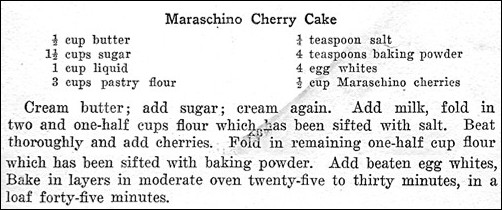
This recipe calls for 1 cup of liquid. When, I made it, I used 1/4 cup of liquid from a jar of Maraschino cherries and 3/4 cup of milk.
The stores where I shop do not carry pastry flour, so I used all-purpose flour. It worked fine.
When I updated this recipe, I reduced the amount of baking powder from 4 teaspoons to 3 teaspoons. Four teaspoons seems like a lot, and I had a little difficulty with the cake falling. A possible cause is the use of too much baking powder, so I decided to reduce the amount.
Here’s the recipe updated for modern cooks:
4 egg whites
1/2 cup butter, softened
1 1/2 cups sugar
1/4 cup liquid from jar of Maraschino cherries
3/4 milk
1/4 teaspoon salt
3 teaspoons baking powder
3 cups pastry (or all-purpose) flour
1/2 cup Maraschino cherries, chopped
Preheat oven to 350◦ F. Beat egg whites until stiff, then set aside.
Put butter and sugar in a mixing bowl, then cream. Stir in Maraschino cherry liquid and milk. Add salt, baking powder, and flour; beat until smooth. Stir in the chopped Maraschino cherries, then fold in the beaten egg whites. Put into prepared pans. A large loaf pan, round layer cake pans, or a rectangular cake pan may be used. Bake until a wooden pick inserted in the center comes out clean (about 35 minutes for cake pans or 45 minutes for a loaf pan). If desired, ice. (I iced the cake with a buttercream frosting. I substitute liquid from a jar of Maraschino cherries for some of the milk when making the frosting.)
 Old-cookbooks occasionally refer to recipes as “receipts.” A hundred years ago, “receipt” was already considered an archaic term. Here’s what it said in a 1925 magazine:
“Receipt” or “Recipe”?
When our grandmothers wrote out the ingredients for any dish and the method of making it, they called this “a receipt,” and in their times the apothecaries had a monopoly of the word “recipe,” which meant to them the physician’s prescription. The tendency, today, is towards the use of the word “recipe” for the cooking formula, while “receipt” is more logically reserved for the written form of acknowledging payment, or the receiving of money.
American Cookery (April, 1925)

Rhubarb is one of my favorite spring foods, so I was pleased to find a hundred-year-old recipe for Rhubarb Turnovers. The turnovers were lovely.
Here’s the original recipe:

I was intrigued by the idea of using syrup from canned fruit as the topping for the Rhubarb Turnovers, so I used the syrup from a can of peaches canned in heavy syrup. A lemon sauce would also be tasty.
The instructions called for “red strawberry rhubarb.” The rhubarb I used was not particularly red, so the turnovers may not have been as attractive as they would have been if a redder rhubarb had been used, but they still looked nice.
I interpreted the instructions to roll the dough out to “less than 1/2 inch thick” to mean about 1/3 inch thick. I ended up with a few more turnovers than the 12 indicated in the recipe.
Here’s the recipe updated for modern cooks:
1 cup sugar
1/2 cup water
2 cups rhubarb (cut into 1-inch pieces)
3 cups flour
1 teaspoon salt
5 teaspoons baking powder
1/2 cup butter
1 cup milk
water and sugar
lemon sauce or syrup from any kind of canned fruit (I used syrup from peaches canned in heavy syrup.)
Combine the sugar and 1/2 cup water in a saucepan. Using medium heat bring to a boil, then reduce heat and simmer until the sugar syrup reaches the thread stage (225◦ F.). Add rhubarb pieces and cook until the rhubarb is soft and tender. Remove from heat.
In the meantime, preheat oven to 400◦ F. Sift flour, salt, and baking powder into a mixing bowl; then cut in the butter until the pieces are small (about the size of a peas). Add milk and mix using a fork until dough starts to cling together. Roll the dough on a prepared surface to about 1/3-inch thick. Cut the rolled dough into 4-inch rounds. (I used an inverted champagne coupe glass to cut the rounds.)
Using a slotted spoon, put a tablespoon of the cooked rhubarb in the center of each round. Fold in half. Moisten edges with water and seal by pressing edges with a fork. Put on baking tray, and bake for 18 minutes or until lightly browned. Removed from oven and use a pastry brush to brush with water, and then sprinkle with sugar. Return the turnovers to the oven for an additional two minutes. Remove from oven.
Serve hot with lemon sauce or the syrup from any kind of canned fruit.
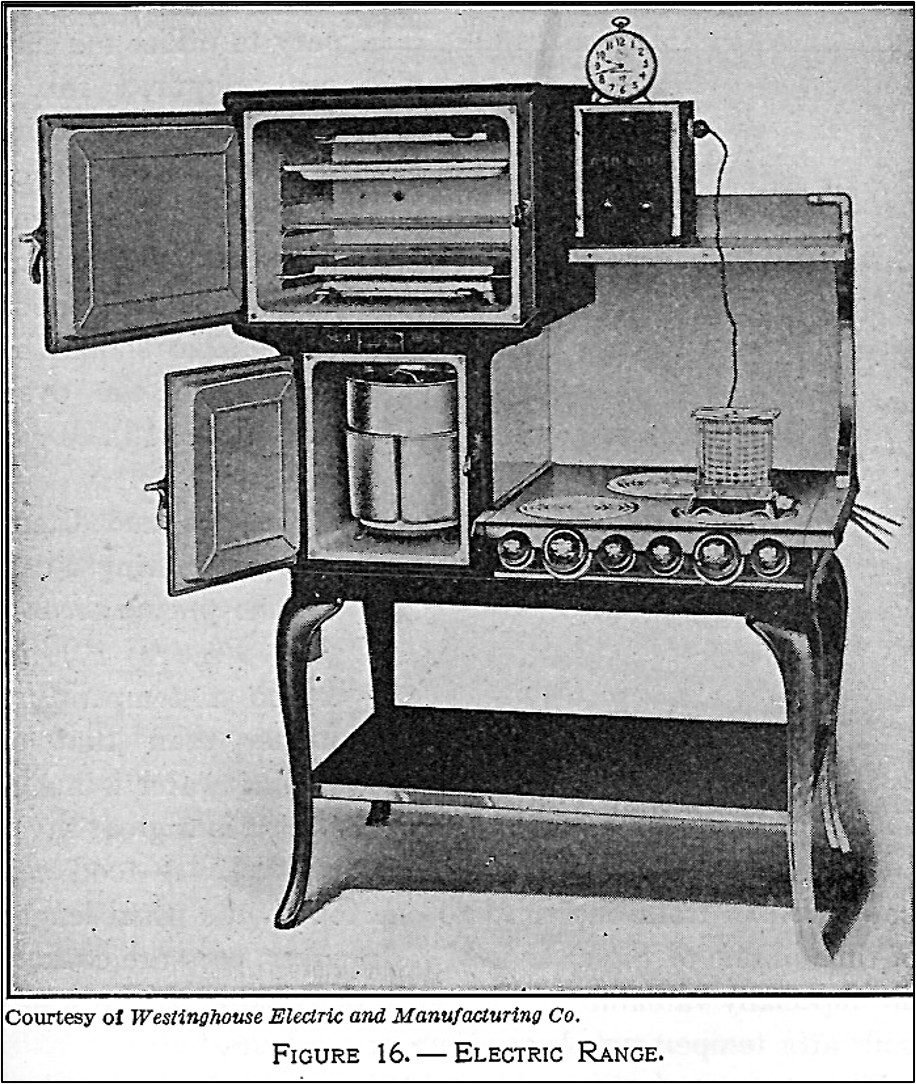
Electric stoves were just beginning to be commonly used in 1925. Here’s a description of electric stoves in a 1925 home economics textbook:
Electric Stoves
It was mentioned previously that electricity is not a fuel. Hence electric stoves are not provided with burners. They have heaters which contain coils of wires through which an electric current passes.
Electricity is the cleanest source of heat for cooking. But in order to operate an electric stove economically, it is necessary to utilize the current required for a heating element to its great extent. For example, if the current is turned on to heat the oven as many foods as possible should be cooked in the oven.
School and Home Cooking by Carlotta C. Greer (1925)
The textbook includes a note to teachers which indicates that if none of the pupils have an electric stove in their home that “the portion of the lesson regarding these stoves may be omitted.”
