Hundred-Year-Old Heinz Baked Beans Advertisement

Source: Ladies Home Journal (March, 1916)

For some reason, beans – baked, canned, whatever – are one of my favorite winter comfort foods. Earlier this week I posted a hundred-year-old recipe for Bean Chowder. And, when browsing though old magazines I was drawn to this hundred-year-old ad for canned Heinz Baked Beans. I wonder if the beans tasted the same back then as what they do now – or if Heinz has changed their recipe across the years.

Hundred-Year-Old Bean Chowder Recipe

bean-chowder-e

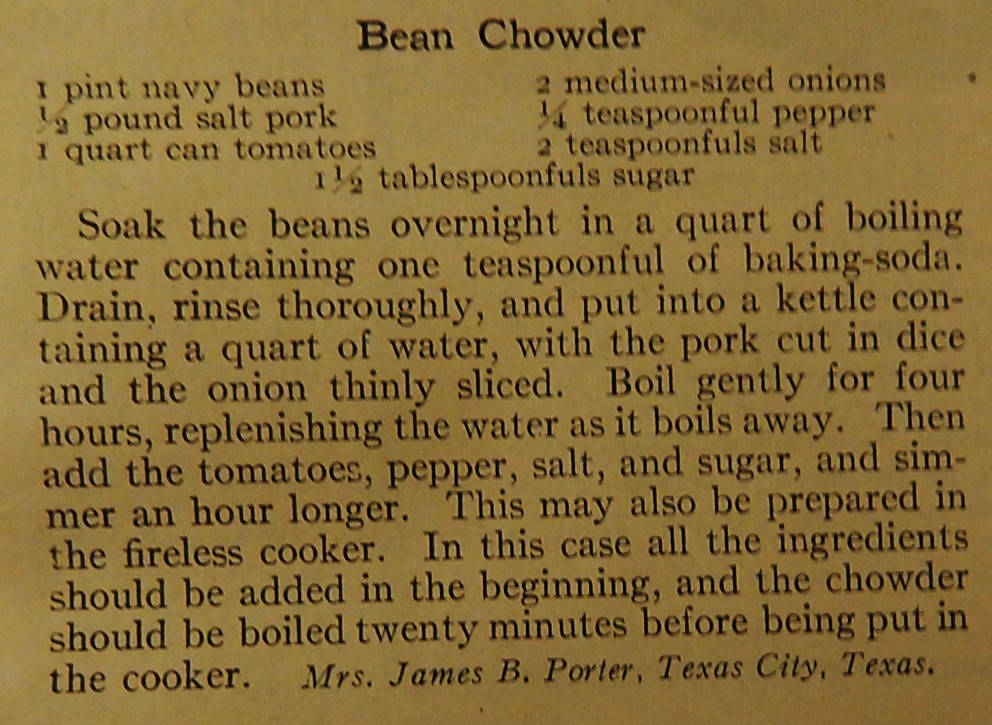
It’s cold and blustery here – and time to make a  hearty soup. I searched though my hundred-year-old recipes and came up with the perfect soup for a cold winter day – Bean Chowder.

This savory, comforting, filling and nutritious chowder is made with dried navy beans, salt pork, onions and tomatoes; and it hit the spot perfectly. This recipe is a keeper (though if I made it again I might shorten the prep time by using canned navy beans).

Here’s the hundred-year-old recipe:

Source: Good Housekeeping (April, 1916)

And, here’s the recipe updated for modern cooks:

Bean Chowder

  • Servings: 8-10
  • Difficulty: easy
  • Print

1 quart (4 cups) water + approximately 2 quarts water

1 teaspoon baking soda

2 cups dried navy beans

1/2 pound salt pork, diced into small pieces

2 medium onions, thinly sized

1 quart (28 oz. can) canned tomatoes

1/4 teaspoon pepper

2 teaspoons salt

1 1/2 tablespoons sugar

In a large saucepan bring 1 quart water and the baking soda to a boil using high heat. Remove from the heat, then stir in the navy beans, and cover. Let sit overnight (10-12 hours).  Then drain the beans. Rinse thoroughly and then put into a large dutch oven or soup pot. Add one quart water, the diced salt pork, and the onions. Bring to a boil on high heat, and then reduce heat and let gently simmer for four hours. Add additional water as needed (approximately one additional quart of water will need to be added).

At the end of the four hours, add the tomatoes, salt, pepper, and sugar. Cook for an additional hour, and then serve.

Is the Bread Crust Less Digestible than the Inside?

bread-crust

People have strong opinions about whether bread crusts are worth eating. I was surprised to learn that people have been questioning the value of bread crusts for a long time. Here’s a question and response that I found in a hundred-year-old magazine:

Is the Crust of Bread Less Digestible than the Inside?

No! The crust is satisfactorily digested when properly chewed. Part of the protein of the crust is present in a more soluble form and some of the starch has been partly digested to dextrin through the action of the heat in baking. The crust is fully as nutritious as the crumb or the inside of the loaf.

Ladies Home Journal (February, 1917)

Creamed Celery with Poached Eggs

creamed-celery-with-poached-eggs

When I saw a delightful picture illustrating a Creamed Celery with Poached Eggs recipe in a hundred-year-old magazine, I knew that I needed to give it a try.

Source: American Cookery (Boston Cooking School Magazine, June/July, 1915)
Source: American Cookery (Boston Cooking School Magazine,) (June/July, 1915)

The recipe did not disappoint. My rendition of Creamed Celery with Poached Eggs was lovely. The presentation was just a tad dramatic, and it turned an ordinary meal into a special one.

This vegetable and egg dish is perfect for breakfast . . . or lunch. The slight tang and bite of the celery combines with the cream sauce and eggs to create lovely taste sensation.

Here’s the original recipe:

Source: American Cookery (Boston Cooking School Magazine, June/July, 1915)
Source: American Cookery (Boston Cooking School Magazine) ( June/July, 1915)

Here’s the recipe updated for modern cooks:

Creamed Celery with Poached Eggs

  • Servings: 2
  • Difficulty: moderate
  • Print

1 1/2 cups celery, cut into 1/2 inch pieces

2 tablespoons butter

2 tablespoons flour

1/4 teaspoon salt

1/4 teaspoon pepper

1 cup milk (preferably whole)

2 eggs

salt and pepper

celery leaves, optional (for garnish)

Put the celery in a medium sauce pan. Cover with water and bring to a boil using high heat; then reduce heat and simmer until tender (about 10 minutes).  Drain well.

In another pan, using medium heat, melt butter; then stir in the flour, salt, and pepper. Gradually add the milk while stirring constantly. Continue stirring until the white sauce thickens. Gently stir in the cooked celery, and remove from heat.

In the meantime, bring 1 1/2 to 2 inches of water to a boil in a skillet, then reduce to a simmer. Break each egg into a small bowl or cup, then slip into the water. Cook for 5 minutes. Remove the poached eggs from the water using a slotted spatula, and drain on paper towels. Sprinkle with salt and pepper.

To assemble the dish: Put the creamed celery in the serving dish, then gently place the poached eggs on top of the celery. If desired, garnish with celery leaves.


Diet for the Expectant Mother

Source: Good Housekeeping (April, 1917)

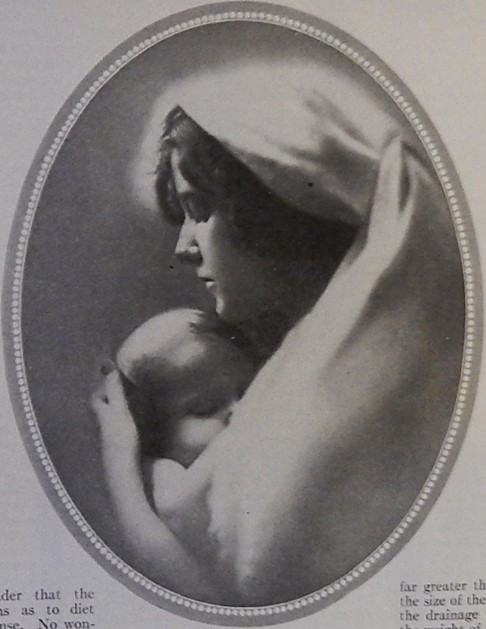
A hundred year ago, just like now, expectant mothers worried about their diet. Here is some hundred-old-advice:

Diet for the Expectant Mother

The ever-great importance of diet is multiplied many times during pregnancy. If children are to be born healthy, mothers can not be starved. If we accept this fundamental, the rest of our course is easy. The mother needs not only the amount of food necessary for her own sustenance and to keep up her own bodily functions, but also a very large increased amount for the growing child.

The food of the expectant mother must be real food. There is no place during the period of pregnancy for the ornaments and finishings of the menu. Every mouthful that she eats should be adapted to the purpose of real nutrition and not merely serve to tickle the palate, or to comply with the follies of fashion. To this end the diet should exclude practically all desserts. These are not so harmful in themselves as they are in taking the place of the necessary things. Cakes, ices, sweets, pudding, and other such accessories are to banished entirely from the table.

It is desirable to omit from the diet during pregnancy tea, coffee, and chocolate. If the craving of the mother is great for these stimulants, then the least harmful of them should be chosen, namely cocoa or chocolate. The more milk the preparation contains, the better for the mother.

The breakfast should always have a fruit; the particular kind is not so important. It is well to interchange them, having a citrus fruit one day and a malic fruit the second day. Apples, pears, and peaches are examples of fruits in which malic acid is predominant; oranges and grapefruit are examples of fruits in which citric acid is predominant. After the fruit a bowl of cereal ground from whole wheat or whole Indian corn or whole oats is to follow. The bread for breakfast should be baked from whole-wheat flour or whole Indian corn meal.

For luncheon, the bread used should be of the same kind as that for breakfast. In addition to this a fresh egg, best coddled or soft boiled, or a lamb chop with a steamed or baked potato carefully cleaned before cooking and eaten with the skins with milk for a beverage is advised.

For dinner the bread and milk are the same character as for breakfast and luncheon. A small piece of roast, preferably of beef or leg of mutton or lamb, with potato and one other vegetable, will be added. Vegetables have little value as food, but great value as regulators and they contain an abundance of minerals and vitamins. A salad, best of lettuce or fruit, will make up the dinner.

I am wholly opposed to alcoholic stimulants, once commonly recommended during pregnancy and motherhood. I suppose it can not be denied that these stimulants do add to the appetite, but a healthy woman does not need any stimulus for her appetite while her child is growing.

As to the quantity of the diet, it has already been intimated that it must be greater than that for normal conditions. The average woman of 130 pounds engaged in the ordinary duties of the household and taking the proper amount of outdoor exercise, requires food to furnish about 2250 calories a day. In the beginning of pregnancy an amount of food should be taken to increase this number by at least fifty a day at first, and soon by 100, 150, 200, 250, and finally 300 or 350.

For about a month or three weeks previous to the birth of the child – as the attending physician will indicate – the mother’s diet should be diminished. The child is then fully formed. This will be no further great drain upon the mother and the burden of nutrition is lessened. It would be well if immediately prior to the birth of the child the mother’s diet should be reduced almost to the normal for her ordinary state of health. This precaution will aid the mother to bear the pain and burden of childbirth better than if she were fully fed up to the very moment.

Good Housekeeping (April, 1917)

Hundred-Year-Old Spiced Sweet Potato Balls Recipe

spiced-sweet-potato-balls-b

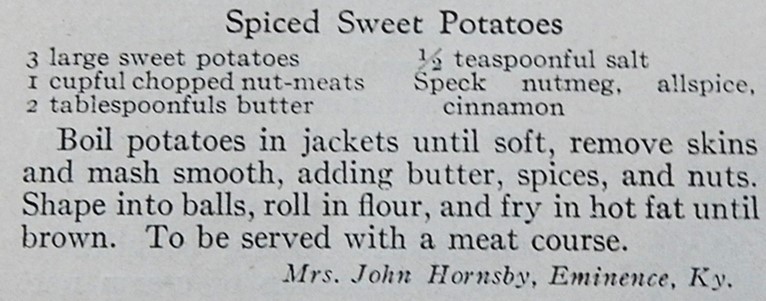
I’m always on the outlook for hundred-year-old winter vegetable recipes, so I was thrilled to find a recipe for Spiced Sweet Potato Balls.

The outside of the Spiced Sweet Potato balls were crisp and browned, while the inside was nutty, rich, and spicy with the warm blend of nutmeg, allspice, and cinnamon. The balls contained ground nuts, which added a nice texture and flavor dimension when combined with sweet potatoes.

Here’s the original recipe:

Source: Good Housekeeping (April, 1917)
And, here’s the recipe updated for modern cooks:

Spiced Sweet Potato Balls

  • Servings: 5-7
  • Difficulty: moderate
  • Print

3 large sweet potatoes (approximately 3 1/2 cups mashed)

2 tablespoons butter

1/2 teaspoon salt

1/8 teaspoon nutmeg

1/8 teaspoon allspice

1/8 teaspoon cinnamon

1 cup nuts, ground (I used walnuts.)

flour

shortening

Place whole sweet potatoes in a large saucepan; cover with water and bring to a boil on high heat. Reduce heat and simmer until the potatoes are tender (30-45 minutes). Remove from heat and drain. Remove the skins from the potatoes then mash until smooth; mix in butter, nutmeg, allspice, and cinnamon. Add ground nuts, and stir to combine. Shape into 1-inch balls, then gently roll in flour.

Melt 1/2 inch of shortening in a large skillet.  Slip the sweet potato balls into the hot shortening, then gently roll the balls with a fork until all sides are a light brown. Remove from heat and drain on paper towels.

Cook’s note: The mashed sweet potato mixture is very sticky. The key to success with this recipe  is shaping the balls, and then gently rolling the balls in the flour while continuing to shape.

Woman’s Wit Pitted Against High Food Prices

Source: Ladies Home Journal (April, 1917)

1917 was a rough year for families. World War I was raging in Europe, and inflation was rampant. Food prices increased that year at the fastest rate they have ever increased in U.S. history. According to a U.S. Congressional Research Service report titled Consumers and Food Price Inflation, “Food inflation hit its all-time high of 28.7% in 1917.”

There are lots of articles in 1917 magazines about the high cost of food. Here’s some excerpts from a hundred-year-old article about how to beat the high cost of food.

Woman’s Wit Pitted Against High Food Prices

We’re racing this year against an ever-soaring opponent, an opponent who has no thought of fairness or humanity, no thought of anything but his own variable wish. You all know whom I mean – Mr. High Cost of Food.

He is a strong opponent. We’re finding him pretty hard to beat. When he rises as he as risen in just the last year, we’re apt to forget about beating him, and give up in despair, for most of our incomes have remained stationary, while the cost of food has grown to monster size, and the elephantine cost of food, we shudder with a “What’s the use?”

To win in any race one must know one’s ground. And the ground in my case was food values–what foods give the most nourishment for the money expended, what foods can take the place of others; it was knowing how to market in order to find out what was there, and to get the best of what I wanted; it was saving of food through proper cooking; it was making use of every ounce I had of brains, perseverance and skills.

It isn’t easy to win the race against food prices- I  haven’t won yet, but I’m constantly finding new ways of economy, from studying and discovering food facts. But I know I am going to win, for practical knowledge is the best sort of whip. And when I have the whip hand, why fear even Mr. High Cost of Food?

Ladies Home Journal (April, 1917)