Old-time Spinach Omelet Recipe

I recently saw a hundred-year-old recipe for Spinach Omelet, and decided to give it a try. A homemade omelet makes breakfast special.

Often omelets are a little greasy and heavy, but Spinach Omelet is light and fluffy. The recipe calls for beating egg whites into stiff peaks, and then folding the remainder of the ingredients into them.  This omelet has a delicate spinach flavor – and is less savory than the typical modern omelet that also contains onions, bacon, or cheese – but is delightful.

Here is the hundred-year-old recipe:

Source: Good Housekeeping (June, 1917)

And here is the recipe updated for modern cooks:

Spinach Omelet

  • Servings: 2
  • Difficulty: moderate
  • Print

1 cup cooked spinach (approximately 4 cups fresh spinach)

2 tablespoons butter

1 1/2 tablespoons flour

1/3 teaspoon salt

dash of pepper

1/2 cup cream (I used half and half.)

4 eggs, separated

If using fresh spinach, rinse the spinach and put into a sauce pan. Do not add any additional water; the water clinging to the spinach leaves will be enough. Using medium heat, cook until the spinach is wilted (approximately 5 minutes). Remove from heat. Cool slightly, then coarsely  chop cooked spinach; set aside.

Using medium-low heat, melt the butter in a sauce pan; then stir in the flour, salt,  and pepper. While continuing to stir constantly, slowly add the cream. Increase heat to medium, and stir until the sauce thickens.  Remove from heat.  Beat egg yolks, then quickly stir into the white sauce.  Add cooked spinach, and stir to combine.

In a separate bowl, beat egg whites until stiff peaks form. (Be sure that the beaters are clean and dry – otherwise the egg whites might not stiffen and form peaks.) Gently fold the egg whites into the egg yolk mixture. Then cook omelet either on the stove top or in the oven.

Stove top method: Pour into a prepared omelet pan. (If needed grease to prevent sticking.) Cover and cook using low heat for about 12 minutes or until the is set. Fold omelet, and slip onto a plate. Serve immediately.

Oven method:  Pre-heat oven to 350° F. Heat a large oven-proof skillet on the top of the stove using medium-low heat. (If needed to prevent sticking, liberally grease the skillet before heating.) Pour the egg and  spinach mixture into the hot skillet, and gently cook for 1 minute. Move the skillet to the oven, and bake for about 12 minutes or until the egg mixture is set. Remove from oven, and loosen the edges of the omelet from the skillet with a knife or spatula, then turn onto a plate; fold into half. Serve immediately.

,

Do Women Waste 10% of their Husbands’ Incomes?

Source: Ladies Home Journal (December, 1911)

In general I enjoy looking at the world of a hundred-years-ago through rose-colored glasses – but sometimes I cringe and am glad I live now. Today is one of those times. Here’s what I recently read in a hundred-old-magazine:

Women, as controllers of at least seventy-five percent of the incomes of the men of the nation, must look to our habits and whether they need to be altered.

It has been said that there are three ways of producing prosperity, namely: by better production, by better choice, and by better consumption. One sees at a glance that the first lies within the diction of the men of the country, while the second and third are at the command of the women.

Statistics have proven that women waste ten percent of their husbands’ incomes! But those statistics are of the past, for the wide-awake women of today are giving time and thought to the study of the various interests of the home with a view of bettering conditions as well as economically as possible. Thrift has become a slogan. . .

Good Housekeeping (March, 1917)

Old-fashioned Rice Muffins

Old home economics textbooks are chock full of tasty and quick recipes (that can be prepared and eaten within a class period). I recently flipped though a 1915 textbook and noticed a recipe for Rice Muffins. My first thought was – Wouldn’t it be wonderful if this recipe was gluten-free?

But no, it was not gluten-free. . . sigh. . .  This recipe calls for a combination of flour and rice.

In spite of my disappointment, I was still intrigued enough by the recipe to give it a try.

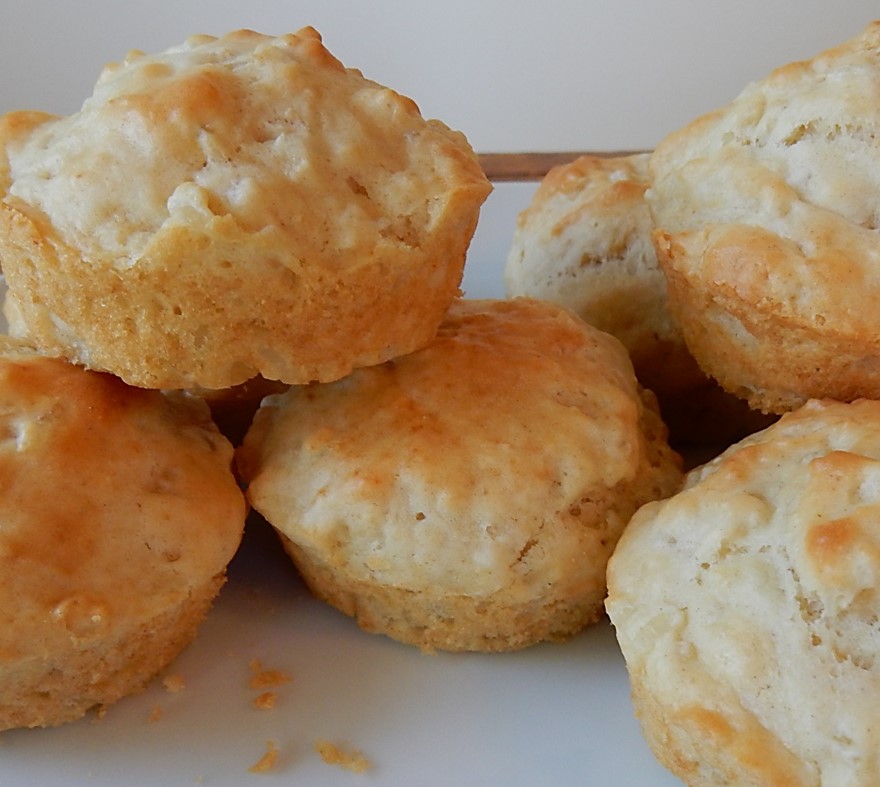
The Rice Muffins were yummy with just the right amount of sweetness. They were very similar to a basic flour muffin, but the rice added interest by providing a bit more texture and chewiness. They are best when eaten the day they are baked.

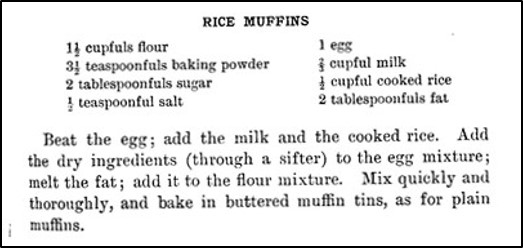
Here’s the original recipe:

Source A Textbook of Cooking (Carlotta C. Greer, 1915)

And, here’s the recipe updated for modern cooks:

Rice Muffins

  • Servings: approximately 12 muffins
  • Difficulty: easy
  • Print

1 1/2 cups flour

3 1/2 teaspoons baking powder

1/2 teaspoon salt

2 tablespoons sugar

1 egg, beaten

2/3 cup milk

1/2 cup rice

2 tablespoons butter, melted

Preheat oven to 400° F.  Sift together flour, baking powder, salt, and sugar. Set aside. In a mixing bowl, stir the egg, milk, rice, and butter together. Add the flour mixture, and stir just enough to combine. Grease muffin tins, and then fill each muffin cup 3/4th  full with batter. Bake for approximately 20 – 25 minutes or until lightly browned.

Hundred-Year-Old “Japanese” Tablescape

Source: American Cookery (November, 1916)

There was a lot of fascination with foods from far away places a hundred year ago. It may seem presumptuous today, but back then people believed that the world was getting smaller, and there was  interest in how people served foods in other countries.

Tea houses were very popular in the United States in the early 1900’s, and it was widely believed that the Japanese knew how to serve tea and other foods very elegantly and gracefully.

Here is the description of how to create a “Japanese” tablescape in a hundred-year-old magazine:

A Japanese table, exquisitely dainty and unpretentious, is that decorated with day lilies. It is laid with a snowy crash runner, and has crash plate doilies. The shallow white center flower bowl contains four claw feet holders, and from these, tall spikes of the white lilies rear their fragile heads above their own bloom. Note the arrangement at the base, and observe how the lily leaves are clustered to form pads, thus accentuating the green and white effect against the snowy background.

A white marble statue of Buddha at each end of the center receptacle under the shelter of a tall lily boom, reminds one of  Sir Edin Arnold’s lines to the Great Lord Buddha:

“The dew is on the lotus,
Rise great Sun!”

Blue and white Canton dishes add the final note of color to this dainty luncheon table.

American Cookery (November, 1916)

When I read this description, “crash runner” and “crash doilies” made no sense to me, so I looked up “crash” in the online Free Dictionary, and found that crash is a type of cloth:

Crash: A coarse, light, unevenly woven fabric of cotton or linen, used for towels and curtains.

Old-fashioned Strawberry Charlotte

I was thrilled when I found a dreamy hundred-year-old recipe for Strawberry Charlotte. This blush pink classic mousse, topped with strawberries, has a light citrus taste and colorful flecks of orange peel.  Strawberry Charlotte is a light and creamy cold dessert that’s perfect on a warm Spring day.

I molded in the  Strawberry Charlotte in individual ramekins (custard cups), rather than using a large mold. I unmolded one for the photo – and served the remainder in the ramekins. Whether on top or bottom, the strawberries worked perfectly in this luscious, creamy dessert. I want to make Strawberry Charlotte again using a large mold. It would make an impressive, beautiful dessert.

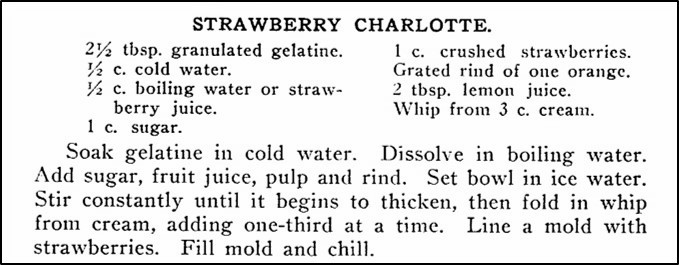
Here is the original recipe:

The Housewife’s Cook Book by Lilla Frich (1917)

And, here’s the recipe updated for modern cooks:

Strawberry Charlotte

  • Servings: 8 - 10
  • Difficulty: moderate
  • Print

approximately 1/2 pound strawberries (1 cup crushed strawberries)

1/4 cup sugar + 3/4 cup sugar

1/2 cup cold water

2 packets unflavored gelatin

1/2 cup strawberry juice (from crushed berries) + additional water

grated rind of 1 orange

2 tablespoons lemon juice

3 cups heavy whipping cream

Hull and slice strawberries, then crush with a fork.  Place in a bowl and stir in 1/4 cup sugar. Set aside for a few minutes to allow the sugar to draw the juice out of the berries.

Put the cold water in a small bowl and sprinkle the gelatin on top of the water. Let sit for at least a minute.

Drain crushed strawberries, reserving the strawberry juice. Measure the juice and add additional water to make 1/2 cup liquid. Put the juice and water in a pan and bring to a boil. Stir in the gelatin mixture. Continue stirring until completely melted. Stir in  3/4 cup sugar, the grated orange rind, and lemon juice; immediately remove from heat. Set aside.

Put the whipping in a mixing bowl and beat until stiff peaks form. Set aside.

Set the pan with the gelatin mixture in a larger pan that contains cold water and ice cubes. Stir the gelatin mixture until it begins to thicken. Then gently fold the gelatin mixture into the whipped cream, one third at a time.

This recipe makes 7 – 8  cups – and would work nicely in a 9-10 cup mold. Arrange the crushed strawberries in the bottom the mold  and then spoon the whipped cream mixture into the mold. (Or use individual molds or ramekins. If individual molds are used, divide the strawberries and whipped cream mixture across the molds.). Chill in the refrigerator until firm (at least two hours).

To serve, quickly dip the mold in hot water, then gently slide the Strawberry Charlotte onto serving plate.  If ramekins are used, may be served without unmolding, if desired.

Outdoor Furniture a Hundred Years Ago

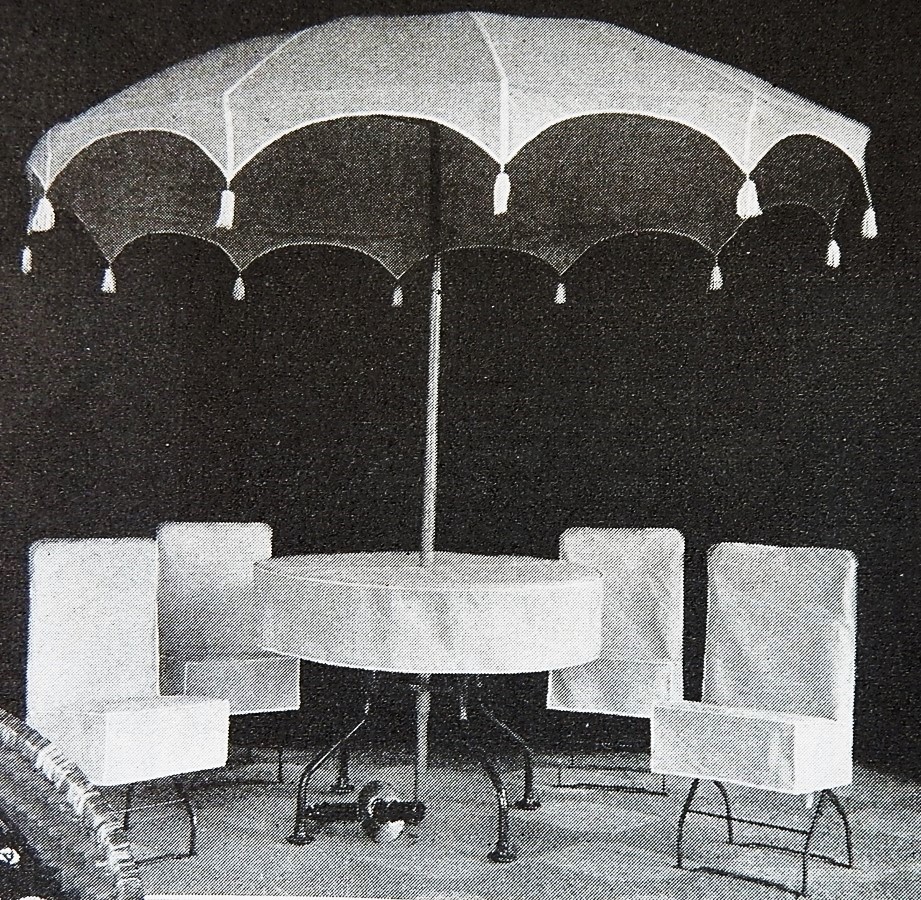
Caption: Garden things never fail to give a pleasant little comfortable thrill that is worth more than money. (Source: Good Housekeeping– June, 1917)

I’m not into keeping up with the Jones, but I’m slightly envious of people with beautiful patios and outdoor rooms filled with stylish lawn furniture. People a hundred years ago also wanted nice outdoor furniture. According to an article in the June, 1917 issue of Good Housekeeping:

Garden furniture reminds one of cool summer drinks to be served.