Old-Fashioned Strawberry Shortcake

16-year-old Helena Muffly wrote exactly 100 years ago today: 

Monday, June 12, 1911: Started to pick strawberries this morning. Of course it will mean some early rising and loss of sleep, but just look at what I can earn.

Her middle-aged granddaughter’s comments 100 years later:

It sounds as if Grandma got paid for picking strawberries. I wonder if she worked for a neighbor who raised the strawberries, hired workers to pick them, and then sold them in town—or if her parents raised berries for sale (and paid their own children to harvest them).

Regardless of who owned the berry patch, I bet that the Muffly family enjoyed eating strawberries.

I don’t know how Grandma’s family served strawberries, but when I was a  child we ate shortcake muffins with strawberries and milk almost daily during June. I would guess that they also ate strawberry shortcake a hundred years ago.

We ate strawberry shortcake for supper—and it was part of the main meal (not a dessert). The  menu consisted of shortcake, and meat or fried potatoes.

It seems a little strange today—but back then on those hot June days we’d typically have a heavy meal for lunch (we called it dinner) and a relatively light meal with strawberry shortcake in the evening. In June on the farm we’d being baling hay—and there was lots of hard, hot labor required to get the hay baled and then stacked in the barn—so it seems even more amazing to me now that we ate a relatively light meal (that many today would consider a dessert) in the evening.

Here’s a traditional recipe for strawberry shortcake:

Strawberry Shortcake

1 1/4 cups flour

1 1/4 teaspoons baking powder

1/4   teaspoons salt

1/4 cup butter, softened

Scant 1/2 cup milk

Sliced strawberries

Additional milk (optional)

Preheat oven to 420 degrees. Stir the flour, baking powder, and salt together. Cut the butter into the flour mixture . Add milk and stir just enough to combine using a fork. Grease muffin pan and fill each about 3/4 full. Cook about 18-20 minutes or until lightly browned. Serve with strawberries and milk (optional).

servings: 6 muffins
Rhubarb Sponge Pie Recipe

16-year-old Helena Muffly wrote exactly 100 years ago today: 

Monday, June 5, 1911: Mother, Besse and Ruthie flew around today a baking pies and cakes. I thought it be fun to swipe one, but oh, the result.

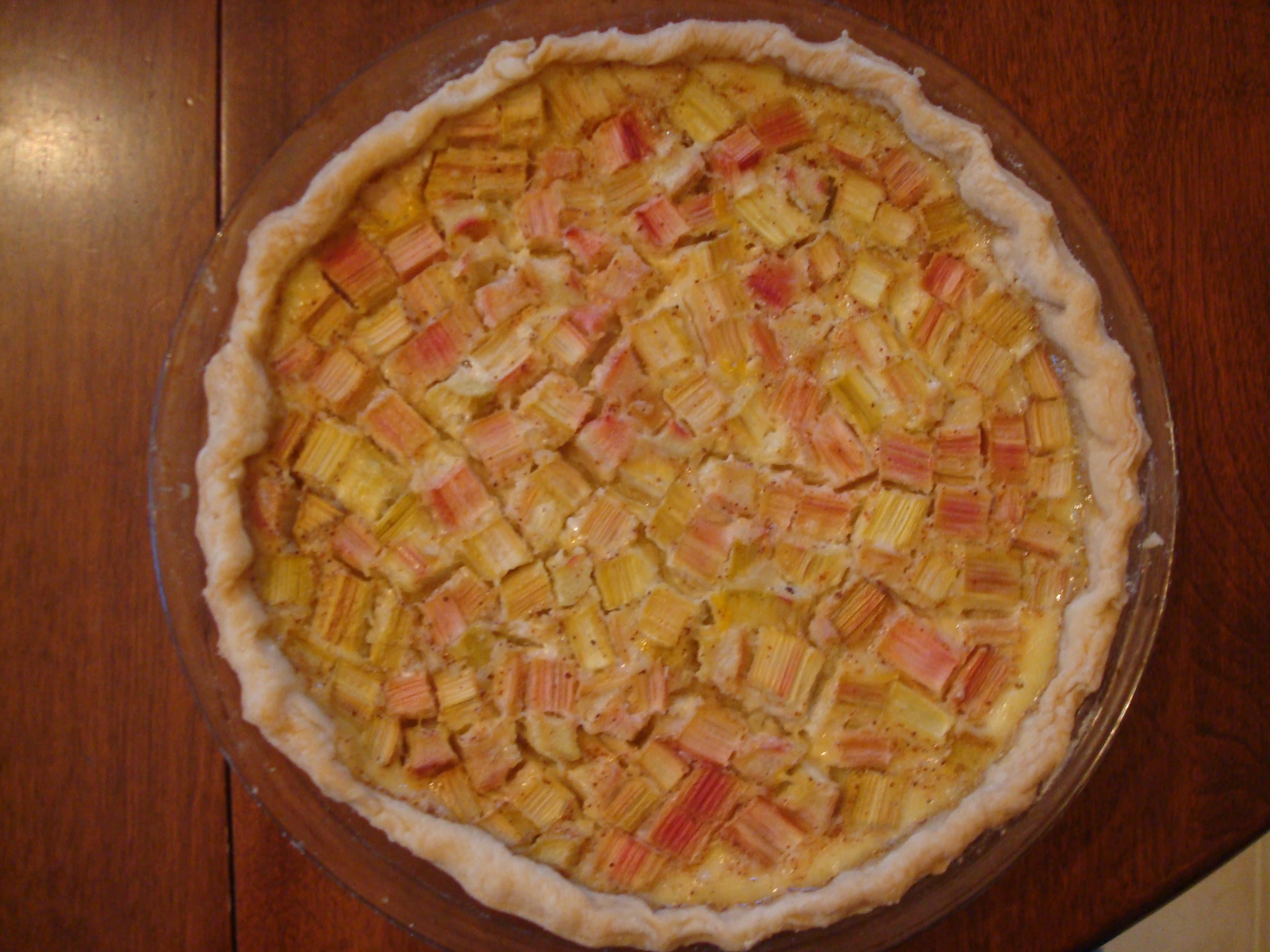
Rhubarb Sponge Pie

 Her middle-aged granddaughter’s comments 100 years later:

Grandma’s married sister Besse came to help her mother and sister bake pies and cakes. It sounds like Grandma didn’t help—I wonder why. As a 16-year-old, you’d think that she’d be a competent baker (or at least could help with some of the easier tasks). But instead Grandma apparently was clowning around—and swiped a pie—and got into trouble. Whew, what  punishment was referred to as “the result”?

What kinds of pie did they make? My favorite old-fashioned spring pie is Rhubarb Sponge Pie. (I got this recipe from my mother-in-law. However, it is an old-time Pennsylvania recipe—and the Muffly women may have made a similar pie.)

Rhubarb Sponge Pie

3 eggs

3 tablespoons all purpose flour

1/2 teaspoon nutmeg

3/4 cup sugar

dash salt

1 cup milk

2 cups rhubarb

9 inch pie shell (see recipe below)

Heat oven to 425 degrees. Beat eggs slightly. Add flour, nutmeg, sugar, and salt; Beat for 1 minute. Add milk and beat until blended. Stir in rhubarb. Bake at 425 degrees for 5 minutes. Reduce heat to 325 degrees. Bake (1 – 1  1/2 hours*) until knife inserted into center of pie comes out clean.

*This pie takes a long time to bake. If the rhubarb starts to turn brown (burn) before the center of the pie is solid, reduce heat to 300 degrees.

Any pie pastry recipe—or a pie pastry purchased at the store— can be used to make Rhubarb Sponge Pie. But for a really flakey crust with an absolutely awesome taste, make an old-fashioned pie shell using lard.

I absolutely love the recipe below. At the stores where I shop lard can be surprisingly difficult to find—and I am always searching for it so that I can make really good pies. (Clayton and Elizabeth, thank you for the lard that I used to make the pie in the photo!)

In any case, here’s the recipe:

Old-Fashioned Pie Pastry (1 crust, 9 inch)

 1 cup flour

1/3 cup lard

2 to 3 tablespoons cold water

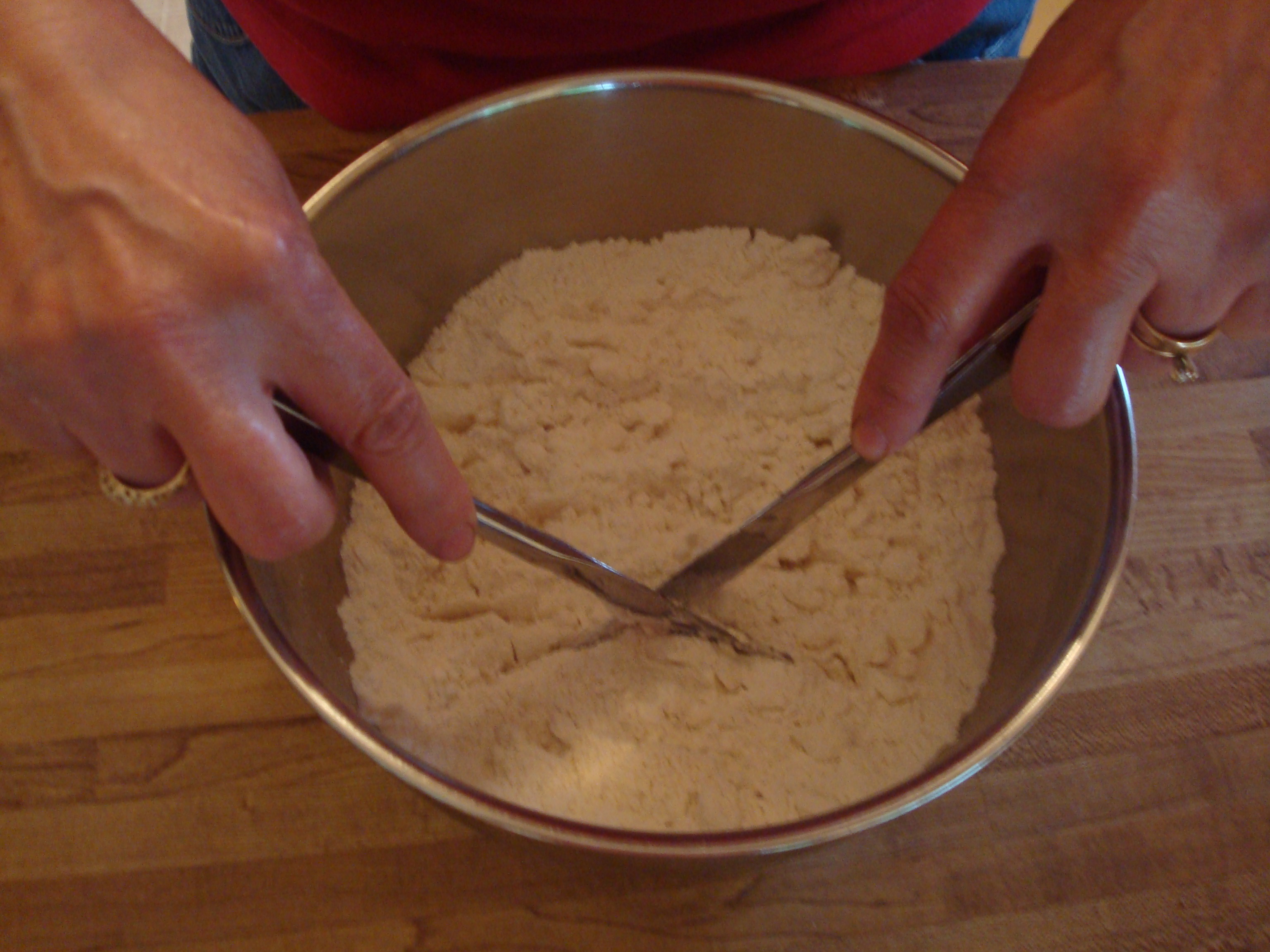
Put flour into bowl. Cut in shortening  using two knives or a pastry blender. Add water and mix using a fork until dough starts to cling together. If needed, add additional water.

With a little practice it’s easy to cut lard (or shortening) into the flour using two knives. I learned how to do it when I was young and have never felt a need to buy a pastry blender.

Gather dough together in a ball. Flatten into a round circle on lightly floured surface (a floured pastry cloth works well).  Roll dough 2 inches larger than needed to fit pie pan using floured rolling pin. Fold pastry into quarters; unfold and fit into pan.

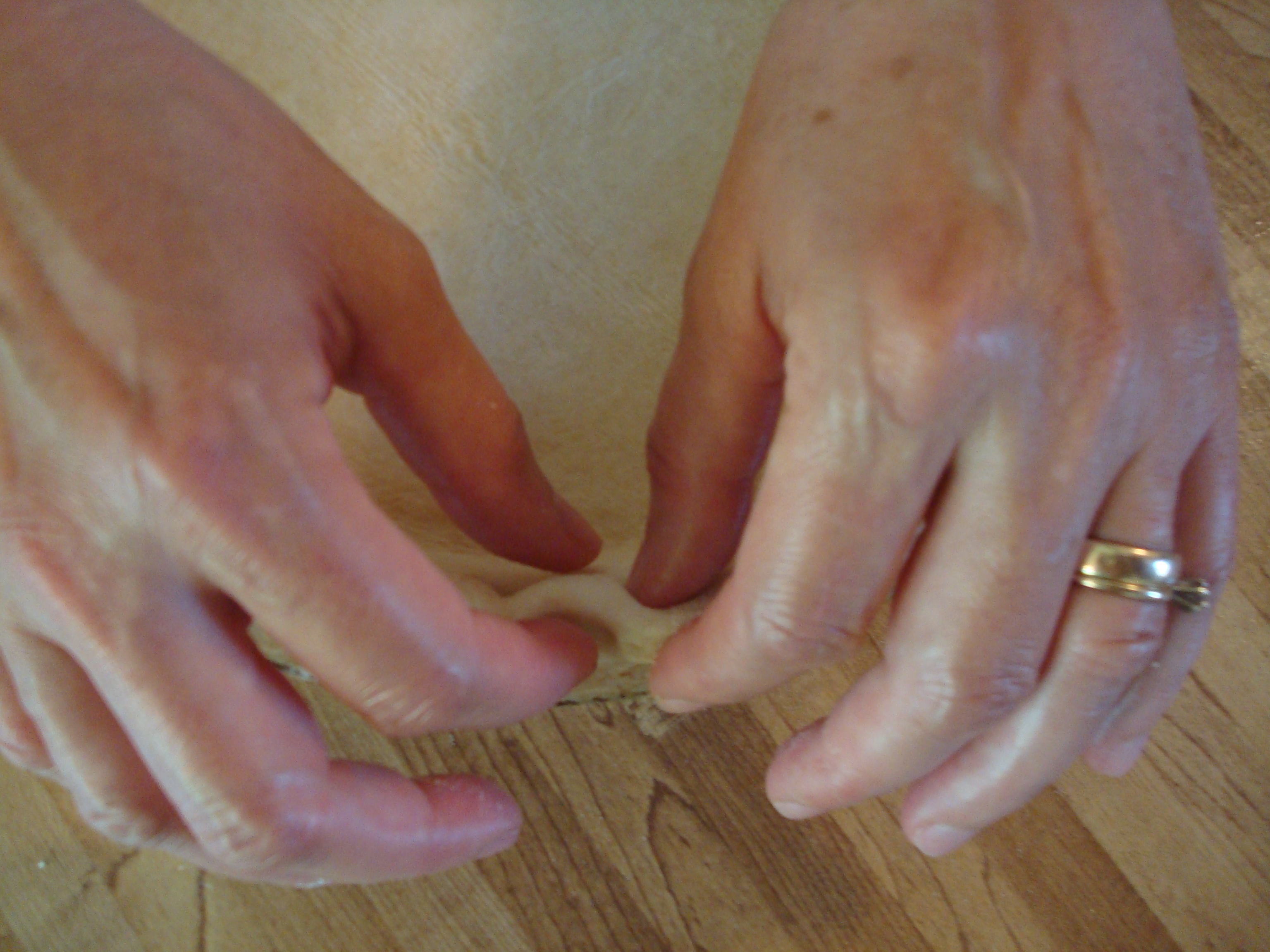
Trim  edge of pastry 1/2 inch from rim of pan. Flute pastry to create edge by pressing between fingers that are moving in opposite directions.

Fluting pie edge

Stewed Rhubarb (Rhubarb Sauce)

16-year-old Helena Muffly wrote exactly 100 years ago today: 

Wednesday, May 24, 1911: One of these days I’m going to do something of some importance. I’m getting rather tired of the same old duties, the same old ways, and the same old troubles.

Her middle-aged granddaughter’s comments 100 years later:

Whew, the same old duties, the same old ways, and the same old troubles. I wonder what Grandma was referring to. Sometimes I wish that she’d tell us more about what her daily duties were—and what she didn’t like about the “old ways”. But of course she couldn’t have known that we’d be reading her diary a hundred years later . . .

Since she didn’t tell us much about what happened, I’m going to try to guess what foods the family have might have been eating in late May.

They were probably enjoying fresh greens, radishes, and other spring vegetables from their garden. They probably were also eating rhubarb. It used to be considered one of the spring tonic foods (dandelion was another) that helped restore people’s energy and health after a long winter without fresh foods.

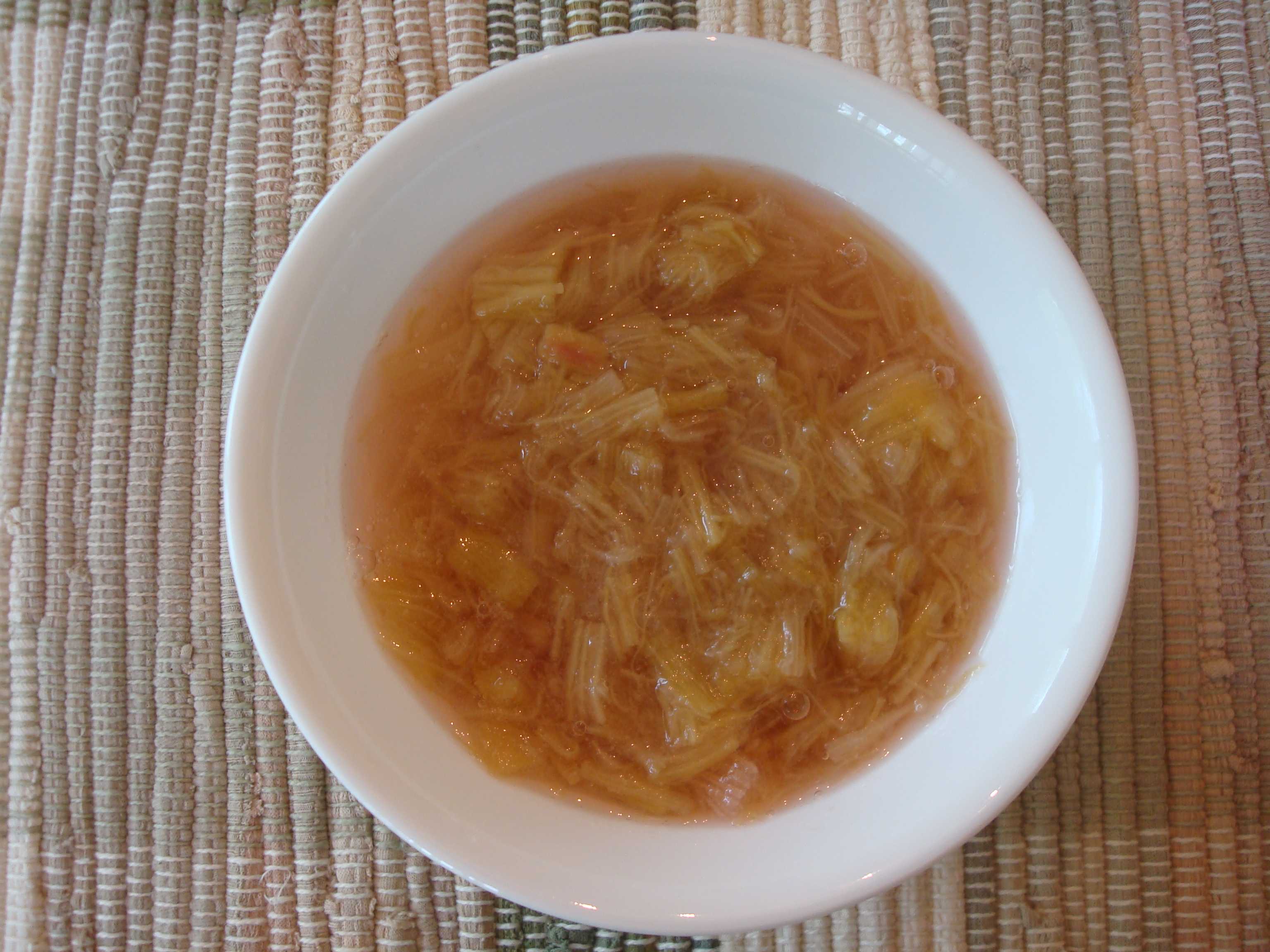
Stewed Rhubarb

When I was a child we often ate Stewed Rhubarb (Rhubarb Sauce) in May. We ate it as a side dish during the main meal. (We ate it warm at the first meal; left-overs were eaten chilled). I don’ t have a recipe for Stewed Rhubarb, and I haven’t made it in years—but yesterday I successfully made it from memory and it tasted just as I remembered.  This is what I did:

Stewed Rhubarb (Rhubarb Sauce)

2 cups rhubarb (cut into 3/4 inch pieces)

1/3 cup sugar

1/4 cup water

1/2 teaspoon salt

Mix all of the ingredients together in a saucepan. Using medium heat, heat to boiling; reduce temperature and simmer until tender (about 5 minutes); stir occasionally. Remove from heat. Can be served either hot or chilled. 2-3 servings. Recipe can be easily doubled or tripled.

The amount of sugar can be adjusted to make the rhubarb tarter or sweeter.

My husband’s family also ate Stewed Rhubarb when he was a child—and he agrees that the recipe turned out perfectly. He took seconds—and we easily ate all of the rhubarb at one meal. (Next time I’ll make more). And, he suggested that we should have it again soon. It’s definitely an old-time food that we’ve enjoyed rediscovering.

Old-fashioned Chocolate Almond Drop Cookies

16-year-old Helena Muffly wrote exactly 100 years ago today: 

Sunday, May 21, 1911: Went to Sunday school this afternoon. The whole Stout family was over this evening. Wormed the results of that letter out of Carrie.

Her middle-aged granddaughter’s comments 100 years later:

This entry describes one of the really nice characteristics of rural life—neighbors just dropping by to visit.  One hundred years ago, on warm spring evenings neighbors probably often gathered to chat about the weather, share the local news, or talk about …. well, just whatever. Long-term friendships were formed over the years—and people would discuss anything and everything.

The adults may have sat around the kitchen table —while the young folks wandered off for their own discussions.  Cookies or other refreshments may have been served. A small cookbook published in 1911 to advertise KC Baking Powder contained this recipe for chocolate almond drop cookies:

K C Almond Drop Cookies

2 eggs, beaten light

1 cup sugar

2 ounces chocolate melted

1 ½ cups blanched almonds, chopped

1 teaspoonful vanilla extract

1 cup flour

1 level teaspoonful K C Baking Powder

½ teaspoonful each, salt and cinnamon

Sift together, three times, the flour, salt, cinnamon, and baking powder. To the eggs add the sugar, chocolate, almonds, extract, and lastly the flour mixture. Drop by teaspoonfuls upon a buttered baking pan. Bake in a moderate oven. This recipe makes about three dozen little cakes.

The Cook’s Book (KC Baking Powder,1911)

When I tried this recipe, I heated the oven to 375 degrees and baked the cookies for about 12-14 minutes. I didn’t sift the flour—and I used unsweetened chocolate, sliced almonds, and a different brand of baking powder. I was surprised that the recipe didn’t call for any butter or other shortening.

The cookies are tasty with a slight hint of cinnamon, and the recipe is definitely a keeper.

Old-time Recipe for Stirred Custard

16-year-old Helena Muffly wrote exactly 100 years ago today: 

Sunday, April 30, 1911:  Pa and Ma and Jimmie went away today. Ruth had invited Helen Wesner and Blanche Bryson to come and do justice to her very excellent cooking. I rode home from Sunday school with them. I choked at the dinner table which displayed my most excellent manners.

Her middle-aged granddaughter’s comments 100 years later:

It sounds like Grandma’s sister Ruth had fun cooking a meal for friends—and that Grandma displayed her sense of humor by pretending to choke on the food. A few days ago (see the April 25 and April 27 postings) two of my cousins shared memories about how much Grandma enjoyed practical jokes when she was an older woman. I can now see that this was a trait that she had throughout her life.

Menu page in April, 1911 issue of Good Housekeeping Magazine.

I wonder what her sister Ruth cooked. A hundred years ago Good Housekeeping magazine included sample menus each month. One of the April, 1911 Sunday dinner menus is below:

Sunday Dinner

Tomato bouillon

Roast veal, brown sauce

Mashed potatoes

String beans

Boiled custard*

Sponge cake

Coffee

An asterisk meant that the magazine contained the recipe.  For  the Sunday dinner menu, the only included recipe was for Boiled Custard:

Boiled Custard

Scald one pint of milk in a double boiler. Unless for some special reason milk should always be scaled, not boiled.

Beat the yolks of two eggs, or one whole egg, very light with two tablespoonfuls of sugar; and when the milk has scalded, pour it slowly on to the eggs and sugar, stirring all the while. The milk is added to the eggs and sugar instead of these being added to it, for two reasons. The slow addition of a small amount of hot liquid cools the egg, already divided by the beating in of the sugar, without coagulating it until it is so hard that it separates and permits the custard to separate. Also, in this way all of the egg and sugar is mixed with the milk. When an attempt is made to add adds to milk it is difficult, especially with a small amount, to clean out the dish properly. A little lost with small proportions may spoil or deduce the deliciousness of the dish.

Return the milk, eggs and sugar to the double boiler and cook for three minutes, stirring slowly, but steadily and carefully. A minute’s carelessness here may spoil the custard. If not sufficiently cooked the custard will have a raw “eggy” taste, and a minute too long cooks the egg too hard and the custard seemingly curdles. As soon as the custard coats the spoon, or as soon as it begins to feel thicker as one stirs, add the salt. [Note: I used ½ teaspoon salt.] Strain into a cool dish and flavor with a teaspoonful of vanilla. Properly made, the custard will be smooth and the consistency of rich cream.

I made this recipe using a sauce pan since I don’t own a double boiler, and it turned out fine.

The stirred custard  had a nice flavor—but the recipe directions are definitely right when it says that the custard has the consistency of rich cream.  As I look back at the menu in the old magazine, I see that it also lists sponge cake. After seeing the consistency of the Stirred Custard, I now think that it may have been used as a sauce on the cake.

Easter and Goldenrod Eggs

16-year-old Helena Muffly wrote exactly 100 years ago today: 

Sunday, April 16, 1911:  Easter Sunday, no chocolate eggs were in evidence. I went to Sunday school this morning. Went over to Stout’s this afternoon. Miss Carrie wasn’t at home though, having gone away to spend Easter.

 Her middle-aged granddaughter’s comments 100 years later:

It sounds like Grandma’s family didn’t celebrate Easter in 1911—though other families in the area apparently participated in extended family gatherings since Grandma’s friend Carries had gone away to spend Easter.

Grandma’s maternal grandparents lived in Turbotville, and her mother, Phoebe Derr Muffly, had 7 siblings—many of whom lived within 15 miles of the Muffly farm. It is somewhat surprising that the extended family didn’t gather to celebrate Easter.

—–

I had lots of fun experimenting with dying eggs using onion skins two days ago—now I have lots of hard-boiled eggs that need to be used.

Goldenrod Eggs are an old-fashioned traditional Easter food.

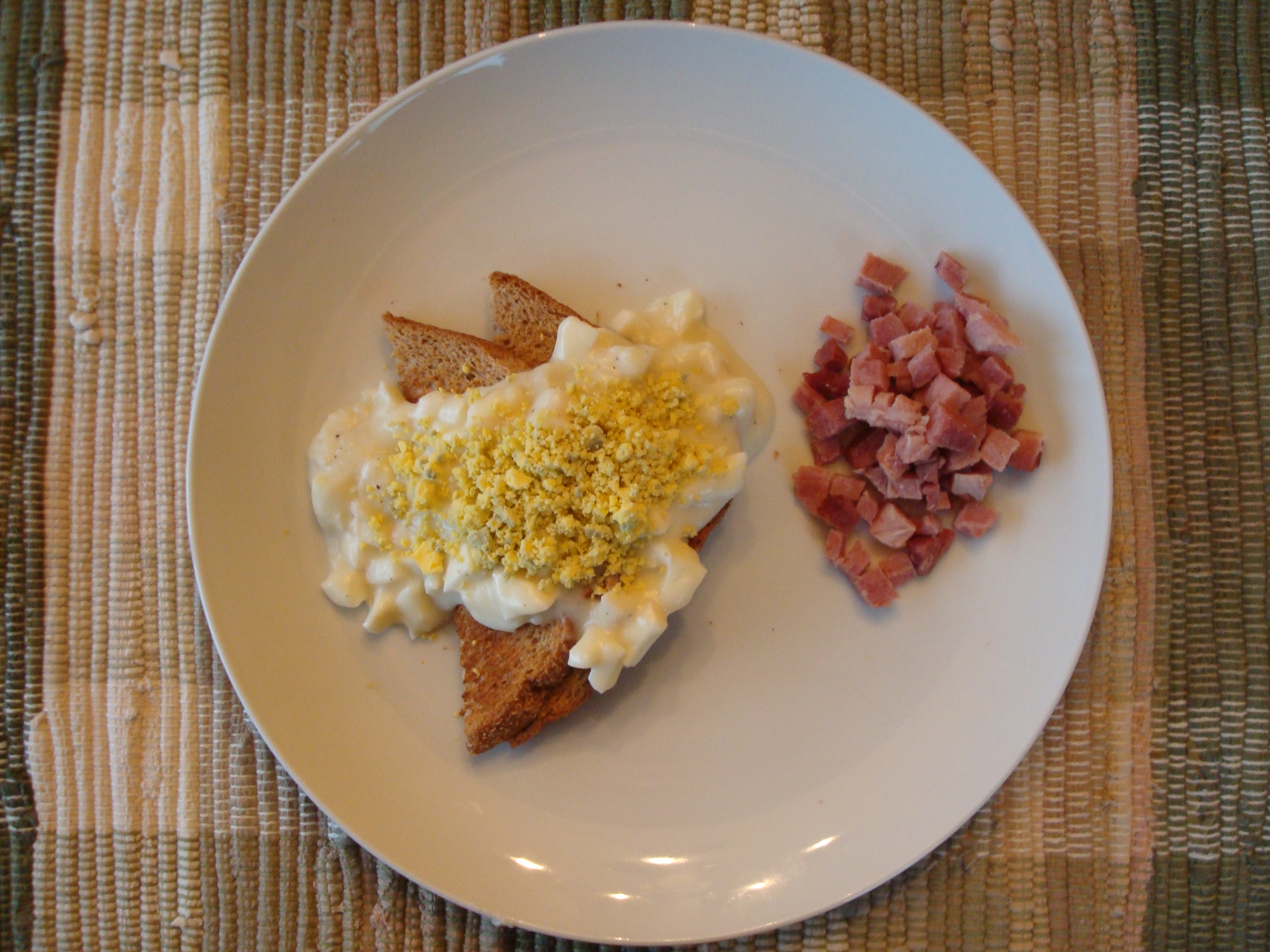
Goldenrod Eggs with Chopped Ham

Goldenrod Eggs

6 slices buttered toast

6 hard-cooked eggs

2 cups white sauce*

1/4  teaspoon salt

few grains cayenne

1/8 teaspoon pepper

Remove shells from eggs; chop whites finely; add to White Sauce. Press yolks through a sieve and add seasonings. Pour White Sauce over toast arranged on a platter, and garnish with yolks of eggs.

This dish may be very attractively arranged by placing spoonfuls of finely chopped ham around the toast.

*White Sauce

4 tablespoons butter

4 tablespoons flour

2 cups milk

1/4 teaspoon salt

few grains cayenne

1/4 teaspoon pepper

Melt butter, add flour, seasonings and liquid. Stir until the boiling point is reached. Boil two minutes, beating constantly.

Lowney’s Cook Book (1907)

Creamed Dandelion Recipe

16-year-old Helena Muffly wrote exactly 100 years ago today:

Monday, April 10, 1911: I helped to wash this morning. Mistress Besse was out this afternoon and went with Miss Ruth out to gather some delicious dandelion. Ours was no good after all.

Her middle-aged granddaughter’s comments 100 years later:

Dandelion! Grandma’s diary entry reflects that excitement that fresh dandelion generated.

Dandelion, endive, and other bitter greens used to be considered a spring tonic. People traditionally had a very limited selection of foods during the late winter months, and they really looked forward to eating fresh greens in the spring.

When I was a child we often ate creamed dandelion served over mashed potatoes in the spring. I remember older relatives saying that they felt healthier after eating spring greens.

I seldom make creamed dandelion, but often make creamed endive.  Endive tastes similar to dandelion, but it isn’t quite as bitter.

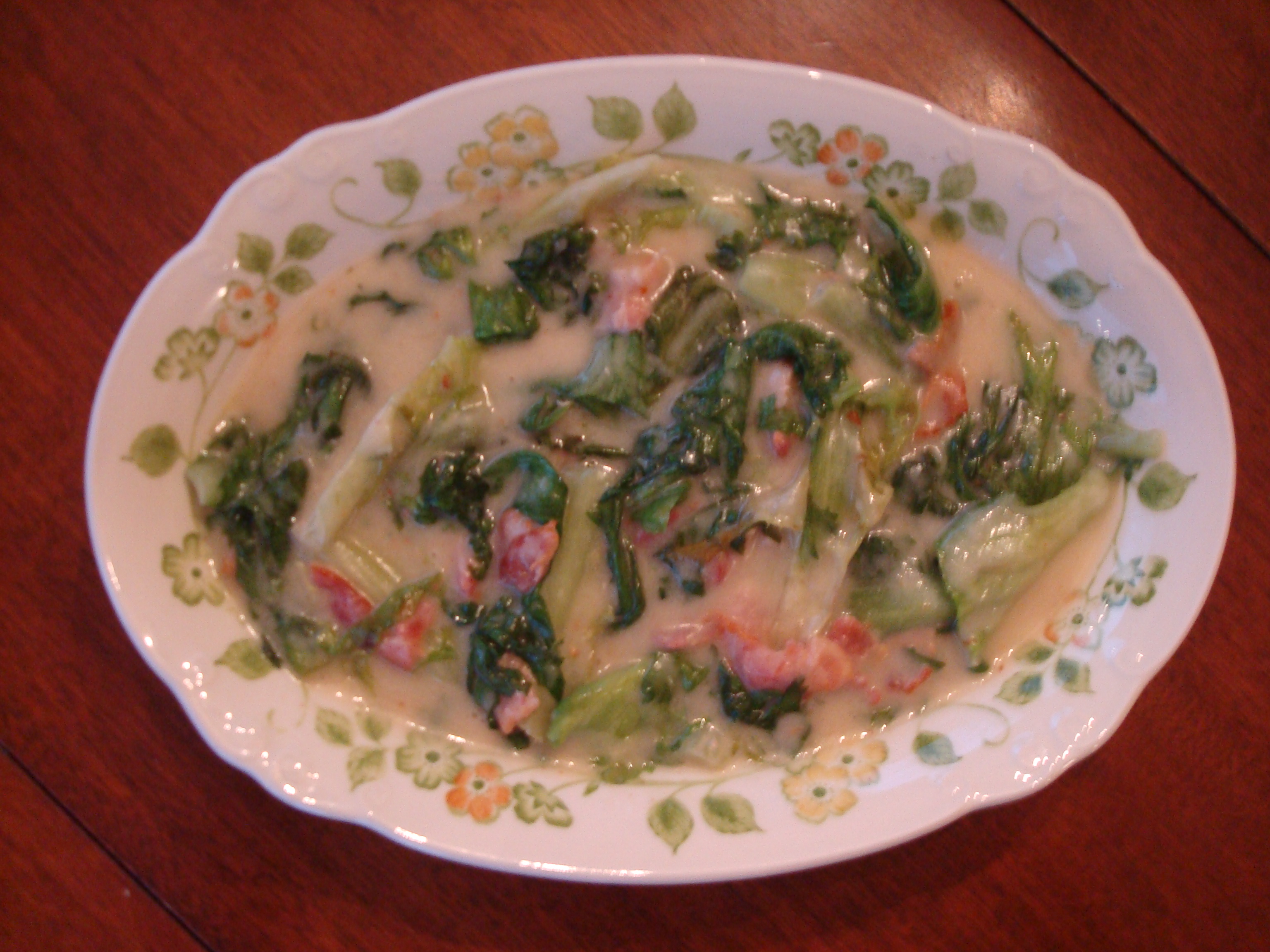
CREAMED DANDELION (ENDIVE)

4 cups dandelion (or endive)

3 slices bacon, chopped

1 1/2 tablespoons flour

1 heaping tablespoon sugar

2  tablespoons vinegar

1 cup milk

Mashed potatoes, if desired

Wash dandelion and tear into pieces; set aside.

Cut bacon into pieces and fry until crisp in a large skillet. Stir in flour, sugar, and vinegar. Gradually stir in milk; heat until bubbly using medium heat. Reduce heat to low; stir in dandelion and cover for 1 minute. Remove lid and stir until wilted. Delicious when served over mashed potatoes.