The Old Cow Died

19-year-old Helena Muffly wrote exactly 100 years ago today: 

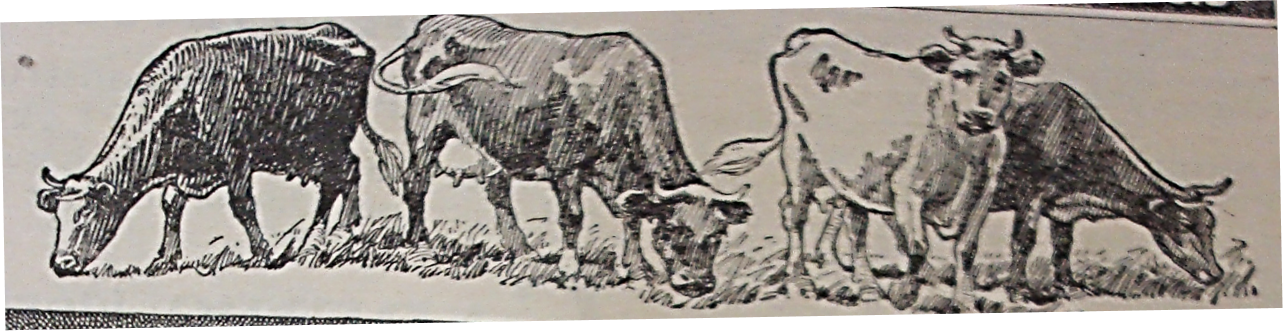
Monday, November 9, 1914:  The same old tune, the old cow died. That reminds me of Pa’s increase, namely cows. They arrived today.

Source: Kimball's Dairy Farmer Magazine (1911)
Source: Kimball’s Dairy Farmer Magazine (1911)

Her middle-aged granddaughter’s comments 100 years later:

Hmm. . . what did Grandma mean by the old cow died?

My first thought: Did a cow on the farm die? . . .Or was Grandma thinking about the end of her romance, and the phrase was an idiom that meant something else?

So I googled it, and discovered that there actually is a song called The Old Cow Died. According to Information Please, the words are:

The Old Cow Died

There was an old man,

and he had an old cow,

But he had no fodder to give her.

So he took up his fiddle and played her the tune:

`Consider, good cow, consider.

This isn’t the time for the grass to grow.

Consider, good cow, consider.’

You can also listen to it (with slightly different words) at: Smithsonian Folkways (click on “play sample”).

I’m still left wondering why the song popped into Grandma’s head. Maybe it was because her father bought some new cows. . . or maybe a somewhat melancholy song was just the right song to hum as she worked her way through the ending of a relationship.

Third Romance Ended in Tragedy

19-year-old Helena Muffly wrote exactly 100 years ago today: 

Sunday, November 8, 1914:  My thoughts are in some kinds of a tangled maze, for it is now November the eighth, and I have decided to begin on a new month at last. Perhaps this may be accounted for in the fact that my third romance has ended in a tragedy to me any way. I have given up all hope for none is left for poor me. No one knows, no one suspects that deep down in my heart there lies something which I would dare tell no one.

Blanche and Margaret B. were down this afternoon. Took their picture. Wonder how it will be for it was raining at the time.

DSC06502

Her middle-aged granddaughter’s comments 100 years later:

Oh Grandma, I’m so sorry. What happened?

I want to ask why you didn’t tell us about your romance via diary entries during the past few months. But, I know you’re feeling too bad to answer. I’m sure you had your reasons.

Blanche and Margaret Bryson were friends of Grandma’s. For more about them see these previous posts:

Blanche and Margaret Bryson

My Memories of Blanche Bryson Kramm

Milford, Margaret, Bertlet, and Blanche Bryson
Milford, Margaret, Bertlet, and Blanche Bryson (Source of Photo: Jane Shuman)

News Reel with War Scenes Shown at Theater

19-year-old Helena Muffly wrote exactly 100 years ago today: 

Friday, November 6, 1914:  <<no entry>>

Source: Milton Evening Standard (September 23, 1914)

Her middle-aged granddaughter’s comments 100 years later:

Since Grandma didn’t write anything a hundred years ago today, I thought that you might enjoy an article in Grandma’s local paper, the Milton Evening Standard, about the showing of a news reel about the War at the local theater.

(I should have posted this back in September. Somehow I lost track of it then, but decided that is still worth posting—even if it is a little late.)

Wait Two Days Before Complaining About a Late Magazine

19-year-old Helena Muffly wrote exactly 100 years ago today: 

Thursday, November 5, 1914:  <<no entry>>

Railroad tracks at Watsontown, PA
Railroad tracks at Watsontown

Her middle-aged granddaughter’s comments 100 years later:

Sigh—another day with no diary entry., but (smile) another day to go off on a tangent.

Are you indignant when a magazine doesn’t arrive in your mailbox on the anticipated date? . . . or is it par for the course?

Well, apparently the mail was so dependable a hundred years ago that people wrote to Ladies Home Journal to complain if their magazine was even one day late in arriving:

Concerning Late Delivery

There is a large part of the edition of The Ladies Home Journal that is not carried on regular mail trains but is shipped by the Government on freight trains. These copies are subject to the delays incident to that method of transportation.

Every copy sent to a subscriber is mailed by us at a time which should insure delivery on the twentieth of the month. Any delay in transportation is beyond our power to control as the Government selects its own methods of shipment regardless of the wishes of the publisher.

So if at any time your copy does not reach you on the twentieth of the month as it should do not write to us immediately, for the delay is probably not due to any fault of ours. Please wait for at least two days before complaining. The copy will probably be in your hands by that time.

Source: Ladies Home Journal (January, 1914)

The Can Opener

19-year-old Helena Muffly wrote exactly 100 years ago today: 

Wednesday, November 4, 1914: <<no entry>>can opener

Her middle-aged granddaughter’s comments 100 years later:

Another quiet day. . .

Since Grandma didn’t provide any clues about the direction this post should head, I thought you might enjoy this short essay about can openers in the December, 1914 issue of Farm Journal. Technology was changing the way meals were prepared—and it wasn’t like back in the “good old days.”

The Can Opener

This handy tool, the household pet, we ply with skill and speed; and in the modern kitchenette it’s really all we need. The shining tool that opens cans makes household work a joke; it supersedes the pots and pans, the stoves that used to smoke.

In olden times the toiling wives were always on their feet; they wore away their weary lives preparing things to eat. They fried the meat, they baked the beans, they cooked the spuds. They had no time for magazines, for euchre, or bridge whist.

How fortunate the modern wife, with many a leisure hour! For she can fill with glee her life, and languish in her bower.

And when at evening comes her man, impatient for the eats, she say, “I’ll open up a can of beans or deviled beets.” It takes three minutes by the clock to get his meal in shape; he’s so well trained he doesn’t balk, or try to make escape.

It may be, as hand over hand, he throws the victuals in, he signs for grub that isn’t canned, that doesn’t taste of tin. It may be that his vagrant mind recalls the old-time steak, the dishes of the good old kind his mother used to make. But idle are the man’s regrets, and vain his hopes and plans; this is the age of kitchenettes , and things put up in cans.

Walt Mason

Old Newspaper Article About Missing Spouses

19-year-old Helena Muffly wrote exactly 100 years ago today: 

Monday, November 2, 1914: <<no entry>>

Source: Milton Evening Standard (November 19, 1914

Her middle-aged granddaughter’s comments 100 years later:

Since Grandma didn’t write anything a hundred years ago today, I thought you might enjoy this article in Grandma’s local paper, the Milton Evening Standard. Sunbury was the county seat of the county where she lived.

Days Are Growing Murky

19-year-old Helena Muffly wrote exactly 100 years ago today: 

Sunday, November 1, 1914:

Chill winders are howling at us now,

And days are growing murky.

The weeks sweep on onto the doom,

Of the saddened sorrowful turkey.

DSC03318.crop.b

Her middle-aged granddaughter’s comments 100 years later:

Grandma-

Is something wrong? The poem this month seems gloomier than most. You’ve never looked forward to the coming of winter, but other years you also could see that there were also a few upsides to November.

Here are the November poems from previous years:

1913

November now is here again

Upon her scenes we’ll linger

Thanksgiving comes e’er she has gone

We count the days upon our fingers.

1912

November brings us many things

And among them is Thanksgiving

The first of the snow

The winds that blow

And all that makes life worthwhile.

1911

November, hastening before the fool steps of winter,

Brings back the stark realities of life.

It is not all the cup of brimming pleasure.

That crowns the triumph of a common strife.

Monthly Poems

Grandma began every month with a poem. For more details see this post:

Monthly Poem in Diary