Wanted: Recruits for an Army of Kitchen Soldiers!

Source: Good Housekeeping (December, 1917)

A hundred years ago, the United States (and many other countries) were engaged in World War I. Much food was being shipped to Europe to feed the troops, and women were being encouraged to support the effort.  Good Housekeeping magazine was even encouraging its readers to join the effort by becoming “Kitchen Soldiers.” Here’s a few excerpts:

Wanted: Recruits for an Army of Kitchen Soldiers!

Women of America, this is a call to you to enlist in an army of food conservation. It is an opportunity to fight a battle that is being waged as earnestly, as bravely, and as skillfully as any battle overseas. It is a call to put your heart and soul into winning this war — to be a Kitchen Soldier!

For Washington the Government is working with a giant’s strength. But the first official request is for cooperation. The Food Administration can make us think, can lay down great, broad, general plans, can tell us what our country and our Allies need. But then the burden comes to us–to work out for ourselves the details of the ways in which each one can serve best.

And that is where Good Housekeeping knows that it can aid you as a central point of contact, a clearinghouse of ways and means, a vast recruiting station for the women of this country.

If you are willing to play an active, vital part of saving food and making every meal a blow for freedom, send us your name to be enlisted in the Kitchen Soldiers’ Army. As a symbol of your devotion to the cause in which the Allied nations are engaged, you will receive from us a richly printed certificate. Hang it upon your kitchen wall to remind you of your pledge!

Good Housekeeping (December, 1917)

Desserts We Can Afford


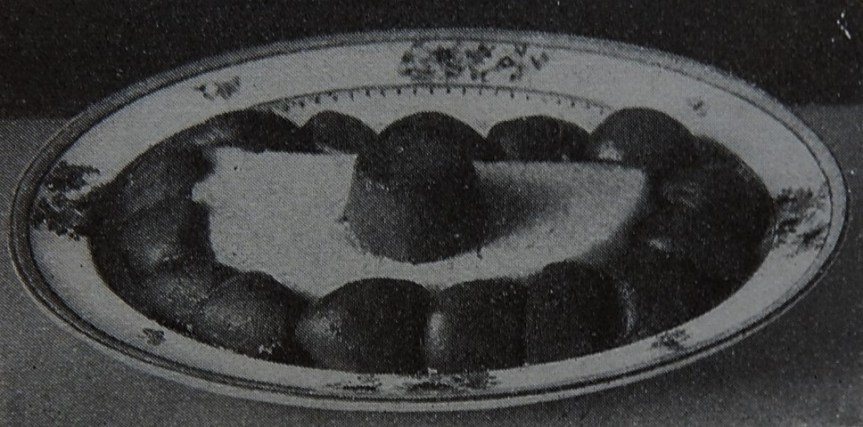
Photo Caption: Rice cooked with gelatin, molded when cold, and served surrounded with apricots makes a delicious dessert and a very healthful one. (Source: Good Housekeeping, November, 1917)

Do you ever worry about desserts being too expensive?

Well, it was also  a concern a hundred years ago. It was the middle of World War I, and food was costly.  Here’s some excerpts from a 1917 magazine article:

Desserts We Can Afford

Ought we to deny ourselves desserts? With all the stress that is being placed upon economy of food, many housekeepers are asking themselves this question.

But luncheon without dessert, or dinner without dessert, would be disappointing to many of us who crave something sweet with which to top off a meal. And what would the children do if they could not look forward and guess what was coming at dessert-time?

To omit desserts entirely is too much to ask in the name of economy. And it would be an unnecessary denial. At present, desserts often come as a superfluous course at the end of a heavy meal. This is a mistake. Do not omit them altogether, but make them count as food. They may be made from materials which furnish concentrated nourishment and that are rich in energy-yielding material. A simple, light meal, topped off with such a dessert will be rich in food value while being economical.

Just because you don’t like the old-fashioned rice pudding, don’t discard rice altogether for dessert. Rice, gelatin, and milk combine very attractively.

Fruits, home-canned or the commercially tinned variety, preserved or dried, are a source of inspiration for inexpensive dessert combinations. All of them combine exceptionally well with rice.

Good Housekeeping (November, 1917)

I only occasionally eat desserts – though this article brought back memories of always having dessert after both lunch and dinner when I was a child.  I’m probably using my only occasional dessert-eating as an excuse, but I decided to pass on making rice cooked with gelatin and served with canned apricots.
Keep Coffee Warm with a Thermos

Source: Good Housekeeping (October, 1917)

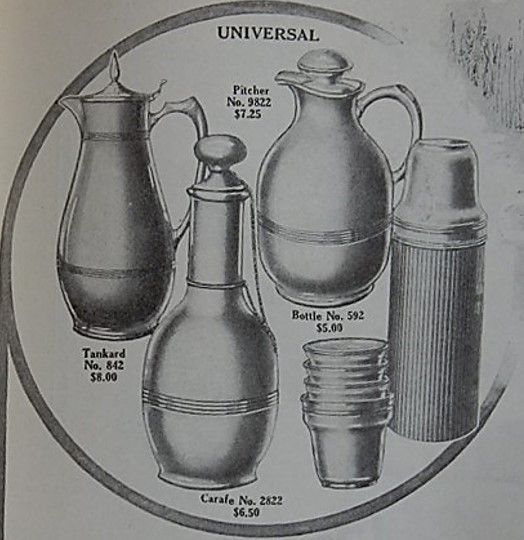
A household hints column in a 1917 issue of Good Housekeeping invited readers to send in their tips for possible publication Readers whose submissions were published received $1 from the magazine. One hint was to keep coffee warm in a thermos bottle when entertaining.

Let the Thermos Help Out

I find my thermos bottle comes in handy when I wish to serve coffee to more people than my percolator will accommodate. My percolator will hold six cups. This I make in the regular way an hour or so before I wish to serve it. Pour it into the thermos bottle, which of course, would keep it hot for hours, and then proceed to make another potful to be ready just in time to serve. The coffee in the thermos bottle I hold in reserve for the second helping.  — Mrs. M.E., Minn.

Good Housekeeping (October, 1917)

Soy: The Coming Bean

Soybean Plan (Source: Good Housekeeping, September, 1917)

According to a 2007 CNN story,  “Soybeans, usually in the form of oil, ­ account for an astonishing 10 percent of our total calories in the United States.” It was very different a hundred years ago when soybeans were a new crop in the U.S.  Here’s some excerpts from a 1917 magazine article promoting the use of soybeans. (Back then “soy” and “bean” were two separate words.)

Soy: The Coming Bean

The soy bean, also called the soja bean, is a native of south-eastern Asia, and has been extensively cultivated in Japan, China, and India since ancient times. The beans are there grown almost entirely for human food, being prepared for consumption in many different ways.

The soy is a coming bean if not the coming bean. It is on its way to arrival in the American kitchen and dining room.

The outstanding fact of importance to consumers of food in the United States today is that a nutritious, palatable, easily grown (and therefore eventually cheap) legume is being recommended by the food experts. Pressure of circumstances has revived interest in foods and combinations of food of which the majority were old and have been forgotten. The soy bean, however, is to practically all American cooks and to the large body of food manufacturers an entirely new product.

Good Housekeeping (September, 1017)

Hundred-year-old Advice for Avoiding Diabetes

Source of drawing under the “no” symbol: Lowny’s Cook Book (1912)

It’s fascinating to see what people knew a hundred years ago about the relationship between diabetes and the foods they ate. Here’s a Q&A on this topic in a 1917 magazine:

Avoiding Diabetes

Question: Can diabetes be avoided by a proper diet? If so, what food should one avoid to escape the disease?  I was told by a physician that diabetes was often inherited, but I want to try to escape it if it depends upon me. –E.L., New York

Answer:  No one can answer definitively your question in regard to avoiding diabetes. There is a general impression among physicians that diabetes is, to a certain extent, a diet disease; that is, it has been brought on through faults of diet.

This introduces the personal element. Why does one man eating a certain diet have diabetes and another man eating the same diet not have it? The answer is that one man is resistant and the other non-resistant; but this does not solve the problem.

I believe that if we would eat less carbohydrates, especially sugars, we would be less liable to diabetes. I would advise a simple, wholesome diet such as I would give any person who wishes to lead a correct life from the dietary point of view. I would emphasize the importance of avoiding the use of tea, coffee, chocolate, and tobacco. Sugar cakes, ice cream, pudding, and things of that kind would not enter into my diet scheme. Diabetes is not inherited, but the tendencies which make it possible may be. 

Good Housekeeping (September, 1917)

What Shall We Have for Breakfast?

There have been arguments over what constitutes a proper breakfast for at least a hundred years. Here are some excerpts from a 1917 article:

What Shall We Have for Breakfast?

Between the old-fashioned hearty breakfast and the coffee and roll of the slender modern meal, there is a golden mean. Those of us whose days are busy ones need to start them with plenty of nourishing food. This does not mean that we should overload the stomach, but it does mean that we should take sufficient food to keep from feeling faint in the middle of the morning.  The body needs to be “coaled up” just as a furnace does for a day’s work.

But steaks and chops every morning are out of the question. Some families, however, still regard the egg as the breakfast dish. Almost everyone wants fruit for breakfast. Stewed rhubarb is a healthful breakfast fruit. Apples, uncooked, baked, fried or in applesauce, cannot be improved upon.

Advertisements on packaged cereals usually quote alluring figures to prove how surprisingly low is the cost of cereals. And, yet, these do not seem so cheap when the housewife begins to cast up accounts! Many grains and cereals — oatmeal, hominy, and others —  can be purchased by the pound. This is particularly delicious with stewed canned berries.

Griddle cakes are always popular, and if well made, and quickly and thoroughly cooked, are light and digestible. If the family does not object to fried things, rice fritters will be enjoyed.

Good Housekeeping (October, 1917)


Old-fashioned Onion Toast

Sometimes simple foods are the best. Toast toppers are a favorite of mine for lunch or a light dinner, so when I saw a recipe for Onion Toast in a hundred-year-old magazine, I had to give it a try.

Mild, sweet onion slices embedded in a rich, creamy sauce are served over a classic French toast.  The bread was soaked in beaten eggs, and then grilled to create a delightful French toast that added an unexpected, but delightful, dimension to this dish.

In days gone by, this simple dish was probably seen as a way to stretch budgets when money was tight – but I would put this dish in the category of gourmet comfort food. This recipe is a keeper, and will become part of my repertoire of recipes that I regularly make.

Here’s the original recipe:

Source: Good Housekeeping (August, 1917)

When I made this recipe I wasn’t exactly sure what a Bermuda onion was, so I googled it and determined that it was a large, mild onion. But I was surprised to discover that in the late 1800s and early 1900s that large quantities of onions actually were imported into the U.S. from Bermuda. According to the Bermuda 4U website, after Mark Twain visited Bermuda, he wrote about its wonderful onions in Rambling Notes of an Idle Excursion:

The onion is the pride and joy of Bermuda. It is her jewel, her gem of gems. In her conversation, her pulpit, her literature, it is her most frequent and eloquent figure. In Bermuda metaphor it stands for perfection — perfection absolute.

Here’s the recipe updated for modern cooks:

Onion Toast

  • Servings: 2 - 4
  • Difficulty: easy
  • Print

Onion Sauce

2 onions, sliced (about 1 1/4 cups sliced onions)

3 tablespoons butter

2 tablespoons flour

1/4 teaspoon salt

1/8 teaspoon pepper

1 cup milk

French Toast

2 eggs

4 slices bread

1/4 teaspoon salt

pepper

butter

Onion Sauce: Melt butter in a skillet using medium-low heat, then add the onion slices and saute until the onions become soft and translucent.  Stir in the flour, salt, and pepper. Slowly add the milk while stirring constantly. Continue stirring until hot and bubbly. Remove from heat and serve over the French Toast.

French Toast: Beat eggs with a fork, then stir in salt and a dash of pepper.  Dip the bread slices in the egg mixture then place on a hot griddle that has been generously greased with butter. Using medium heat, grill until the bottom side of the bread is browned, then flip and cook the other side.

Cook’s notes: The original recipe called for 6 slices of bread, but I used 4 slices. I only had enough of the beaten eggs to coat 4 slices – and the amount of onion sauce seemed about right for 4 slices. I also did not scald the milk prior to stirring it into the onion mixture.