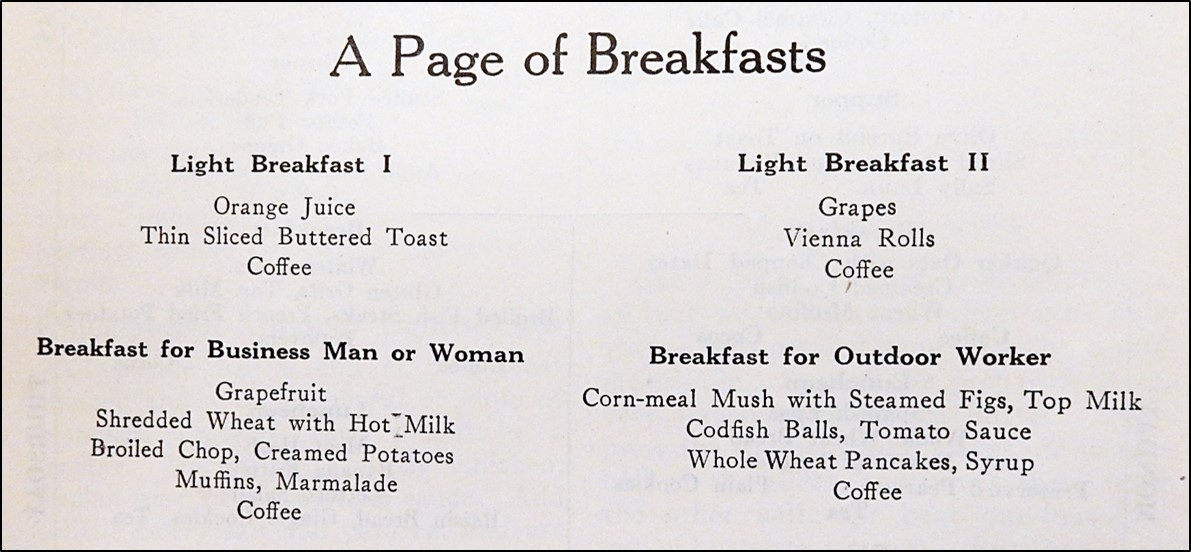
Across the years (and across regions and countries), there has been wide variation in what people eat for breakfast. In the early 1900’s many people ate heavy breakfasts. By 1920 there was a focus on lighter breakfasts for those who did less strenuous labor. The January, 1920 issue of American Cookery magazine contained several breakfast menus. The menus ranged for very light breakfast options to calorie-laden options.
Some things never change. People have always wanted to live healthier lives, and eating appropriate foods is considered a key part of healthy living. Both now and a hundred-years-ago, people worried that they were getting soft, and living lives not as conducive to health as their ancestors. Here are some excerpts from an article in a 1920 magazine on how to be healthier:
To Raise a Family in Whose Arteries the Blood Leaps
It is a matter of comment among many soldiers that the old men of Europe kept things going while the young men were at war. Women and graybeards kept the state alive, and took care of the nation’s affairs.
It was no rarity to see men seventy years of age in the morning look after the stock, and then go into the fields for real hard work.
What makes these people so hardy?
They live differently than we do.
It must be the simple life which provides these people with the panacea for a healthy old age. They do not know anything about dietetics. But neither do they know anything of high living. Their fare is of the simplest.
Can it be the fact that they eat meat but once a week that keeps them in such excellent condition? An excessive meat diet, while producing in life’s first half extraordinary energy and restless activity, leaves the body a used-up, empty shell after forty-five.
Can it be that on account of eating denatured grains (white flour bread) our children are suffering from eczema and eruptions?
Vegetables cooked in steam, and prepared with only butter, a little salt and pepper, will soon build up a run-down constitution.
Wild growing foods are bitter and full of fiber; they act in the stomach vigorously, like a brush. The bitter principles activate a copious flow of bile. The harness of the substance and the fibrosity required strong chewing. The vigorous exercise of the organs brought about a being with strength and muscular development.
Simple fare and correctly prepared foods will imbue the person with the chaste health of the country lassie. It will not develop excessive fat or obnoxious pugnacity.
One of the simple joys of life is the aroma of warm homemade bread when it first comes out of the oven. And, when the bread is thickly sliced and smothered with butter, it is one of my all-time favorite comfort foods. Though I’ve been making hundred-year-old recipes for years, I recently realized that I’ve never made a hundred-year-old recipe for White Bread, so when I came across a White Bread recipe in a 1920 cookbook, I just had to give it a try.
The bread did not disappoint. This classic white bread has golden crust, and a light and fluffy texture.
Here is the original recipe:
Source: Balanced Daily Diet (1920) by Janet McKenzie Hill
When, I made the recipe, I substituted a packet of dry yeast for each cake of yeast.
In a large bowl dissolve the yeast and sugar in the lukewarm water. Add shortening and half the flour; until smooth beat. Add salt and then gradually add the remaining flour until the dough reaches a consistency where it can be handled. Turn onto a floured surface and knead until the dough is smooth and elastic (about 10 minutes). Put in a large greased bowl, cover and place in a warm spot that is free from drafts until doubled in size (about 1 1/2 hours).
Punch dough down, then divide dough into four equal parts and shape into loaves. Place in four greased loaf pans, and cover. Let rise until doubled in size (about 1 hour).
Bake loaves in 375° F. oven for 35 -45 minutes or until lightly browned.
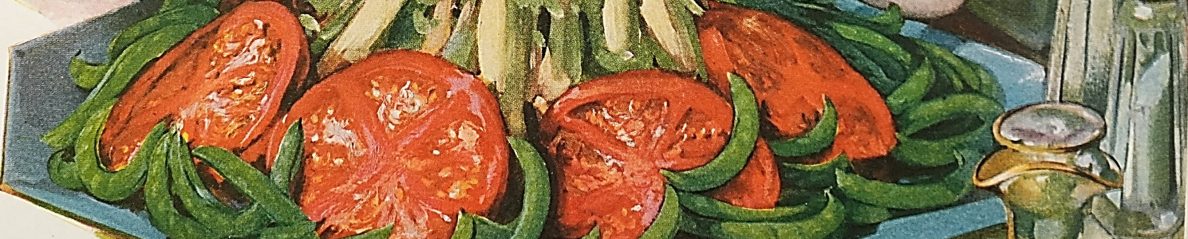
A popular 2020 New Year’s resolution is to eat better – and salads often top the list of “good” foods. People have been making similar resolutions for at least a hundred years. There is a poem near the front of the January, 1920 issue of American Cookery that is an ode to salads. Salads clearly were seen as a treat for epicureans. I think the poem also suggests that salads are healthy – though I’m not sure.
“Receipt” is an archaic term for recipe that was sometimes used a hundred years ago.
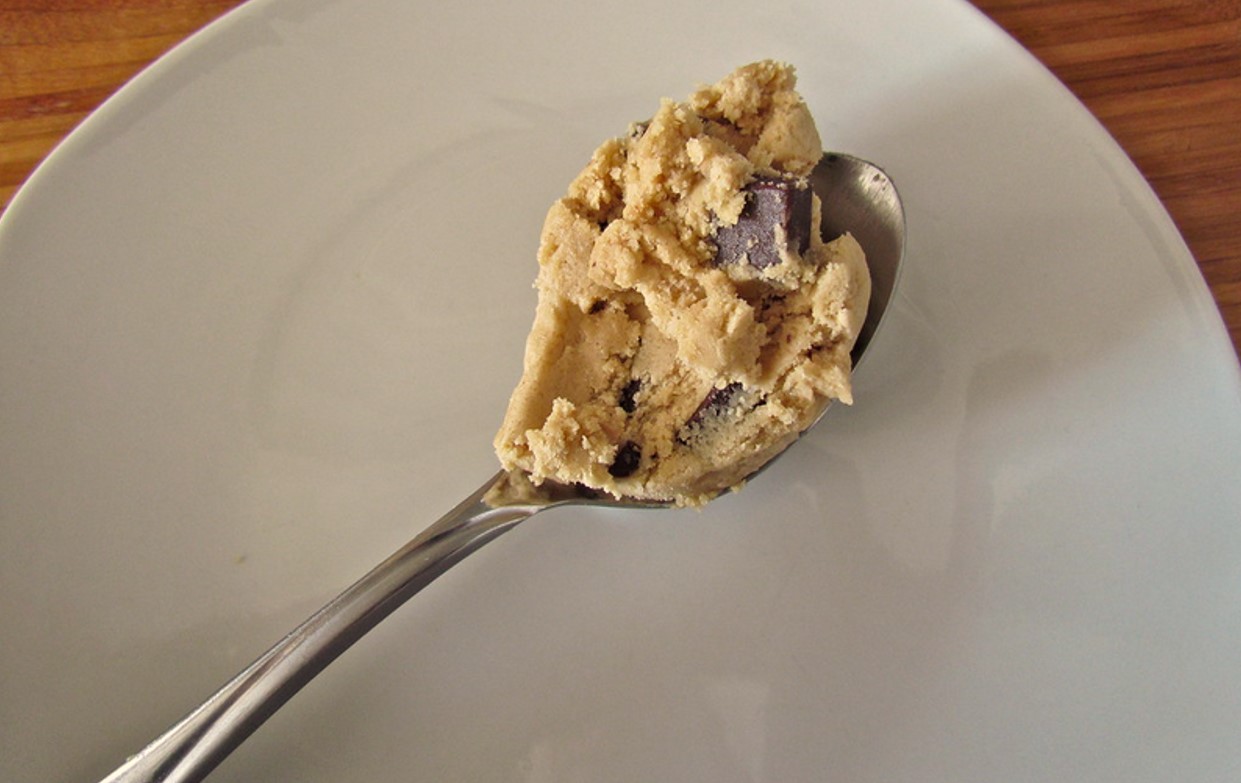
As the holiday baking season approaches, I’m always on the outlook for tips that will make it easier. So I was pleased to find advice for how to more easily make drop cookies.
To Drop the Cookies Easily
When making cookies or drop cakes, try using a teaspoon. Dip it in hot or cold water each time before putting in the mixture, and the dough will slides from the spoon without the aid of a knife or other spoon to push it.
W.M., Me.
Source: Good Housekeeping (November, 1919)
To be totally frank, I wonder whether this tip actually solves a major problem. Many cooks use cookie scoops to quickly drop nearly uniform balls of dough on a baking sheet when a lever is pressed. I still use a spoon, and I often push the dough from a spoon using another spoon. But, it goes very quickly, and I never really considered pushing the dough off the spoon to be a problem. It almost seems more time consuming to dip the spoon in water between the dropping of each cookie – but maybe others will find this tip very helpful.
Source – Household Engineering: Scientific Management in the Home by Mrs. Christine Frederick (1919)
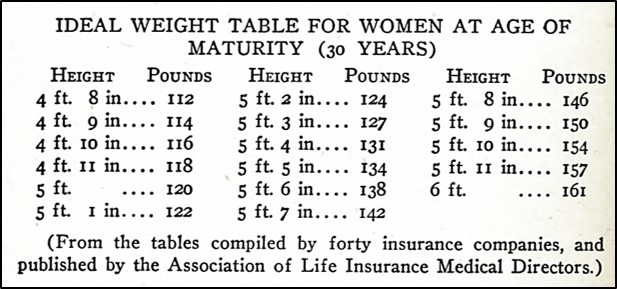
Some things haven’t changed much over the past hundred years. Similarly to now, people worried about their weight back then. A 1919 home economics textbook even contained a table that showed the “ideal weight” by height for a 30-year-old woman.
The book also offered advice for women about the importance of improving their eating habits:
Many women say, “Oh, I know I’m fat, but I feel all right anyway.” Nevertheless such women should practice those habits which will keep weight down automatically, no matter how well they feel, because (1) excess fat is unattractive from the appearance standpoint; (2) overweight after 35 years (according to the best insurance statistics) is closely associated with a high death rate; (3) an excess weight particularly handicaps efficiency in work or recreation.
Every homemaker, then, should closely estimate her own dietary. If she has servants and merely makes the beds or does light dusting, etc., then she needs only approximately 1,800-2,400 calories daily; but if she does most of her housework, including the heavier work of room cleaning, laundry work, etc., then she will need more nearly 2,500-2,800 calories.
Source – Household Engineering: Scientific Management in the Home by Mrs. Christine Frederick (1919)