How Many Dishes Do I Need?

List of dishes
Source: Housewifery by L. Ray Balderston (1919)

I used think that I have too many dishes, but then I can across a list in a 1919 book, and realized (at least by the standards of a hundred years ago), that I may not own enough dishes.

With regard to table equipment, the number of individual dishes is controlled by the size of the family, and the kind of service desired. Most housewives would choose dainty service and good style, and would prefer to have convenient dishes in adequate number and appropriate silver, even if less expensive china , and silver and glass is chosen. For such a standard, which is strongly recommended, buy twice as many of all individual dishes, glasses, and silver, as the number in the family. This makes possible entertaining with much less worry and work, and relieves one of the feeling of not having enough. It is certainly a reasonable standard to choose china, glass, and silver which is not expensive to replace and is, therefore, not a source of anxiety to the housewife.   

Source: Housewifery by L. Ray Balderston (1919)

1919 High School Lunch Menus

eight lunch menus
Source: American Cookery (October, 1919)

Does anyone like school lunches? I hear both parents and their children complain about them. According to my local school district’s website, today’s high school menu is:

Menu – October 24, 2019

Main: Italian Entree Choice
Grill: Grilled Chicken Sandwich
Salad: Italian Entree Choice

Smart Sides: Caesar Salad, Celery Sticks

But, is it worse than school lunches a hundred years? Somehow I just can’t imagine students today getting excited about Jellied Salmon.

Century-Old Advice for Giving an Awesome Toast

drawing of woman making a speech
Source: Source: Stickney & Poor advertisement, American Cookery (November, 1919)

Making a toast can be nerve-racking. And, it’s always especially stressful to decide what to say. It may be a little out of date, but here is some hundred-year-old advice:

Toasts for Dinner Occasions

Since much of the enjoyment of good toasts comes from clever local allusions, it would be difficult to make specific suggestions for dinners in general. Almost any subject, if well handled, will stimulate a good response. Such topics of current interest as the coal strike and the “wet” and “dry” issues, treated with humor and without political bias, furnish unfailing springs of interest.

Local practices and happenings, covert and complimentary allusions to the guest of honor, or to the business or profession of other prominent guests will be in order.

American Cookery (December, 1919)

The Last Fresh Vegetable Month

squash

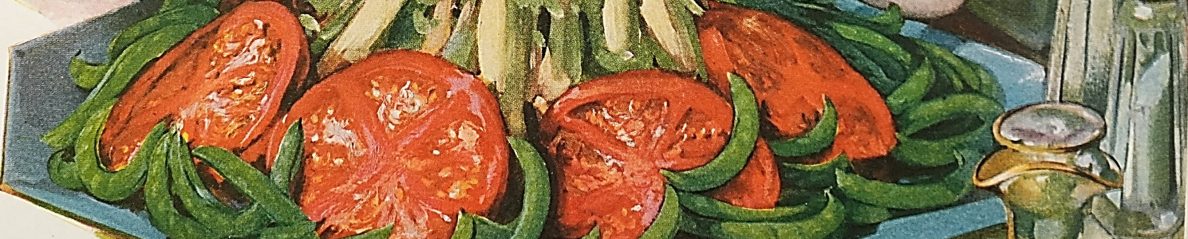
According to the October, 1919 issue of Good Housekeeping, October is the last fresh vegetable month:

The Last Fresh Vegetable Month

In October vegetables may still hold the post of honor on the table which is planned on a truly economical and sensible basis. By using freely and consistently what is in season, and by utilizing especially the delicious vegetable overflow, it is possible to lessen the meat bill appreciably. If we do use the abundant fresh vegetables lavishly when in season, it will make us feel more comfortable about the increased meat consumption, which the cold weather later makes necessary. The savings on meat and grocery bills when we effect by living largely on vegetables during the summer and fall will help us to balance the budget satisfactorily.  

A hundred-years-ago people apparently ate more meat in the winter than during the warmer months. I don’t think that my meat consumption varies much across the year, though I have vague childhood memories of having strawberry shortcake as the main course sometimes in June, and being told that, “We eat lighter in the summer because it’s hot.”

Save and Reuse Extra Butter

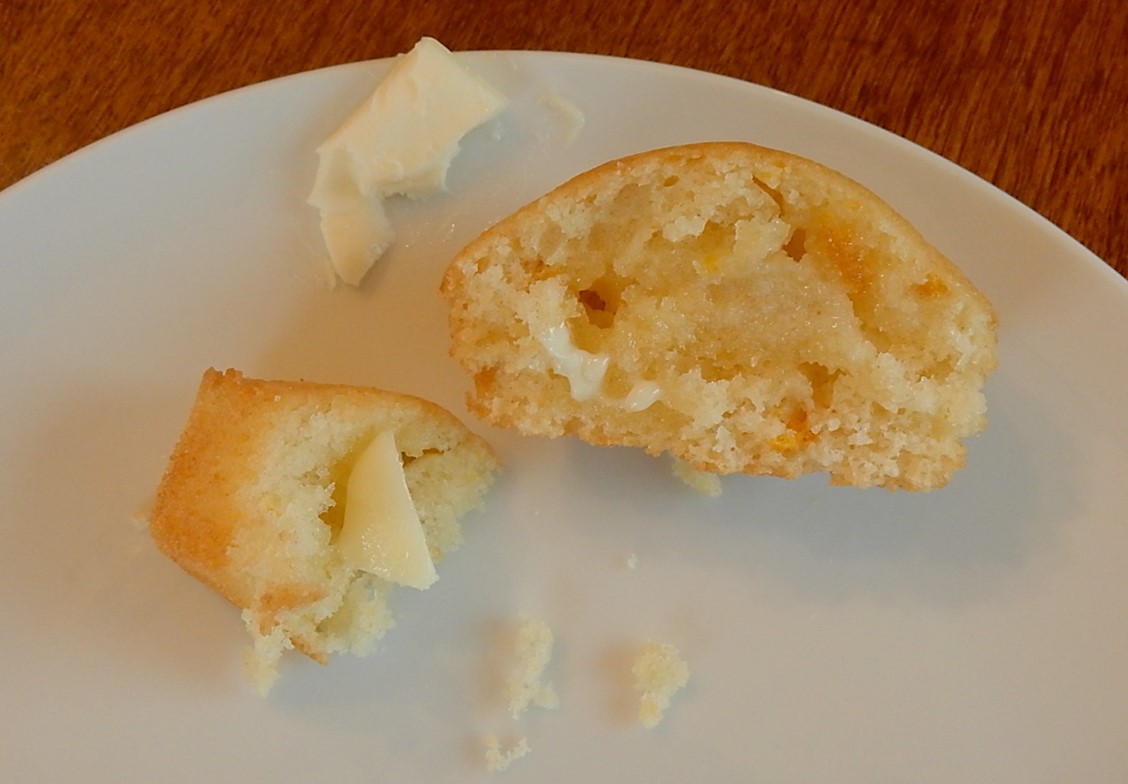
muffin with butter on plateFood must have been a lot scarcer a century ago than it is now. A hundred-year-year old magazine had this tip about how to successfully save those tiny dabs of extra butter that are sometimes left over after buttering bread:

Use bread and butter plates – yes, even if you do your own dishes. Every bit of left-over butter or margarine can be saved this way. It can’t be, or isn’t always, if put on the dinner plate.

American Cookery (August-September, 1918)

Is it just me, or does this tip seem slightly gross? At my house, I scrape any left-over butter off the plate and throw it away. Of course, I never use bread and butter plates, but still this seems a bit over the top.

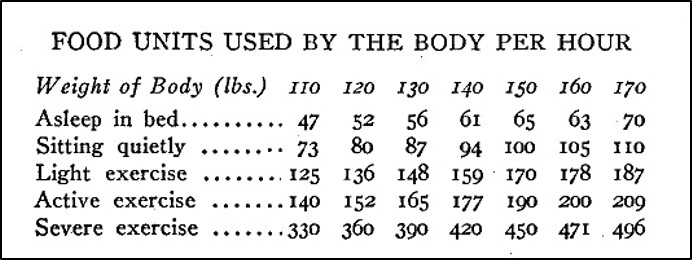
Calories Used Per Hour by Weight and Activity Level

Table
Source: Household Engineering: Scientific Management in the Home (1919)

People have wondered for a long time how exercise and other activities affect the number of calories needed. A 1919 home economics textbook contained this table with U.S. Department of Agriculture data on the “average calorific requirements of the body under different conditions.” The book contained examples of how the table could be used to calculate the number of calories needed by an individual:

A woman of about 130 pounds, sleeping for 8 hours, doing light housework 10 hours, reading, etc. 6 hours, would require (8 X 56) + (10 X 148) + (6 X 87) = 2,450 calories.  A boy of about the same weight with 8 hours sleep, 8 hours active exercise, 6 hours playing tennis (severe exercise) and 2 hours quiet would require (8 X 56) + (8 X 165) + (6 X 390) + (2 X 87) = 4,282 calories.   

Household Engineering: Scientific Management in the Home by Christine Frederick (1919)

hmm. . . I wonder if the information in the 1919 table is still considered correct.