Poem in Hundred-year-old Cookbook

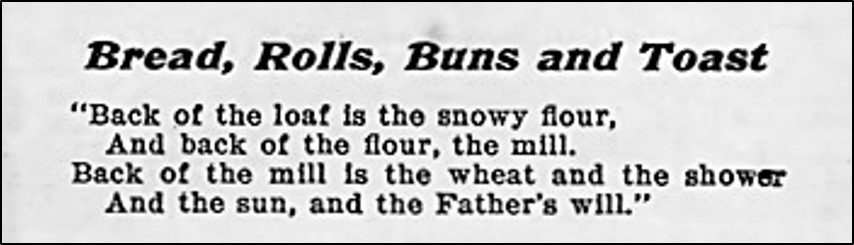
poem titled, "Bread, Rolls, Buns and Toast"
Source: The Old Reliable Farm and Home Cook Book (1919)

Old cookbooks sometimes have poems, such as this one in a 1919 cookbook. It was at the beginning of a chapter containing bread recipes. The poem lays out the path involved in creating a bread ingredient (flour). People were so much closer to agrarian life back then, and had a clear understanding of relationship between the weather, wheat production, the milling process, and flour. Would a similar poem resonate with cookbook users today?

Hundred-Year-Old Recommendation to Eat Bread Crusts

two bread crusts on a cutting boardSome people eat bread crusts and consider them the best part of a loaf of bread; others toss them in the trash. Apparently, the value of bread crusts is a long-standing question. Here are some excerpts from a 1919 magazine article:

“Eat the Crusts”

“Eat the crusts, dear,” grandfather used to say to me when on those delightful never-to-be forgotten childhood visits to grandpa’s house.

Whether it was because of the dear old man’s admonition and the love I bore I don’t know, but I do know that I have always eaten crusts and do yet.

In childhood I ate crusts because my elders said it was right to eat them, and as I grew up and went to high school and college, I took a more than passing interest in chemistry, and then I discovered the real reason why one should eat bread crusts. The heat of the oven has a particular effect on the starch and sugar contained in the flour of the wheat and changes it into dextrine, and the greatest amount of dextrine is found in the crusts, so that the crusts of bread are the most easily taken care of by the stomach.

American Cookery (October, 1919)

Kitchen Cabinets a Hundred Years Ago

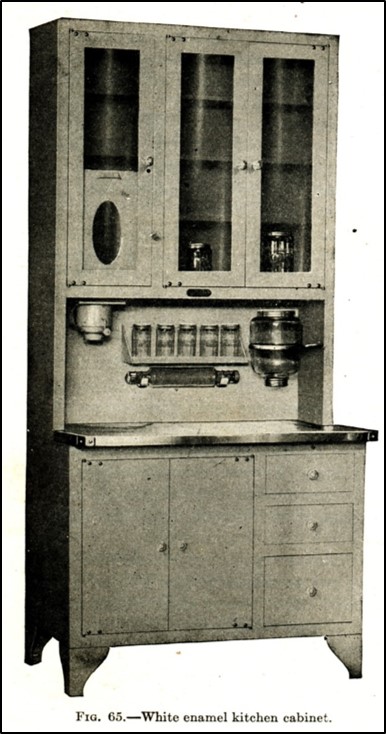
enambled metal kitchen cabinet
Source: Lippincott’s Home Manuals: Housewifery by Lydia Ray Balderston (1919)

Today built-in kitchen cabinets are the norm. A hundred years ago “modern” kitchen cabinets were moveable.

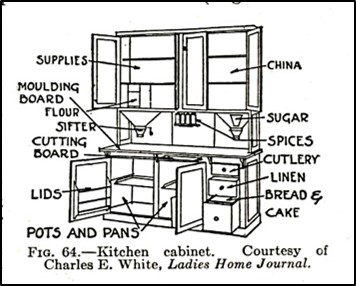
diagram of kitchen cabinet
Source: Lippincott’s Home Manuals: Housewifery (1919)

Here are some excerpts from the description of kitchen cabinets in a 1919 book:

Kitchen cabinets are combined tables and closets which have been constructed as the outcome of efficiency methods. They represent grouping about the working center the supplies and tools that belong to the work of that center.

Such cabinets may be purchased today in wood or in metal which has an enamel painted or enameled. The wood cabinets were the first on the market, and represent the same points in capacity and convenience that the metal ones do, but the question of cleanliness rather turned the attention to the metal ones. The metal cabinets are more noisy than the wooden ones, but are more likely to be proof against vermin, rats, and mice, and may be easily cleaned by water without becoming water-soaked. Metal cabinets are also nonabsorbent to odors and to any spilled food.

Lippincott’s Home Manuals: Housewifery by Lydia Ray Balderston (1919)

1919 Lazy Susan

Lazy Susan on a table
Source: Household Engineering: Scientific Management in the Home by Mrs. Christine Frederick (1919)

I associate Lazy Susan revolving servers with Chinese restaurants, but they actually have been used in other settings for at least a hundred years. Here’s what a 1919 home economics textbook said:

The so-called “Lazy Susan” or servette finds favor with the homemaker who is her own maid. This is a revolving circular wooden or glass disk, supported on a stand placed in the center of the table. Food laid on the disk may be revolved to each person in turn, thus saving “passing,” or frequent rising. It also saves space on the the table by giving a place to bread and butter, sauces, condiments and other small dishes.

Household Engineering: Scientific Management in the Home by Mrs. Christine Frederick (1919)

Hundred-year-old Tips for Storing Honey

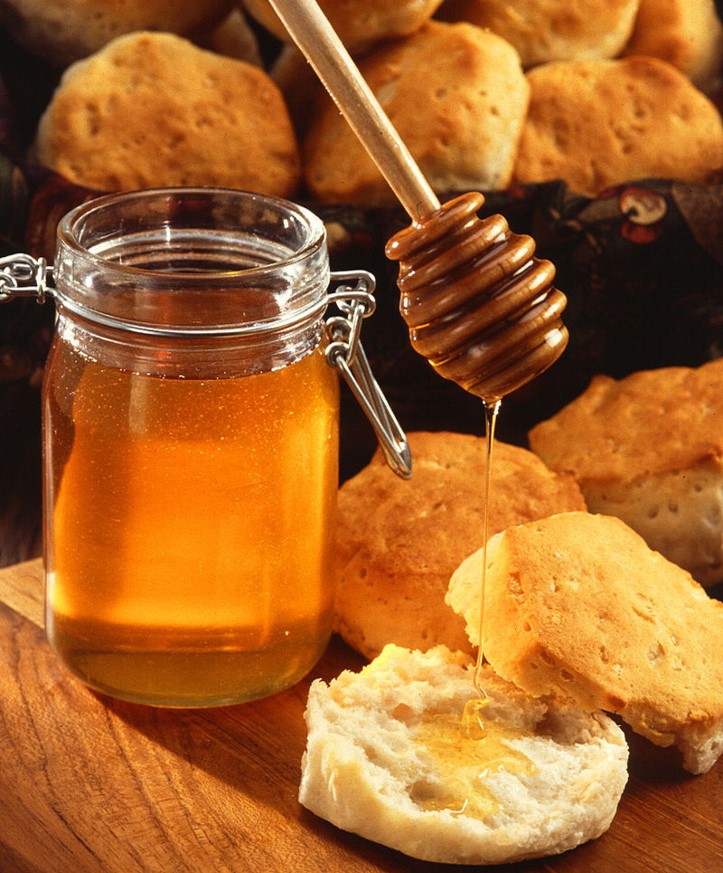
honey in jar

I keep a jar of honey in one of my kitchen cupboards, but never really thought about how to best store it until I read a short article in a hundred-year-old magazine. (When I read the article, I also realized that I never even considered storing honey in some of places where people apparently put it in 1919.)

How to Keep Honey

In using honey as a substitute for sugar, the housewife may encounter some difficulty through lack of knowledge in storing this product according to the American Food Journal. Housewives usually put their honey in the cellar for safekeeping, probably the worst possible place, as honey absorbs moisture from the atmosphere, and will become thin and in time sour. Comb honey kept in a damp place will be hurt in appearance, as well as in quality. A practicable rule is to keep honey in any place where salt remains dry. If honey has granulated or candied, put the can containing it in a large vessel holding water, not hotter than the hand can be borne in. If the water is too hot, there is danger of spoiling the color and ruining the flavor of the honey. The can of honey should be supported by a block of wood in the vessel of water, so that the heat from the stove will not be too intense.

American Cookery (January, 1919)

Berrying a Hundred Years Ago

wild strawberry plant

What was it like to pick wild strawberries a hundred years ago? Here’s a description that appeared in a 1919 magazine:

One might manage April and May, or even July, in the city, but a wild strawberry June belongs only in the heart of the country.

Do you know where these, the sweetest of wild berries, thrive? Up a hill road strewn with leaves, where an ovenbird calls and the red squirrel scolds, over a wall in a mowing, shut away from the rest of the world by pines and birches. A towhee hops on a crumbled stone fence. From remote woods is the trill of a thrush. A squirrel speaks out of the abundance of his irascible nature. The trees sway, the clouds trail their shadow across the slopes of the mountain.

Gathering wild strawberries is exceeding intimate work. Here they grow in a wide patch, to the exclusion of other plants, so thick that when you lean close to them and peek under the leaves you see a red-spotted carpet. Continued bending is painful. Continued squatting is impossible. You select a less fruited section and kneel. Then, preferring stains to stiff joints, you sit. Basket full, you cover the delicious sweetness with ferns and, then, there at the foot of the hill is the brook in which to dip your arms to the elbow and lave your hot face.

Excerpt from “Berrying” by Beulah Rector (American Cookery, June/July, 1919)