You might enjoy this hundred-year-old recipe for Valentine Milk Biscuit Novelties. These sweet biscuits with a cinnamon and sugar topping are tasty and easy to make,
Here’s the original recipe:
Source: Mrs. Scott’s Seasonal Cook Books (The North American Newspaper, Philadelphia, Winter, 1921)
The original recipe makes a lot of biscuits so when I updated the recipe I made it for half of the old recipe.
Preheat oven to 450° F. Combine flour, baking powder, sugar, and salt in a mixing bowl. Cut in butter. Add most of the milk and mix using a fork until dough starts to cling together. Add more milk if needed. Roll dough on a prepared floured surface into a rectangle 1/2-inch thick. Cut with heart-shaped cookie cutter. Brush with melted butter, then sprinkle with sugar and cinnamon. Place on an ungreased baking sheet. Bake for approximately 12-20 minutes (or until lightly browned).
Source: Mrs. Scott’s Seasonal Cook Books (The North American Newspaper, Philadelphia, Autumn, 1920)
Valentine’s Day parties used to be one of the big annual elementary school events. Remember making valentine “mailboxes” out of shoeboxes? . . . And, remember reflecting on who to give which card? And, the anticipation and suspense before opening the valentines?
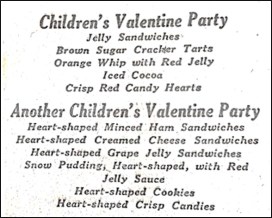
A hundred-years ago Valentine’s Day parties were also popular. A 1921 newspaper recipe supplement contained several menus for children’s valentine parties. Some of the recipes, like Brown Sugar Cracker Tarts, sound intriguing; others less so. Somehow heart-shaped minced ham sandwiches and heart-shaped creamed cheese sandwiches don’t quite work for me.
Source: Elementary Home Economics (1921) by Mary Lockwood Matthews
A 1921 home economics textbook offered these recommendations for a well-designed kitchen:
The Kitchen
The kitchen is a workshop where food is cared for, prepared, cooked and served.
The most convenient kitchen has windows or doors on two sides of the room, so that when these are open, a cross draft of air clears the room of smoke and odors.
The kitchen should be the cleanest room in the house. The most sanitary kitchen has walls finished in materials that can be washed, such as oil paint or tile. Walls and woodwork should be light in color, because this makes the room seem more cheerful and also makes it easy to “see the dirt”, which then may be removed.
Hard-wood floors may be oiled or waxed and used without covering. Soft-wood floors may be covered with linoleum or cork carpet, or they may be painted.
The kitchen should have built-in cupboards with plenty of space for utensils.
The sink, with a drain board at each end, should be set where there is plenty of light, and it should be open underneath to avoid the dampness often found in sink cupboards.
The kitchen may have a built-in ice-box arranged to be iced from the outside of the house. Some kitchens have a dumb waiter to the basement.
If an ironing-board is used in the kitchen, it may be built into a space in the wall, being let down when needed and folded back when not in use.
Other devices sometimes found in the kitchen are: a closet for cleaning implements, such as broom, bucket and brushes; a cupboard for the leaves of the dining-table, and a built-in kitchen cabinet. There may also be a pantry.
Each housekeeper decides for herself how to make the kitchen a well arranged and equipped workshop. In a well arranged kitchen the equipment is so placed the housekeeper can use it without losing time or wasting strength in walking.
Elementary Home Economics (1921) by Mary Lockwood Matthews
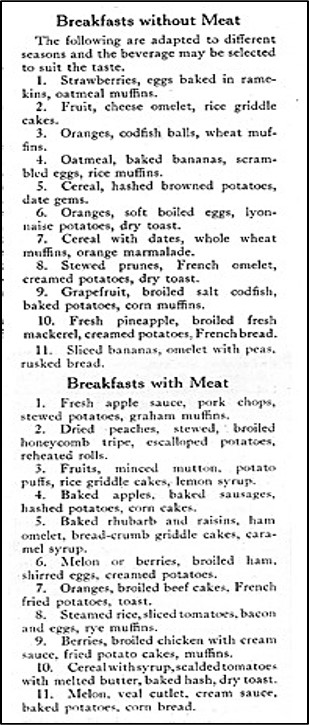
Most days I have cereal for breakfast. On week-ends, I may have a large breakfast with eggs, bacon, and toast. After looking at this list of 1921 suggested breakfast menus (with and without meat), I’m realizing that both my meatless breakfasts and my breakfasts with meat are relatively small by 1921 standards. To use 1921 terminology, I generally eat a “dainty” breakfast.
I never thought much about how many vegetables to serve at a meal until I read recommendations in a hundred-year-old home economics textbook, but my first thought was “the more the better.” That’s not exactly what the old book said:
Too many vegetables should not be served at dinner; the general rule of serving two is a good one to follow. Lettuce is usually served with any salad and would make the third. In choosing the two, it is better to select one starch and one green vegetable; the two being pleasing in taste when eaten together.
Elementary Home Economics (1921) by Mary Lockwood Matthews
Source: Household Arts for Home and School, Vol. II (1920)
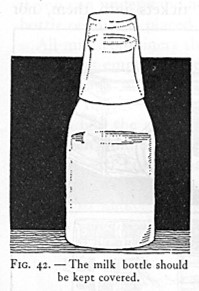
Other than putting the jug of milk in the refrigerator immediately after I get home from the supermarket, I don’t think much about how to keep the milk clean and fresh. A hundred years ago, people worried a lot more about maintaining milk quality. Here’s what it said in a hundred-year-old home economics textbook:
There are many very important things to know about milk, but nothing is more important than to know how to care for it in the home. Because it is such a perfect food, it is a very good place for germs to grow.
Be sure to wash the bottle before pouring out any milk. Get into the habit of doing this. You do not know what kind of dirt may have come in contact with the bottle after the milk was put into it.
If milk is left in the bottle replace the cap or, better, provide a clean one. A cup or glass may be inverted over the bottle. Do not pour the milk into another utensil unless necessary. If necessary, be sure that the container is absolutely clean. Milk very readily absorbs the odors and flavors of other food in the refrigerator, and this is another good reason for covering it.
Sometimes milk is not delivered in bottles but is dipped from a can and poured into pans or pails. Be sure that the pans are scalded and kept covered until the milk id delivered. Do not put milk tickets into them, or leave them uncovered on the doorstep. If milk is bought at the grocery store one should not walk through the streets with the pail uncoverered.
As soon as the milk is delivered the bottle should be washed and put into the refrigerator. If allowed to stand in a warm room it sours very quickly.
All milk containers should be rinsed with cold water as soon as empty. They should then be washed with clean, soapy water and rinsed with scalding water. In the summer time it is a good plan to boil the pans and pails with soda water for fifteen minutes.
Household Arts for Home and School, Vol. II (1920) by Anna M. Cooley and Wilhelmina H. Spohr
[The book also contained directions for making a homemade cooler for those who did not have a refrigerator – but that is potentially another post, another day.]
Source: Household Arts for Home and School (Vol. II), 1920
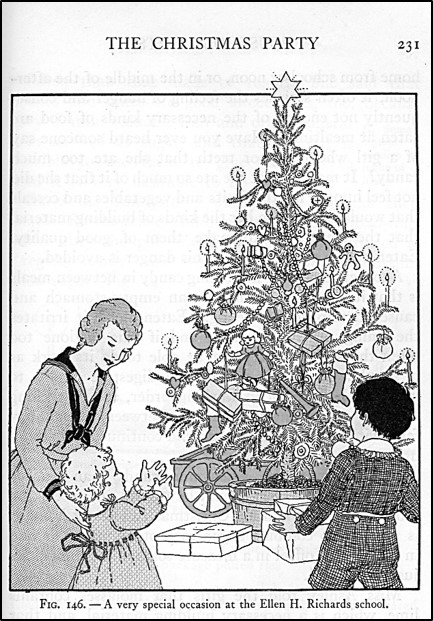
A 1920 home economics textbook contained a running storyabout the activities of a “household arts” class. Here’s some excepts from the section about preparing foods for a Christmas party for younger children at the school:
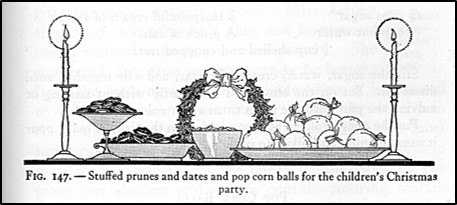
When the Christmas party was planned each of the classes did its share to help. The household arts classes helped to fill the boxes and stockings with homemade candy and tied up many pop corn balls.
The girls enjoyed wrapping their boxes and pop corn balls in bright-colored papers to hang on the tree. Miss Washburn, the art teacher helped the girls make them attractive. Christmas gifts, however small, she said always give more pleasure when special care is given to the wrapping and tying. There was no danger in covering the pop corn balls with colored paper for they were first wrapped in waxed paper.
Household Arts for Home and School (Vol. II) (1920) by Anna M. Cooley and Wilhelmina H. Spohr

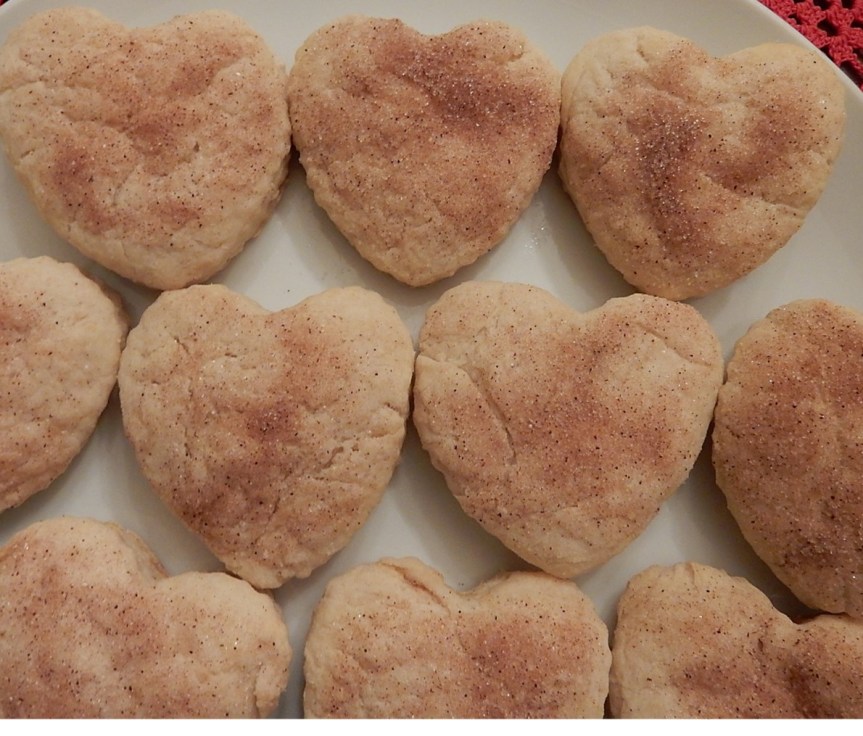 Happy Valentine’s Day!


 I never thought much about how many vegetables to serve at a meal until I read recommendations in a hundred-year-old home economics textbook, but my first thought was “the more the better.” That’s not exactly what the old book said: