15-year-old Helena Muffly wrote exactly 100 years ago today:
Sunday, March 19, 1911: I went to Sunday school and church this morning. I saw such a pretty baby today with a head fairly covered with thick auburn hair. It struck me that I looked something like that baby when I was about her age. I had so much hair then with a bit of waviness in it, and dimples in my smiling cheeks, but this is enough flattery for one night. I must scratch gravel off and to bed, and to my sweet beautiful dreams, so vivid and real.
15-year-old Helena Muffly wrote exactly 100 years ago today:
Thursday, March 16, 1911: It has been so biting cold today. We all crowded around the stove at school this morning, and about all I did was to shiver for I couldn’t study. Well I am shivering now, this room is rather cold. I must hurry off to bed.
Her middle-aged granddaughter’s comments 100 years later:
I’ve seen several lists of events that occurred during 1911. Two things of note happened exactly 100 years ago today:
(1) Nazi war criminal Josef Mengele was born in Bavaria (Germany) on March 16, 1911. He was the physician responsible for many deaths at the Auschwitz-Birkenau prison camp during World War II, and is sometimes called the “Angel of Death”. World War II seems like it happened very, very long ago. It’s kind of amazing that an infamous figure in that war was just an infant a 100 years ago. Mengele would have only been in his early 30s during the war—I don’t think that I ever thought about his age before, but I had pictured him being older.
Las Vegas a Hundred Years Later
(2) The city of Las Vegas was incorporated on March 16, 1911. It is the largest city founded during the 20th century in the U.S. It’s hard to imagine how parts of the west were still the “wild west” a hundred years ago–though I guess in a different way, today Las Vegas still is the wild west.
Neither of these events would have been news outside of their local community in 1911. Only subsequent events many years later made them become history timeline material.
15-year-old Helena Muffly wrote exactly 100 years ago today:
Wednesday, March 15, 1911: It snowed last night, and the trees were covered thick with snow. My, but it was an exquisite night, but it soon vanished, for by noon the trees were as bare as ever. We got our reports cards today. Some of my marks were something wonderful. As a whole I seem to be a wonderful girl and something out of the ordinary.
15-year-old Helena Muffly wrote exactly 100 years ago today:
Sunday, March 12, 1911: Tweet slept with me last night. I was rather restless. Don’t know whether she was the cause or not. This afternoon I went to Sunday school and church, staid for catechize. Besse and Curt were out this afternoon. I guess they just happened to come because we had some ice cream left from dinner.
Her middle-aged granddaughter’s comments 100 years later:
Grandma faithfully attends Sunday school in the diary. I’m still trying to figure out why the Baptist Church in McEwensville which Grandma apparently attended closed and vanished from the scene a few years later (See February 5 entry).
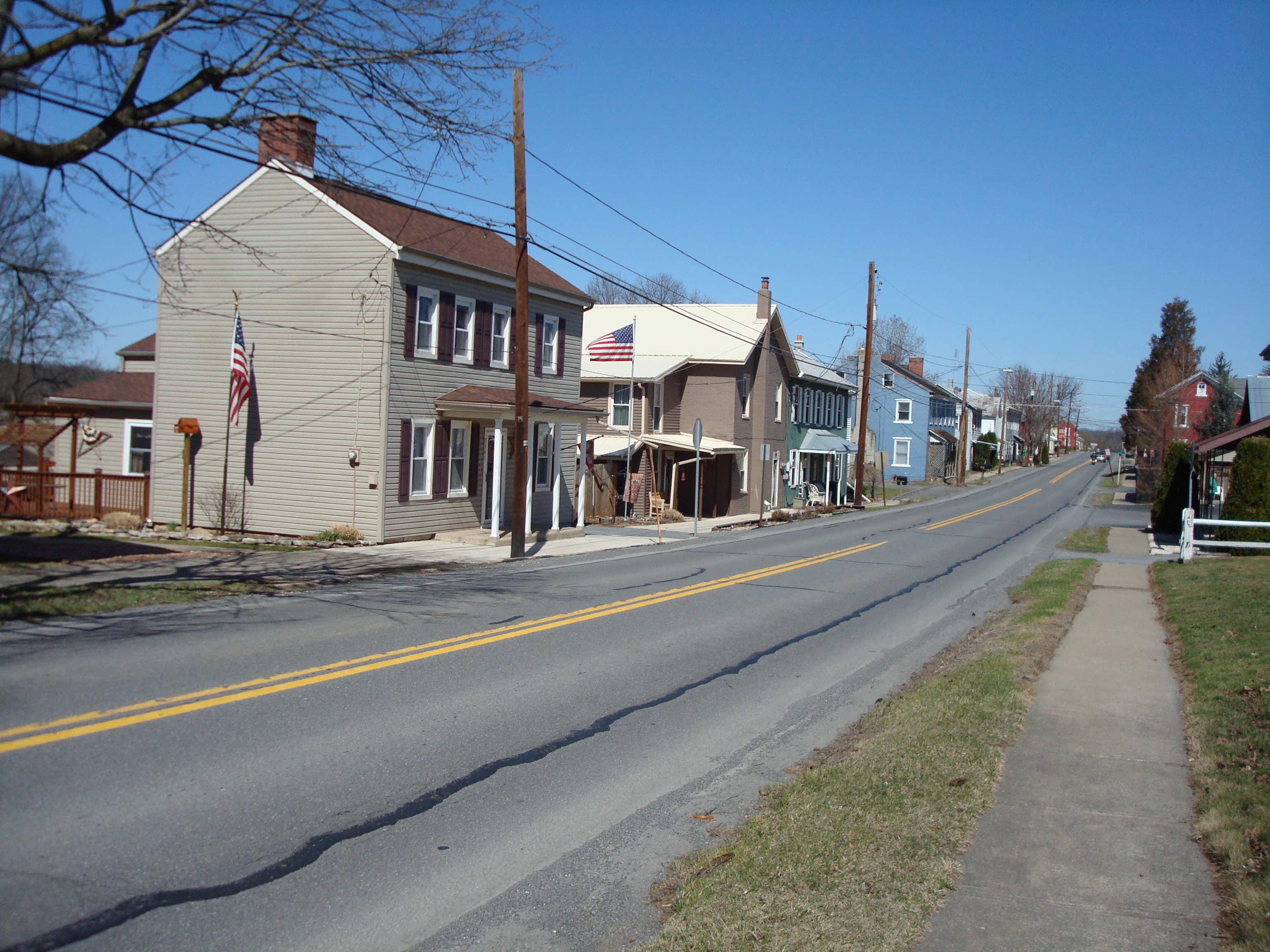
The Baptist church building was demolished years ago, but it was located somewhere in this section of Main Street.
There were many different denominations and ethnically-based churches scattered across rural America a hundred years ago. And memories were still strong of the ancestors who had migrated to the United States for religious reasons. Those who traced their ancestry to Germany often attended a Lutheran or Baptist church. The Scot-Irish generally were Presbyterian and so on.
There were a number of church closures early in the 20th century and the McEwensville Baptist probably was caught up in those closures. As the older generation passed on–and the differences across the various protestant denominations seemed less clear to younger people–many tiny, struggling rural churches closed.
Also, in 1911 national leaders in the United States believed that there was a “rural problem” because so many rural youth were migrating into the cities. The Country Life Commission published a plan for revitalizing the countryside a hundred years ago. The Commission believed that little rural churches with few social activities and members who bickered with members of neighboring churches were part of the problem with rural life—but that churches had a role in revitalizing rural America. (I’ve heard elderly people say that in the old days you knew people didn’t get along if there were more churches in a town than bars.)
The present system of little struggling churches involves great financial and moral waste, divides rural people instead of uniting them. . . Still, federation and cooperation embody the dominant spirit of the age we are now entering . . .
If the church is to play any important part in rural reorganization, it must evolve a program for social betterment and make its ministrations such as will enable it to render effective social service. Only a giving church is a growing church. There are many real needs of rural people which today call for ministration, and the church should set itself the task of finding these and trying to serve them.
Rural Life and Education: A Study of the Rural-School Problem as a Phase of the Rural-Life Problem (1914) by Ellwood Cubberley
That said, in 1911 the McEwensville Baptist Church seems to be meeting Grandma’s needs. She mentions attending church or Sunday school every week in her diary.
15-year-old Helena Muffly wrote exactly 100 years ago today:
Saturday, March 11, 1911: I had to bustle around and do some work today. I did most of it this forenoon and too a rest this afternoon. Helen Wesner alias Tweet was coming down to go along with Rufus to a play at W. tonight and I poor kid had to stay at home.
Her middle-aged granddaughter’s comments 100 years later:
This is the first time in the diary that Grandma referred to Helen Wesner as Tweet—though she’s previously mentioned her. (And, be sure to see the Tweet ‘Tweeting’ posting.)
Grandma calls her sister Ruth Rufus in this entry. Both Ruth and Helen were three years older than Grandma. W. probably refers to the nearby town of Watsontown.
15-year-old Helena Muffly wrote exactly 100 years ago today:
Monday, March 6, 1911: I passed a rather restless night. I was most too tired to sleep. I did some moaning before the night was over. It snowed in the night. Daddy took me to school this morning. What M.C.R. did at S. Was so electrified for a few moments. I got a ride home tonight. Did today’s walking yesterday.
Her middle-aged granddaughter’s comments 100 years later:
I have no idea who M.C.R. was (another unsolved mystery in this diary!) or what was done—but it sure seems to have made an impression. Today’s “walking yesterday”, refers to walking the rails to Turbotville the previous day.
15-year-old Helena Muffly wrote exactly 100 years ago today:
Sunday, March 5, 1911: I went to Sunday school this morning. Carrie Stout and I walked to Turbotville this afternoon going up the rail road. We were rather weak in our feet by the time we got home. Ruth and I went to church this evening.
Her middle-aged granddaughter’s comments 100 years later:
Whew, this was a hike. It’s about 5 miles each way via road and it may be a little further on the railroad tracks. In 1911 the roads weren’t paved yet, and Helena and Carrie were probably trying to avoid the mud by walking on the railroad.
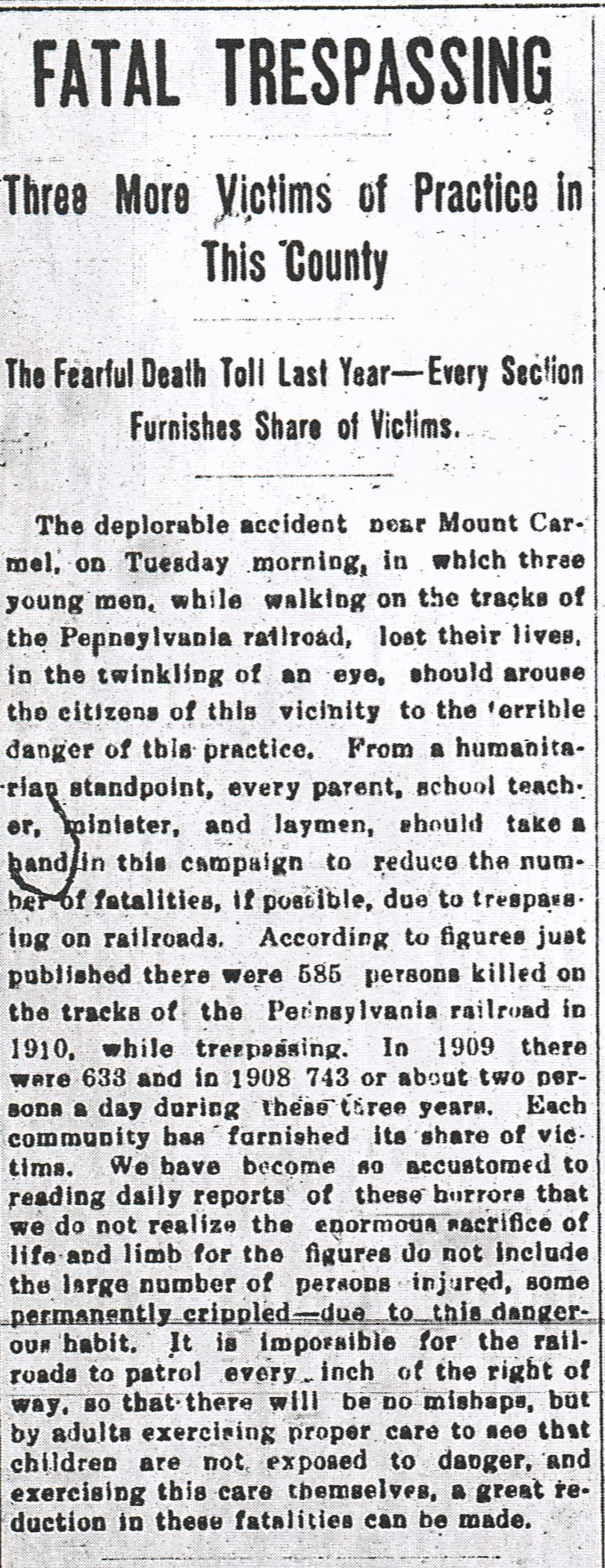
Apparently lots of people walked train tracks in those days even though it officially was considered trespassing and could be dangerous. Below are excerpts from an article in the local paper, the Milton Evening Standard, that was written less than two months before Grandma and Carrie walked the rails.
Article in Milton Evening Standards, January 19, 1911
FATAL TRESPASSING
Three More Victims of Practice in the County
The Fearful Death Toll Last Year—Every Section Furnishes Share of Victims
The deplorable accident near Mount Carmel on Tuesday morning, in which three young men while walking on the tracks of the Pennsylvania railroad lost their lives in the twinkling of an en eye, should arouse the citizens of this vicinity to the terrible danger of this practice. . .
According to figures just published there were 585 persons killed on the tracks of the Pennsylvania railroad in 1910, while trespassing. In 1909 there were 633 and in 1908 743 or about two persons a day during these three years. Each community has furnished its share of victims. . .
We have become so accustomed to reading daily reports of theses horrors that we do not realize the enormous sacrifice of life and limb for the figures do not include the large number of persons injured, some permanently crippled—due to this dangerous habit. . .
It is impossible for the railroads to patrol every inch of the rights of way, so that there will be no mishaps, but by adults exercising proper care to see that children are not exposed to dangers, and exercising this care themselves, a great reduction to these fatalities can be made.