16-year-old Helena Muffly wrote exactly 100 years ago today:
Friday, March 31, 1911: I got kicked today, and it was such a violent one that it caused me to land on my back. It was by a modest cow, who happened to kick me and the bucket at the same time. I guess I was as much surprised as she was.
Her middle-aged granddaughter’s comments 100 years later:
Whew, that sounds like it hurt. I continue to be amazed at how seldom Grandma mentioned her routine farm chores in the diary. Even though she probably milked cows twice a day—it only merited recording when an unexpected or painful event occurred.
16-year-old Helena Muffly wrote exactly 100 years ago today:
Thursday, March 30, 1911: I saw a rainbow this evening. I am trying to prepare myself for my final examinations. It’s a most difficult task when you don’t feel like it. I just happened to get a spot of ink on the bureau spread. I soon fixed it though.
Her middle-aged granddaughter’s comments 100 years later:
In the old days the top of a bureau (tall chest that held clothes) was covered with a decorative embroidered or crocheted cloth. I suppose that Grandma was using a fountain pen—ball point pens won’t be invented for another forty years or so–to write the diary entry and a little ink dripped on the bureau cloth.
It can be tricky to successfully remove ink stains. A book published in the early 1900s explained how to get them out:
To Remove Ink Stains
Whenever ink is spilled, salt should be thrown upon it at once and renewed frequently until as much of the ink has been absorbed as is possible. It is impossible to give an unfailing rule for the removal of ink stains for the reason that the solvent to be applied varies with the composition of the ink. The following processes have, however, been pursued with success. . .
With Common Household Materials. Soak in lemon juice and salt, vinegar and salt, or pieplant juice and salt. [an aside: Pieplant is an archaic term for rhubarb.] Rub for a time, apply more salt, rub again, so continuing until the ink disappears. These acids may any of them exert a harmful action and should, therefore, in all cases, be tried upon a small sample of the goods, before being applied to the whole article.. . .
To Remove Ink Stains from Colored Goods. If ink is spilled on colored goods, wash in milk (either sweet or sour) and salt. Rub for a time, apply more salt, allow to soak, then rub again; continue this process until the stain disappears.
To Remove Purple Ink. Absorb all possible with blotting paper or salt, while the ink is fresh. Afterwards apply alcohol and glycerine in equal parts, and rub and sponge the stained spot with this mixture until the ink disappears.
Juanita Shepperd in Laundry Work for Use in Homes and School (1909)
——————-
The school year was shorter a hundred years ago than it is now. Back then the school year ended in early April because families needed their children at home on the farm to help with the spring planting.
16-year-old Helena Muffly wrote exactly 100 years ago today:
Tuesday, March 28, 1911: W.J. Dentler was up at our school awhile this morning. We hustled at our lessons but fortunately he left before we had any classes. He also came down to see Ruth and bid her good-bye I suppose.
I got an invitation to the commencement today, and now I’ll be in for getting another present. Alas my pocketbook.
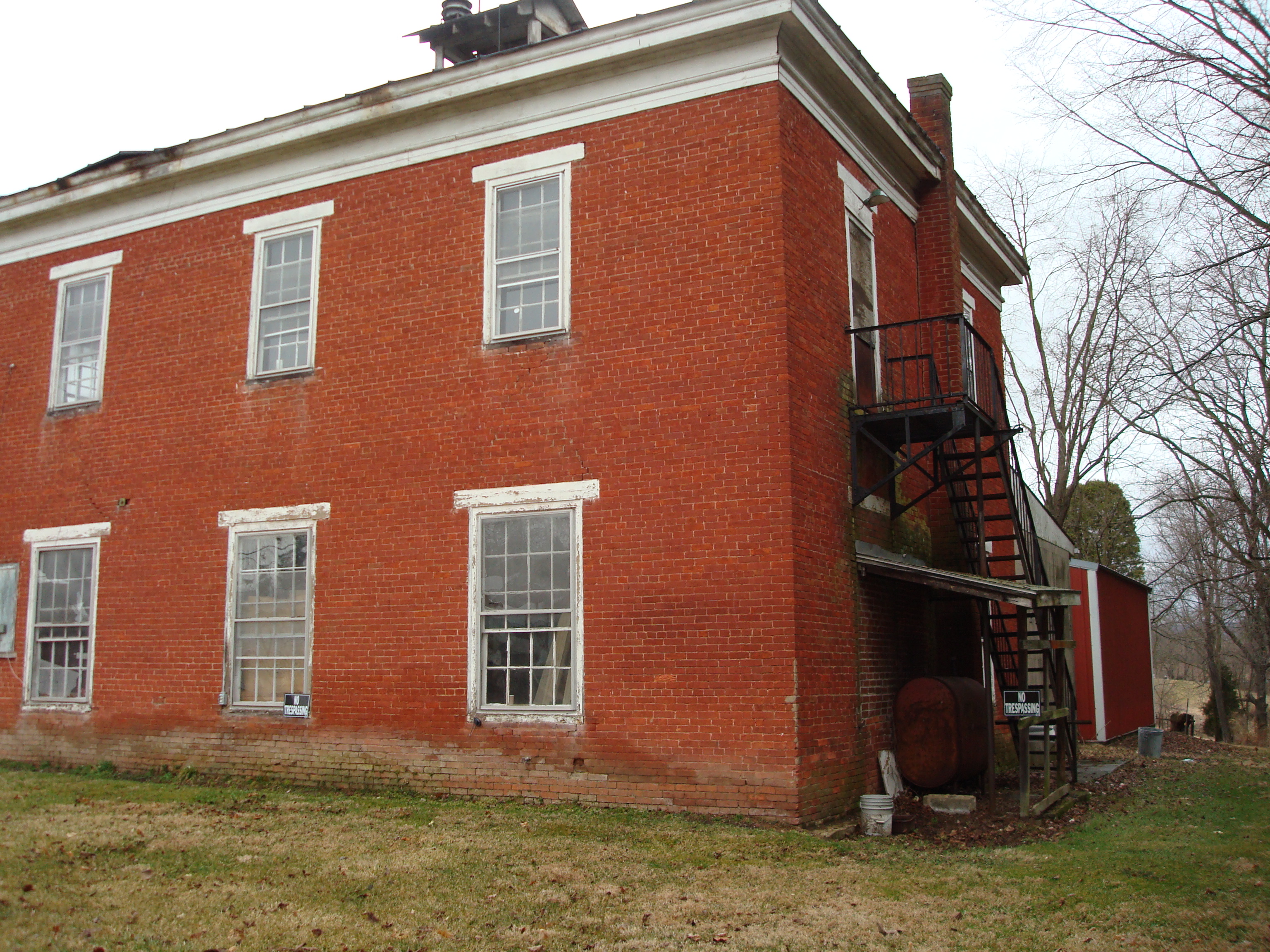
Recent photo of abandoned building that once housed McEwensville High School.
Her middle-aged granddaughter’s comments 100 years later:
Entries like this one are very frustrating. They raise many questions—none of which I’ve found any answers to.
W.J. Dentler is mentioned nowhere else in the diary and I have no idea who he is. Since W.J visited McEwensville High School, my first thought was that he was a school official (country superintendent, school board member), but then Grandma discusses him coming to the Muffly farm to say good-bye to her sister Ruth.
Was W.J. a former or potential beau of Ruth’s? Where was he going? Maybe he was someone who graduated from the high school a year or two prior to the diary entry—and came back as an alumni to visit.
Two days previously Grandma’s diary entry mentioned Ruth “chasing” another guy—James Oakes. It seems like there may have been some sort of mismatch between the guys that Ruth thought were cute and the guys who thought she was cute. (Ah—I’m glad that I’m past all of intrigues of the teen-aged years.)
16-year-old Helena Muffly wrote exactly 100 years ago today:
Monday, March 27, 1911: I got caught in a rainstorm while coming home from school this evening, but I soon got out of it. Bessie was out this afternoon to freshen Rastus up with some news.
15-year-old Helena Muffly wrote exactly 100 years ago today:
Sunday, March 26, 1911: Went to Sunday school and church this afternoon. Mother is busy reading a novel, and I’m making this entry in her room, because I can’t have the light. Ruthie has the honorable James B. Oakes down in the sitting room, but she had to go after him or he wouldn’t have been here. Papa is down there also, so nothing will happen. Tee hee, poor me.
Her middle-aged granddaughter’s comments 100 years later:
Grandma’s father apparently believed that it is appropriate to stay in the living room when a beau was visiting one of his daughters—though parents in 1911 did not always chaperone. The May 15, 1911 issue of the Ladies Home Journal had a question and answer on this topic.
Unchaperoned While Entertaining a Caller
When a young man calls upon my daughter in the evening is it necessary for me to remain in the room during his call? I have been in this country only a short time.
French Mother
In this country young girls are allowed far more liberty than in France. The fact that your daughter is trusted to act as she should makes her worthy of the trust in the majority of cases. I should suggest that you receive your daughter’s guest with her, and, after remaining for a few minutes, leave the young people to enjoy each other’s society. If this is not convenient go into the room during the call and leave again after exchanging a few words with the young man. The idea to be conveyed is that a young’ girl’s parents take an interest in all that concerns her. A mother, therefore, is expected to wish to become acquainted with all those in whose society her daughter is thrown.
16-year-old Helena Muffly wrote exactly 100 years ago today:
Tuesday, March 25, 1911: I did a wee bit of work this morning. This afternoon I manufactured a rat, it’s quite harmless though, and of course I tried its effect, but it didn’t agree with my fastidious sister. I’m not sure whether I’ll wear it very much now or not.
Her middle-aged granddaughter’s comments 100 years later:
Today Grandma is focused on her own small world. How can she make her hair look better? . . .and would a hair “rat” be the solution to her problems? Yet a horrific event was taking place less than 200 miles away in New York City–the Triangle Shirtwaist Factory Fire.
(Please forgive me if this post just doesn’t work. Somehow things as trivial as a hair rat and as consequential as the fire don’t seem like they should be mixed together–but the diary entry seemed like it needed an explanation and the fire is just too important to ignore. )
Triangle Shirtwaist Factory Fire
A hundred years ago today 146 people, mostly young women, died when the building they worked in caught fire. The factory was on the ninth floor and some doors may have been locked to keep the women from stealing or sneaking out to take breaks.
The nation (including central Pennsylvania) was horrified by this disaster. A hundred years ago the small towns that dotted the Pennsylvania landscape were filled with factories that–like the Triangle Factory–sometimes had poor working conditions. An outcome of the fire was a mass outcry for better working conditions. This led to more support for unions and the passage of industrial safety laws that improved working conditions for all.
If you are interested in learning more about the fire and its outcomes, the Kheel Center at Cornell University has a really nice remembrance site with lots of photos and survivor interviews.
A ‘rat’ was used to make it look like a person had more hair than she really had. A rat (which was made out of one’s own hair) was tucked under hair when it was pinned up to make it look puffier.
Grandma would have collected her own hair by gathering shed hair that had accumulated in her brush. When she had enough hair she would have rolled it into an oblong and then placed it into a small piece of hair netting. A few stitches would have then held it all together.
Grandma must have been trying to create a stylish hairdo—I wonder if she ever actually used the rat since her sister apparently made fun of how she looked.
16-year-old Helena Muffly wrote exactly 100 years ago today:
Friday, March 24, 1911: Ruth and I went to a play tonight or rather I went with her. Carrie Stout went along with us. It was up at the Town Hall, given by the senior class of Turbotville. I thought it was very interesting, but Rufus didn’t agree or didn’t seem to agree. I suppose by that she wanted it distinctly understood that her queenly presence had attended many better plays than that insignificant one.