Hundred-Year-Old Cottage Cheese Pie Recipe

cottage-cheese-pie

Occasionally a recipe that I pass over when selecting what to make for this blog will somehow get stuck in my memory, and I keep getting pulled back to it.  The recipe I’m sharing today for Cottage Cheese Pie is one of those recipes.

I first saw this recipe for Cottage Cheese Pie in a hundred-year-year-old magazine almost a year ago, and made an image of it. But it sounded just different enough that I didn’t actually make it at the time. Every time I cleaned up my blog material  files, I’d see this recipe again and wonder, “What does Cottage Cheese Pie taste like?” –and I couldn’t quite bring myself to discard the recipe.

Source: Good Housekeeping (March, 1916)

Well,  a few days ago I finally made Cottage Cheese Pie and I now know what it tastes like. The rich  cottage cheese custard contains dried currants and  just a hint of lemon. Even though I’ve never eaten Cottage Cheese Pie before, it immediately fell into the comfort food category for me. It is not very sweet–and could be eaten either for lunch or as a dessert.

My first reaction when I took my first bite of Cottage Cheese Pie was, “hmm . . . This is a little different.”

When I took the second bite I thought, “It tastes like cottage cheese, but it’s sort of like a cross between a quiche and a cheesecake.”

By the time, I finished the slice I was thinking, “This actually is pretty good.”

And, a half hour later I wanted to eat another slice (and had to struggle to convince myself that I really should wait until dinner to eat any more of the pie).

Here’s the recipe updated for modern cooks:

Cottage Cheese Pie

  • Servings: 5 - 7
  • Difficulty: easy
  • Print

2 cups cottage cheese

2 eggs, beaten

2 tablespoons milk

2 tablespoons sour cream

1/3 cup sugar

1/4 teaspoon lemon extract (or reduce the milk to 1 tablespoon and use 1 tablespoon lemon juice instead of the extract)

1/2 teaspoon flour

1/4 teaspoon salt

1/2 cup dried currants

1 9-inch pie shell

Preheat oven to 425° F. Put the cottage cheese, eggs, milk, sour cream, sugar, lemon extract, flour, and salt in a mixing bowl; mix until combined. Stir in the currants, and put the mixture in the pie shell. Bake 15 minutes; then reduce heat to 350°. Continue baking (about 30-40 minutes) until a knife inserted in the center of the pie comes out clean.

Hundred-Year-Old Orange and Mint Salad Recipe

orange-salad-

Orange and Mint Salad is bright and sunny; and the perfect antidote to boring winter foods. The bite-size chunks of orange are mixed with chopped mint, and then drenched in a delightful citrus and wine liquid  to create a refreshing, yet light salad (or dessert).

.  .  . hmm. . . . Now that I think about it, this salad would also be lovely on a hot summer day.  Bottom line: This salad is good whenever you eat it.

Here’s the hundred-year-old recipe

orange-and-mint-salad-recipe
Source: Lowney’s Cook Book (1912)

And, here’s how I updated it for modern cooks.

Orange and Mint Salad

  • Servings: 3 - 4
  • Difficulty: easy
  • Print

3 medium navel oranges

2 tablespoons powdered sugar

2 tablespoons mint, chopped

2 tablespoons wine

2 tablespoons lemon juice

2 tablespoons orange juice

1 tablespoons maraschino cherry juice (optional)

maraschino cherries and mint sprigs, for garnish

Peel the oranges using care to remove the white membrane. Pull the orange segments apart into two halves, and then pull them apart again so there are quarters. Slice the quarters into pieces about 1/3 inch thick.  Put the orange pieces in a bowl, and gently stir in the powdered sugar and mint.

In a small bowl combine the wine, lemon juice, and orange juice (and, if desired, the maraschino cherry juice). Pour the liquid over the orange and mint mixture.

Serve in champagne (or other decorative) glasses. Garnish with maraschino cherries and mint sprigs.

I only used half as many oranges as were called for in the old recipe.  I also halved the amount of mint that I used.  I did use the full amount of the other ingredients so that I would have plenty of liquid to pour over the orange pieces.

I also added a little maraschino cherry juice to the liquid to give it a lovely pink hue.

And, I skipped the angelica because it’s not easy to find these days. Angelica is the dark green candied fruit that was frequently used in fruit cakes in days gone by.

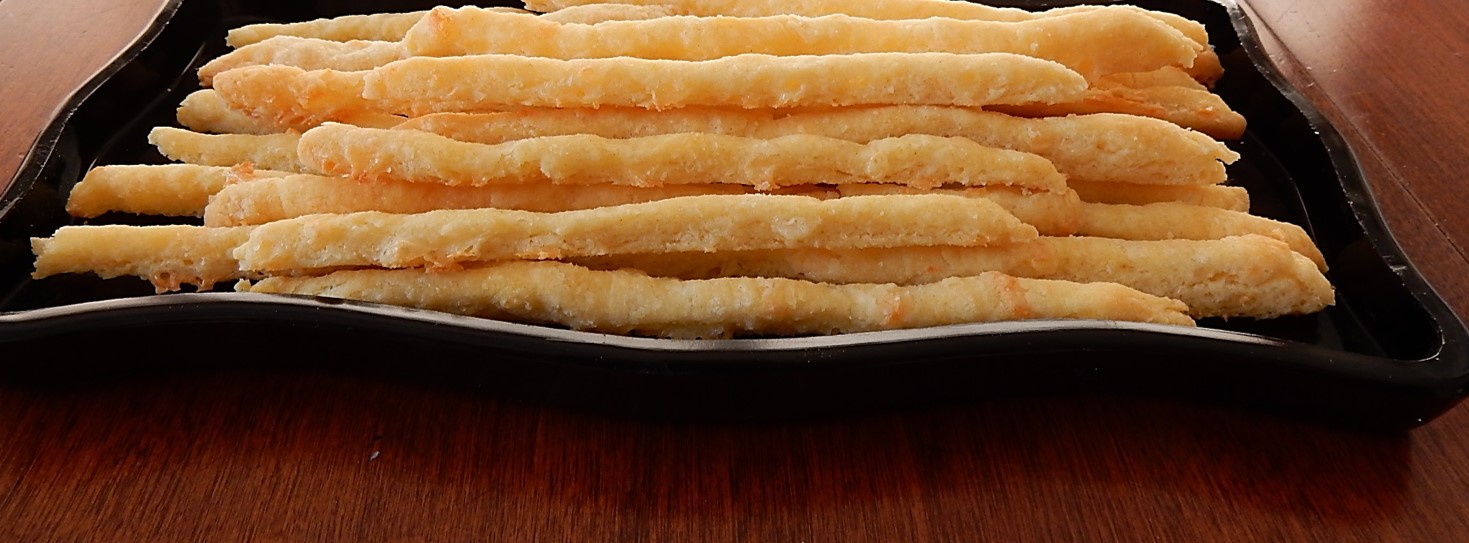
Hundred-Year-Old Cheese Straws Recipe

chees-straws

“What hundred-year-old food are you making for the Super Bowl party?”

My jaw dropped. . . umm. . . Do the words “Super Bowl” and “hundred-year-old foods” even belong in the same sentence?

But, being one who is always ready for a new challenge (and who is thrilled when friends actually ask for hundred-year-old foods), the search was on.  I began scanning old cookbooks looking for the perfect Super Bowl recipe.

And, I think that I’ve succeeded. I found an easy-to-make, awesome hundred-year-old recipe for Cheese Straws. The Cheese Straws will be perfect for nibbling while dissecting the Super Bowls ads and plays with family and friends.

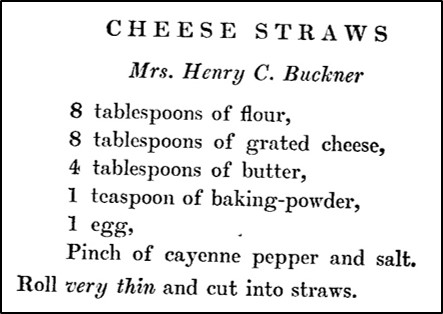
cheese-straws-recipe-blue-grass-cook-book
Source: The Blue Grass Cook Book by Minnie C. Fox (1917)

Here’s the original recipe:

And, here’s the recipe updated for modern cooks:

Cheese Straws

  • Servings: approximately 35 straws
  • Difficulty: moderate
  • Print

1/4 cup butter softened

1/2 cup shredded cheddar cheese

1 egg

1 teaspoon baking powder

1/8 teaspoon cayenne pepper

1/8 teaspoon salt

1/2 cup flour

Preheat the oven to 375° F. Put the butter, cheese, egg, baking powder, cayenne pepper, and salt in a mixing bowl, then beat to combine. Add the flour and stir until thoroughly mixed.

Place the dough on a lightly floured surface. Roll the dough into a rectangle about 1/4 inch thick and 5 inches wide. Cut the dough into strips that are approximately 1/3 inch wide. Put the strips on a lightly greased baking sheet, and place in the oven. Bake for approximately 9-11 minutes or until the strips are lightly browned. Remove from oven and let cool slightly, then remove from the baking sheet with a spatula and place on a cooling rack to complete cooling.

When Potatoes Are Expensive, Substitute Rice

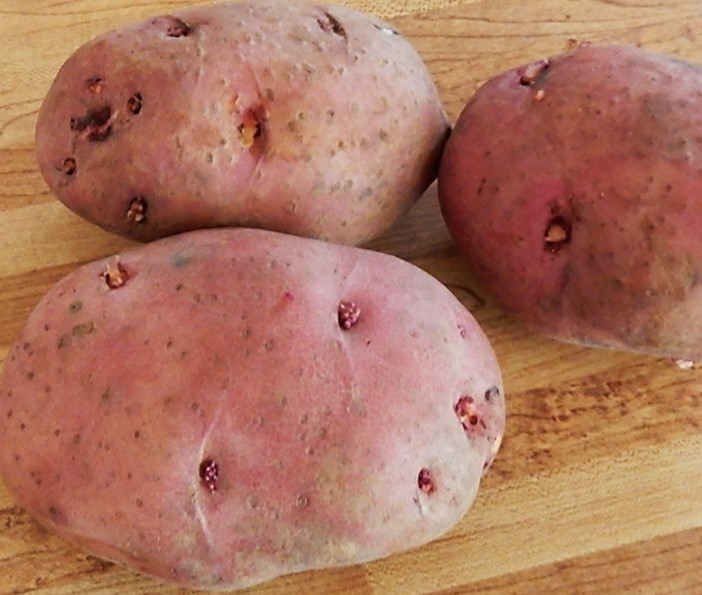
potatoes

In 1917, food prices were rising rapidly in the U.S. because of World War I and the demand for food in Europe. Magazines were filled with articles about how to cope with the high food prices. One article encouraged readers to substitute rice for potatoes. Here’s a few excerpts:

Who Cares for Potatoes?

When there are cheaper foods that can take the place of Irish potatoes, why do we worry over their increasing cost? Besides, mankind has not always had potatoes to eat. The potato became widely popular only about one hundred years ago. It was the middle of the sixteenth century that the Spaniards found the potato in Peru and took it back to the Continent where it was cultivated as a curiosity.

In our own country we know the potato was cultivated in the temperate sections, for we have record of Sir Walter Raleigh’s taking it in 1585 from North Carolina to Ireland, to be cultivated on his estate near Cork. Its cultivation first became general in Ireland (whence its name) and not until a little more than a century ago did it come into widespread popular usage.

Certainly  we are not wholly dependent upon the potato for a well-balanced dietary since our ancestors thrived without it. To be sure, the potato has justly soared its popularity because of its cheapness, its food-value, its palatability, the convenience with which it can be shipped and stored, and the ease with which it can be prepared in a surprisingly large variety of attractive ways.

Source: Good Housekeeping (March, 1917)

It is true that men and women are largely creatures of habit, but the time has come when the women, as controllers of at  least seventy-five percent of the incomes of the men of the nation, must look to our habits to see whether they are expensive and whether they need to be altered.

Starch is not the only necessary constituent of a substitute for potatoes. The potato is rich in vitamins. This property, however, is possessed by most fruits and vegetables, and by milk.

Rice would more than fit the bill, as it contains nearly three times as much energy-building material as the potato. If we substitute it for potatoes, me must have at the same meal vegetables or fruits that will supply the needed potassium and bulk. Such vegetables and fruits are: Cabbage, cauliflower, asparagus, cucumbers, beets, lettuce, celery, string beans, parsnips, rhubarb, rutabagas, spinach, tomatoes, turnips, bananas, apricots, lemons, oranges, peaches pineapple, strawberries.

In purchasing rice we have a chance to economize by buying the broken kernels, which sell for several cents a pound cheaper than the whole grain, and have exactly the same food value.

Not that we wish to taboo potatoes–far be it from that–but since their price is relatively high we can save money by using potato-less menus.

Good Housekeeping (March, 1917)

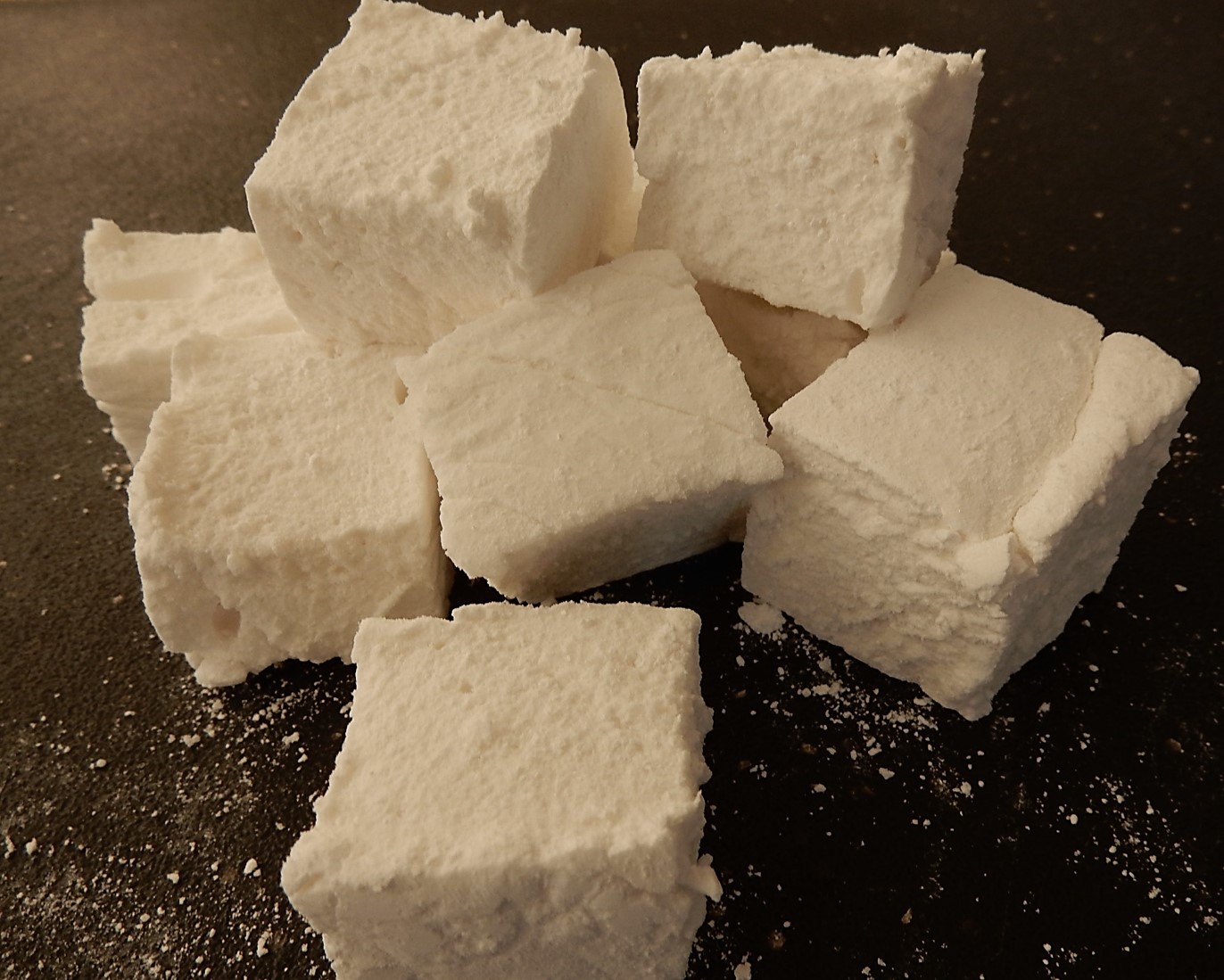
Hundred-Year-Old Marshmallows Recipe

homemade-marshmallows

Did you know that it’s easy to make homemade Marshmallows? I didn’t until recently.

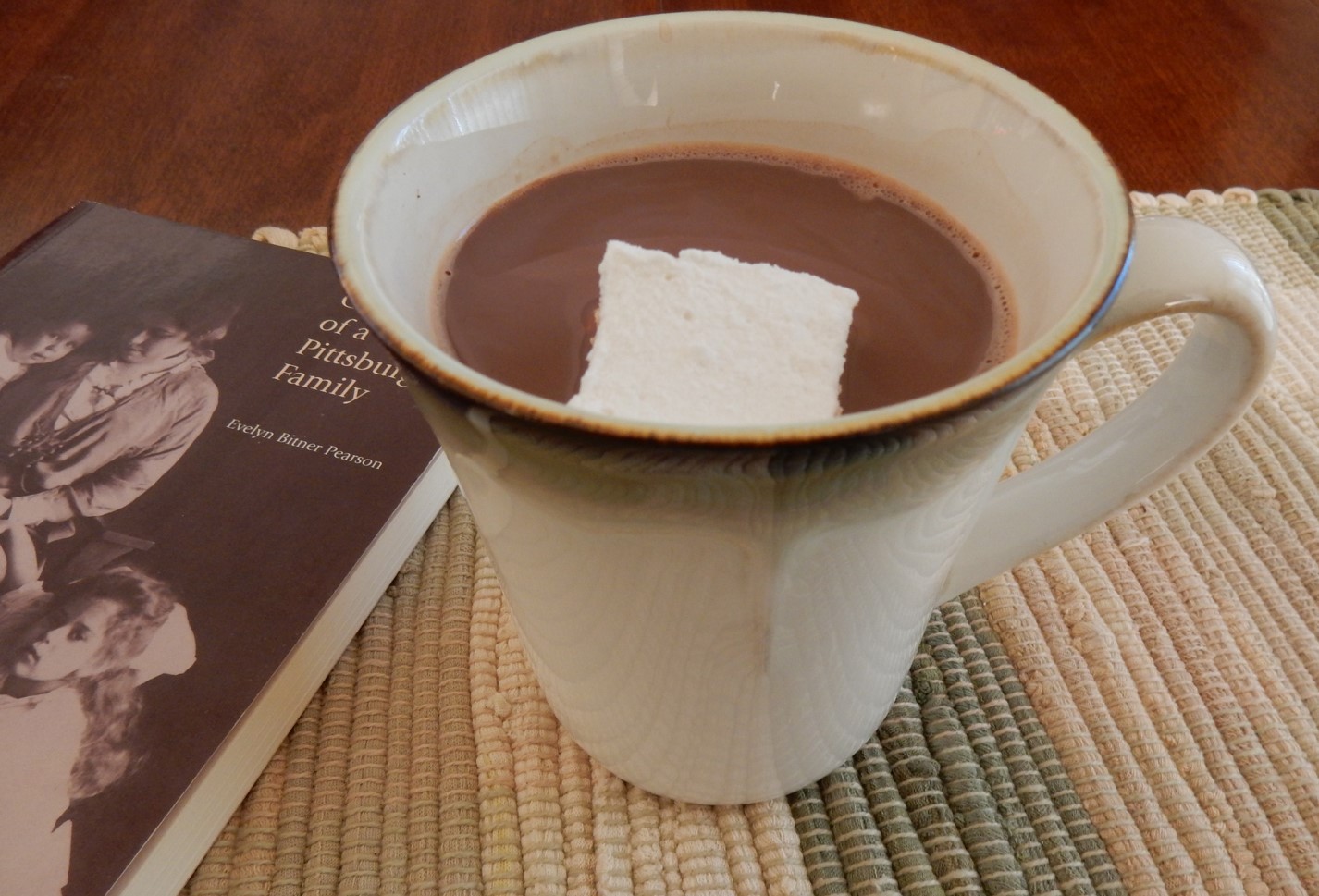
When browsing through a hundred-year-old cookbook, I saw a recipe for Marshmallows. I was intrigued, and decided to give the recipe a try. The Marshmallows were fun and easy to make.  They were  light and fluffy (and so much fresher and tastier than store-bought marshmallows) – and would be perfect in cocoa, in s’mores, or roasted over a fire.

Another plus- So many modern candy recipes call for corn syrup, so I was thrilled that sugar was the only sweetener in this recipe.

marshmallow-in-cocoa

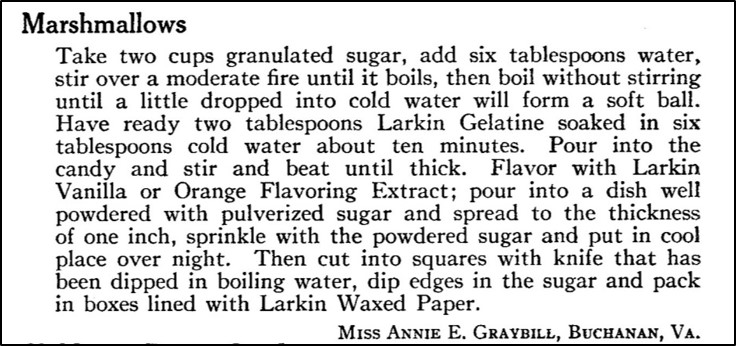
Here’s the hundred-year-old recipe:

Source: Larkin Housewives Cook Book (1915)

And, here’s the recipe updated for modern cooks:

Marshmallows

  • Servings: approximately 60 marshmallows
  • Difficulty: moderate
  • Print

2 cups sugar

6 tablespoons water + 6 tablespoons water

2 tablespoons unflavored gelatin (3 packets)

2 teaspoons vanilla

confectioners’ sugar

Prepare an 8 inch by 8 inch pan by thickly covering the bottom of the pan with confectioner’s sugar.

Combine the sugar and 6 tablespoons water in a heavy saucepan. Bring to a boil using medium heat while stirring occasionally until the sugar is dissolved; then reduce heat and continue to gently boil until it reaches the soft ball stage (245° F.).  Do not stir. In the meantime put 6 tablespoons of water in a mixing bowl and sprinkle with the gelatin.  Let sit for about 10 minutes or until the sugar mixture reaches the soft ball stage.

Remove the sugar mixture from the heat and pour into the bowl with the dissolved gelatin while beating rapidly. Continue beating. When the mixture begins to thicken, add the vanilla, then continue beating until the mixture is very thick and sticky.  The beating process will take 10-15 minutes.

Pour the mixture into the prepared pan, and sprinkle with confectioner’s sugar. This mixture is extremely sticky. A mixing spoon that has been coated with butter or shortening can be used to spread the mixture in the pan.

Let sit for at least four hours (or overnight), then cut into squares using a knife that has been coated with butter or shortening (or that has been dipped in boiling water). Coat the cut edges of the marshmallows by tossing in a bowl that contains powdered sugar.

Hundred-Year-Old Bean Chowder Recipe

bean-chowder-e

It’s cold and blustery here – and time to make a  hearty soup. I searched though my hundred-year-old recipes and came up with the perfect soup for a cold winter day – Bean Chowder.

This savory, comforting, filling and nutritious chowder is made with dried navy beans, salt pork, onions and tomatoes; and it hit the spot perfectly. This recipe is a keeper (though if I made it again I might shorten the prep time by using canned navy beans).

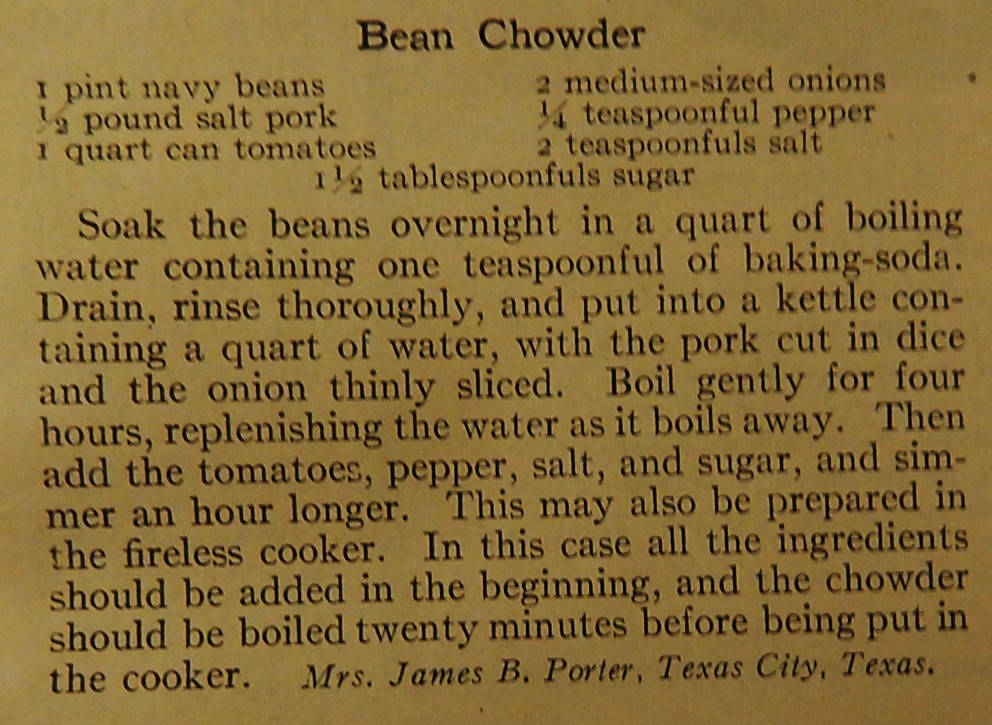
Here’s the hundred-year-old recipe:

Source: Good Housekeeping (April, 1916)

And, here’s the recipe updated for modern cooks:

Bean Chowder

  • Servings: 8-10
  • Difficulty: easy
  • Print

1 quart (4 cups) water + approximately 2 quarts water

1 teaspoon baking soda

2 cups dried navy beans

1/2 pound salt pork, diced into small pieces

2 medium onions, thinly sized

1 quart (28 oz. can) canned tomatoes

1/4 teaspoon pepper

2 teaspoons salt

1 1/2 tablespoons sugar

In a large saucepan bring 1 quart water and the baking soda to a boil using high heat. Remove from the heat, then stir in the navy beans, and cover. Let sit overnight (10-12 hours).  Then drain the beans. Rinse thoroughly and then put into a large dutch oven or soup pot. Add one quart water, the diced salt pork, and the onions. Bring to a boil on high heat, and then reduce heat and let gently simmer for four hours. Add additional water as needed (approximately one additional quart of water will need to be added).

At the end of the four hours, add the tomatoes, salt, pepper, and sugar. Cook for an additional hour, and then serve.

Creamed Celery with Poached Eggs

creamed-celery-with-poached-eggs

When I saw a delightful picture illustrating a Creamed Celery with Poached Eggs recipe in a hundred-year-old magazine, I knew that I needed to give it a try.

Source: American Cookery (Boston Cooking School Magazine, June/July, 1915)
Source: American Cookery (Boston Cooking School Magazine,) (June/July, 1915)

The recipe did not disappoint. My rendition of Creamed Celery with Poached Eggs was lovely. The presentation was just a tad dramatic, and it turned an ordinary meal into a special one.

This vegetable and egg dish is perfect for breakfast . . . or lunch. The slight tang and bite of the celery combines with the cream sauce and eggs to create lovely taste sensation.

Here’s the original recipe:

Source: American Cookery (Boston Cooking School Magazine, June/July, 1915)
Source: American Cookery (Boston Cooking School Magazine) ( June/July, 1915)

Here’s the recipe updated for modern cooks:

Creamed Celery with Poached Eggs

  • Servings: 2
  • Difficulty: moderate
  • Print

1 1/2 cups celery, cut into 1/2 inch pieces

2 tablespoons butter

2 tablespoons flour

1/4 teaspoon salt

1/4 teaspoon pepper

1 cup milk (preferably whole)

2 eggs

salt and pepper

celery leaves, optional (for garnish)

Put the celery in a medium sauce pan. Cover with water and bring to a boil using high heat; then reduce heat and simmer until tender (about 10 minutes).  Drain well.

In another pan, using medium heat, melt butter; then stir in the flour, salt, and pepper. Gradually add the milk while stirring constantly. Continue stirring until the white sauce thickens. Gently stir in the cooked celery, and remove from heat.

In the meantime, bring 1 1/2 to 2 inches of water to a boil in a skillet, then reduce to a simmer. Break each egg into a small bowl or cup, then slip into the water. Cook for 5 minutes. Remove the poached eggs from the water using a slotted spatula, and drain on paper towels. Sprinkle with salt and pepper.

To assemble the dish: Put the creamed celery in the serving dish, then gently place the poached eggs on top of the celery. If desired, garnish with celery leaves.