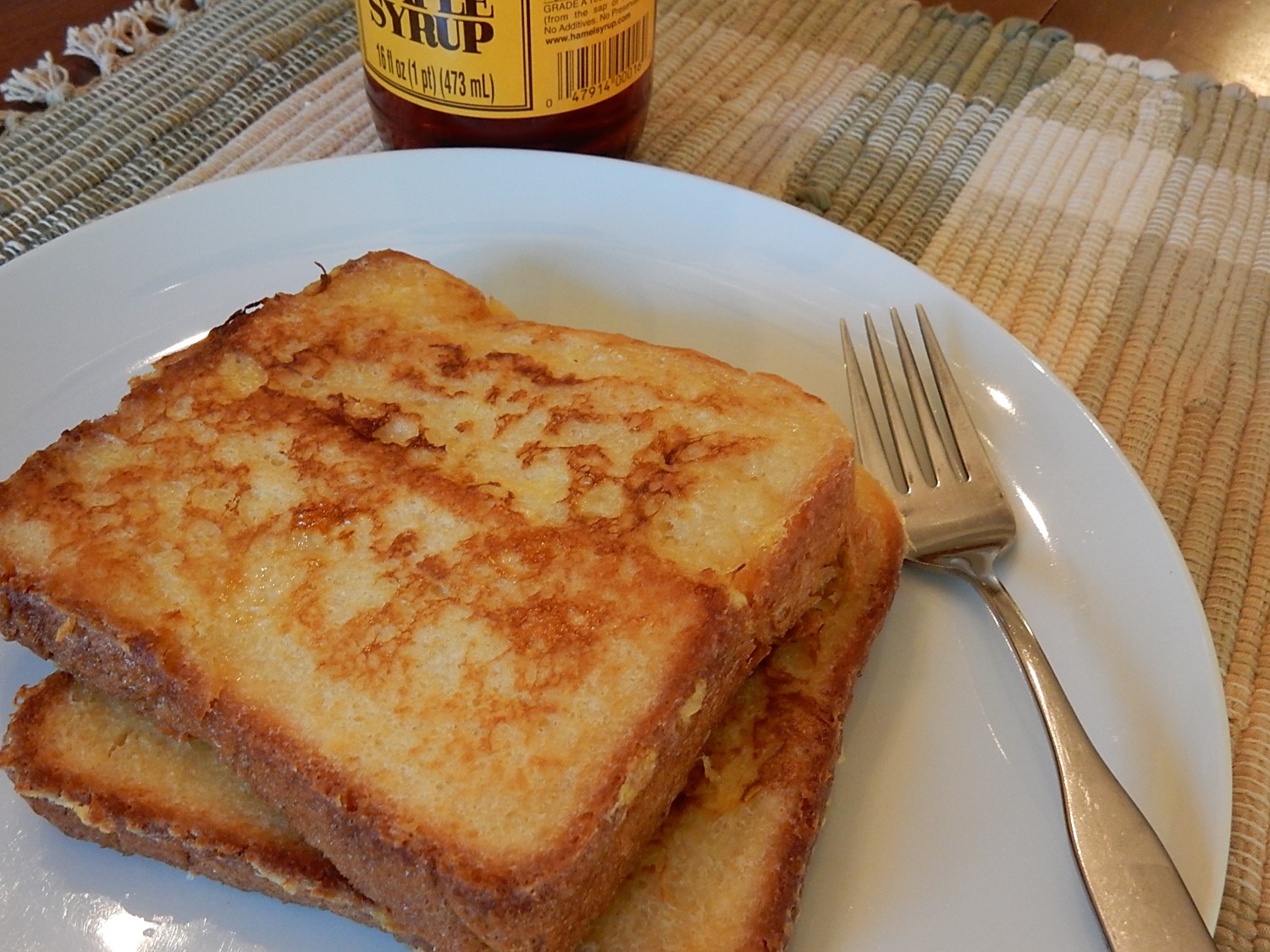
Sour Milk French Toast

Ever wonder what to do with a food once it’s past its prime? A hundred years ago that was often a problem. For example, the homemade bread would often go stale before it was all eaten, and the non-pasteurized milk that most people drank often soured.

The solution was to make a dish that was even tastier than the original foods. The century-old recipe that I found for Sour Milk French Toast calls for – well, you guessed it – sour milk and stale bread.

I had neither sour milk nor stale bread, but decided to give the recipe a try. I used vinegar to “sour” the milk. (Lemon juice would also work.). And, I used day-old homemade bread (though commercially made bread would also work well).

This recipe made a tasty French toast that I’ll definitely make again.

Here’s the original recipe:
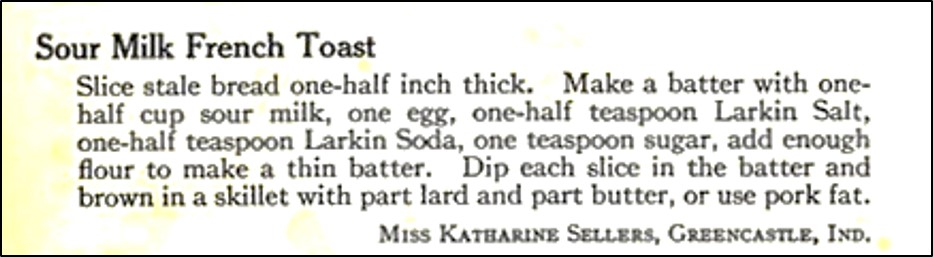
Source: Larkin Housewives Cook Book (1917)

And, here’s the recipe updated for modern cooks:

Sour Milk French Toast

  • Servings: 2 - 3 slices
  • Difficulty: easy
  • Print

2 -3 slices bread

1/2 cup milk

1 1/2 teaspoons vinegar or lemon juice (I used vinegar.)

1 egg, slightly beaten

1/3 teaspoon salt

1/2 teaspoon baking soda

1 teaspoon sugar

2 tablespoons flour

butter

shortening or lard

Stir together milk, vinegar, egg, salt, baking soda, sugar, and flour to create a thin batter. Dip each slice of bread in the batter.

In the meantime, heavily grease griddle or skillet with a mixture of butter, and shortening, or lard. (The old recipe suggests that a mixture of butter and lard might add a nice flavor.)  Heat griddle or skillet, and put prepared slices of bread on it. Brown bottom side; flip and brown on other side. Remove from heat and serve immediately.
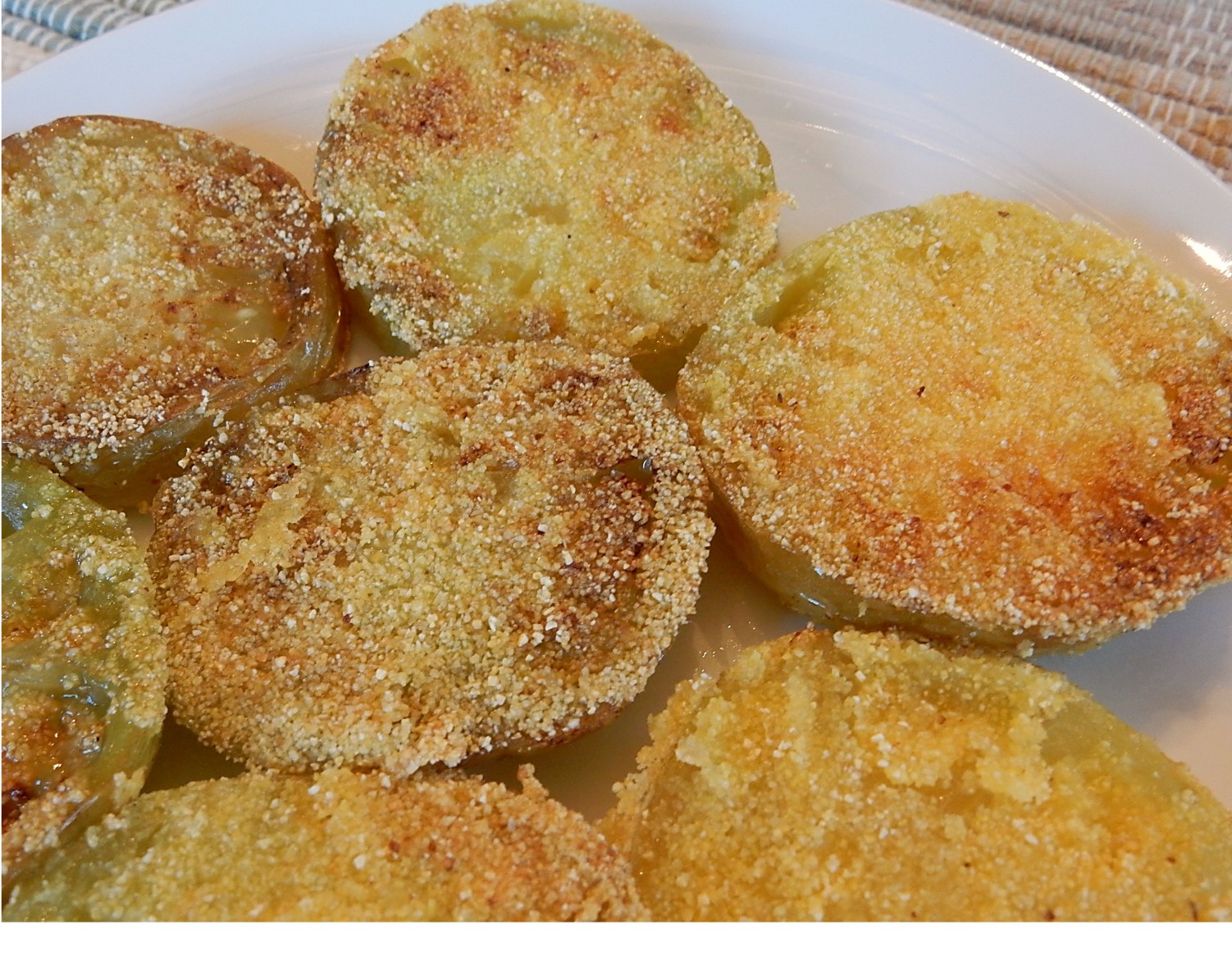
Old-fashioned Fried Green Tomatoes

I think of Fried Green Tomatoes as a classic comfort food – but I never actually tried them until I recently made a hundred-year-old recipe.

This is a food that I should have tried years ago. The Fried Green Tomatoes turned out wonderfully.  They were delightful with a crispy cornmeal coating.

Here is the original recipe:

Source: The Blue Grass Cook Book (Compiled by Minnie C. Fox, 1917)

And, here’s the recipe updated for modern cooks:

Fried Green Tomatoes

  • Servings: 3 - 4
  • Difficulty: easy
  • Print

4 medium green tomatoes, cut into 1/2-inch slices

4 cups water

1 teaspoon salt

sugar

salt

pepper

1/2 cup corn meal

shortening or lard

Combine  the water and  1 teaspoon salt in a mixing bowl, then soak the sliced tomatoes in the water for approximately 30 minutes. Remove the tomatoes from the water and drain on a paper towel, then lay the tomatoes in a single layer on a baking sheet, and sprinkle with sugar, salt, and pepper. Put the cornmeal in a small bowl, then roll each tomato slice in the cornmeal.

Heat 1/2 inch of shortening or large in a large frying pan. Carefully place the breaded green tomato slices in the pan in a single layer. Depending upon pan size, the slices may need to be cooked in several batches. Fry for about 3 minutes or until the bottom side of each slice is lightly browned, then gently turn and fry until the other side is browned. Remove from pan and drain on paper towels. Serve immediately.

Old-fashioned Potato O’Brien

When browsing through hundred-year magazines, I came across a recipe for Potato O’Brien. Diced potatoes (that are first boiled) and green pepper are immersed in a hot and bubbly mild cheese sauce. The dish is then browned in the oven.

This version of Potato O’Brien is a little different from most modern recipes (which generally call for frying the potatoes), but it’s delicious. It reminds me a little of Scalloped Potatoes, but with cheese and green peppers.

Here’s the original recipe:

Source: American Cookery (June – July, 1918)

This recipe contained several firsts for me. It’s the first hundred-year-old recipe that I’ve ever seen that called for American Cheese. I googled it, and learned from Wikipedia that:

After the official invention of processed cheese in 1911, and its subsequent popularization by James L. Kraft in the late-1910s and the 1920s, the term “American cheese” rapidly began to refer to this variety, instead of the traditional but more expensive cheddars also made and sold in the US.

Apparently by 1918, American cheese was commonly enough available that it was included in recipes published in magazines.

It’s also the first hundred-year-old recipe that I’ve ever seen that called for skim milk. I’m not clear to me why skim milk is preferred in this dish, so when I updated the recipe I just listed milk as an ingredient.

Here’s the recipe updated for modern cooks:

Potato O'Brien

  • Servings: 3 - 4
  • Difficulty: easy
  • Print

4 medium potatoes (about 2 cups, diced)

1 tablespoon butter

1 green pepper, chopped

1 tablespoon flour

1/2 cup milk

3/4 teaspoon salt

1/4 teaspoon pepper

1/2 cup American cheese, grated

Preheat oven to 425° F.

Peel and dice the potatoes into 1/2 inch pieces. Put diced potatoes in a saucepan and cover with water. Put on high heat and bring to a boil; reduce heat and simmer until the potatoes are tender (about 10 minutes).

In the meantime, in a skillet, melt butter using low heat. Add the green pepper;  saute until tender, and then stir in the flour, salt, and pepper. While stirring constantly, slowly pour in milk and bring to a boil over medium heat. Add cheese, and stir until the cheese is melted. Gently stir in the cooked potatoes. Put into a baking dish and place in the oven. Bake until the top is lightly browned (about 20 – 30 minutes).

One teaspoon of salt seemed like a lot to me, so when I updated the recipe, I used less salt than was called for in the original recipe. I also sauted the green pepper in butter, rather than cooking it separately first.

Old-fashioned Cabbage and Beet Salad


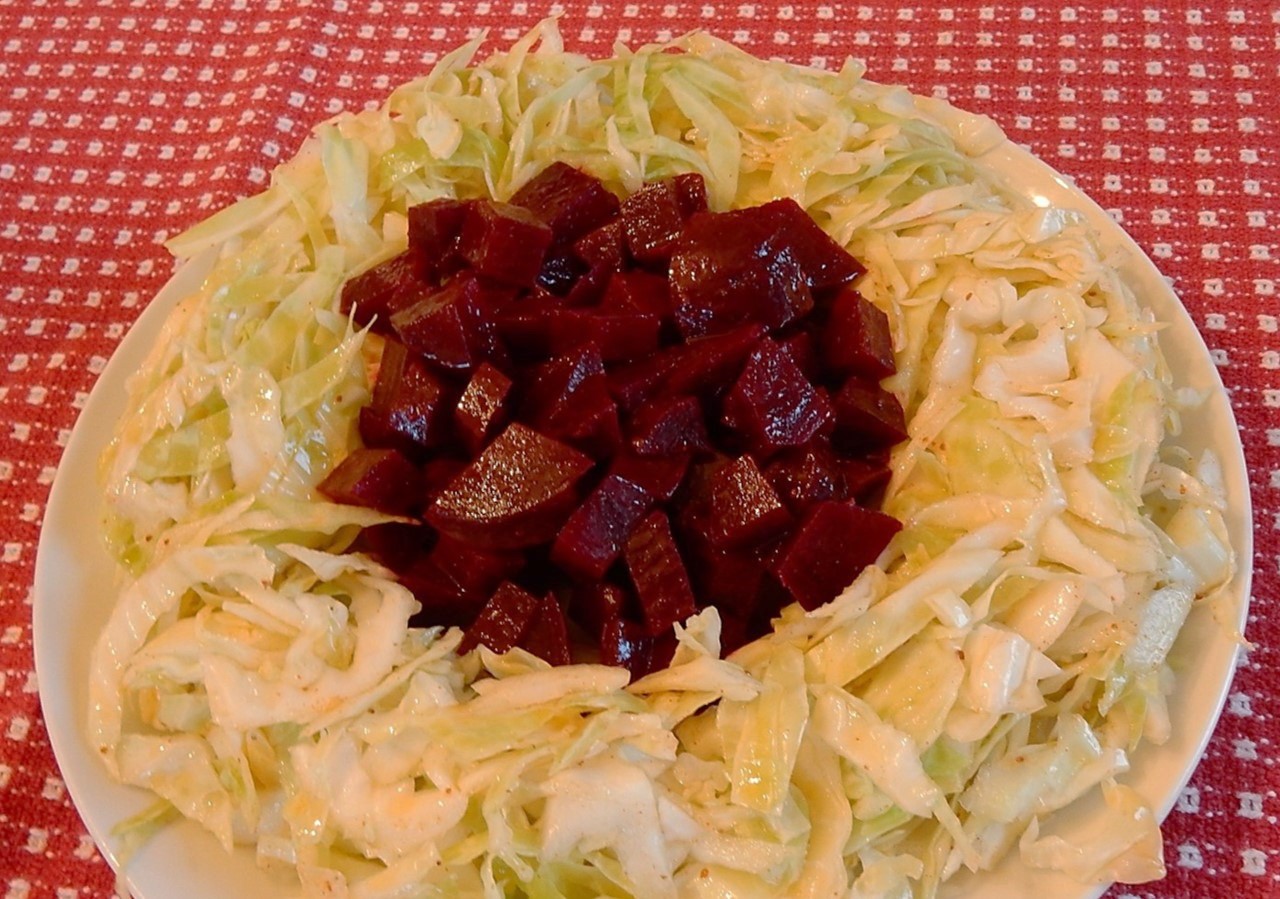
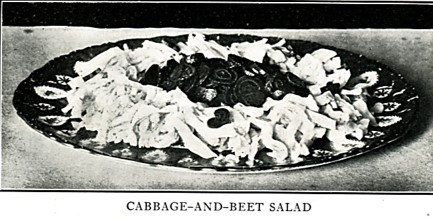
Sometimes salads can seem a bit boring, so I was delighted to find a hundred-year-old recipe for Cabbage and Beet Salad. This salad makes a lovely presentation that is just a tad dramatic. And, a subtle homemade French dressing adds just the right amount of flavor to the salad.

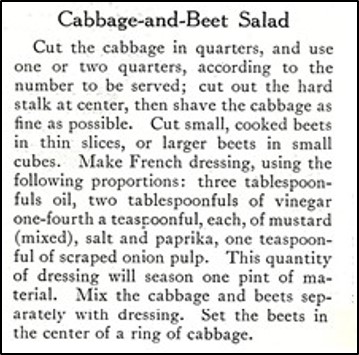
Here’s the photo and recipe for Cabbage and Beet Salad in the hundred-year-old magazine:

Source: American Cookery (August – September, 1918)

And, here is the recipe updated for modern cooks:

Cabbage and Beet Salad

  • Servings: 5-7
  • Difficulty: moderate
  • Print

1 small cabbage, shredded (about 5 cups shredded cabbage)

2 medium beets, cooked and diced into 1/2 inch cubes (about 1 cup diced, cooked beets)

French Dressing

6 tablespoons olive oil

4 tablespoons vinegar

1/2 teaspoon salt

1/2 teaspoon mustard

1/2 teaspoon paprika

2 teaspoons onion, finely minced

Put shredded cabbage in a bowl; gently stir in 2/3 of the French dressing. Put in refrigerator, and chill for at least 2 hours.

Put diced beets in another bowl; gently stir in 1/3 of the French dressing.  Put in refrigerator, and chill for at least 2 hours.

To serve:  Drain any excess dressing from the shredded cabbage, then arrange the cabbage in a ring with a hole in the center. (I pressed the cabbage into a circular mold, covered with the serving plate, and then quickly flipped and removed mold – but a mold is not necessary.)

Drain any excess liquid from the beets. Place beets in the center of the ring. Serve immediately.

To make French Dressing:  Put olive oil, vinegar, salt, mustard, and paprika in a small bowl; stir to combine. Stir in minced onion.

Old-fashioned Okra and Tomatoes

I seldom eat okra, but I recently saw some beautiful okra at the local farmers’ market, and decided to give it a try. Then, of course, I had to find a hundred-year-old okra recipe. I found a delightful Okra and Tomatoes recipe in 1904 Kentucky cookbook, called The Bluegrass Cookbook.

The Okra and Tomatoes (and a little onion) were tasty, as well as easy-to-make and nutritious. One drawback – the okra had a bit of a gooey (some call it a slimy) texture; but that’s just par for the course for this vegetable.  No vegetable’s perfect.

Here’s the original recipe:

Source: The Bluegrass Cook Book by Minnie C. Fox (1904)

And, there’s the recipe updated for modern cooks:

Okra and Tomatoes

  • Servings: 3-4
  • Difficulty: easy
  • Print

1 cup okra, sliced

2 medium tomatoes

1/4 cup onion, diced

1 tablespoon butter

1/2 teaspoon salt

1/8 teaspoon pepper

Put okra in a saucepan, and add enough water to just barely cover it. Bring to a boil using high heat, then reduce heat to low and cook until tender (about 10 minutes). Remove from heat, and thoroughly drain.

In the meantime, put a pan of water on the stove; bring to a boil. Drop the tomatoes into the water for about 15 seconds: remove from heat and gently slip the skin off the tomatoes. Core tomatoes, then dice.  Put the diced tomatoes in a saucepan, and using medium heat cook 5 minutes while stirring frequently; then add onions. Continue cooking and stirring until soft and juicy (about an additional 5 minutes). Stir in butter, salt, and pepper. Add cooked okra, and stir gently to combine. Serve immediately.

Note: See the reader comments. Several readers suggested adaptations to this recipe that might improve the texture and make the okra less gooey.

Old-fashioned Graham Nut Muffins

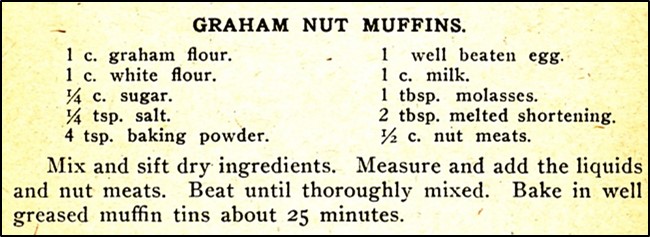
Maybe it’s just me, but I’m soooo tired of the sugary muffins typically sold at coffee shops, so I was pleased to recently find a hundred-year-old recipe for Graham Nut Muffins. The recipe called for just a little sugar (and a little molasses). The nuts embedded in the muffin add flavor and texture. This hearty muffin has a nice texture, is tasty, and is a healthy alternative to sweeter muffins.

Here’s the original recipe:

Source: The Housewife’s Cook Book by Lilla Frich (1917)

And, here’s the recipe updated for modern cooks:

Graham Nut Muffins

  • Servings: approximately 16 muffins
  • Difficulty: easy
  • Print

1 cup graham flour

1 cup all-purpose flour

1/4 cup sugar

1/4 teaspoon salt

4 teaspoons baking powder

1 egg, beaten

1 cup milk

2 tablespoons molasses

2 tablespoons butter, melted

1/2 cup nuts, chopped (I used walnuts.)

Preheat oven to 400° F. Grease muffin pans (or use paper liners). In a mixing bowl combine graham flour, all-purpose flour, sugar, salt and baking powder. Add egg, milk, molasses and butter; then stir just enough to combine. Gently stir in the nuts. Spoon batter into muffin  cups; fill each cup about 3/4ths full. Place in oven. Bake approximately 25 minutes or until lightly browned and the muffins spring back when lightly touched.

Old-fashioned Tomato and Nut Salad (Stuffed Tomato with Nut Salad)

The dog days of summer are upon us, but the good news is that delectable garden-fresh tomatoes are plentiful.  So I was thrilled to recently find a hundred-year-old recipe for Tomato and Nut Salad.  This is really a stuffed tomato recipe. The tomato is stuffed with a mixture of chopped tomatoes, walnuts, and green pepper, with a little mayonnaise for added flavor and to bind everything together. The crunchy stuffing reminds me of Waldorf salad – though that isn’t exactly an accurate description since there are no apples in this recipe.

The recipe calls for peeling the tomato. I almost skipped this step- but it’s worth doing. The peeled tomato has a lovely velvety surface which adds to the presentation.

Here’s the original recipe:

Source: Lowney’s Cook Book (1912)

And, here’s the recipe updated for modern cooks:

Tomato and Nut Salad (Stuffed Tomato with Nut Salad)

  • Servings: 1 serving per tomato
  • Difficulty: moderate
  • Print

For each serving use the following ingredients:

1 medium tomato

2 teaspoons walnuts, chopped

2 teaspoons green pepper, chopped

2 teaspoons mayonnaise

lettuce leaves, optional

Put a pan of water on the stove; bring to a boil. Drop the tomato into the water for about 15 seconds: remove from heat and gently slip the skin off the tomato.  Using a knife remove the stem end and the firm core from the tomato and discard. Scoop out the tomato pulp and seeds, place in a strainer and drain off any excess liquid. Place pulp in a bowl; add the walnuts and green pepper. Stir in the mayonnaise, then stuff the tomato with the mixture. If desired serve on lettuce leaves.