A hundred years ago people ate many unprocessed, local foods – but, even way back then, many processed foods were available; and, cooks often considered them more modern and up-to-date than more natural foods. This week I decided to make a recipe that called for two commercially manufactured foods – corn flakes and Crisco.
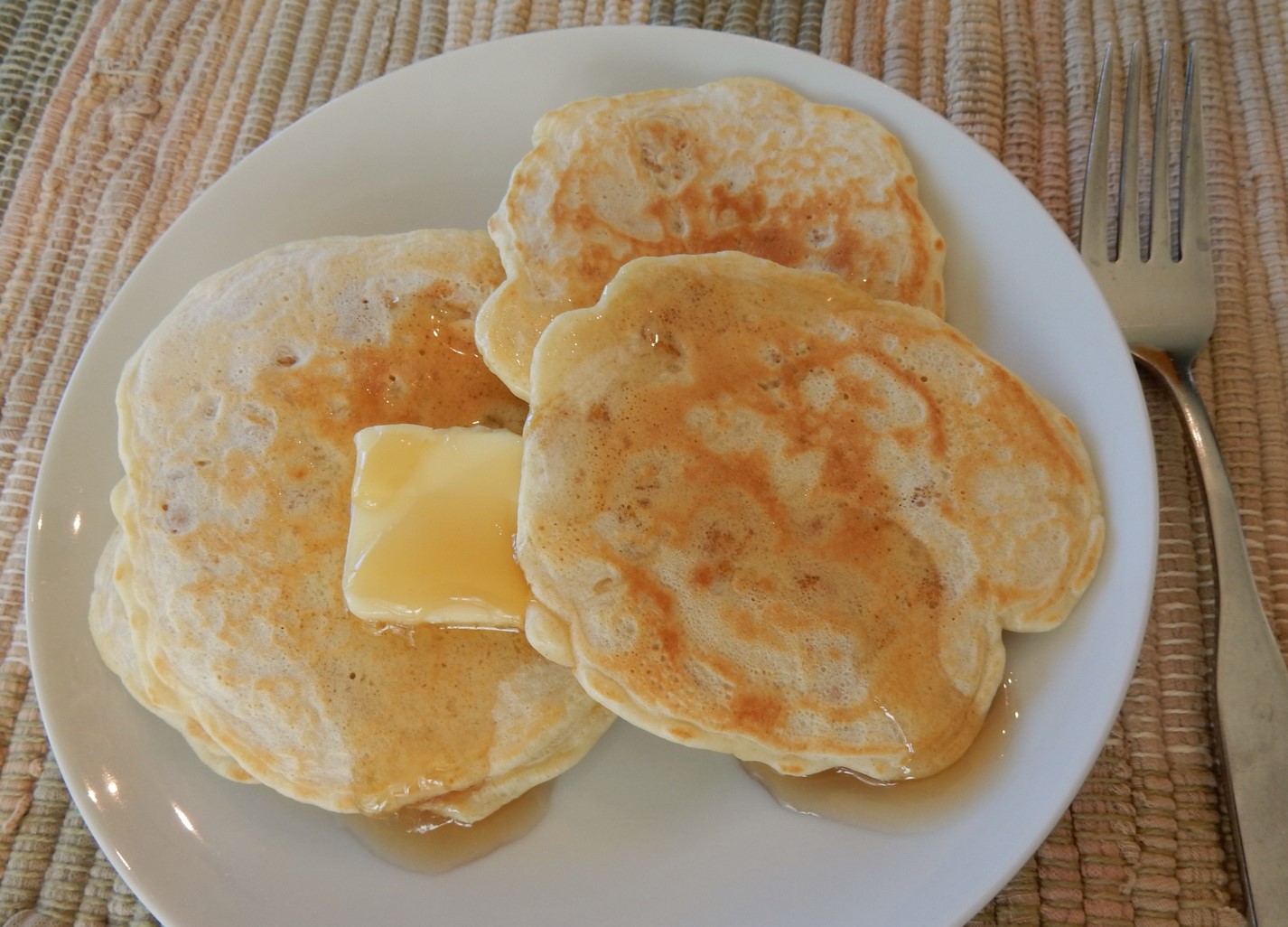
The recipe I selected was for Corn Flake Griddlecakes. This recipe is from a 1919 cookbook published by Procter and Gamble that promoted the use of Crisco.
And, even though I am somewhat biased against using highly processed foods as an ingredient, I must admit that the Corn Flake Griddlecakes were delicious. They were thick, yet light, with just a hint of the toasty corn flakes.
Here’s the original recipe:
Source: Recipes for Everyday by Janet McKenzie Hill (1919)
Put flour, baking powder, salt, egg, milk, and shortening in a mixing bowl, beat until smooth. Stir in corn flakes. Heat a lightly greased griddle to a medium temperature, then pour or scoop batter onto the hot surface to make individual griddlecakes. Cook on one side , then flip and cook other side.
A recipe in a hundred-year-old cookbook for Feather Cake piqued my interest. Was the cake really as light as a feather?
The short answer: No. The longer answer: This cake might not be as light as a feather, but it’s still delightful.
Feather Cake is a spice cake with nuanced tones of cinnamon, nutmeg, and cloves. It has a lovely texture – though it was not a particularly light cake. The cake was easy to make, and the recipe made a small 8 -inch square cake that is perfect for a small family.
Here’s the original recipe:
Source: The Old Reliable Farm and Home Cook Book (1919)
Baking powder is a combination of baking soda and cream of tartar. This recipe calls for both baking soda and cream of tartar (rather than just using baking powder) – which suggests that even though this recipe appeared in a 1919 cookbook that its origins might be much earlier.
1/2 cup raisins (optional) (I didn’t use raisins when I made this recipe.)
Preheat oven to 350° F. Grease and flour an 8-inch square baking pan. Put all ingredients (except for the raisins) in a mixing bowl. Beat until well blended. If desired, stir in the raisins. Pour into prepared pan.
Bake 35 to 40 minutes, or until wooden pick inserted in center comes out clean. Frost if desired.
It’s peak rhubarb season here – so it’s time to try new rhubarb recipe. . . Well, actually, this being A Hundred Years Ago, it’s time to try a “new” old recipe. I found a great recipe for Rhubarb Fanchonettes in a 1919 magazine. Fanchonettes are basically Rhubarb Tarts with Meringue Topping.
The Fanchonettes are a perfect spring treat. The small, individual tarts are a nice size for a snack or dessert. The rhubarb filling is delightfully tart and balanced by the sweet meringue topping.
Here is the original recipe:
Source: American Cookery (March, 1919)
I found some aspects of this recipe fussy and challenging. For example, I couldn’t figure out why the rhubarb needed to be cooked twice, so I just cooked the rhubarb until tender and then stirred in the other ingredients, but didn’t reheat. And, what are brownie tins?
Here is the recipe updated for modern cooks:
Old-fashioned Rhubarb Fanchonettes (Rhubarb Tarts with Meringue Topping)
1 tablespoon lemon juice or 1 tablespoon grated orange peel (I used lemon juice.)
1 cup sugar
1/2 teaspoon salt
3 tablespoons flour
2 egg yolks, beaten
pie pastry (Enough for a 2-crust 9-inch pie – more may be needed if pre-rolled sheets are used. I re-rolled pastry scraps several times to make all of the small fanchonette shells.)
Place rhubarb pieces and water in a large saucepan. Bring to a boil using medium heat, then reduce heat and simmer until the rhubarb is tender while stirring occasionally (about 10 minutes). Remove from heat and strain to remove excess liquid. (It is okay if there is still a little liquid after draining). Measure the cooked rhubarb; there should be approximately 2 cups. (Excess rhubarb can be sweetened and eaten as stewed rhubarb.) Return to pan. Stir in lemon juice, sugar, salt, and flour. Quickly stir in the egg yolks. (If the rhubarb is still very hot, stir a small amount of the cooked rhubarb to the beaten egg yolks while stirring rapidly to avoid coagulation of the yolks; then quickly stir the egg yolk mixture into the remaining rhubarb.) Set aside.
Preheat oven to 425° F. Roll pastry dough and cut into pieces. Fit each piece into a small pie pan; trim and flute edges to make the fanchonette shells. (I used a fairly shallow muffin pan to make the fanchonettes.) The number needed will vary depending upon size, but approximately 12-15 should be enough to hold all the filling.
Fill each fanchonette shell with cooked rhubarb mixture. Place in oven and bake for 15 minutes. Reduce oven temperature to 350° F. Continue baking until the rhubarb comes to a slow rolling boil. Remove from oven, and top each fanchonette with a heaping tablespoonful of Meringue (see recipe below). Spread Meringue to edge of fanchonette. Bake at 325° F. for 10 minutes or until the meringue is lightly browned.
Meringue
2 egg whites
4 tablespoons sugar
Place egg whites in a bowl, and beat until stiff peaks form. Gradually add sugar while continuing to beat.
Now that winter is rapidly becoming a distant memory, I’m enjoying the first of the local 2019 vegetables, spring (green) onions. They are a good source of vitamin C, vitamin B2, and thiamine. They also are a good source of copper, phosphorous, magnesium, chromium, and other minerals; so I was thrilled to find a hundred-year-old recipe for Fried Spring Onions.
The Fried Green Onions are served with bacon in a light gravy. They were easy to make and tasty.
Here is the original recipe:
Source: The Old Reliable Farm and Home Cook Book (1919)
6 bunches spring onions (about 2 1/2 cups of green onions cut into 1-inch pieces)
3 slices bacon, diced
1 tablespoon flour
2 cups boiling water
Clean spring onions, then cut off roots and the top part of the onions. Cut into 1-inch pieces. Set aside.
Place the bacon in a skillet; then using medium heat fry bacon until browned while stirring occasionally. Remove the bacon from the pan and set aside.
Place the onion pieces in the hot fat in the skillet and saute until tender while stirring occasionally (about 5-7 minutes). Push onion pieces to side of pan and stir in the flour. Slowly add the boiling water while stirring constantly. Bring to a boil, add bacon pieces. Gently stir to combine the bacon and onions. Remove from heat and serve immediately.
If you are looking for a hundred-year-old recipe, come back next week. This week, I’m revisiting the early days of this blog – and including a 70-year-old recipe for Soft Molasses Cookies to boot.
I began A Hundred Years Ago in 2011 to post my grandmother’s diary entries a hundred years to the day after she wrote them. My grandmother, Helena Muffly [Swartz] kept the diary from 1911 to 1914 when she was a teen living on a farm near McEwensville in central Pennsylvania. After I posted all the diary entries, I reinvented A Hundred Years Ago to its current focus on food. Today I’m going to go back to those diary years —
When I was a child, I lived about a mile from Grandma – and most of her other grandchildren also lived nearby. But one of Grandma’s daughters lived in the Philadelphia area with her husband and three children. It was always a special occasion when those cousins visited.
I recently received a comment on a post I did about Grandma’s cookies from Pat Donaldson, one of my “Philadelphia” cousins. She then followed up with an email. She wrote:
I too remember Grandma’s cookies fondly. We’d come to visit, and her cookie jar would always be full, with either Molasses or Peanut Butter cookies. The Molasses cookies were soft, with a dark crinkly top, and the Peanut Butter cookies had the trademark cross-hatching on them. We’d eat the cookies as we ran in and out of the house playing tag.
Later, when we were grown and attending a wedding we talked about those cookies and found how scarcely they were given out to our cousins, who would have to ask for just one very politely. They were scandalized that we just reached in and ate them! But we were only there one weekend a month, and Grandma never said a word about our cookie habit – just kept the cookie jar full for us.
After her funeral, we were all given a chance to take home one item to remember Grandma by. I chose her Sunbeam mixer, which came with a little cookbook. The mixer was a Sunbeam Mixmaster 10, which was sold around 1950. Since I was in college and needed a mixer, that’s what I chose. It lasted quite a while – decades at least. The recipe book came with the mixer
Inside the cookbook I found recipes for molasses and peanut butter cookies. I’m not sure about the peanut butter cookies – but the molasses cookies have an “X” next to the recipe, and I’m fairly sure they’re the ones Grandma baked. I’ve scanned the pages from the recipe book. The Sunbeam cookbook is still a bit recent for your food blog – but the cookies can be eaten any time.
p.s.: One year when we were visiting we went exploring in the attic, and found Grandma’s cookie stash. She must have baked dozens and dozens of them, and they were all sitting in a box waiting to go into the cookie jar as soon as we emptied it. That solved the mystery of how Grandma’s cookie jar could always be full, when we never saw her baking cookies!
Here’s the first page of the little cookbook that came with the mixer::
And, here’s the recipe in the cookbook (with Grandma’s “X” marking it as a recipe she had made):
Source: Cookbook included with Sunbeam Mixmaster (circa 1950)
Of course, I had to try Grandma’s (i.e., the Sunbeam Mixmaster Cookbook) Soft Molasses Cookie recipe. The cookies turned out wonderfully. They were soft and chewy with just the right mixture of spices and raisins. Making the cookies with a mixer was very 1950’s, but the cookies are definitely a wonderful, traditional, soft molasses cookie that brought back fond memories of Grandma, her kitchen, and wonderful times playing with my cousins.
Banana Fritters are a wonderful comfort food, so I was thrilled to find a hundred-year-old recipe for them. The fritters were crispy; and, when served with a little confectioners sugar sprinkled on top, had just the right amount of sweetness. The fritters are made using banana slices or chunks, and when I bit into them, the embedded fruit was pure delight. This recipe is a keeper.
2 medium bananas, sliced or cut into small chunks (I sliced the bananas.)
shortening or lard
confectioners sugar (optional)
Put flour, baking powder, salt, egg, and milk in a mixing bowl; beat until combined. Add sliced or cubed bananas, and gently stir until the bananas are evenly distributed throughout the batter.
Heat 1/2 inch of shortening or lard until hot in large frying pan. Drop heaping teaspoonfuls of batter into hot shortening. Fry for about 2 minutes. Flip fritters and fry until golden brown on both sides. Remove from heat and drain on paper towels. If desired, sprinkle with confectioners sugar. Serve immediately.
It’s always a challenge to get kids to eat healthy foods, but one trick that parents have been using for a long time is to dress foods up so they look like animals or other creatures. I recently came across a fun hundred-year-old recipe for Butterfly Salad that is quick and easy to make.
The recipe called for asparagus, lettuce, pineapple slices, olives, and pimento strips. This combination of ingredients sounded a bit unusual to me, but it actually was very tasty. The olives added a nuanced saltiness to the other ingredients, but did not overwhelm them.
2 flat lettuce leaves (I used the top portion of the outer leaves from a head of Romaine lettuce.)
1 slice canned pineapple
1 spear cooked asparagus (chilled)
2 – 3 stuffed green olives
2 strips pimento
2 tablespoons French dressing or mayonnaise (optional)
To make a butterfly set the asparagus spear in the center of the plate to represent the body. To make the wings place the lettuce leaves on either side of the asparagus spear. To make the head, set an olive at the base of the asparagus spear. Cut the pineapple slice in half, and symmetrically set each half on a lettuce leaf. Slice the other olive(s), and place slices on the pineapple to decorate the leaf “wings”. Put the strips of pimento above the olive head to represent the butterfly’s antennas. If desired, serve with French dressing or mayonnaise.