Old-fashioned Lima Bean en Casserole (Baked Lima Beans)

Casserole dish filled with Lima Beans en Casserole

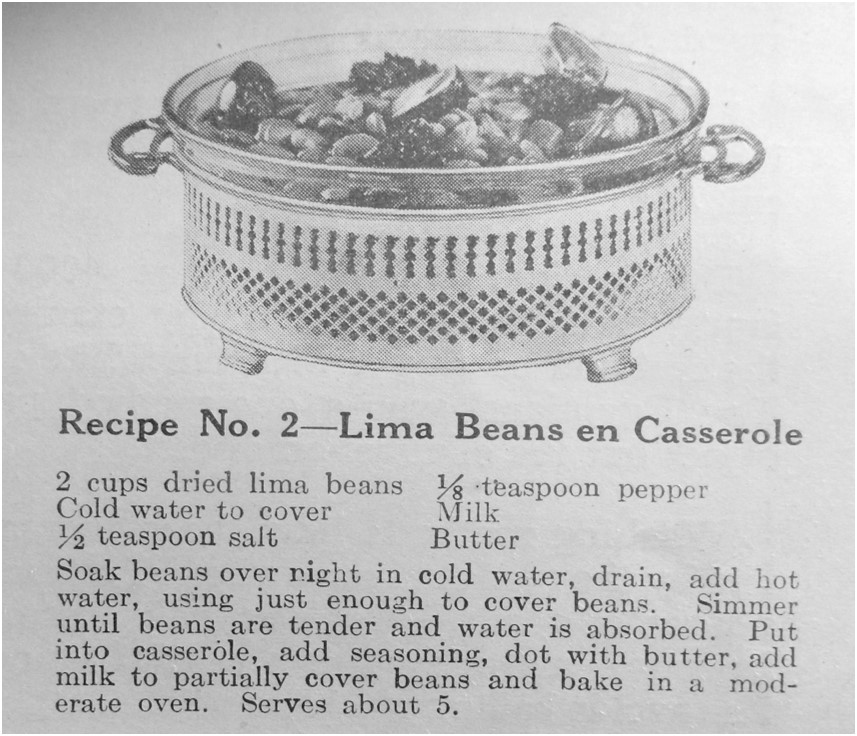
Christmas dinner is a time for tradition; a time when we often make the foods that our mothers and grandmothers once prepared. Often these dishes bring back warm food memories; other times they bring back less warm memories of foods that might be family traditions, but weren’t personal favorites. Well, I had the latter reaction when I saw a photo and recipe in a hundred-year-old magazine for Lima Beans en Casserole (Baked Lima Beans).

Recipe for Lima Beans En Casserole
Source: Advertisement by the California Lima Bean Growers Association in Good Housekeeping; December, 1919)

Memories flooded back of this lima bean dish that my mother made every Christmas. I usually managed to avoid eating it during the holiday festivities – but I always had to eat it during the week following Christmas when my mother served the left-overs (and there always seemed to be lots of left-over lima beans).

Each year, I hopefully suggested that maybe we didn’t need to make Baked Lima Beans; and every year, my suggestion would be vetoed by my father (which seemed very strange because he didn’t generally get involved in menu planning). But he always insisted that it wouldn’t be Christmas without lima beans.

When I saw the old recipe for Lima Beans en Casserole (Baked Lima Beans), I just had to give it a try. Was it really the bland tasteless dish of my memories, or was it a food worthy of the Christmas dinner table?

I’m pleased to say that Lima Beans en Casserole tasted like I remember, but in a much better way. Across the years (and as my taste buds have matured), Lima Beans en Casserole have morphed into a tasty comfort food that has the added bonus of being a great source of fiber and protein.

Here’s the recipe updated for modern cooks:

Lima Beans en Casserole (Baked Lima Beans)

  • Servings: 6 - 8
  • Difficulty: moderate
  • Print

2 cups dried lima beans

cold water to cover

hot water to cover

2 tablespoons butter

1/2 teaspoon salt

1/8 teaspoon pepper

1 cup milk (more may be needed)

Rinse the lima beans, put in a bowl and cover with water (water should be about 1-inch about the top of the beans); then cover bowl, and soak overnight. Drain beans, then put in a sauce pan, and cover with hot water. Bring to a boil using high heat, then reduce to very low heat and cover pan. Gently simmer until the beans are tender and the water absorbed (about 1- 1 1/2 hours).

Preheat oven to 350° F.  Remove from heat, and put beans in a large casserole dish (1 1/2 quart). Dot with butter.

In the meantime, put the milk in a bowl, and stir in the salt and pepper. Gently add the milk mixture to partially cover the beans. (Add additional milk if needed).  Put in oven and bake until hot and bubbly, and the top is just beginning to brown. Remove from oven and serve.

Old-fashioned Mock Maple Kisses

Mock maple kisses on plate

I always try to make a wide variety of holiday cookies, including a gluten-free option. Meringue cookies are a personal favorite, so I was pleased to find a hundred-year-old recipe for Mock Maple Kisses. They are a light and airy meringue cookie. When I bite into them, they take me back to a summer evening, and remind of marshmallows delicately toasted over a campfire.

Here is the original recipe:

Recipe for Mock Maple Kisses
Source: Good Housekeeping (December, 1919)

I found this recipe to be a little challenging. Since very little liquid is called for, the boiled brown sugar mixture quickly moves past the “thread’ stage to the “soft ball” stage. I added a little additional water to get the temperature and stage right. But, the meringues ended up not having the classic “kiss” shape.

Here is the recipe updated for modern cooks:

Mock Maple Kisses

  • Servings: approximately 40 kisses
  • Difficulty: difficult
  • Print

2 cups brown sugar

2 tablespoons water

1 teaspoon vanilla

1 egg white

Put sugar, water, and vanilla in a sauce pan; stir, and then using medium-low heat, bring to a boil. Reduce heat, and cook until the mixture reaches the “thread” stage (223° – 234° F.). Since there is very little liquid, the mixture will reach this stage very quickly after it comes to a boil. A little additional water may need to be added if the mixture inadvertently moves beyond the “thread” stage.) Remove from heat.

In the meantime, preheat oven to 250° F. Put the egg white into a mixing bowl and beat with an electric beater until stiff peaks form. Slowly add the sugar sauce, one tablespoon at a time, while continuing to beat. Drop by rounded teaspoons two inches apart on greased baking sheet lined with parchment paper. Bake for 35-45 minutes or until the kisses can easily be removed from the parchment paper.

Old-fashioned Lemon Star Cookies

frosted star-shaped cookies on plate

Cut-out cookies are so much fun to make, and it’s a wonderful family activity, so I’m always on the look-out for hundred-year-old recipes for cut-out cookies. I recently found a wonderful recipe in a 1919 magazine for Lemon Star Cookies. The frosted cookies are sprinkled with chopped walnuts, and have a delicate lemon flavor.

I used buttercream frosting, though other types of frosting could be used. Any type of walnuts would work well in this recipe, but I had some black walnuts so used them. The bold, richness of the black walnuts combined perfectly with the sweetness of the frosting and the lemon in the cookies. This cookie is a winner – whether the cookies are cut into stars or some other shape.

Here’s photo of the cookies in the old magazine:

Frosted star-shaped cookies on plate
Source: Good Housekeeping (December, 1919)

All was good. The cookies tasted wonderful, and they looked similar to the photo of Lemon Star Cookies in the old magazine. Then the Saturday newspaper arrived on my doorstep. There was a beautiful feature showing how to make decorated cut-out cookies. It included directions for making royal icing, piping the icing to make an outline around the edge of the cookie, and then “flooding” the cookie with additional icing.

I suddenly realized that my cookies weren’t as awesome and picture-perfect as I’d thought a few minutes earlier. That said, the buttercream frosting I smeared on the top of the cookies with a knife is probably very similar to what cooks did a hundred years ago – so I keep telling myself that at least my cookies are authentic even if they aren’t Instagram perfect.

Here’s the original recipe:

Recipe for Lemon Star Cookies
Source: Good Housekeeping (December, 1919)

Lemon Star Cookies

  • Servings: 50 - 60 cookies
  • Difficulty: moderate
  • Print

3/4 cup butter or margarine (I used butter.)

1 cup sugar

3 eggs

2 cups pastry flour (all-purpose flour can be substituted)

1/2 teaspoon salt

3 teaspoons baking powder

1 tablespoon lemon extract

white frosting (I used buttercream frosting.)

chopped walnuts (I used black walnuts, but the typical walnuts that are sold in stores also would work well.)

Preheat oven to 400° F. In a mixing bowl, cream the  butter (or margarine) together. Stir in the eggs, then add the flour, baking powder, salt and lemon extract. Stir until well-mixed. Refrigerate dough 1/2 hour or until chilled.

On well-floured surface, roll out dough to 1/8 inch thickness. Cut into shapes using a star cookie cutter (or use other shaped cutters, if preferred). Place on greased baking sheets. Bake 9-11 minutes or until lightly browned.

Remove from oven, and cool on wire racks. Ice the cookies with the frosting, and then sprinkle chopped walnuts in the center of each cookie.

Hundred-year-old Cranberry Sauce Recipe

bowl of cranberry sauceIt just isn’t Thanksgiving without Cranberry Sauce. Some years I make the whole berry sauce recipe printed on the bags of fresh cranberries; other years I grit my teeth and buy a can of jellied canned sauce.  But, I have vague food memories a wonderful smooth homemade Cranberry Sauce that was served at Thanksgiving gatherings when I was a small child.

So, I was thrilled to find a classic smooth Cranberry Sauce recipe in a hundred-year-old magazine. The Cranberry Sauce contained tiny bits of cranberries, and was a delightful blend of sweet and sour.

And, here is the recipe updated for modern cooks:

Classic Cranberry Sauce

  • Servings: 5 - 7
  • Difficulty: moderate
  • Print

4 cups cranberries

1/3 cup + 2 tablespoons (scant 1/2 cup) water

1/4 teaspoon baking soda

2 cups sugar

Wash cranberries, then place cranberries and water put in a saucepan. Bring to a boil on medium high heat. Stir in the baking soda, then reduce heat and simmer until the berries have softened and burst (5-7 minutes). Skim any froth that rises to the top while cooking. Remove from heat, and press through a sieve. (I used a Foley mill.) Place the pulp in a clean pan and stir in the sugar. (The berry skins should be discarded.) Cook until the mixture begins to boil while stirring constantly. Remove from heat, and put the cranberry sauce in the serving dish. Cool in refrigerator at least 3 hours before serving. Once the sauce is cooled, it should be covered to prevent a thick “skin” from forming on the top.

(Cook’s note: Today many cranberries are sold in 12 ounce bags – which is 3 cups of cranberries. If using one 12-ounce bag of cranberries, make three- fourths of this recipe. This would mean using a little less than 1/3 cup water, 3/8 teaspoon baking soda, and 1 1/2 cups sugar.)

Hundred-year-old Recipe for Bread Stuffing

bread stuffing in bowl

I’m a traditionalist when it comes to stuffing, and I still use the bread stuffing recipe in my 1976 Betty Crocker Cookbook. Betty Crocker calls for combining bread crumbs with lots of butter, minced onion and celery; and then seasoning with sage and thyme. That recipe is tasty – but this year I wanted to make an authentic hundred-year-old recipe, so was thrilled to find a Bread Stuffing recipe in a 1919 magazine.

The hundred-year-old recipe skips the onion and celery – and uses poultry seasoning instead of the individual spices that I usually use. It also calls for an egg that acts as a binder to help keep the stuffing from falling apart.

The seasoning for the old recipe was just right, and is perfect for those who want an authentic, old-fashioned bread stuffing recipe.

Here’s the original recipe:

bread stuffing recipe
Source: American Cookery (November, 1919)

And, here is the recipe updated for modern cooks:

Bread Stuffing

  • Servings: 2 - 3
  • Difficulty: moderate
  • Print

Note: This recipe makes enough stuffing to stuff a 2-3 pound chicken. Double recipe for a 5 – 6 pound chicken; quadruple for a 10-12 pound turkey.

1/2 cup butter, melted

1/4 teaspoon salt

1/4 teaspoon pepper

1/2 teaspoon poultry seasoning

2 cups soft bread crumbs (tear bread into 1-inch pieces)

1 egg, beaten

In a large bowl stir together, butter, salt, pepper, and poultry seasoning. Add bread crumbs and egg; stir gently until thoroughly combined. Scoop stuffing into chicken or turkey body and neck cavities. Cook poultry thoroughly. Remove stuffing from poultry, and place in a bowl. Fluff with a spoon or fork, and then serve. May also be served cold.

Old-fashioned Nutted Cream

molded Nutted Cream on plate

Holiday gatherings when I was a child meant lots of relatives crowded around a table – with all the leaves added, and topped with two or three mismatched tablecloths – in a tiny dining room with floral wallpaper on the walls. The table would almost sag from all the food – turkey or ham (or maybe both), stuffing, mashed potatoes, pickles, creamed vegetables  . . .  and molded salads or desserts. Back in those days, molded foods that contained gelatin were salads – today, similar food are often considered desserts.

There was always just a bit of drama surrounding the molded salad. They were unmolded shortly before we ate to help ensure that they looked their best. But, there always were questions about how long the mold needed to be dipped in hot water to successfully unmold it. If it wasn’t dipped long enough, the salad might only partially come out (and look like a mess) . . . and if it was dipped too long, it might partially melt (and look like a mess).

So when I recently came across a recipe in the November, 1919 issue of American Cookery for a gelatin and cream salad (or dessert) with nuts, I just had to give it a try. There were just too many memories to pass over it – and just enough risk to make it seem like it a fun, yet slightly challenging recipe to try.

I’m pleased to report that the Nutted Cream recipe was a huge success – and I didn’t have any trouble unmolding it. The creamy salad (or dessert) with embedded nuts had just a hint of sweetness, and was a delightful treat.

In many ways the Nutted Cream seemed surprisingly modern – and if I’d put it in individual cups, instead of the mold, it would be similar to some lovely desserts that I’ve recently had at very nice restaurants.

Here’s the original recipe (and a picture!) in the 1919 magazine:

Nutted Cream on Plate
Source: American Cookery (November, 1919)
Nutted Cream Recipe
Source: American Cookery (November, 1919)

And, here is the recipe updated for modern cooks:

Nutted Cream

  • Servings: 7 - 9
  • Difficulty: moderate
  • Print

2 packets unflavored gelatin

1/2 cup cold water

1/4 cup hot water

3 cups heavy cream

3/4 cup powdered sugar

1/3  cup finely chopped nuts (I used walnuts.) + (if desired) additional nuts for garnishing

Put the cold water in a small bowl and sprinkle the gelatin on top of the water. Let sit until softened (about 2 minutes).  Add hot water, then place the small bowl in a pan that contains hot water. Stir the gelatin mixture until dissolved. Remove small bowl from the pan. Set aside.

Put the whipping in a mixing bowl and beat until stiff peaks form. Gradually add the powdered sugar while continuing to beat, then gently stir in the walnuts. Set aside.

Set the bowl with the gelatin mixture in a pan that contains cold water and ice cubes. Stir the gelatin mixture until it begins to thicken. Then gently fold the gelatin mixture into the whipped cream mixture.

Spoon whipped cream mixture into an 8-cup mold.  Chill in the refrigerator until firm (at least two hours).

To serve, quickly dip the mold in hot water, then gently slide the Nutted Cream onto serving plate. If desired, garnish with additional chopped nuts.

Traditional Carrot Pie

slice of carrot pie

Old-fashioned carrot pie is a delightful fall pie. It is very similar to pumpkin pie – but a little lighter and sweeter.

Here’s the original hundred-year-old recipe:

Carrot Pie Recipe
Source: Good Housekeeping (February, 1919)

Two medium, “grocery-store” style, long, slender carrots are not nearly large enough to make 1 – 1 1/4 cups pureed carrot. The recipe must be calling for the large, thick relatively short carrots that home gardeners often raise. When I made the recipe, I used a 1-pound bag of carrots, and ended up with about the right amount of pureed carrot.

Here’s the recipe updated for modern cooks:   

Carrot Pie

  • Servings: 6
  • Difficulty: moderate
  • Print

1 pound carrots

1/4 teaspoon ground ginger

1/4 teaspoon cinnamon

1/2 teaspoon salt

1/2 cup sugar

2 eggs

1 1/2 cups milk

1 – 9-inch pie pastry

Peel and slice carrots. Put carrot slices in a saucepan and just barely cover with water. Using high heat bring to a boil, then reduce heat, and simmer until carrots are tender (approximately 20 – 25 minutes). Remove from heat and drain; then press through a sieve or puree (I used a Foley mill.) Measure the pureed carrot. There should be approximately 1 – 1 1/4 cups.

Preheat oven to 425° F. Combine all ingredients (except pie shell) in a mixing bowl; beat until smooth. Pour into pie crust. Bake 15 minutes; then reduce heat to 350°. Continue baking (about 50-60 minutes) until a knife inserted in the center of the pie comes out clean.