Christmas has come and gone. As the holidays wind down, I’ve been reflecting on the various tasks required to prepare for Christmas, and the differences between 1924 and today. Some tasks that were necessary years ago may not be required today. A hundred years ago silverware needed to be polished in preparation for the big meal. Some hostesses used Magic Bright to remove tarnish. I shifted to using stainless steel years ago, and can’t remember the last time I polished silver.
I’m a little confused about exactly what Magic Bright was. It says that it was used to polish silver, but also notes that it cleans “without polish.” I think that Magic Bright was mixed with water and then flatware was dipped into it to remove tarnish rather than the more traditional way of rubbing polish on the flatware.
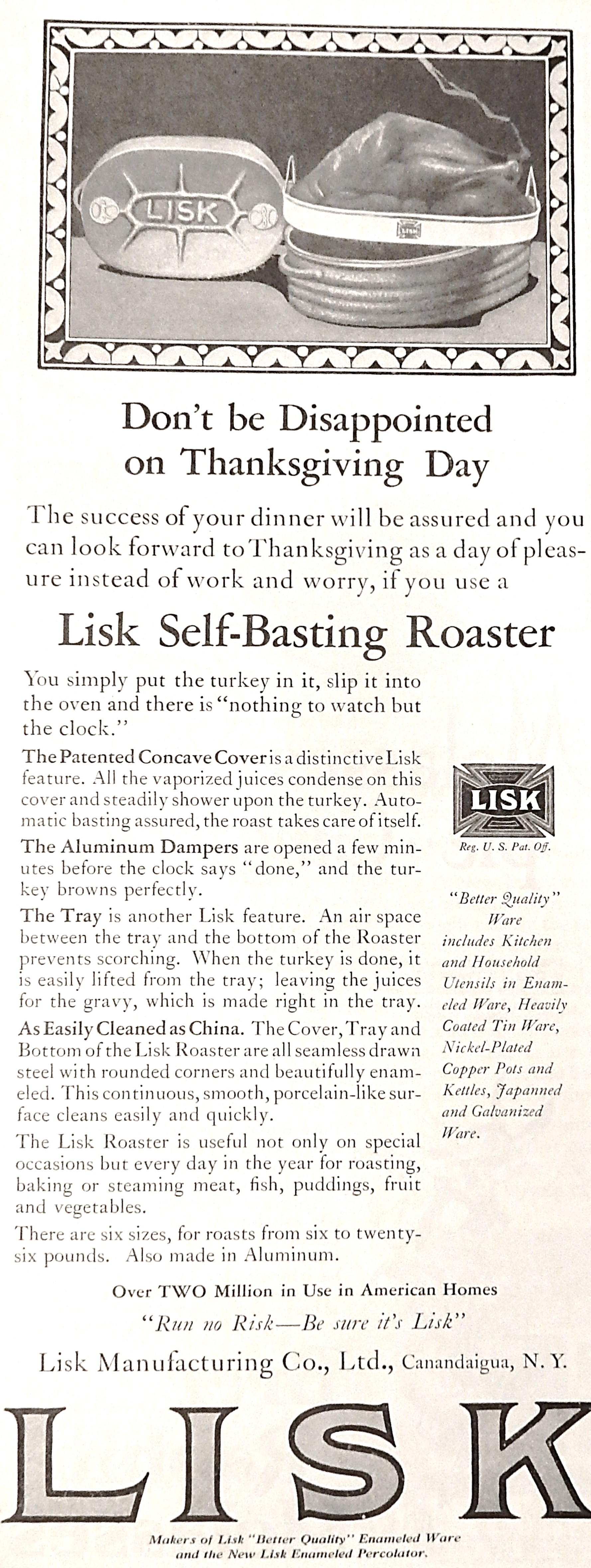
Here’s a hundred-year-old advertisement you might enjoy. So many things to think about when roasting a turkey. Wish I had a Lisk Roaster. The slogan, “Run no Risk – Be sure it’s Lisk” works for me.
Today we have margarine and spreads that are substitutes for butter. A hundred years ago there was a spread (or oleomargarine – not sure why it wasn’t just called margarine back then) called Nucoa that was made using a mixture of coconut and milk. I did a search on the name, and it looks like it may be still available in some areas (though I don’t think that it contains milk anymore), but I never heard of it.
I was surprised to see an advertisement in a hundred-year-old magazine for paper baking cups. Until I saw the ad, I never thought about it – but think that I would have guessed that they were a more recent invention.
Heinz has advertised for more than a hundred years that it has 57 varieties. I’ve heard that 57 is a made up number and that Heinz has many more than 57 varieties, but a 1924 advertisement lists 57 varieties, so maybe they actually had that number back then.
Source: Cook Book of the Susquehanna Valley Country Club, Sunbury PA (1924)
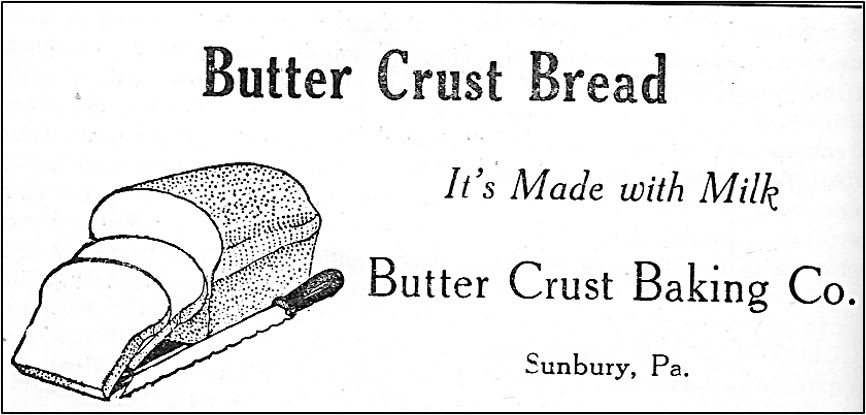
When I saw an advertisement for Butter Crust bread in a 1924 cookbook, it brought back very vague memories of bread my family sometimes bought when I was a child. Butter Crust was a soft white bread, and I can’t say whether I particularly liked it or not. I think that it was fairly nondescript and about like other white bread. But, as I worked on this post, I ended up being surprised that I found this bread and the company that made it more interesting now than back when I ate it.
Let me back up for a moment. I recently bought a hundred-year-old cookbook off eBay that was published by the Susquehanna Valley Country Club which was located in Sunbury, Pennsylvania. Sunbury is the county seat of Northumberland County. I was really excited to get this cookbook because I grew up on a farm in Northumberland County, and looked forward to getting a cookbook from my “home turf.” I’ll be making some recipes from the cookbook over the next few months, but I decided to first post this advertisement from the cookbook.
I googled “Butter Crust Bread” so I could add a little context to this post and was surprised when nothing came up with that exact spelling. Instead a bread company called Butter Krust Bread Company popped up. It also was located in Sunbury. I assume that it is the same company, but that the spelling was changed years ago. Is a “k” cooler than a “c” when spelling “crust”? In various articles that I found about the company Butter Krust is sometimes hyphenated; other times not. The name of this company sure seemed to have a lot of variations!
I found an article about a president of the Butter Krust Bread Company on the American Society of Baking website which said that Butter Krust was the first baker east of the Mississippi River to offer sliced bread and to wrap bread in cellophane. Who would have guessed that a very innovative baker was located in Sunbury?
The company was sold to Sara Lee in 2006 for $72 million. According to a 2010 article in the Sunbury Daily Item, Butter-Krust as well as other Sara Lee bakeries were then sold to Grupo Bimbo. At that time there were 200 employees at the Sunbury plant. A later Sunbury Daily Item article said that the plant was closed in 2017.