1911 Advertisements for Christmas Gifts

16-year-old Helena Muffly wrote exactly 100 years ago today: 

Wednesday, December 6, 1911: Have my part of the dialogue well under way. You may think I’m smart, but I haven’t much to say. I’m commencing to get streaks of thinking what I’ll buy for Xmas presents. My pocketbook is limited so I’ll have to make a careful list beforehand.

Maybe Grandma thought about buying bracelets for her sisters. (Ad Source: A portion of a Merry Mason Company  advertisement in The Youth’s Companion, December 7, 1911)

Her middle-aged granddaughter’s comments 100 years later:

Grandma was memorizing a dialogue for a school “entertainment” that was to be held before the Christmas break.

Let’s see—Grandma probably needed to buy gifts for at least seven people: her mother, her father, her sister Ruth, her little brother Jimmie, her married sister Besse, her brother-in-law Curt, and her best friend Carrie Stout.  Whew, I can see how that it could be expensive.

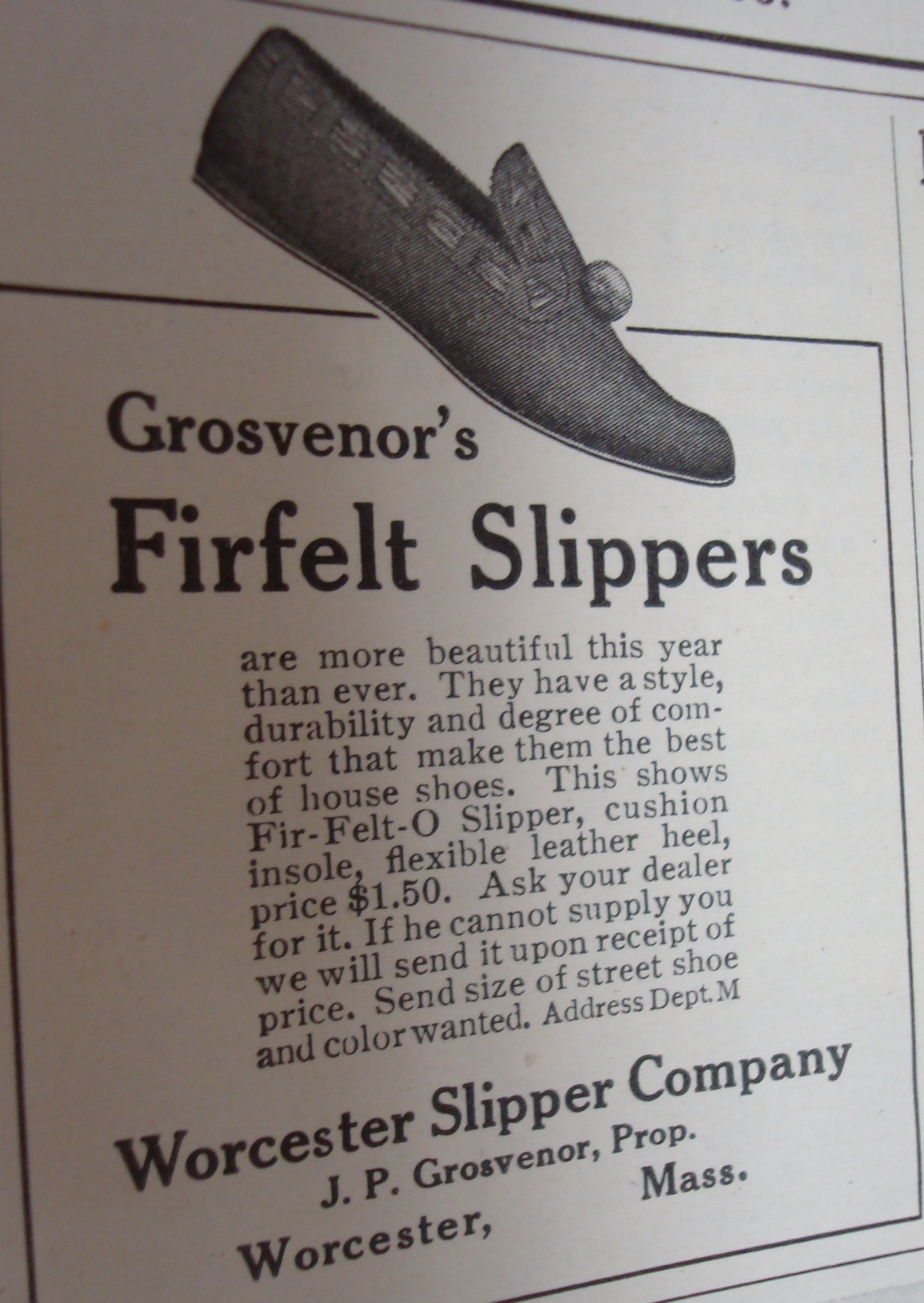
How about slippers for brother-in-law Curt? (Ad source: Ladies Home Journal, December, 1911)

In many ways the young woman who wrote the diary seems very different from the elderly grandmother that I remember—but this is one place where I can really recognize my grandmother. She always worried about money and I can picture her carefully planning what she would purchase before she went shopping.

And, maybe a glass candle holder for Mother? (Ad source: Ladies Home Journal, December, 1911)

Hundred-Year-Old Alarm Clock Ad

16-year-old Helena Muffly wrote exactly 100 years ago today: 

Monday, December 4, 1911: Pa took us to school this morning. Such a time as I had waiting on him, but we got there in plenty of time. You see our old clock was the cause of it all, being over half an hr. fast.   

Her middle-aged granddaughter’s comments 100 years later:

Maybe the family needed to get a Big Ben clock for Christmas. The December 15, 1911 issue of Kimball’s’ Dairy Farmer magazine had an alarm clock advertisement.

The ad text says:

Big Ben

Merry Christmas! Here is Big Ben.

May he wish you many of them!

Don’t waste a minute of this merry day. Have the presents ready Christmas eve. Hang each stocking up. Arrange the presents that won’t go inside in little piles around each stocking.

Then when all have gone to sleep, sneak into each bedroom a joy-faced Big Ben.

He’ll ring the merriest Christmas bell you have ever heard and get the family down to see the presents bright and early so the whole day will be yours to fully enjoy.

Big Ben is a gift worth the giving, for he is a clock that lasts and serves you daily year after year.

He is not merely an alarm clock—he’s an efficient timepiece—to get you up or to tell you the time all day—a clock for bedroom, parlor, library or hall.

Big Ben stands seven inches tall. He’s massive, well poised, triple plated. His face is frank, open, easy to read—his keys large, strong, easy to wind.

He calls you every day at any time you say, steadily for ten minutes, or at repeated intervals for fifteen.

He is sold by jewelers only—the price is $2.50 anywhere.

If you cannot find him at your jeweler’s, a money order sent to his designers, Westclox, La Salle, Illinois, will bring him to you express charges paid.

100 Year Old Ad for Quaker Oatmeal

16-year-old Helena Muffly wrote exactly 100 years ago today: 

Tuesday, November 21, 1911: Nothing doing.

Her middle-aged granddaughter’s comments 100 years later:

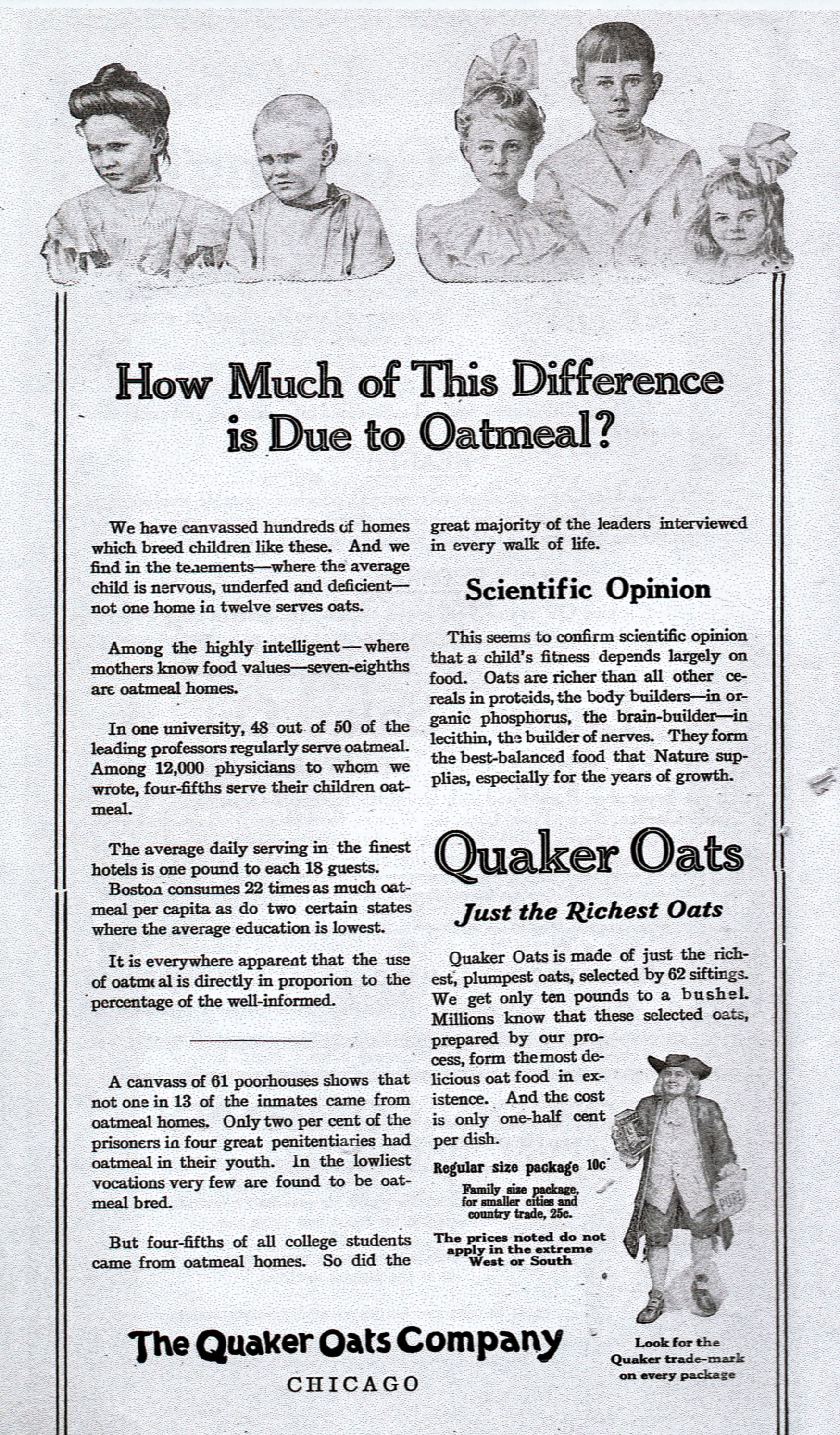
Since Grandma didn’t write much a hundred years ago today, I’ll share an old advertisement for Quaker Oatmeal.

It has lots of mind-boggling “statistics.” I wonder if there were any truth in advertising requirements regarding what types of research was needed to back up the numbers a hundred years ago.

How Much of This Difference is Due to Oatmeal?

We have canvassed hundreds of homes which breed children like these. And we find in the tenements—where the average child is nervous, underfed and deficient—not one home in twelve serves oats.

Among the highly intelligent—where mothers know food values—seven-eighths are oatmeal homes.

In one university, 48 out of 50 of the leading professors regularly serve oatmeal. Among 12, 000 physicians to whom we wrote, fourth-fifths serve their children oatmeal.

The average daily serving in the finest hotels is one pound to each 28 guests.

Boston consumes 22 times as much oatmeal per capita as do two certain states where the average education is lowest.

It is everywhere apparent that the use of oatmeal is directly in proportion to the percentage of the well-informed.

A canvass of 61 poorhouses shows that not one in 13 of the inmates came from oatmeal homes. Only two per cent of the prisons in four great penitentiaries had oatmeal in their youth. In the lowliest vocations very few are found to be oatmeal bred.

But four-fifths of all college students came from oatmeal homes. So did the great majority of the leaders interviewed in every walk of Life.

Scientific Opinion

This seems to confirm scientific opinion that a child’s fitness depends largely on food. Oats are richer than all other cereals in proteids, the body builders—in organic phosphorous, the brain –builder—in lecithin, the builder of nerves. They form the best-balanced food that Nature supplies, especially for the years of growth.

Quaker Oats

Just the Richest Oats

Quaker Oats is made of just the richest, plumpest oats, selected by 62 siftings. We get only ten pounds to a bushel. Millions know that these selected oats, prepared by our process, form the most delicious oat food in existences. And the cost is only one-half cent per dish.

Regular size package 10 cents.

Family size package, for smaller cities and country trade, 25 cents.

The prices noted do not apply in the extreme West or South.

Look for the Quaker trade-mark on every package.

The Quaker Oats Company

Chicago

National Foods Magazine (December 1910)

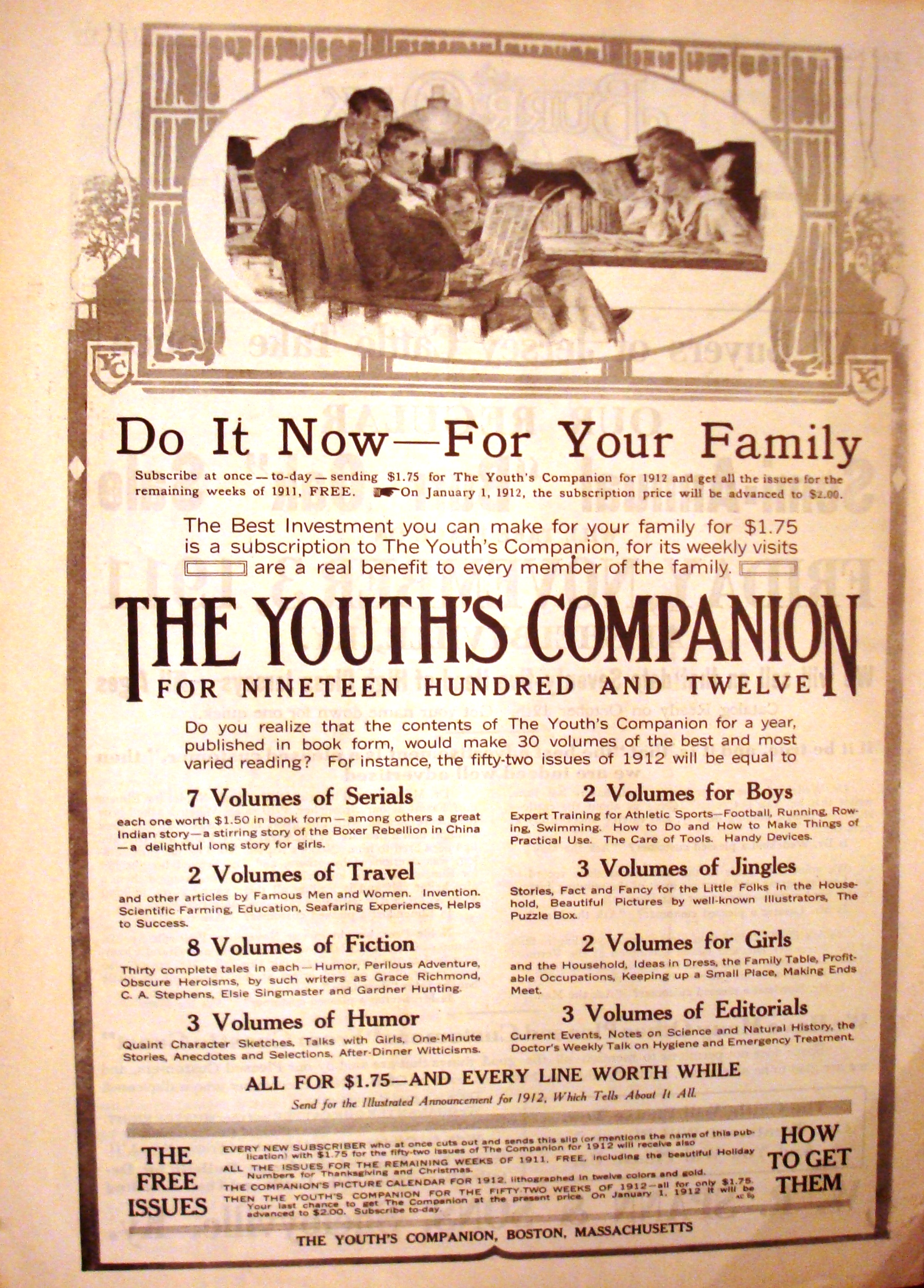
Youth’s Companion Advertisement

16-year-old Helena Muffly wrote exactly 100 years ago today: 

Monday, October 23, 1911: Subscribed for the Youth’s Companion today. Beginning to get cold. I mean the weather not me.

Advertisement for The Youth’s Companion on the back cover of Kimball’s Dairy Farmer Magazine (November 1, 1911)

Her middle-aged granddaughter’s comments 100 years later:

The Youth’s Companion was a popular magazine in the late 1800s and early 1900s.

According to the Collecting Old Magazines website the magazine began as a children magazine, but was aimed at the entire family by the time that Grandma wrote this diary entry:

 . . .  an audience limited to children only gave The Youth’s Companion only so many years in the life of a subscriber. The magazine expanded its offerings to include the entire family, and by doing so expanded its own lifetime to the lifetime of the subscriber. . . The typical issue would include “outdoor adventure stories, historical articles, anecdotes, contests, travel articles, and editorials.

“The Children’s Page” was there for the youth in its title, but by 1897 The Youths Companion also touted itself as “An Illustrated Family Paper,” which throughout that decade and into the new century would publish work from notables such as Grover Cleveland, Theodore Roosevelt, Booker T. Washington, Helen Keller, as well as literary notables such as Kate Chopin, Edith Wharton, Jack London and Emily Dickinson.

Magazine History and Collecting Tips, Collecting Old Magazines

Old Beet Pulp Advertisement

16-year-old Helena Muffly wrote exactly 100 years ago today: 

Saturday, August 19, 1911: Such a pleasant surprise awaited me when I came down to breakfast this morning. Mollie, my cute little heifer had a calf this morning. Wasn’t that grand? But the unromantic part about it is that I have to break her. I tried it this afternoon and found that she kicked some but not nasty. Saw my name in today’s paper about that picnic.

Her middle-aged granddaughter’s comments 100 years later:

Grandma must have owned one of the dairy cows on the Muffly farm. Mollie apparently had just had her first calf. Young cows that haven’t yet had their first calf are referred as heifers.

It can be a challenge to get young cows used to the milking process—and it sounds like Mollie was being really stubborn. At least she didn’t kick Grandma too hard.

I wonder if Mollie would be eating differently now that she’s a mother. When I was growing up on a farm many years after Grandma’s time, we often fed the milking cows a richer diet than the young stock.

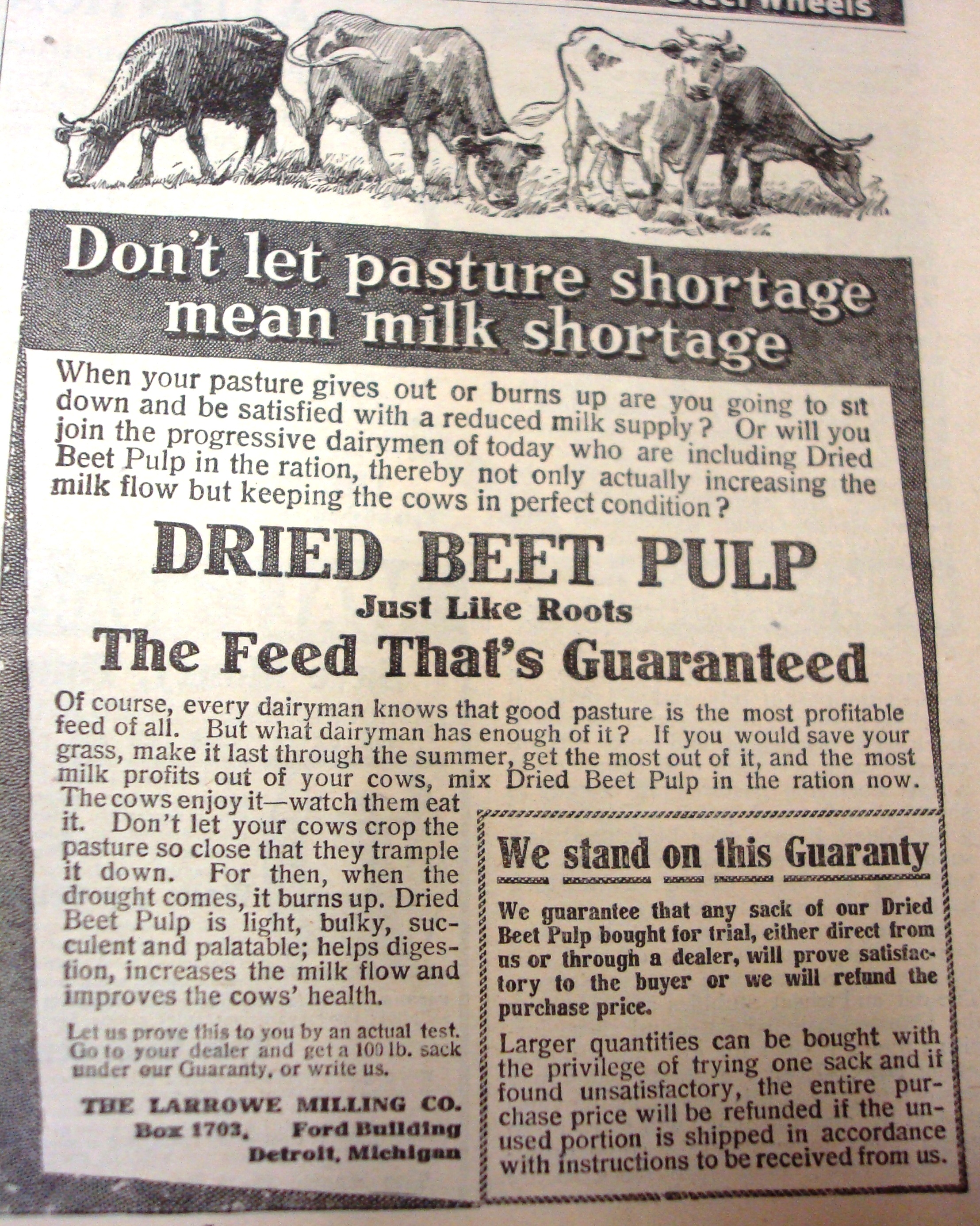
Advertisement  in July, 1911 issue of Farm Journal

In the July 1911, issue of Farm Journal I found an advertisement for beet pulp. I would have guessed that a hundred years ago that dairy cows would have gotten most of their food during the summer by grazing on pastures—and that in the winter they would have eaten hay, silage, and grain raised on the farm.

I was surprised that at least some farmers were already supplementing their cows’ diets.

Name in Paper

In 1911 when people wanted to tell their friends about recent events they submitted them to the local newspaper. Apparently Grandma submitted an item about the August 16th picnic that she’d organized to the newspaper.

Next time I get into the Milton Library I’ll have to search the old microfilms of the Milton Evening Standard to see if I can find her name in the paper.

For more information about how newspapers reported even minor social events a hundred years ago, see a posting that I did last winter called Tweet ‘Tweeting’ in 1911.

De Laval Cream Separator Advertisement

16-year-old Helena Muffly wrote exactly 100 years ago today: 

Thursday, August 10, 1911: Trotted after the cows this morning and did some sewing this afternoon. Don’t like to sew very well, but must when no one else will for me.

Her middle-aged granddaughter’s comments 100 years later:

The cows must have somehow managed to escape from the pasture AGAIN. This is the fifth time during summer 1911 that Grandma mentioned chasing cows. Only two days previously she wrote about a rebellious heifer in the orchard.

I wonder how many cows the Muffly family had. A hundred years ago farms were more diversified than they are today. Most farms had only a few cows, a couple of pigs, some chickens, some ducks, and maybe a few sheep. (Whew, it’s starting to sound like Old McDonald’s Farm).

I’d guess that Grandma’s family only had 4 or 5 milking cows—plus a couple heifers and calves—but that’s only a guess.  Many farm families sold butter, so they probably had a cream separator that separated the skim milk from the cream. The family would have fed much of the skim milk to calves and pigs—and the butter that the family didn’t use would have been sold.

Cream Separator (Source: Wikimedia Commons)
Advertisement in June 30, 1911 issue of Farm Implement Magazine

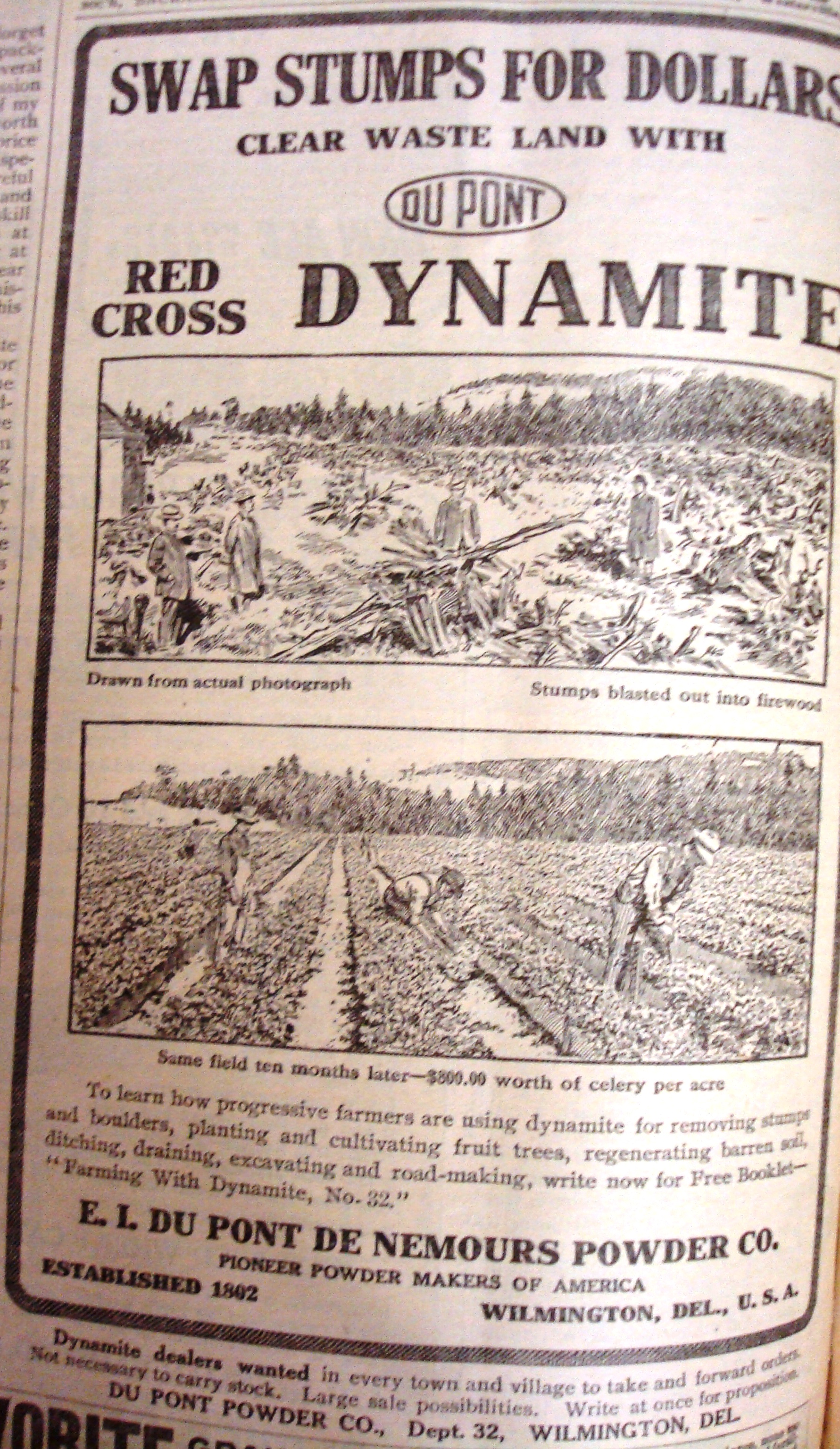
“Free Booklet– Farming with Dynamite, No. 32”

16-year-old Helena Muffly wrote exactly 100 years ago today: 

Monday, July 24, 1911: If I could go elsewhere sometime, I might be able to write something in this diary that would be interesting, and not have every entry fill of stale doings. I’ve expressed my feelings fully for tonight, so good-night.

Her middle-aged granddaughter’s comments 100 years later:

Sometimes I’m amazed at how much times have changed in the last one hundred years. Since Grandma didn’t write much today, I’ll show you an advertisement for dynamite that I found in the August 1911 issue of Farm Journal

The text in the paragraph says:

To learn how progressive farmers are using dynamite for removing stumps and boulders, planting and cultivating fruit trees, regenerating barren soil, ditching, draining, excavating and road-making, write now for Free Booklet–“Farming With Dynamite, No. 32.”

I guess that in some sections of the US, virgin forests were still being cleared and people were blasting out the stumps. Farmers may have also wanted to remove fencerows that contained trees to enlarge fields. Amazingly farmers apparently could just walk into a store and buy dynamite back then.  Whew, it’s scary to think about all of the environmental and safety issues.