19-year-old Helena Muffly wrote exactly 100 years ago today:
Wednesday, July 15, 1914: Wednesday—Perhaps a little different from other days.
Source: Wikimedia Commons
Her middle-aged granddaughter’s comments 100 years later:
Grandma. . .HOW is Wednesday different from other days? Did your family have specific chores for each day of the week?
Washing clothes on Monday. .
Did you do the mending on Wednesdays? Different lists have different chores for Wednesday, but the most frequently mentioned one seems to be mending. I’ve also seen lists where the ironing is listed as the Wednesday chore.
19-year-old Helena Muffly wrote exactly 100 years ago today:
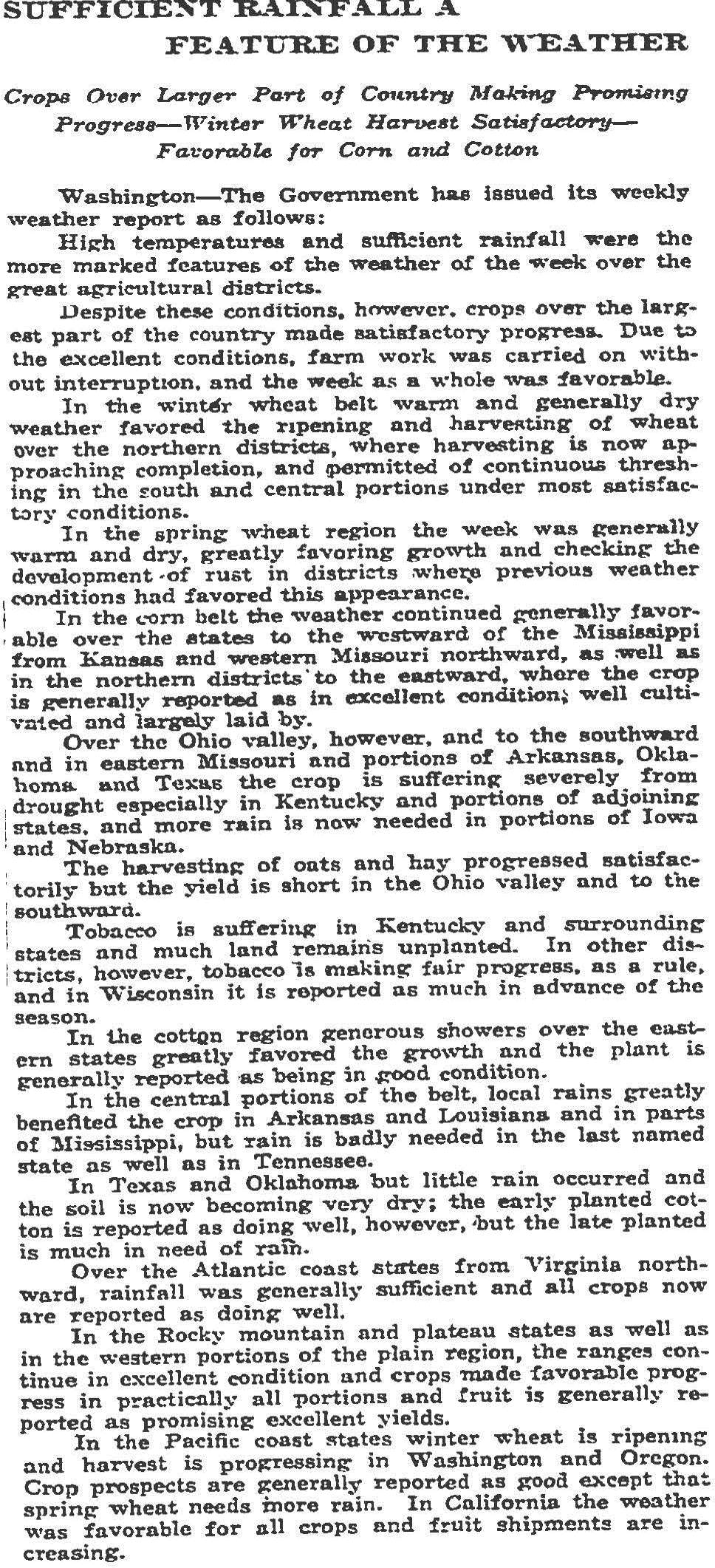
Tuesday, July 14, 1914: It’s raining some these days. One can even tire of the rain for a time.
Her middle-aged granddaughter’s comments 100 years later:
Grandma—
I understand! I tire of rain very quickly, too. But rain is good.
It looks like Pennsylvania (and most of the rest of the country) is getting enough rain, and the crops are doing well. I bet that your father is happy.
19-year-old Helena Muffly wrote exactly 100 years ago today:
Monday, July 13, 1914: I remember now what I did today, which wasn’t anything unusual.
Source: Wikimedia Commons
Her middle-aged granddaughter’s comments 100 years later:
Grandma—You remembered. . . so please tell us. . . WHAT did you do?
Did you work in the fields? . . . weed the garden? . . . can green beans? . . . stack fire wood for next winter? (Oh, never mind. . . Maybe this is the wrong time of year for stacking wood.)
—-
Several days ago a reader commented that he’d enjoy a post about stacking firewood. Well, here goes-
I haven’t seen any old articles about how to stack firewood, but I have seen cordwood problems in a hundred-year-old arithmetic book:
Cordwood
Cordwood is 4 ft. long.
A cord of wood is a pile 8 ft. long and 4 ft. high.
A cord of stove wood is a pile of wood 8 ft. long, 4 ft. high, and of any length that will fit a stove.
Rule: To find the number of cords of wood in a pile, multiply the length of the pile by the height in feet and divide by 32.
Problems
1. How many cords of wood are there in a pile 18 ft. long and 4 ft. high?
2. At $6 per cord, what is the value of a pile of oak cordwood 40 ft. long and 6 ft. high?
3. Which is cheaper for a man living in town: to buy stove wood 16 in. long at $3 per cord, or to pay $6 per cord for cordwood and give a man $2 to saw and split it into stove wood?
4. How many cords of wood 16 in. long can be placed cross-wise in a wagon bed 10 ft. long, 3 ft. wide, and 14 in. deep?
5. Make an estimate of the number of cords of wood in the fallen trees that are wasting on your father’s farm. What is the value of this wood at $2 per cord?
Rural Arithmetic (1913) by John E. Calfee
You may also enjoy these previous posts with other hundred-year-old math problems:
19-year-old Helena Muffly wrote exactly 100 years ago today:
Sunday, July 12, 1914: Went to Sunday school this afternoon. Besse and Curt were out this evening.
Her middle-aged granddaughter’s comments 100 years later:
Grandma’s sister Besse and her husband Curt lived in nearby Watsontown, and probably came out to the farm on a pleasant summer evening. Did the family sit on the porch and chat about everything—and nothing?
I bet they ate some dessert while they chatted . . . probably something made with fresh fruit.
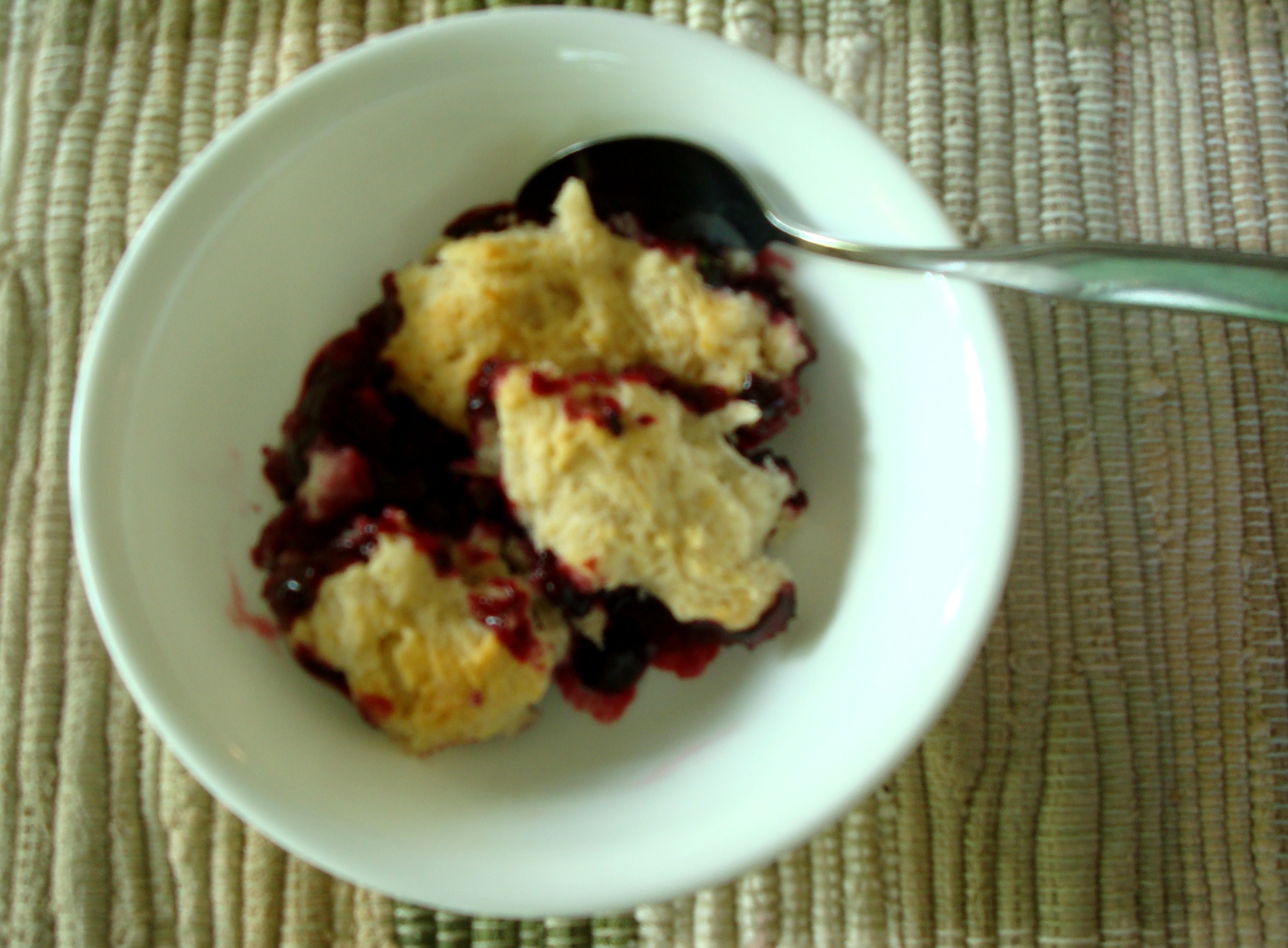
My black raspberries are ripe, so maybe they had something with black raspberries. . . maybe Black Raspberry Cobbler.
Black Raspberry Cobbler
1 quart (4 cups) black raspberries
1/2 cup sugar
2 tablespoons flour
1 cup flour
1/2 teaspoon salt
1 1/4 teaspoon baking powder
1/4 cup shortening
1/2 cup milk
Preheat oven to 450° F. Combine sugar and 2 tablespoons flour, and mix with the raspberries. Put into a 2 quart dish. In a separate bowl combine 1 cup flour, salt, and baking powder. Cut in shortening with a pastry blender or two knives. Add all the milk at once, and stir with a fork until the dough clings together. Pat pieces the dough to 1/4 inch thickness and place on top of fruit mixture. When all of the dough is used, most of the top of the fruit will be covered, but there should be gaps here and there so the steam can escape. Bake for 15 minutes; reduce heat to 325 ° F and continue cooking until berries are hot and bubbly, and the crust is lightly browned. Serve warm.
19-year-old Helena Muffly wrote exactly 100 years ago today:
Friday, July 10 – Saturday, July 11, 1914:Forgot the particulars of these days.
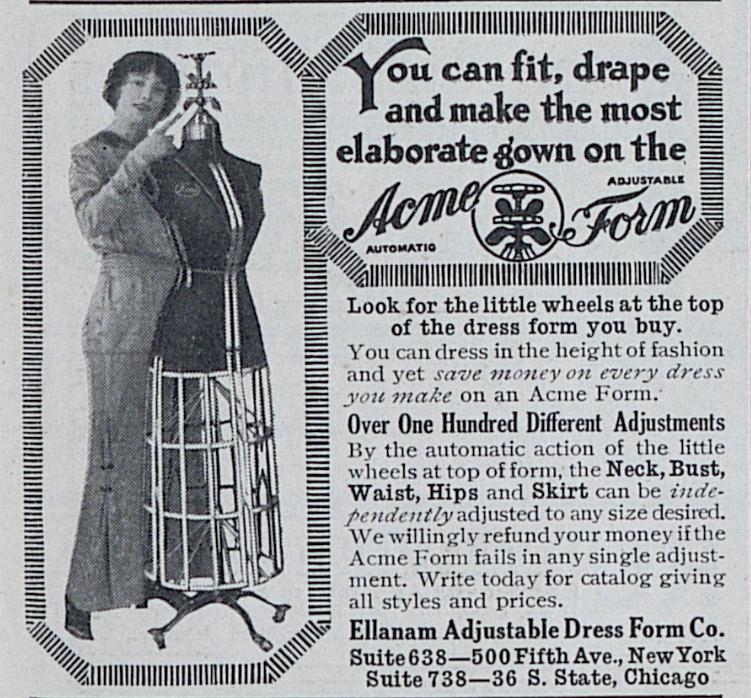
Source: Ladies Home Journal (February, 1914)
Her middle-aged granddaughter’s comments 100 years later:
Since Grandma didn’t write any specific for this date, I’ll share an advertisement that I found for Acme Dress Forms. I knew a few people who had dress forms when I was a kid. Does anyone have them anymore?
19-year-old Helena Muffly wrote exactly 100 years ago today:
Thursday, July 10 – Friday, July 11, 1914: Forgot the particulars of these days.
Did Grandma go up to McEwensville to visit friends?
Her middle-aged granddaughter’s comments 100 years later:
Grandma’s had a dry spell lately—the previous four days (July 6-9), she merely wrote “nothing doing.” Now, apparently on July 12, she wrote an entry that explained away the 10th and 11th.
. . . or maybe she went shopping in Watsontown?
Why weren’t all six days combined into one entry? It almost seems like Grandma actually wrote the “nothing doing” for the first four days on the 9th—then again set the diary aside for a couple more days.
. . . or led a horse as the hay was unloaded into the hay mow?, , , or sat in the house and dreamed of more exciting days to come?
19-year-old Helena Muffly wrote exactly 100 years ago today:
Thursday, July 9, 1914: Nothing doing.
Source: Vegetable Gardening (1914)
Her middle-aged granddaughter’s comments 100 years later:
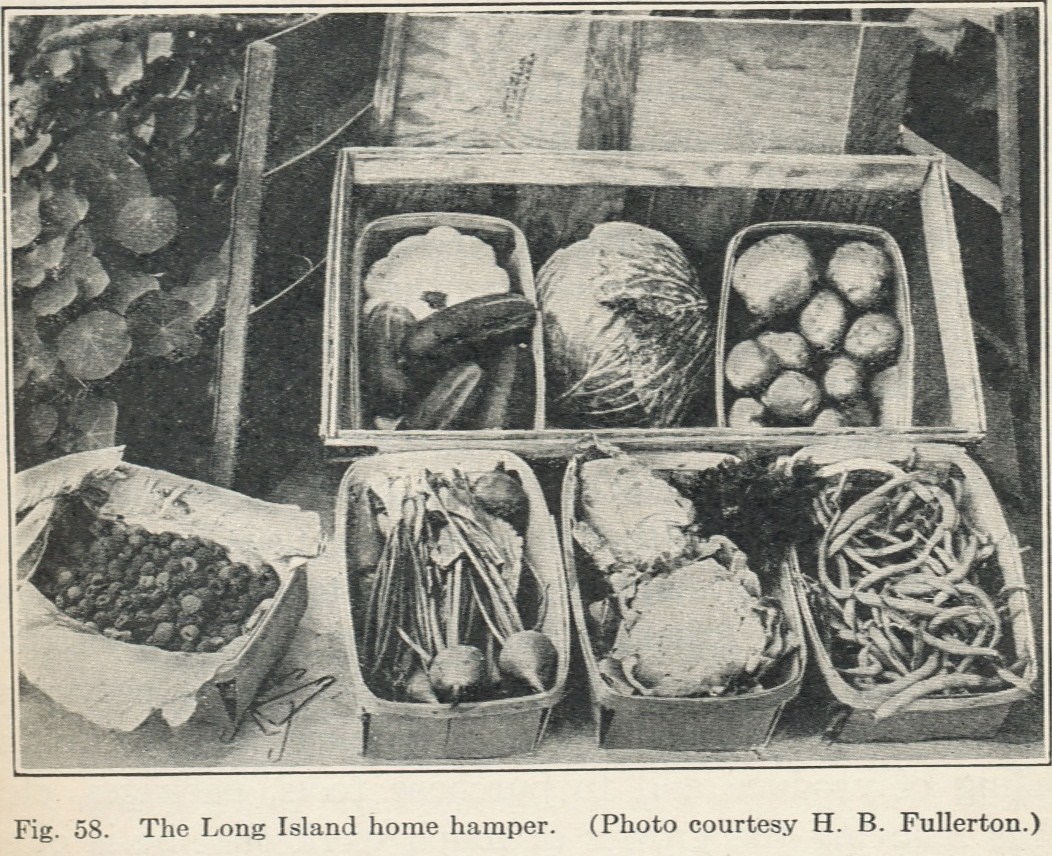
Since Grandma didn’t write much, I’m going to go off on a tangent. I was surprised to discover that some vegetables were marketed using a method similar to modern CSAs (community support agriculture) a hundred years ago.
H.B. Fullerton, of Long Island, has developed a package which he calls the home hamper. This is filled with a seasonable variety of vegetables and expressed directly to the consumer at stated times as may be agreed on.
This gives the customers the variety of vegetables they may desire and enables them to obtain them fresh. A cut of this hamper is shown in Fig. 58. A certain priced hamper is usually agreed on for the season or for the year.