Many children are picky eaters, though a recently published book, Picky: How American Children Became the Fussiest Eaters in History, says that it wasn’t always that way. Years ago, children ate the same foods as adults, but with changing technology and the abundance of food, there was a shift toward children eating a narrower diet of “children’s foods.” This shift was already occurring by the 1920’s. A short article in a 1926 magazine suggests making individual casseroles for children:
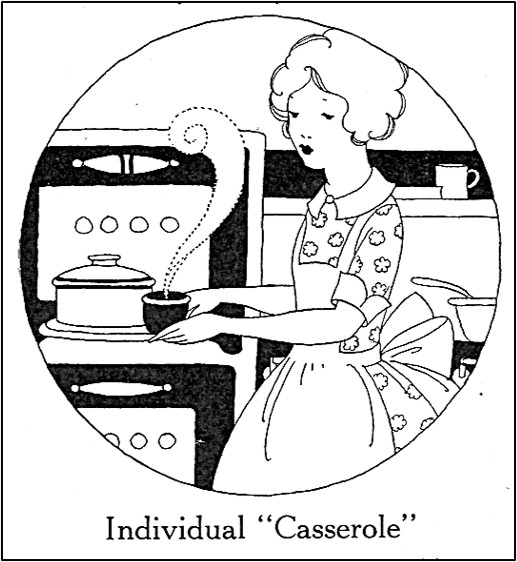
Individual “Casserole”
I have found that it is an easy thing to fill a little ramekin or custard cup and bake it separately when preparing a casserole dinner. Often the grown-ups must have their heavy meal in the evening, and by doing this I can give my child his most substantial meal at noon. A “fussy” child is often tempted to eat when his own special little dish is set before him, and another point is that one often uses seasoning and spices in the grown-ups’ casserole that he will be better off without.
Children appreciate pretty dishes and well-served meals as much as grown people, though many mothers do not seem to realize this. Children who are served from “left-over” China often have table manners to correspond, whereas dainty food set before them has a wholesome effect on their morale at mealtime.
American Cookery (October, 1926)

I kind of like this idea – it would have been fun to try when my kids were little.
I also think that my children might have enjoyed this when they were small.
It is a good idea. I remember, as a kid in the early sixties, people coming up with all kinds of ways to make us eat, such as the Clean Plate Club.
I have vague memories at having to sit at the table until I finished my food. It wasn’t a successful technique. It didn’t make me like the foods that I was forced to eat.
Thankfully times have changed.
Ah, I guess I forgot to make my food dainty enough for the little ones!
She does have a good point, kids love special dishes. I found some old school type lunch dishes at a yard sale, the kind with little compartments for everything even the flatware, and the kids loved eating out of them. Of course, I had to have something in every compartment which ended up being good because they had a larger variety of foods at the meal.
Similarly I had some plates with little compartments when my children were small. I still occasionally get them out when my grandsons visit.
They are kind of fun!
We did not have “picky eaters” in my home growing up… We did have a few items we did not care for such as cooked carrots and okra for my part but there was always plenty of other items on the table. I probably should not share the creative ways I got the okra and cooked carrots off the plate..
Now I’m curious. 🙂
It is interesting that the writer linked poor table manners with the use of “leftover china.” It was my experience growing up that your parents and grandparents taught you proper table manners, which have nothing to do with the type of dishes one is eating from. No elbows on the table, no feet on the chair (stop feeding your knees!), no smacking, talking with your mouth full, slurping soup or drinks, and “may I be excused?” were the norms growing up in our non-dainty food, leftover china household. Please “excuse me for rolling my eyes here”–I was suddenly overcome by a fit of excessive social class assumption! Thanks, Sheryl, for another fun read!
I agree! Table manners are very different from the type of dishes one is eating from.
My children were probably average on the picky scale. I asked them to taste everything that was served, not requiring them to eat full portions. They accept many more foods today, probably because good manners made them eat things served in other homes. I also think they experimented when they knew I wasn’t watching.
My children were picky eaters when they were little. Fortunately, they seem to have outgrown it.
i was a poor eater in my very young days. None of my kids were picky eaters, a real blessing because picky eaters really irritate me. I never knew this before I had grandchildren who were.
Some of my grandchildren are picky eaters. Sometimes, I enjoy seeing how my children (former picky eaters) handle this.
This is such an eye-opener! I completely assumed that picky eating was a modern byproduct of processed foods and endless grocery options.
It’s fascinating how there have been picky eaters for more than a hundred years.