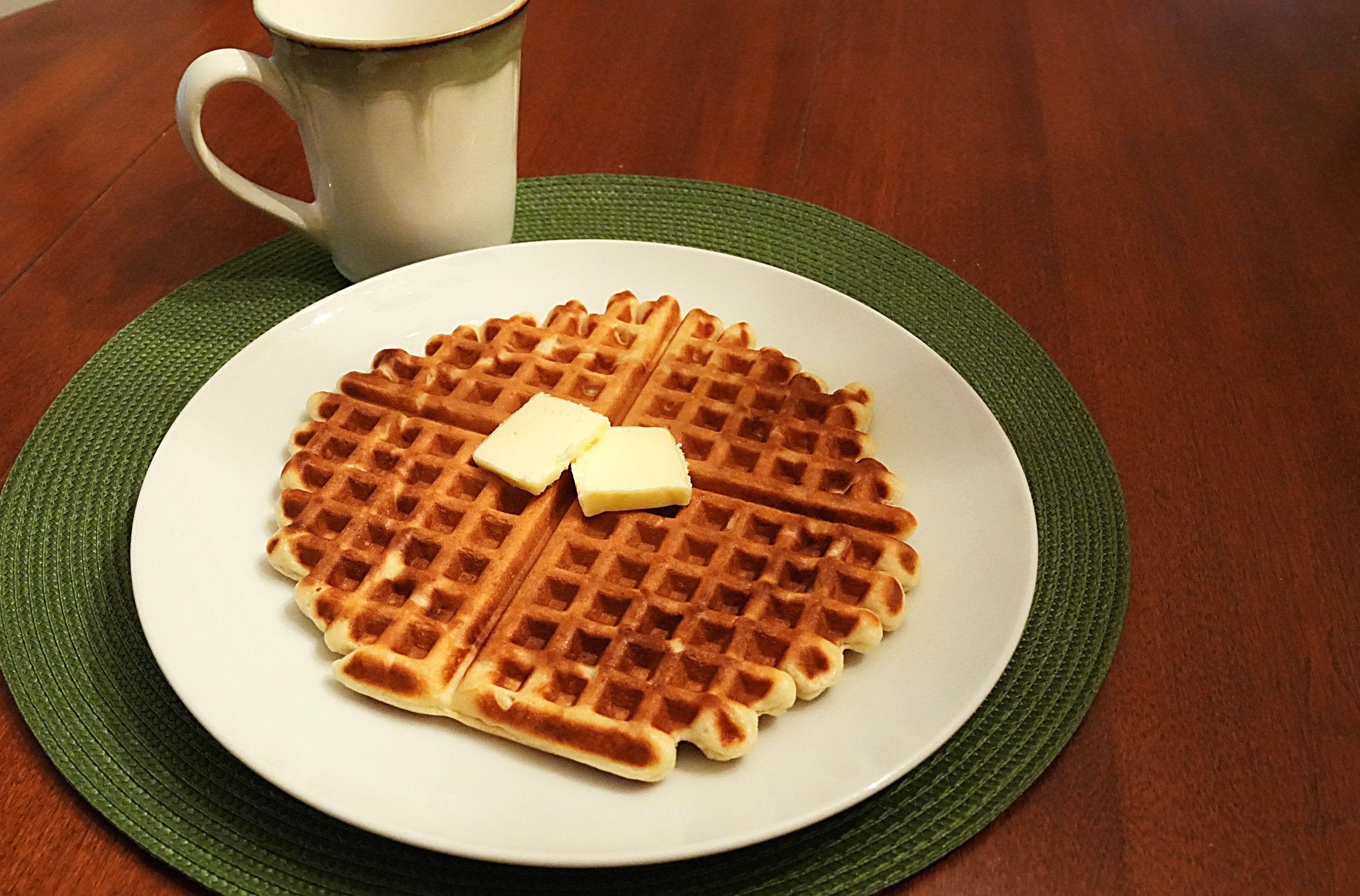
Often waffles taste almost like pancakes, so when I came across a recipe in a hundred-year-old cookbook for traditional Waffles with Yeast, I decided to give it a try. The recipe included an option for making overnight waffles, and I decided to go that route since it can be hectic in the morning, and I liked the idea of doing most of the prep work the previous evening.
The Overnight Waffles with Yeast were tasty with an old-fashioned goodness. The waffles were heartier and chewier than the typical modern waffle.
Here’s the original recipe:
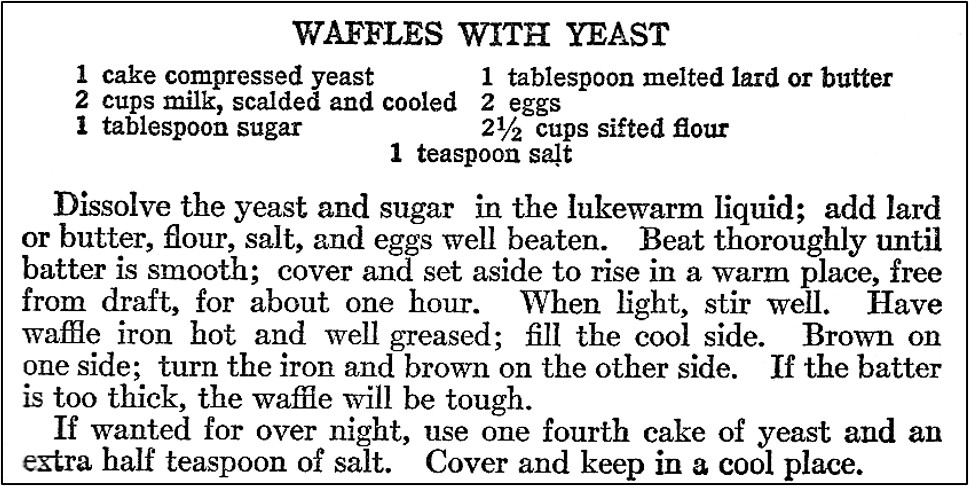
A cake of compressed yeast contained about the same amount of yeast as a packet of active dry yeast (2 1/2 teaspoons of active dry yeast).
Since I made the waffles using the overnight method, I updated the recipe for that option. Here’s the recipe updated for modern cooks:
Overnight Waffles with Yeast
2 cups milk
2/3 teaspoon active dry yeast (1/4th of packet)
1 tablespoon sugar
1 tablespoon butter or lard, melted
2 eggs, beaten
2 cups flour
1 1/2 teaspoons salt
Step 1. Put milk in saucepan, then heat with medium heat while stirring until the milk is scalded (180 – 185° F.). Remove from heat and cool to 105 – 110° F.
Step 2. Sprinkle the yeast and sugar on the warm milk, then stir to dissolve.
Step 3. Put the milk mixture in a mixing bowl, then add the melted butter or lard, eggs, flour, and salt; beat until the batter is smooth.
Step 4. Cover and put in the refrigerator overnight (10 – 15 hours).
Step 5. Remove from refrigerator, gently stir, then ladle batter onto a hot waffle iron and cook following the waffle iron directions.

This looks and sounds like one I need to try!
It’s a nice hearty waffle.
Sadly, like most Britih people I don’t own a waffle iron – in fact I wouldn’t now where to buy one. (Later) I’ve looked them up now. They ARE on sale, but you have to decide whether you want the thicker, airier type like Belgian waffles, or thinner and crunchier like American ones. I don’t have a lot of room in my kitchen, so I suspect I wouldn’t use it often enough to justify storage room. Ah well ….
Similarly to you, I always think twice before buying any new kitchen equipment or utensils. I just don’t have much extra space.
Interesting recipe. I do an over. night blender waffles that Iireally like. But. I might have to try yours..
Overnight blender waffles sound wonderful. I never would have thought of making the batter using a blender.
Oh! For an audience! I wouldn’t make these just for myself. They sound wonderful.
Maybe it would be possible to freeze extra waffles and then reheat them later.
I freeze leftover waffles to pop into the toaster for another day. (L’Eggo my Eggo!)
That hearty, chewy texture that yeast gives waffles sounds so much better than standard pancake-style batter! Modernizing a century-old recipe from the New Winston Cook Book for an easy overnight prep is such a brilliant idea. Definitely saving this, Sheryl!
Thanks! It’s nice to hear that you enjoyed this post.
Thank you for writing it Sheryl 😊
Thanks very much for this recipe, Sheryl. I like that they’re heartier and chewier than today’s waffles which I actually don’t care for all that much.
You’re welcome. These waffles definitely are different from the very airy modern waffles.
I use my sourdough discard to make an overnight starter for waffles. It works great.
I like it. Great suggestion!
Perhaps, good things come to those who wait overnight!
Nicely said.
We all love waffles. I will have to try this one.
They’re a lovely hearty waffle that’s chewier than many modern waffles.
Sounds perfect to me!
Sounds perfect to me!
Yeast is the trap in these old books, and I love that you kept it. A “cake of yeast” in a 1910s recipe is one modern packet (about 2 1/4 tsp) of dry yeast, since the old cakes were 0.6 oz each. Same with butter: “butter the size of an egg” is 1/4 cup, or 57 grams, and “a gill” is half a cup. I spend my days translating old measures and test-baking stuck family recipes, so this post made me smile.
Thanks for translating the old ingredient amount descriptions into modern measurements.