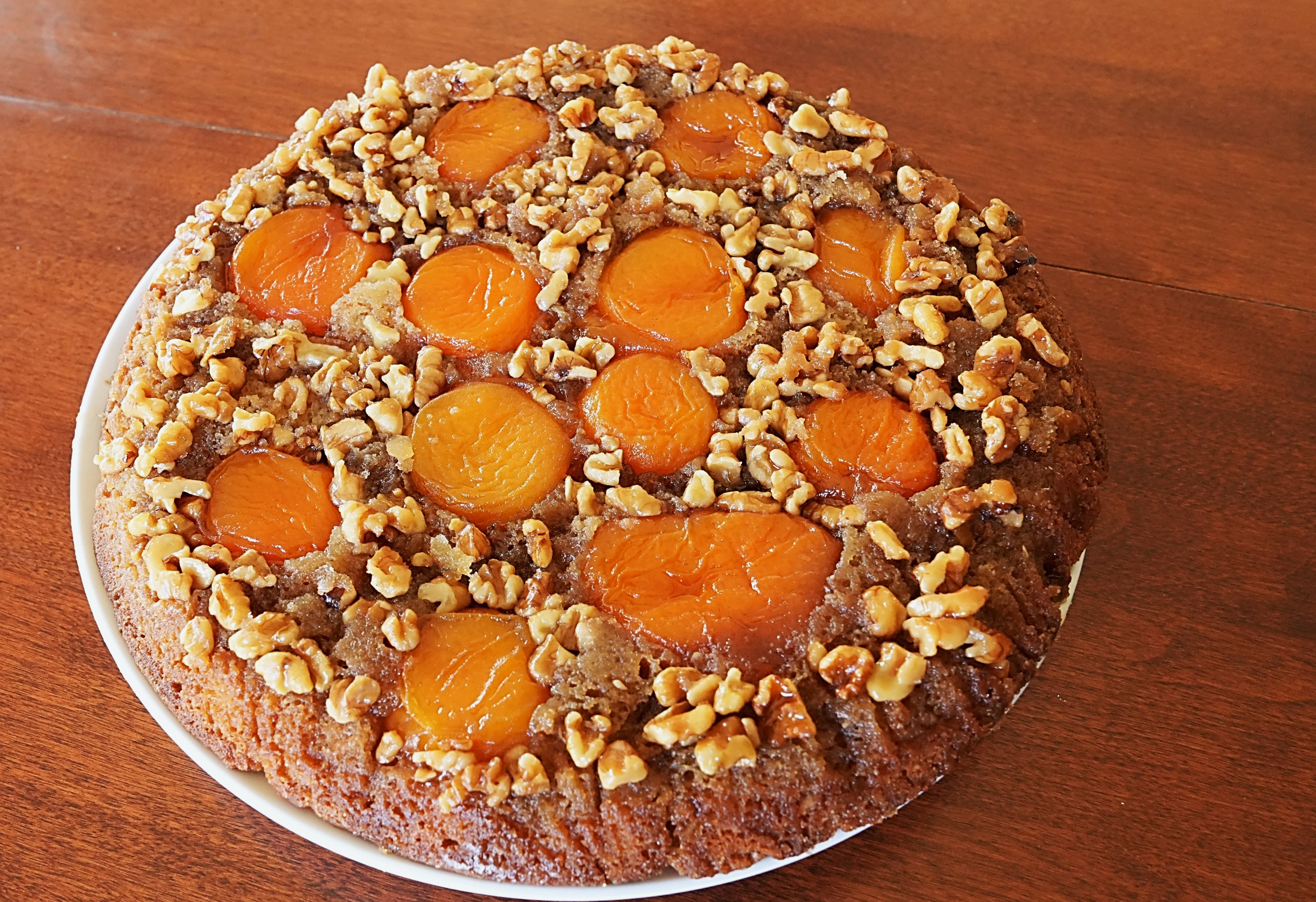
We had friends over for dinner last week-end. I wanted to make a tasty dessert that made a lovely presentation, and that was relatively easy to prepare (and, of course, it had to be a hundred-year-old recipe). I flipped through my old cookbooks and found a recipe for Apricot Torte (Apricot Upside Down Cake) in a church cookbook from Culbertson, Nebraska that looked like it might fit the bill.
This recipe is a winner. I feel certain that I will make it again. The Apricot Torte (Apricot Upside Cake) looked wonderful, and tasted even better. It only took me a few minutes to prepare the cake batter and arrange apricot halves and chopped walnuts for the topping, and then it baked in the oven while I set the table and did other things to prepare for the dinner.
Here’s the original recipe:
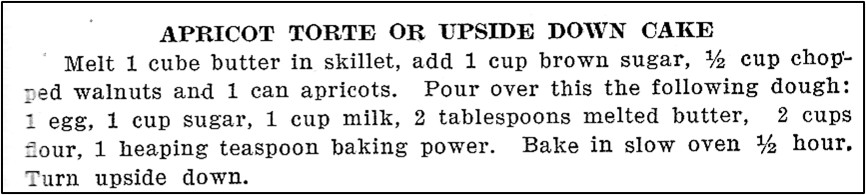
I’m clueless how much butter is in a “cube” of butter. I decided to use 1 stick (1/2 cup) of butter, and that worked well.
I interpreted a “heaping teaspoon baking powder” to be 1 1/2 teaspoons of baking powder.
Here’s the recipe updated for modern cooks:
Apricot Torte (Apricot Upside Down Cake
1/2 cup butter
1 cup brown sugar
1 can apricots (15 – 16 ounce can), drained
1/2 cup walnuts, chopped
1 egg
1 cup sugar
1 cup milk
2 tablespoons butter, melted
2 cups flour
1 1/2 teaspoons baking powder
Step 1. Preheat oven to 350° F.
Step 2. Melt 1/2 cup butter in an oven-proof skillet that is about 10-inches in diameter; add brown sugar and stir. Remove from heat, and evenly space the apricot halves (cut side facing up) in the skillet. Sprinkle the chopped walnuts around the apricot halves. Set aside.
Step 3. Put the egg, sugar, and 2 tablespoons melted butter in a mixing bowl; beat until mixed. Add the milk, flour, and baking powder; beat until smooth.
Step. 4. Evenly pour the batter over the apricots and walnuts.
Step. 5. Put in oven and bake until a wooden pick comes out clean (about 35-45 minutes). Remove from oven. Let partially cool for 10 minutes, then invert the skillet on the serving plate.

I bet those walnuts are awesome baked and browned in the butter and sugar!(❁´◡`❁)
The walnuts (and the rest of the topping) were wonderful.
Yummmmmm!
It’s always interesting to see the interpretations of today’s baking with yesterday’s recipes–“cube” of butter, like you say, and heaping baking powder (read as “power” in the recipe) and “slow” oven. Looks like your interpretations were spot-on, Sheryl. Wonderful.
In some ways, this recipe is so characteristic of the types of recipes found in community and church cookbooks. The cooks who contribute recipes to these cookbooks generally select their personal favorites, so like many recipes in these cookbooks, this recipe is really tasty. However, the ingredient list and directions in these cookbooks often have some limitations – and there may be typos and formatting issues. But, I think that’s one reason I find these old cookbooks enjoyable.
That’s what I like too, Sheryl–these recipes are personal and heart-driven.
I like how you described these recipes. You worded it well – “personal and heart-driven.”
I’d like to make this – sounds good. I’ll just have to get over being British and needing to do the maths about the ‘cups’. Especially ‘half a cup of butter’ Does that mean melted in this case then? And I always find instructions like ‘tablespoons of butter’ difficult, as blocks of butter don’t lend themselves to being spooned! Oh hang on, that must mean melt it first – before you can measure it. Is that right?
In the U.S., butter doesn’t need to be melted to be measured, because it typically comes in 1-pound packages, and each package contains 4 sticks. The paper wrapper on each stick of butter is labeled that it contains 1/2 cup of butter. There are also often markings on the wrapper that indicate where the stick should be cut to get 1 tablespoon of butter, 2 tablespoons, etc. I think that it would work for you to melt the butter first, and then measure it. The differences across countries in whether ingredients are measured using volume or weight, and the differences in the units (ounces/cups or grams/liters) sure make it more complicated to make a recipe from a place where a different system is used.
I can see that you are helped along the way. You must be equally foxed by our recipes. Older ones in lb..and oz., more modern ones in grams. I’ve adapted to grams, but many older cooks still prefer Imperial measures.
Until you mentioned it, I’d forgotten that the U.K. had switched from Imperial measures to metric. The U.S. considered making the change when I was young, but I haven’t heard anything about possibly shifting to metric in many years.
With us being so near Europe (and part of it too until that dreadful day in 2020 when we left) it makes sense to use the same measurements they do. And it is SO much easier.
Oh Wow.. that looks so good!!! When I grew up all we had was pineapple upside down. Now I have made rhubarb, banana, and apple and should add apricot to the list
It was yummy. A lot of different fruits can be used to make really good upside down cakes.
And it all starts with Brown sugar and butter!!! What could go wrong?
How true! Brown sugar and butter are a good start to any recipe.
It looks and sounds very tasty. I would have use pecans since I can’t eat walnuts.
Pecans would be wonderful in this recipe.
That looks so good! Apricots are lovely in a cake, I find. Their tanginess is such a great counterpoint to the sweetness. This recipe is also very straightforward. Thanks for updating it. Cheers.
It’s tasty! Apricots work well in this recipe. It’s nice to hear that you liked how I updated it.
the cube of butter reminds me of recipes with ‘one square’ of chocolate – no idea how big that square was :=) This looks very pretty.
sherry
It’s interesting how some recipe authors use unclear or imprecise measurements. There seems to be an assumption that cooks who will use the recipe have a similar understanding of what vague terms mean (or maybe they are encouraging cooks to creatively use their judgment to tweak the recipe).
Oh yum!!! It looks sooo good!!
It’s delicious.
Looks like a tasty recipe – thanks for adapting it for us!
The concept of this blog really reminds me of a channel on YouTube called Townsends that “translates” and makes recipes from early America. They go after a different time period, but perhaps you will enjoy.
Here’s an example of them demystifying “good gravy:”
Thanks for sharing the link. It’s fun to see how old recipes are interpreted on these videos.
This looks sweet, zesty, and impossible to resist!
It definitely went quickly, and was gone before I knew it.
This looks like a fancy company treat, but sounds really easy!
Exactly – it looks fancy, but is easy to make.
We still have cubes of butter, we just don’t think of them that way due to clever packaging. A box of butter comes with four cubes of butter, with each cube being 1/2 cup or a stick of butter.
It’s interesting how butter is packaged differently from one area to another.