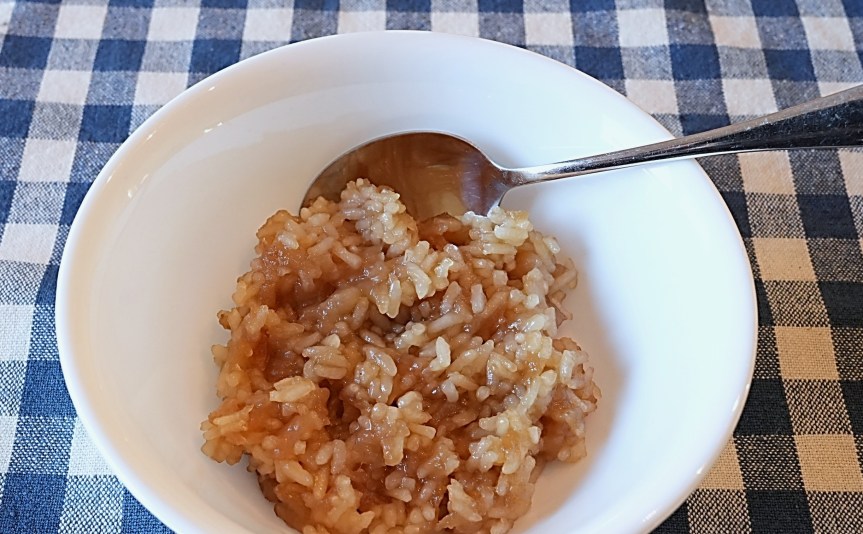
Rice puddings are a classic comfort food, so I was intrigued when I saw a recipe in a hundred-year-old cookbook for Rice Caramel Pudding. I decided to give it a try. The recipe made a baked rice pudding that contained apples. It called for using brown sugar rather than the more typical white sugar.
The Rice Caramel Pudding was rich and sweet with lovely caramel undertones. I used coarsely chopped apples. The apple variety I used softened and lost their shape when cooked. This worked well, though for the apples to be more prominently featured in this recipe, an apple variety could be selected that keeps its shape when cooked and they could be sliced rather than chopped.
Here’s the original recipe:
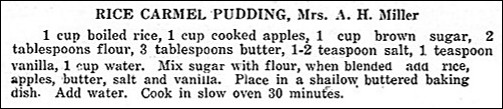
The recipe called for 1 cup of water. It does not list when the water should be added to the pudding, except to say that water should be added after the rice pudding was put in a baking dish. I found this confusing. It seemed like the 1 cup of water should be stirred into the pudding mixture before it was put in the baking dish (which is what I did), and that the “add water” referred to setting the baking dish in a pan with water so there would be a water bath while it baked. That said, I may not have understood the recipe writer’s directions.
For this recipe, I interpreted a “slow oven” to mean 325° F. I cooked the pudding for about 45 minutes.
Here’s the recipe updated for modern cooks:
Rice Caramel Pudding (with Apples)
1 large apple (2 medium apples), peeled and coarsely chopped or sliced (I chopped the apples.)
1 cup cooked rice
1 cup brown sugar
2 tablespoons flour
3 tablespoons butter, softened
½ teaspoon salt
1 teaspoon vanilla
1 cup water + additional water
Step 1. Preheat oven to 325° F.
Step 2. Put apples in a saucepan; add a little water so the apples won’t stick to the pan, then heat with medium heat. Cook until the apples they soften (about 5 – 7 minutes), then remove from heat.
Step 3. Put the brown sugar and flour in a mixing bowl; stir to combine. Then add the butter, rice, cooked apples, water, salt, and vanilla; stir to mix the ingredients.
Step 4. Put the mixture in a 1-quart baking (or similar-sized shallow) baking dish.
Step 5. Set the baking dish in a pan with 1-inch of hot water, then place in oven and bake until the rice pudding is hot and has thickened (approximately 45 minutes).

Ooh, I haven’t had rice pudding for years! Such a comforting dish. Yes, I’d like to try this, though I’m really surprised the dish calls for ready-cooked rice. Is that the American way? We usually cook pudding rice slowly in milk, never water, which is absorbed into the rice.
I had to follow up on this and learn what is pudding rice and the British method of making rice pudding. Thanks for sharing!
It’s illuminating that by following Sheryl’s blog, I’ve discovered just how many of the dishes we allegedly have in common are in fact quite different.
It is interesting to see the differences between countries and cultures.
Yes, rice pudding recipes generally call for cooked rice – though the additional liquid in many recipes would be milk rather than water.
If I try your way, may I suggest you also try the British way? Its soft and creamy texture is the ultimate winter comfort food. Though other comments suggest you may not have access to pudding rice, a roundish grain, close cousin of arborio rice for risotto. https://www.bbc.co.uk/food/recipes/rice_pudding_85172
mmm . . . the British version looks wonderful. I’m going to have to see if I can find pudding rice. In addition to pudding rice being difficult to find in the U.S., I noticed that the recipe called for caster sugar, which has granules that are a little finer than the typical sugar granules in the U.S. – though some stores do have caster sugar. I also think that regular sugar can be substituted for caster sugar.
Honestly, I wouldn’t worry about the sugar being a little coarser. It can matter if you’re cake making, but not for this. As to pudding rice. I’d suggest paella or risotto rice as a substitute. Or ‘short grain’? Long grain or basmati really won’t work well. Good luck! Please let me know how you get on – here’s a genuine 1920s recipe from a well-known English recipe writer, Margaret Powell: https://www.stoves.co.uk/en-gb/centenary-rice-pudding
Thanks! It’s fun to see the old 1920’s recipe. When I get a chance, I’ll have to give one of these recipes a try.
👍
This sounds wonderful. I will definitely try it!
It is a nice recipe.
I am thinking my home canned apples will work for this. My mama always make rice pudding with leftover rice and cook it in a custard in the oven.
Home canned apples would work well in this recipe.
I remember this from my childhood! It used to be such a comfort dish, especially in the winter when the weather was particularly bad. Thank you for updating and sharing your recipe.
It’s nice to hear that this recipe brought back some warm memories.
The instructions puzzle me here as well. It is not a custard – no eggs or even milk so why a water bath? 1 cup of water seems a lot but it would need some. Perhaps her cooked apples were fairly “saucy” and that would add quite a bit of moisture. It seems like the apples would be more the flavor without milk. I have a large apple and the required amount of cooked rice so I will give it a go as re-written.
Follow up, I used about 1/4 cup more rice because I had it but didn’t up the water. It still seemed like too much water. Not the typical creamy rice pudding texture, but the rice pudding hater (mild dairy issues) liked it. We all thought it was too sweet but liked the brown sugar and apple (granny smith so nice texture). There is a slight caramel flavor which we liked. I think we will actually use this as a starting point again for a dessert but reduce the water and sugar and up the apple to 2 keeping it a granny smith for the texture and tartness. Very glad I tried it.
Thanks for describing how the recipe turned out. It is really helpful, and I’m certain that others will try some of the adjustments you suggest.
Sweet, creamy and textured – yummy!
It’s tasty – though less creamy than some rice puddings since the recipe doesn’t call for any milk.
I remember making rice pudding with milk, no eggs. That seems like lots of sugar.
It was fairly sweet. The amount of sugar probably could be reduced.
Never had rice pudding that wasn’t made with milk. The apples are also a new idea! We just put raisins in our with the milk based pudding.
I’m not sure why the original recipe author used water instead milk. Maybe it was a way to make the recipe less expensively. Milk could easily be substituted and the pudding would be creamier. Apples add some nice variety to the rice pudding. I actually could see possibly using both apples and raisins in this recipe.
We love rice pudding but we have a little bit different version. I love how you can use apples as well. I am going to try this for sure.
The apples were a nice addition, though if I made this recipe again, I would definitely select an apple variety that maintained its shape a bit more when cooked than the variety I used.