
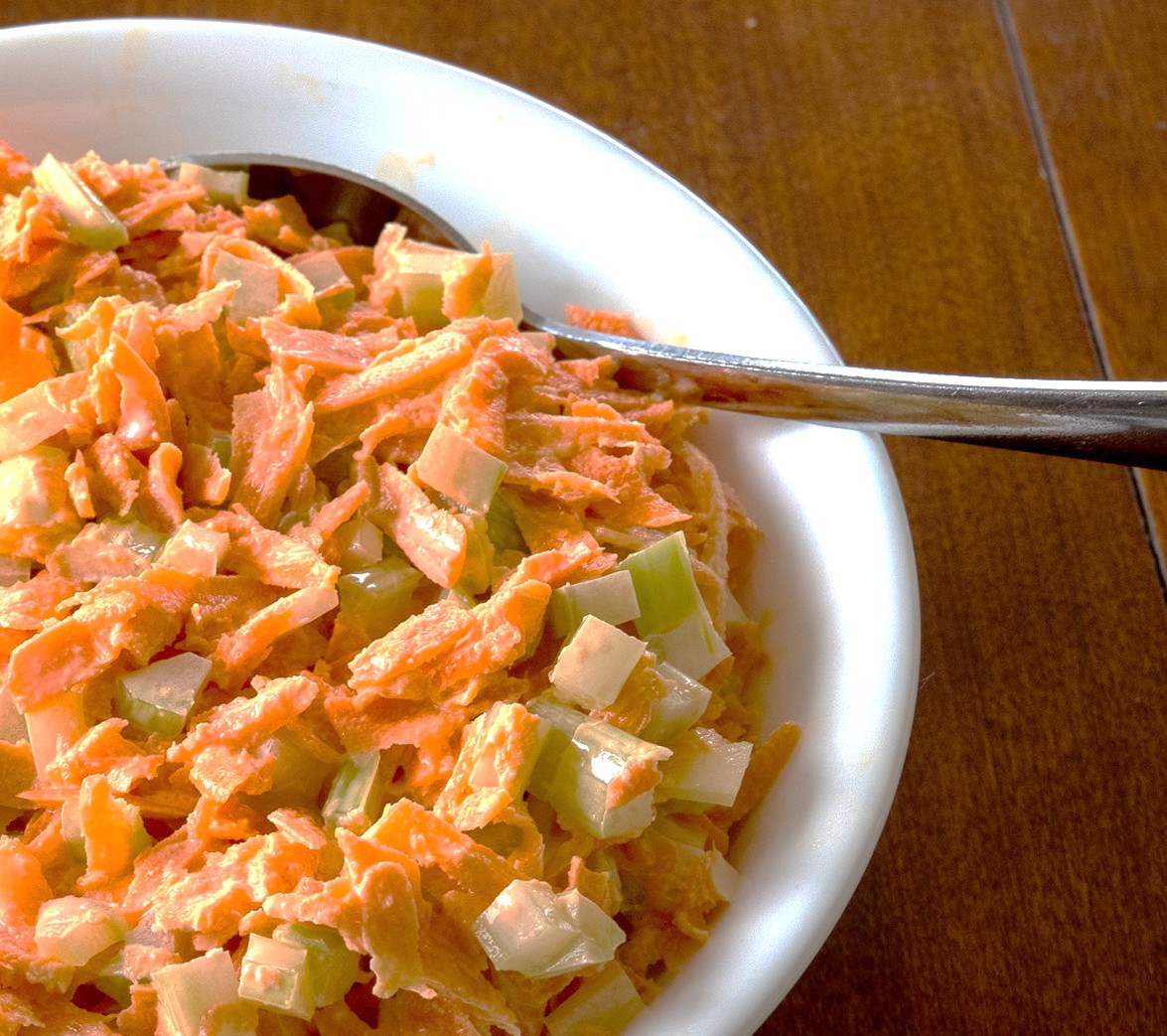
Occasionally, a hundred-year-old recipe brings back vivid memories. I recently came across a recipe in a 1926 cookbook for a Carrot and Celery Salad. Suddenly long forgotten memories flowed back. Easter dinner and other family gatherings were often held at my parents’ home, and my mother generally served a Carrot Salad. When my brother and I were in elementary school, we assisted in preparing the big meal. Mom always found fun, but easy tasks for us. A favorite kid task was to grate carrots for Carrot Salad.
For some reason, I can’t remember much about those Carrot Salads. I don’t know what the other ingredients were or what they tasted like. I just know that it was fun grating carrots.
In any case, when I saw the old recipe for a Carrot Salad that contained carrots and celery, I immediately knew that I wanted to make it, and I’m glad I did. The Carrot and Celery Salad was quick and easy to make. It only contained three ingredients: grated carrots, chopped celery, and a little mayonnaise to bind everything together.
This salad is a winner. The slight sweetness of the carrots combined with the crunchiness of the celery, and the rich, tanginess of the mayonnaise was delightful.
Here’s the original recipe:

I decided to put the salad in a bowl rather than on lettuce leaves. The recipe does not provide any details about the salad dressing. The same cookbook also contained another recipe for “Carrot Salads” which suggests that mayonnaise should be used as the salad dressing, so I went with that when updating this recipe. Here is the old Carrot Salads recipe:

Here’s the recipe updated for modern cooks:
Carrot and Celery Salad
2 cups grated carrot
1 cup celery, chopped
1/4 mayonnaise
Put all ingredients in bowl; stir to combine, then put in serving dish.

Sounds simple and yummy. I would add tiny equal parts of sugar and vinegar. I like my salads of the sweet/sour variety.
A little sugar and vinegar would be a nice addition.
Easy, and I’m sure will tickle the memories of many folks! Mine included.
It’s nice to hear that you enjoyed this post.
Its the season for carrot salad with the “bunny” making the rounds. Mama always added raisins.
Raisins would be good in this salad. I have a vague memory that my mother may have sometimes made a salad that was just carrots, raisins, and mayonnaise.
I don’t recall if we ever had salads like this, but Mom did make apple and celery salad. I always enjoy looking up the towns where the various cookbooks were from, and learned a little more about Woodcock Center Grange. It is now a small borough, but still very pretty with large farm houses and cute little cottages! It reminds me of how much I would like to go back to Pennsylvania and see more of the areas we passed through during our time there.
Since I’m originally from Pennsylvania, I also have really enjoyed seeing which towns the various recipes in the Pennsylvania State Grange Cook Book were from. Like you, I wasn’t familiar with Woodcock Center, and did an online search to figure out where it was located. One of the things on my to-do list is to research the Grange a little more, and then do a post about it and the old cookbook that I have. The Grange has such a long fascinating history. Not sure when I’ll get it done, but I’ll get the post written sometime before the end of the year.
That would be wonderful!
I know too many people who don’t like celery. I would gladly eat your salad, but I wouldn’t make it just for myself.
A nice thing about this salad is that the amounts are very flexible. It could be made using just one carrot (or half a carrot), a little chopped celery, and a little mayonnaise to hold everything together.
Yes, the amounts are flexible, but maybe I’m not!!
You gave me a chuckle, Anne!
My aunt used to make carrot, apple and pineapple salad. No mayo or dressing. A little of the juice from the pineapple tidbits moistened everything. As kids, we loved it.
I always say I’m going to make it but then never do. 🤦🏼♀️
Your aunt’s salad sounds delicious. And, I like that it’s easy to make.
Our family loves carrot salad, only I add raisins yet. I usually let it set overnight as the juices from the raisins add just a touch of sweet then.
mmm. . . raisins would be a great addition. I like the idea of making it ahead so the juice from the raisins can add a bit of sweetness to the carrots.
As a child, my mother made something similar, but I think she added pineapple to it. This looks so good!
Pineapple would be nice in this salad.
It was interesting that both recipes had the salad served on a lettuce leaf.
Old-time salad recipes often indicate that the salad should be served on lettuce. Years ago, I think that salads were often plated on salad plates for serving. When updating a recipe like the one in this post, I struggle with whether I should reproduce how the recipe author probably served the salad or whether I should show the salad in a way that modern cooks are more likely to serve it. I go back and forth on this. For example, several years ago I did a Tuna Salad post where I served the salad on lettuce.
You gotta love the simplicity of it! I’ll bet it’s delicious!
Sometimes simple is best.
There is a joy in simple recipes. For me, it brings comfort. Yesterday I was reading about pie recipe and it’s history. I feel no matter what, how many recipes we try, we love but one will always go back to basic, simple dishes that made them happy once 🙂
How true. Sometimes I enjoy trying recipes that are complicated or challenging; but, like you, I go back to my favorite recipes that I’ve made many times before.
I tried to recreate a French carrot salad (a finely shredded raw carrots with vinaigrette) that I had eaten about 25 years ago when visiting France on vacation. I stayed with a French family and the mom was a most excellent home cook! I had never heard of carrot salad before, much less eaten it before, and I honestly thought it was going to be terrible… But it ended up absolutely blowing me away!
It was so damn delicious, and I know that it was overwhelmingly due to the amazing seasoning/vinaigrette the mom had made from scratch and mixed into the carrot shreds. Well, I had never tried to make carrot salad myself until around a month or so ago (I recently got a food processor, so I could grate the carrots that way, but I was left wondering how in the heck the French mom did it for so many people back then, because I don’t remember her having a food processor, and I would’ve thought it would take forever to grate that much carrots by hand).
Anyways, I hadn’t any idea what vinaigrette to make for it, but upon looking up a lot of videos of people making the dish, it seemed the most common vinaigrette used is a lemon vinaigrette, so that is exactly what I made for it! I will say though that it was too mild – I ended up having to add quite a bit more vinegar – the lemon was too subtle. It was a yummy carrot salad, but I still have a ways to go in trial-and-error to figure out the exact seasoning/flavor that the French mom had infused in her gorgeous carrot salad (or get as close as I can to how I remember it being!).
And then, after I get that recipe nailed down, I have to try to figure out how she made her mind blowing apple pie lol. It was nothing at all like American pie (which I hate, because it has that jelly goop in it). That French mom really could cook! I loved everything she put together in that kitchen!
So I spent a long time looking through recipes online, and then I fed a TON of recipes I gathered into Grok’s ai, asking it which one was most authentic for me to try to re-create. This is what Grok responded with (in case you would like to try it for yourself, because it was delicious and I guarantee you it was way better than this mayonnaise concoction you made lol:
___________________
The most authentic version of the classic French grated carrot salad (known as **carottes râpées** or **salade de carottes râpées**) is a very simple, everyday dish in France—often served as a starter in bistros, cafeterias, markets, or home meals. It’s prized for being fresh, cheap, vitamin-rich, and requiring minimal ingredients: just finely grated raw carrots (peeled), tossed lightly in a basic vinaigrette, sometimes with a touch of chopped parsley for color and freshness.
The core authentic elements, based on traditional French sources and common descriptions:
– **Carrots**: Finely grated (use the finest side of a box grater or the fine shredding disc on a food processor for the classic texture—thin, almost julienne-like strands that absorb dressing well without being mushy).
– **Vinaigrette**: Extremely simple, almost always a classic French-style emulsion with:
– Acid: Fresh lemon juice (most common and traditional for brightness) or a mild vinegar like white wine or red wine vinegar.
– Oil: Neutral vegetable oil or olive oil (extra-virgin olive oil is common in modern versions, but neutral oil keeps it lighter and more classic in some bistro styles).
– Seasoning: Salt, pepper, and often a small amount of Dijon mustard (to emulsify and add subtle tang—very French).
– Optional tiny sweetener: A pinch of sugar or honey if the carrots are not naturally sweet enough, but many skip it.
– **Herbs**: A light sprinkle of finely chopped flat-leaf parsley (Italian parsley) is traditional and common, but used sparingly—not overloaded.
– **No extras in the purest form**: Avoid garlic, shallots, raisins, crème fraîche, maple syrup, Herbes de Provence, green onions/chives, or heavy honey/garlic unless it’s a modern variation. The dish is intentionally minimalist to highlight the carrots’ natural sweetness and crunch.
– **Method notes**: Make the vinaigrette separately (whisk or shake to emulsify), toss gently with the carrots, let it sit 15–60 minutes (or longer in the fridge) to meld and slightly soften the carrots. Serve chilled or at room temp.
### Which of your researched recipes is closest to authentic?
– The **first YouTube one with the French accent** ( https://youtu.be/yx10U93SxZo ) is the most authentic among those you listed. It presents itself as the “real Parisian version” of a classic bistro/family staple, with two simple options: lemon juice + oil + salt/pepper, or red wine vinegar + oil + salt/pepper. It emphasizes the finest grater disc, light parsley, and the classic shaking technique for emulsification. This aligns closely with traditional descriptions—no mustard here, but that’s a valid simple variant (many classics omit mustard or use it sparingly).
– Several others are close but add extras:
– The shorts with olive oil, lemon juice, whole grain mustard, optional garlic/parsley/chives (e.g., https://youtube.com/shorts/6YtCItbjpPI and similar) are very common modern/authentic-ish takes—Dijon mustard is extremely French and often included for binding/emulsification.
– The small-dressing one (last video – https://youtu.be/KcWf535deFI ) with minimal Dijon, lemon, honey, oil is also quite close and restrained.
– Versions with honey, garlic, shallots, raisins, crème fraîche, Herbes de Provence, or lots of green onion (e.g., Always Yummy, Kelly’s Clean Kitchen, the one with crème fraîche) are tasty but more Americanized or contemporary twists—not strictly traditional.
– The Life Jolie one with maple syrup and Herbes de Provence is a nice variation but not classic.
**Ingredients** (serves 4 as a side/starter):
– 1 lb (about 450–500g) carrots, peeled
– 1–2 tablespoons finely chopped fresh flat-leaf parsley (optional but classic—use sparingly)
– For the vinaigrette:
– 1–2 tablespoons fresh lemon juice (or 1 tablespoon white/red wine vinegar for a sharper version)
– 2–3 tablespoons extra-virgin olive oil (or neutral oil like canola/grapeseed for lighter classic feel)
– 1 teaspoon Dijon mustard (smooth or grainy—helps emulsify and adds French tang; many classics include it)
– Salt and freshly ground black pepper to taste
– Optional: ½–1 teaspoon honey or a pinch of sugar if your carrots aren’t very sweet
**Instructions**:
1. Grate the carrots finely (food processor with finest disc is easiest and most consistent—many French cooks do this).
2. In a small jar or bowl, make the vinaigrette: Whisk/shake the lemon juice (or vinegar), mustard, salt, and pepper first to dissolve. Slowly add the oil while whisking/shaking vigorously to emulsify into a creamy dressing. Taste and adjust (it should be bright and tangy but not overpowering).
3. In a large bowl, toss the grated carrots with the parsley (if using). Pour over the vinaigrette and mix gently to coat evenly—don’t overmix to avoid mushiness.
4. Let it sit at room temperature or in the fridge for 15–60 minutes (or longer) so the flavors meld and the carrots soften slightly.
5. Taste again, adjust seasoning, and serve chilled or at room temp as a fresh side.
This keeps it pure, fresh, and true to the French classic—simple enough for everyday but delicious. If you want ultra-minimalist, skip the mustard and honey entirely (like the first video). Start here, and you can tweak based on taste. Enjoy your first authentic carottes râpées!
The Carrot Salad with a vinaigrette dressing that you had in France sounds incredible. Thanks for sharing your memories and for all of the research into how to make this lovely French salad.
I will try this when my carrot harvest comes in I am growing a colorful variety.
What a great idea! I hadn’t thought of using purple carrots or other colorful varieties in this recipe. There are always colorful carrots at the farmers’ market in late summer. I’m going to have to buy some and make this recipe again.