
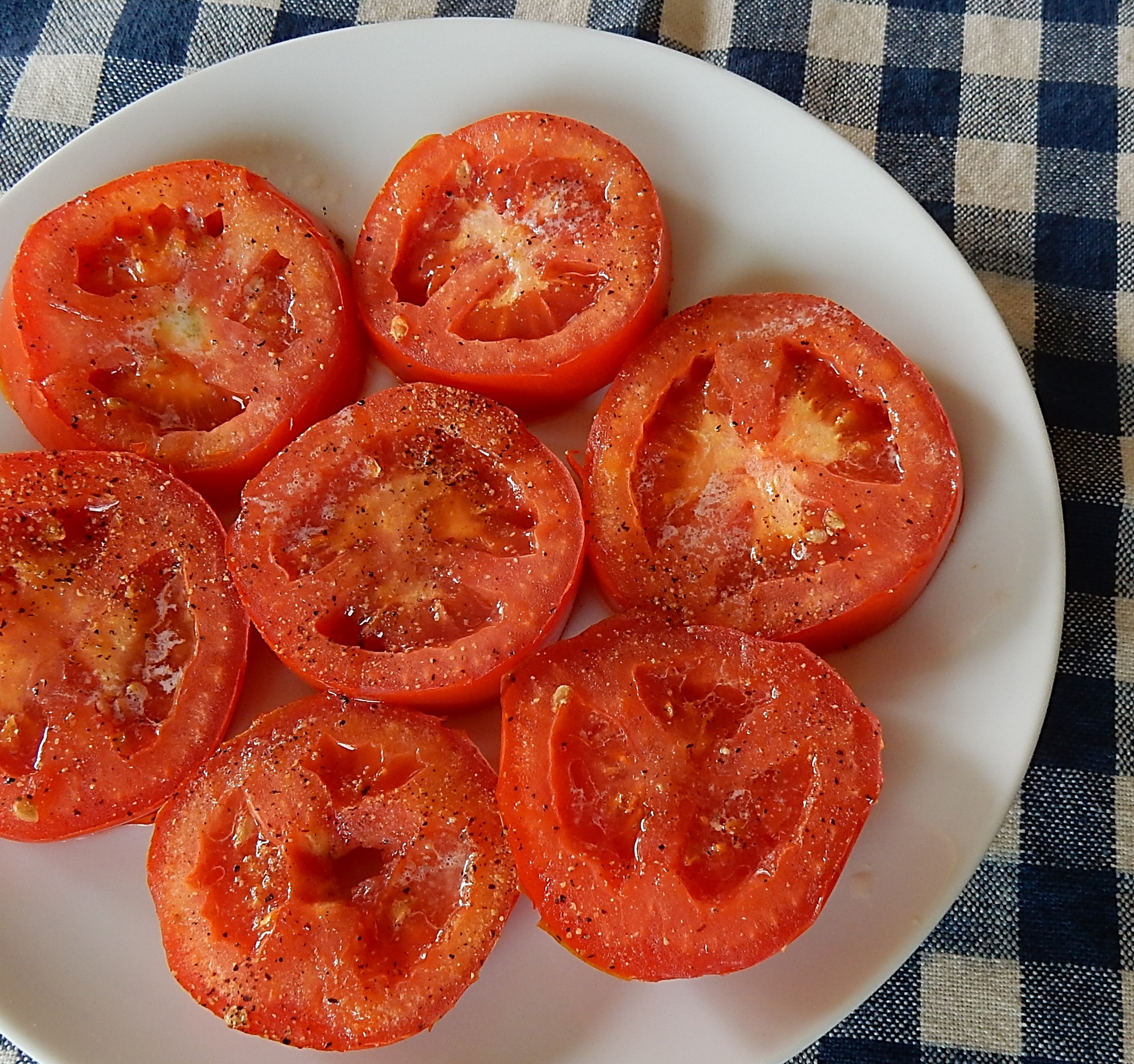
I recently came across a hundred-year-old recipe for Broiled Tomatoes, and decided to give it a try. But I then wondered . . . What type of tomatoes should I use in the recipe? Should I use purple, chocolate, yellow, or orange heirloom tomatoes? . . . or should I use red tomatoes. . . . beefsteak? . . . plum?
What did tomatoes look like a hundred years ago? When I search on “tomato” and “history” I get articles about wild tomatoes that were small and yellow or orange. The Aztecs and Mayans raised tomatoes, and tomato seeds went from Latin America to Europe in the 1500s. They became very popular, though some people thought that they weren’t safe to eat. The number of tomato varieties increased and they were bred for various characteristics. Tomatoes were then brought back to North American during the colonial era. But, I’m not finding information about what tomatoes were like in 1924. I think that they generally were red, so I decided to use red, medium-sized tomatoes.
The Broiled Tomatoes were easy to make and tasty. They are topped with just salt, pepper, and a little butter, which allows the naturally balanced flavors to shine.
Here’s the original recipe:

Here’s the recipe updated for modern cooks:
Broiled Tomatoes
2 medium tomatoes
salt and pepper
2 teaspoons butter
Cut tomatoes into slices 1/2 inch thick. Put on a foil-lined baking sheet. Sprinkle with salt and pepper. Top with small dabs of butter. Place under the broiler and broil until hot (about 3-4 minutes).

I made these in Home Ec. in 1973-74. They were easy and everyone thought they were tasty. My MIL made them but added seasoned bread crumbs on top! That was a wonderful addition….
It’s fun to hear that you made these in a home ec class. The seasoned bread crumbs sound like a good addition.
Is broiling what we Brits call grilling? i.e. under a naked flame.
The process is pretty similar for broiling and grilling, but in the U.S. grilling is generally done outside on a grill, while broiling is done inside in the oven. Both use intense direct heat to cook the food.
Ah! Thanks!
I think I’ll try these, they sound good.
I have to admit when I first saw the caption, I thought it said “boiled” tomatoes. That didn’t sounds as good.
I think that you’ll like the Broiled Tomatoes. I’m not sure about “boiled” tomatoes, but personally I’m not a fan of stewed tomatoes.
I think most people would be surprised to learn that the tomatoes of a hundred years ago were abundant in variety and color, open pollinated, and in all the sizes we think of today. When we purchase ‘heirloom’ tomatoes, that’s one example of just some of the offerings. When I worked at a garden center, our grower had us all trial heirloom varieties that were at least a hundred years old, and we ended up finding seeds for about 40, most of which we never heard of before. It was amazing the quality of the flavors and textures.
So my guess would be that to make these tomatoes, one would simply choose a locally grown tomato, of any color, that had uniform size so everything would cook easily and present nicely.
Amazing! I bought 3 tomatoes at the local organic market recently, all 3 were different shapes and colors, and all 3 tasted like tomatoes used to taste!
That’s the key, the flavor. So many tomatoes have been bred for shipping, and they forgot the eating part!
I read a fascinating article about why tomatoes do not taste (or smell) like tomatoes any more. Fascinating, but makes me want to never eat a tomato from the regular grocery store again now that I know what they do to them!
It’s frightening what they have done to our food Suz! Genetically manipulated, bred for toughness and not flavor. Industrialized food has fed millions, but unfortunately, not very well.
Agreed. Gives new meaning to why the farm to table movement is so important. I think I need to give up flowers and start growing vegetables!
Ah, squeeze them both together, and grow edible flowers!
It’s a little scary how even the quality and characteristics of produce in supermarkets is affected by needs of shippers.
The totatoes at farmers markets and other local markets are so much better than the grocery store tomatoes. There’s no comparison.
It’s good to know that it probably would work to use any color tomato of a uniform size that was locally grown. It sounds like so much fun to have the opportunity to trial heirloom tomatoes varieties. It must have been fascinating to see what the various one were like.
We had a blast! 40+ varieties in my garden, old time names: Rev. Morrow’s Peach, Celia’s Sister’s Pride, etc., and they were all tasty! We chose the ones that were the most disease resistant and the most flavorful or prolific to grow regularly at the center. One of those was Amish Paste, which I am now seeing everywhere as starts in the spring! I remember that one of my Amish Paste tomatoes weighed 12 ounces, and it was all sweet flesh, few seeds, and made incredible sauce.
What fun names! I’m really impressed by the process the garden center used to decide which varieties to grow.
We were known at the time for having the most unique starts for sale, and we were quite proud of the tomatoes we offered.
Wow, that’s impressive. It’s too bad that places like that garden center are so rare – and that there tend to be almost identical vegetable varieties from one store to the next.
I know! We’ve lost so much diversity. But luckily, there are quite a few seed savers exchanges on-line where folks can find some interesting throw-backs.
It does sound good. My parents were always looking for something to do with their tomato crop. I bet they would like it.
It’s easy to make and tasty. I think that they’d like it.
I grew up on these in the late 1940’s and 1950’s. A nice variety adds herbs (sweet basil, thyme, marjoram, etc., one at a time) to the tomatoes and omits the butter.
mmm. . . it would be really good with herbs.
I used to make broiled tomatoes on top of cheese bread. Great easy and cheap meal when I was a young college student.
It sounds good – and since it was also easy to make and inexpensive it sounds even better .
It was good, and I did not have a lot of cooking skills, nor a lot of money during that time. I love how your 100 year old recipes inspire such commentary!
It’s nice to hear that you enjoy the commentary on this blog. You are one of the readers who enables these types of extended discussions to occur. Thank you!
A benefit of experience, right? I love how it recalls to mind the things I learned from my great grandmother, grandmothers, and mother. Thankful for all our grandmothers who kept diaries and their handwritten cookbooks, or at least passed it down to us.
One type of tomato that would have been available in the 1920s would be a San Marzano, one of the ancestors of the Roma tomato.
Thanks for the info. It’s good to know that Roma-type tomatoes were around a hundred years ago. I think that they would work well in this recipe.
When I make these, I sprinkle basil and top with seasoned breadcrumbs with a bit of brown sugar mixed in. And yes, tomatoes from a local farm are always so much better than grocery store tomatoes!
mmm. . . The added brown sugar and seasoned breadcrumbs – and tomatoes from a local farm – sound wonderful.
Awesome
It’s nice to hear that you enjoyed this post.
Interesting I will have to try this while I have tomatoes.
I think that you’ll like it.
This sounds delicious. Huge tomato fan here
They’re yummy.
That sounds really yummy! I’ll have to try making this!
This is a nice recipe. It’s tasty, quick, and easy to make.
Sounds delicious!
It’s tasty.