
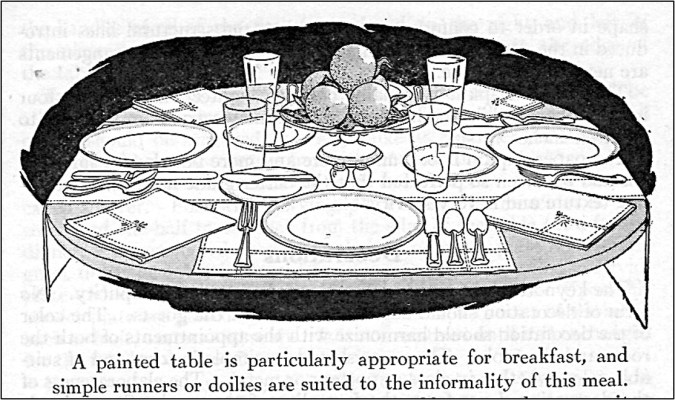
Here’s how a hundred-year-old cookbook describes table clothes and other table coverings:
Table Coverings
The table-cloth is the form of table covering most frequently used, and if in an exquisite texture it may be considered the most formal type of cover. The table-cloth should always be laid over a silence cloth, which is usually of felt or a double-faced cotton material made expressly for this purpose. The silence cloth should drop over the edges of the table several inches. Many prefer to fold it at the corners and pin it underneath the table. The silence cloth prevent noise, protects the table and improves the appearance of the linen.
The table-cloth must be laid with great exactness. The center lengthwise crease should fall exactly in the middle of the table and extend over the sides and ends of the table until its edges just escape the seats of the chairs. For breakfast, luncheon or supper, a smaller cloth may be used, simply covering the top of the table or falling a few inches over the edge. Great care must always be taken that the threads of the cloth are parallel to the diameter of a round table, or parallel to the edges of a square or rectangular table. A table seldom presents as restful and interesting a picture when the cloth is placed diagonally as when it is placed with the treads running parallel to the edges of the table.
The small table-cloth, or the cloth used on informal occasions, does not need to be the snowy white linen used for the formal dinner. Nothing is more satisfactory or pleasing than beautiful unbleached cloths with possibly a simple line design in color along the edges.
Doilies for each place are also used instead of the table-cloth and silence cloth, and are most satisfactory not only for their ease in laundering but for their appearance when correctly arranged on a well-polished table top. . .
Runners are another type of covering used on the bare table. These may be made of linen, or of the various cotton materials sold for such use. The runner is used for the informal meal.
Paper coverings are being used more and more for very informal occasions and may be secured in a very usable quality and size.
The New Butterick Cook Book (1924)
In the old cookbook, “table-cloth” was always hyphenated. I guess its an example of how words have changed across the years.

I love old linen tablecloths, and buy them when I find some I like. These are not necessarily for the table as they make beautiful and sturdy plain shirts for me that are very soft to wear! Especially if they have a pattern.
That is a very useful and interesting re-use!
I love it. I never would have thought of repurposing table clothes to make shirts.
I really enjoyed this century-old review of table coverings, Sheryl. I guess table mats and placemats are a newer addition to the table. Very interesting, thanks.
I wonder if the terminology has changed across the years. The description of “doilies” sounds somewhat similar to placements.
Yes, I wondered the same thing, Sheryl. 🙂
Goodness. I’ve failed again at housekeeping skills ;)
Maybe the descriptions of the tables and table coverings is “aspirational.” 🙂
Definitely!
How interesting… I never heard of a silence cloth before. I still enjoy setting a pretty table.
Until I came across this in the old cookbook, I never had either. My parents had a table mat on their dining room table. I wonder if a silence cloth was a somewhat similar idea.
Most interesting Sheryl!
It’s nice to hear that you enjoyed this post.
Love this article. Thank you for sharing.
You’re welcome. I’m glad you enjoyed the post.
This is a fun read – I have an etiquette book from the 1920s that goes into great detail on the placement of the silverware…
Things were so much more formal with lots of “rules” back then.
Oh my yes! It even has a section on which handkerchief a lady carries at different times!!
I am certainly not an expert in this table setting thing.
Really? I never would have guessed. 🙂
It’s true. Haha.