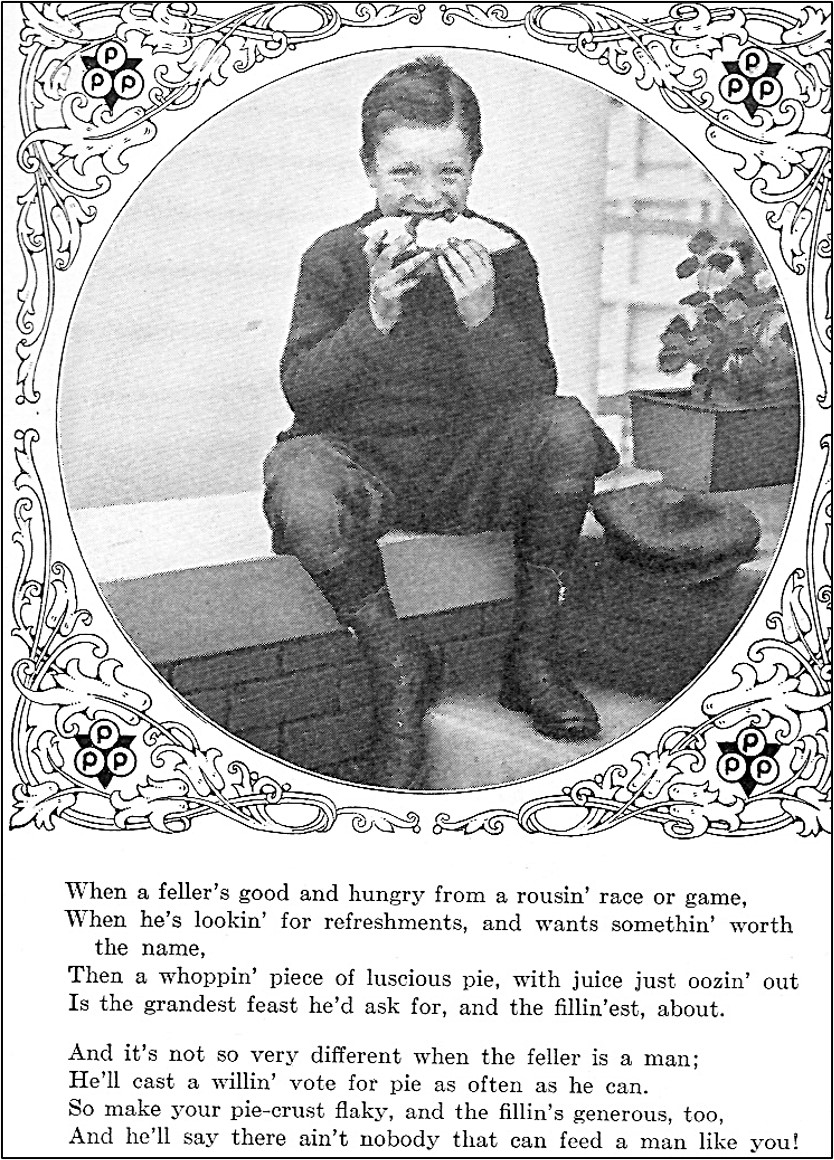
A hundred-years-ago men’s roles and women’s roles were defined very differently. Women were responsible for cooking, and their culinary skills were considered a measure their success. This poem in a 1924 cookbook reminds me of the old saying that “food is the way to a man’s heart.”
Marble Cake has always been one of my favorite types of cake, so when I saw a hundred-year-old recipe for Variety Marble Cake, I decided to give it a try. The old recipe had lots of options, including options for Marble Cocoa Cake and Marble Spice Cake. I went with the Marble Cocoa Cake option.
The cake was easy to make and tasty. This recipe makes a small 8″ X 8″ cake, which is perfect for a small family.
Here’s the original recipe:
Modern Priscilla Cook Book (1924)
When I made this recipe, I needed to add about 2 tablespoons of melted butter to the eggs to get 1/2 cup. I used vanilla for the flavoring.
The recipe says to alternate putting spoonfuls of light and dark batter into the pan. I followed this direction – though if I made the cake again, I’d also lightly swirl the batters using a knife to get a more even marbleing.
The recipe says to bake the cake for 45 minutes. When I made this cake, it took significantly less time (more like 35 minutes).
Preheat oven to 350° F. Grease and flour an 8-inch square baking pan. Put all ingredients (except for the cocoa) in a mixing bowl. Beat until well blended.
Put 1/3 of the batter into another bowl; then add the cocoa to this batter. Beat until well-blended. Alternate putting the light and dark batters into the prepared pan, then lightly swirl with a knife.
Bake 30 to 40 minutes, or until wooden pick inserted in center comes out clean. Frost, if desired.
I enjoy reading household tips in hundred-year-old magazines and cookbooks. Often the advice is good, and has stood the test of time. However, occasionally an old tip leaves me scratching my head. Like this tip about how to store grated cocoanut. Is it really a tip when the author says that the advice given is guesswork, and that she does not really know how it is done?
And, by the way, what is currently considered the correct spelling for “cocoanut”? I tend to think that “cocoanut” is an archaic spelling, and that it is usually is now spelled “coconut,” but am not sure.
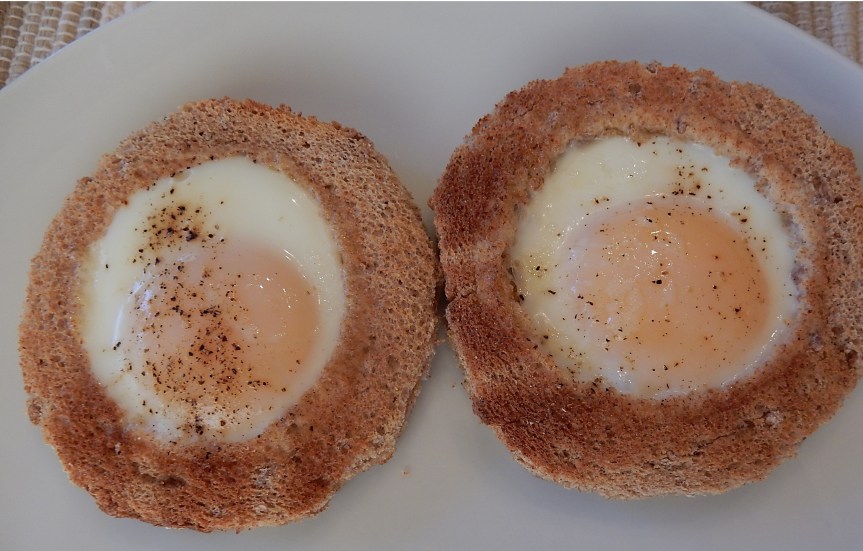
When my children were young they used to enjoy making Eggs in a Hole where a hole is cut out of a slice of toast and an egg is dropped into the hole. So when I saw a recipe in a hundred-year-old cookbook for Baked Eggs that looked similar to Eggs in a Hole, but with a twist, I had to give it a try. Instead of just cutting one circle in the toast, two circles are cut to create a ring of toast. The egg is then dropped into the ring. It gave an old classic a new twist -though that’s not quite right. Maybe I should say that I found an old twist for a classic recipe.
I enjoyed making this recipe, and anticipate making it again when children or grandchildren visit.
Source: The Metrolpolitan Cook Book (published by the Metropolitan Life Insurance Company, 1924)
The old recipe says that the hole the egg is put into is created by removing a little of the center. I interpreted this to mean that a small circle should be cut out of the center of the toast.
Preheat oven to 350° F. Lightly grease an oven-proof skillet with butter. Cut a large round circle out of the toast. (I used an inverted champagne glass to cut the circle). Then cut a smaller circle out of the center of the circle. (I used a round cookie cutter to cut the small circle. A small inverted juice glass would also work.) Put the resulting toast ring in the skillet, then gently break the egg and put the contents in the hole. Sprinkle with salt and pepper, and dot with a few small pieces of butter. Spoon the milk over the egg. Put in oven and bake until the egg is cooked (about 10-15 minutes).
I think this product still exists – though the name has changed slightly across the years. In 1924, it was called Grandma’s Old Fashioned Molasses while today it is just called Grandma’s Molasses. Interesting that company no longer considers it necessary to include “Old Fashioned” in the name, even though it’s been around for at least a hundred years.
Sometimes I know that I want to make a recipe for a particular seasonal food. This week is one of those times. I had some rhubarb, so began going through my hundred-year-old cookbooks and magazines looking for a rhubarb recipe. I found two that looked like possibilities Rhubarb and Figs and Bread and RhubarbPudding. I leaned towards making the Rhubarb and Figs. The Bread and Rhubarb Pudding recipe seemed complicated and I couldn’t quite picture what it would be like. However, my husband said that he didn’t like figs, and my daughter said that she thought the Bread and Rhubarb Pudding sounded awesome, so I decided to give it a try.
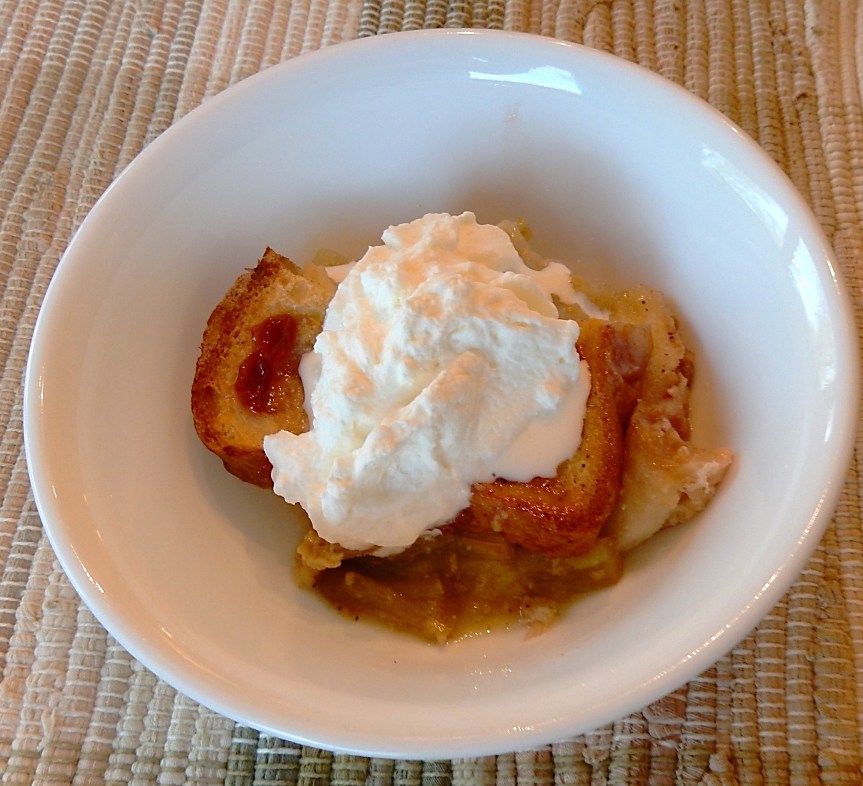
I’m glad that my family talked me into making Bread and Rhubarb Pudding. This recipe is a winner. Rhubarb and slices of bread are layered in a baking dish, then a milk, egg, and nutmeg mixture is poured over it. The dish is baked in the oven, and then jelly is spread over it. (I used current jelly – though the old recipe suggested using grape jelly.) I served the Bread and Rhubarb Pudding with whipped cream. The dish definitely was a hit with my family. My daughter said that it had just the right amount of sweetness, and my husband said that I should make it again.
One thing that I’d do differently if I made it again is to try to work a bit more on the presentation. My baking dish and the bread slices that I used when making this recipe didn’t exactly align in size and I had to cut some of the bread slices. If I made it again, I might either use another dish, bread slices that were a different size, or cut every slice of bread (and not just the ones that didn’t fit when whole).
Here’s the original recipe:
Source: American Cookery (March, 1924)
I cut the rhubarb into 1-inch pieces; 2 inches seemed a bit long to me. I decided that the egg and milk mixture that is poured over this dish made about enough to cover 8 slices of bread and 4 cups of diced rhubarb.
The recipe called for using sugar in the amount of “half the bulk” of the rhubarb (plus 4 additional tablespoons for the milk mixture). I decided to go with 1 1/2 cups of sugar, which may be a little less than half the bulk, but the Bread and Rhubarb pudding had just the right amount of sweetness so that’s the amount I put in the updated recipe.
I don’t have whole nutmeg, so I used 3/4 teaspoon of ground nutmeg.
I decided to serve with whipped cream rather than going the meringue route.
grape or other flavor of jelly (I used current jelly.)
whipped cream
Preheat oven to 400° F. Put the rhubarb and 1 1/2 cups sugar in a bowl; stir to coat the rhubarb with sugar. Then put half of the rhubarb mixture in a 7 1/2 ” X 12″ X 2″ (or similar sized) baking dish. (The dish I used was about the right size as far as volume goes, but I had to cut some of the bread slices, so if I made it again, I may use a different dish.)
Spread butter on 4 of the bread slices. Arrange the slices (buttered side down) on top of the rhubarb. Then put the remaining rhubarb over the bread slices. Spread butter on the other 4 bread slices, and place buttered side up on top of the rhubarb. Set aside.
Put the egg, 4 tablespoons sugar, and nutmeg in a mixing bowl; beat until smooth. Add milk and beat until combined. Pour the milk mixture over the rhubarb and bread. Cover (I used aluminum foil to cover), and then put in the oven. Bake for approximately 30 minutes or until the rhubarb is tender, and hot and bubbly. (Periodically check on how the baking is coming along. When I made this dish, liquid boiled over and onto my oven while I had the dish covered.)
Once the rhubarb is hot and bubbly remove cover, and continue baking until the bread is lightly browned (about another 10-15 minutes). Remove from oven and spread with jelly. Serve with whipped cream. I served this warm, though it could also be served cold.
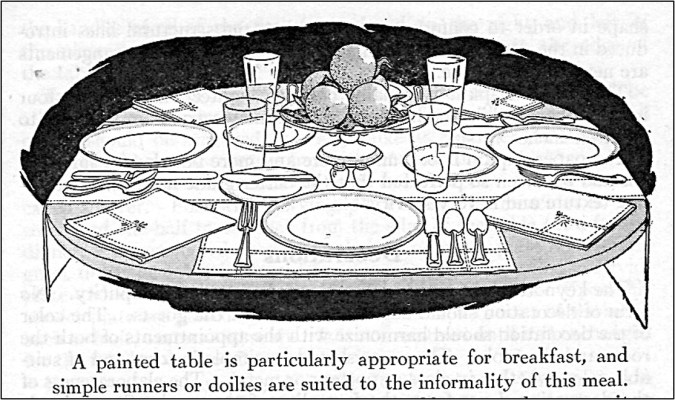
Here’s how a hundred-year-old cookbook describes table clothes and other table coverings:
Table Coverings
The table-cloth is the form of table covering most frequently used, and if in an exquisite texture it may be considered the most formal type of cover. The table-cloth should always be laid over a silence cloth, which is usually of felt or a double-faced cotton material made expressly for this purpose. The silence cloth should drop over the edges of the table several inches. Many prefer to fold it at the corners and pin it underneath the table. The silence cloth prevent noise, protects the table and improves the appearance of the linen.
The table-cloth must be laid with great exactness. The center lengthwise crease should fall exactly in the middle of the table and extend over the sides and ends of the table until its edges just escape the seats of the chairs. For breakfast, luncheon or supper, a smaller cloth may be used, simply covering the top of the table or falling a few inches over the edge. Great care must always be taken that the threads of the cloth are parallel to the diameter of a round table, or parallel to the edges of a square or rectangular table. A table seldom presents as restful and interesting a picture when the cloth is placed diagonally as when it is placed with the treads running parallel to the edges of the table.
The small table-cloth, or the cloth used on informal occasions, does not need to be the snowy white linen used for the formal dinner. Nothing is more satisfactory or pleasing than beautiful unbleached cloths with possibly a simple line design in color along the edges.
Doilies for each place are also used instead of the table-cloth and silence cloth, and are most satisfactory not only for their ease in laundering but for their appearance when correctly arranged on a well-polished table top. . .
Runners are another type of covering used on the bare table. These may be made of linen, or of the various cotton materials sold for such use. The runner is used for the informal meal.
Paper coverings are being used more and more for very informal occasions and may be secured in a very usable quality and size.
The New Butterick Cook Book (1924)
In the old cookbook, “table-cloth” was always hyphenated. I guess its an example of how words have changed across the years.