

Sometimes the most basic ways of preparing a simple food changes over the course of a hundred years. String beans are a good example. Here’s what it says in a hundred-year-old cookbook:
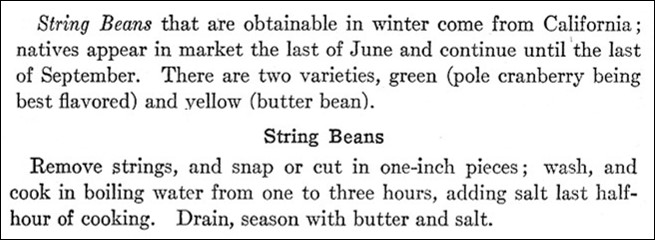
The old recipe calls for boiling the string beans 1-3 hours!! And, for breaking or cutting them into 1-inch pieces. Today, many people leave them whole. (I normally break string beans into 2 -3 inch pieces, but if preparing a meal for my children or grandchildren I would definitely leave them whole.) The old recipe also calls for removing the strings from the beans – which many string beans no longer have. (I guess that technically they may not be string beans.)
When I made the recipe I did cut the string beans into 1-inch pieces, but I couldn’t bring myself to cook the beans for 1-3 hours, and in the updated recipe say to boil them for 10-15 minutes – though I did provide information about cooking longer, if desired.
Here’s the recipe updated for modern cooks:
String Beans
1 pound string beans
water
1 teaspoon salt
1 tablespoon butter
Trim the ends of the beans, and then cut or break the beans into one-inch pieces. Wash and put in a saucepan. Cover with water; add salt. Bring to a boil using high heat; then reduce heat and cook 10-15 minutes. Drain, then add butter. Let the butter melt, stir gently, then serve. (If desired, cook longer for a softer consistency. This will result in string beans that are prepared more similarly to how it was done a hundred years ago. A 1923 cookbook calls for cooking the beans 1-3 hours.)

How interesting! In England, runner beans are known as ‘string beans’, whereas your ‘string beans’ are our French beans, which I’ve also seen called ‘bobby beans’.
We’ve found another difference across the two sides of the Atlantic. 🙂
All interesting, if not terribly useful!
It keeps us entertained. 🙂
I can’t image cooking them for hours and I like my veggies well done. Did you ever call the yellow beans, wax beans? I grew up in PA calling them that and in TX no one uses that term. There is only one grocery store in my area that sells them and they are canned.
In New England, we still call the yellow ones wax beans.
When I volunteered at a Botanical Garden someone left a seed packet of Wax Beans and no one knew what they were.
How funny! It’s amazing how vegetables that once were very common are now apparently somwhat unusual.
That’s so funny! Ask a few northerners what a butter bean is and you’ll get three different answers!
hmm. . . I think that if someone had asked me what a butter bean was prior to reading the old cookbook, I think that I would have said that a butter bean is a large dried lima bean – but I’m probably incorrect.
I think you are right, but I don’t think they have to be dried. However, what do I know, I’m a northerner!
In the midwest, they are also called wax beans.
Back when I was growing up in PA, I think that my family just called them yellow beans. We always raised both yellow and green beans in our garden, and froze lots of both. They don’t sell yellow beans in the store here either (except for maybe the canned version). I bought the beans in the photo at a farmers’ market.
My grandmother would cook them for hours! The first serving would be very soft. Because she would cook a huge pot they would be served for many days. With each reheating she would “doctor” them – a little onion, some pepper, maybe some bacon… They became a soft mashed mess. I grew up thinking I didn’t like green beans. Then I had steamed green beans! What a difference!
Even if they tasted awful, I love your description of how your grandmother “doctored” the beans with each reheating to make them a little different. I can picture some of my relatives doing something similar.
I can’t imagine!
I saw in the comments that our runner beans are known as string beans maybe in some parts of the UK but I have always known them as rummer beans and have always cut them the same as my mother and grandmother did and that was length wise my mother used to have a bean cutter that we pushed the bean through to make even sized pieces she didn’t cook them for hours maybe 10-15 minutes and served with butter..I could just eat a plate of those and nothing else I love them but haven’t had them for years…
They sounds lovely. I’m not familiar with runner beans. I wonder if they are available in the U.S.
I don’t know it may depend on the climate so maybe in some states they different texture to the shorter beans like French beans etc they ate long flat bean,,,this video is interesting as they originated in South America https://youtu.be/H0EFocDn-_w
Thanks for the link. I’m going to have to look for them.
You are welcome, Sheryl I hope you find them 🙂
Yikes! That’s a lot of cooking!
I agree!
My memory is it was more of a long slow simmer, not a rapid boil. My grandmother would cook a pot of beans while she did other things–like laundry, or plowing a section of field. What I remember also is that green beans, pinto beans, or black-eyed peas with snap beans were delicious prepared that way, and “mushy” was not a common feature. While my tastes have changed and I generally saute green beans in olive oil, or cook for a short time in a waterless cookware with a tight-fitting lid, slow-cooked turnip greens or collards or green beans or black eyed peas are still delicious to me.
It’s intriguing how cooking methods have changed across the years – yet both ways can result in tasty beans; they’re just different. I also remember it being common to just sort of let foods cook themselves while my family did other things when I was child.
My father wouldn’t eat any vegetable unless had been boiled to death, which annoyed my mother. She would cook his serving for hours but only do ours until just soft. As she said that long boiling “cooked all the good out of them”. I do my green beans in the microwave these days, nicely steamed instead of boiled because they taste better.
I’ve also heard that vegetables lose vitaimins when they are boiled a long time.
How interesting! I think of string beans as being green and wax beans as yellow. I helped snap and string beans many hot summer afternoons. They were cooked with bacon grease and simmered slowly until tender. I’ve never really liked green beans, but do prefer they are cooked just until tender – but LOL I think the bacon grease is not mandatory anymore!
I also helped snap beans on many hot summer afternoons. I especially remember helping my mother-in-law in the early years of my marriage. She’d have bushel baskets full of of beans that needed to be snapped. We sit on a screened porch and snap them. It was a nice chance to talk. I don’t think that I liked snapping the beans back then, but it’s a nice memory now.
I hated ‘green’ beans until I finally got fresh raw ones. Love them raw, like them slightly cooked, but when they cook to grey – yuck. I grow and freeze them and they are edible but canned are disgusting to me. Visited my sister in law once and she was cooking string beans with a bit of ham. She asked me to check and see if they were done. Just looking they had lost their color so I said they were done (very over done to me). She grumped at dinner because to her (mid-westerner through and through) they were not yet done! It’s all a matter of taste.
What a fun story! It’s fascinating how cooks in different regions have different ways of preparing the same basic foods.
My mother made cooked green beans similarly. She had her children string and break the Ky Wonder beans into 1 to 3 inch pieces. Then she rinsed and covered them with fresh water and left them to boil for a while, adding chicken grease (she was allergic to pork. I add cut up bacon to mine) and salt to season. She boiled them until the water was almost gone. This is also the way I cook the Ky Wonder green beans I grow and can myself. I add enough water to cover if there wasn’t enough in the jar. I also like them boiled dry and scorched on the bottom. My father always cooked them that way by accident whenever Mother was in the hospital having babies (8 living, 6 miscarriages).
I also pick them young and tender to freeze whole and add to stir fry dishes for a change of pace. I am approaching 80 years old.
Thanks for sharing. Bacon (or chicken fat) would add a nice flavor – though I’m not sure that I’d like them scorched on the bottom (but I maybe I should give it a try). I agree that it’s best to pick beans when they are young and tender.
actually, a little bit of scorching makes them sweeter. But it is tricky. Dad let them scorch because he was so busy trying to do women’s work and he had never been taught how to cook by his grandmother. His mother died when he was only 3. So sometimes his scorched beans were more like burned beans. But we didn’t know the difference, food was food.
I’m intrigued – I may have to try just a bit of scorching. Your dad sounds like a wonderful person who made the best of things, even when they were challenging. I like your description about how “food was food.”
I think now they call it “caramalizing”. Turns out you can do it with string beans. My mother also made a meal we all hated which she called “vegetable soup” but we called it “all-kinds-of-soup.” She took the left-overs (if there were any) and refrigerated them. At the end of the week they all went in a pot (regardless of whether or not they were vegetables) and she cooked that up until everything in it tasted the same, none of it good. It was barely edible. I thought that was her way of encouraging us to eat everything up at every meal. But I guess it was really her way not to waste anything because we were so poor
Caramelized sounds so much better than scorched. It’s all how it’s framed. 🙂 We used to call regularly eaten foods that weren’t very good, “grub.”