16-year-old Helena Muffly wrote exactly 100 years ago today:
Sunday, October 22, 1911: While walking to Sunday School this afternoon, I saw three men taking a man and n_____ woman to jail. Anyway that’s very likely where they’ll land before long. It’s raining tonight real hard.
Her middle-aged granddaughter’s comments 100 years later:
Whew, this diary entry upsets me. Grandma spelled out n___ in her handwritten entry in the diary, and her attitude bothers me a lot.
Grandma would have walked a mile or so on country roads to get to Sunday School in McEwensville.
Central Pennsylvania was not very diverse a hundred years ago, but a few Blacks lived in the area. C.V. Clark, in a presentation to the Northumberland County Historical Society, mentioned that in the late 1800’s a freed slave named Eliza lived in McEwensville–and her descendents probably were still living in the area in 1911.
I know that times were different back then, but the bottom line is that Blacks were often treated terribly a hundred years ago. To help better understand what things were like in 1911 I’d like to share some disturbing information that I recently discovered.
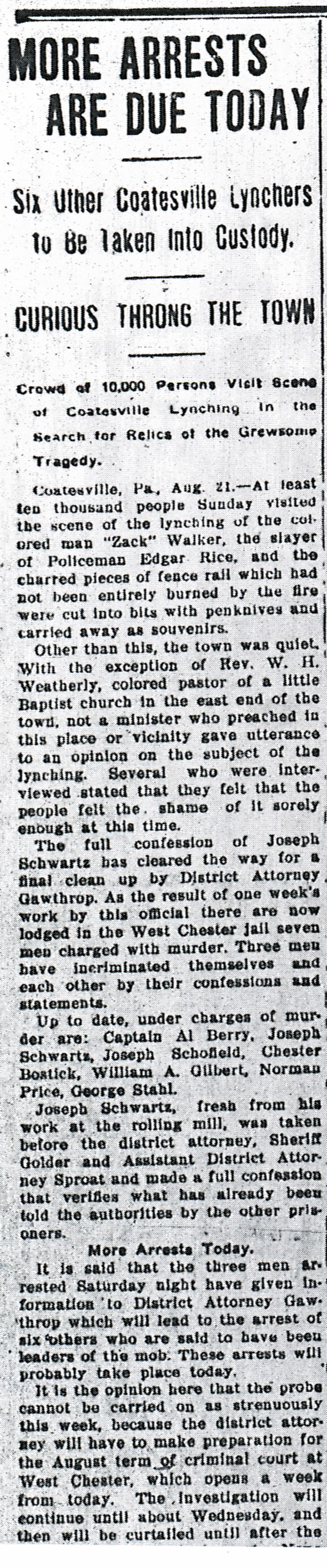
The last lynching in Pennsylvania occurred on August 13, 1911. Zachariah Walker was lynched in Coatesville which is near Philadelphia.
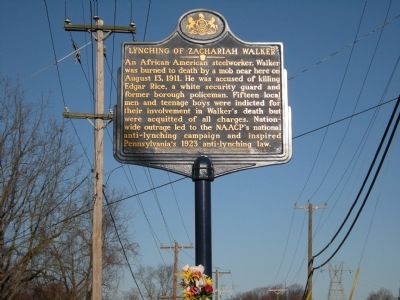
The inscription on the historic maker about the lynching says:
LYNCHING OF ZACHARIAH WALKER
An African American steelworker, Walker was burned to death by a mob near here on August 13, 1911. He was accused of killing Edgar Rice, a white security guard and a former borough policeman. Fifteen local men and teenage boys were indicted for their involvement in Walker’s death but were acquitted of all charges. Nationwide outrage led to the NAACP’s national anti-lynching campaign and inspired Pennsylvania’s 1923 anti-lynching law.
Even though Grandma lived more than a hundred miles from Coatesville, she probably was aware of the lynching. The local paper, The Milton Evening Standard periodically ran stories about it.