Visiting Relatives

16-year-old Helena Muffly wrote exactly 100 years ago today: 

Sunday, October 8, 1911: Ruth and I went down to Aunt Lizzie’s near Montandon. Such a time as we had this afternoon a hunting chestnuts and walking around. We went down on the train and came home that way. Tuu (??) took us to the depot on the return trip. Such a pain as I had a coming home. I guess I ate too much dinner.

Her middle-aged granddaughter’s comments 100 years later:

Sounds like a fun Sunday. Montandon is about 10 miles south of the Muffly farm.  Grandma and her sister Ruth would have taken the train that ran from Watsontown to Milton and then on to Montandon.

I’m not sure whether Aunt Lizzie (Elizabeth) was a good cook or a poor one since Grandma ended up with a stomach ache—though the entry seems to indicate that Grandma must have enjoyed the food.

Aunt Lizzie was a sister of Grandma’s father, Albert Muffly. I’m not sure who she married—and can’t quite read Grandma’s handwriting in the diary to figure out who took them to the train station.

Albert Muffly was the fourth child of Samuel K. and Charlotte Muffly. He was born in 1857. Lizzie was born in 1862 and was the seventh child in the family. Samuel K. and Charlotte had eleven children.

For more on the Muffly family genealogy see these previous postings:

I’m at Least 0.4% Swiss!

Grandma’s Parents

Two Bachelor Uncles

Hundred-Year-Old Excercise for Shoulders and Back

16-year-old Helena Muffly wrote exactly 100 years ago today: 

Friday, October 6, 1911: Went over some of my studies tonight in order to learn what I don’t know. Exams are approaching. Dear me.Her middle-aged granddaughter’s comments 100 years later:

Grandma sounds really worried about the exams. Maybe she did some exercises to relieve stress.  Here’s one from a 1911 book:

Shoulder and Back Exercise

First Position (Fig. 40)—Stand erect, with the feet together, and both arms extended on a plane with the should, so that in the first position the left arm is extended directly in front of the body and the right arm on the same plane directly behind the body. The arms must be held rigidly on the same plane.

Second Position (Fig. 41)—by a circular movement, the position of the left arm is assumed by the right, and vice versa. During the entire movement the feet must be kept firmly planted on the floor, pivoting at the hips only, while making the continuous circular movement of the arms.

Personal Hygiene and Physical Training for Women (1911) by Anna Galbraith

Chestnut Trees A Hundred Years Ago

16-year-old Helena Muffly wrote exactly 100 years ago today: 

Thursday, October 5, 1911: Besse was out a little while this afternoon. Brought some chestnuts. Didn’t have any before. Such an extraordinary occurrence. Ruth’s cow had twin calves. Both are white, rather good lookers. Ruth and I carried one down out of the field and out to the barn. Then we put him in the express wagon and he tumbled out.

Chestnuts (Source: Wikimedia)

Her middle-aged granddaughter’s comments 100 years later:

This entry befuddles me. I’m surprised that Grandma considered chestnuts a treat when her married sister Besse brought them, and that she’d never previously eaten any.

I would have guessed that chestnut trees were very common in central Pennsylvania in 1911—and my research supports that impression. Here’s what I found:

Chestnut trees were once more popular in the US than they are today—but many died due to a chestnut blight.

According t o Wikipedia, the blight was first identified on Long Island, New York  in 1904—and chestnut trees largely died out in the US over the next 40 years.  Wikipedia also says:

In some places, such as the Appalachian Mountains and others, one quarter of hardwoods were chestnuts. Mature trees often grew straight and branch-free for 50 feet (15 m), up to 100 feet, averaging up to 5 feet in diameter. For three centuries, most barns and homes east of the Mississippi River were made from it.

Bottom line—I still think that chestnut trees were common in 1911, so I’m still confused by this entry.

Twin Calves

It’s relatively rare for a cow to have twins. When I was growing up on a farm in the 1960’s we had a herd of 40 cows—and about one set of twins was born per year. I’m not sure how many cows the Muffly’s had, but it probably was in the range of 5 to 10 cows—so years probably went by between the birth of twins.

I can almost picture Grandma and her sister Ruth chatting and laughing as they collaboratively worked to bring one of the calves down to the barn.

For a discussion of how the Muffly children owned their own cows see the previous post on this topic.

Using Willpower to Improve Behavior

16-year-old Helena Muffly wrote exactly 100 years ago today: 

Wednesday, October 4, 1911: Had a clash with Ma this morning. I guess she thinks I am one terrible kid! I must bring about a reform if possible.

Her middle-aged granddaughter’s comments 100 years later:

I wonder what Grandma did.  This entry seems to indicate that Grandma believed that she was in the wrong—and that if she will had enough willpower that she might be able to “reform” herself.

In 1911 willpower was considered an important precursor of good behavior:

The Power of the Will or Inhibition

The conduct of mankind is chiefly governed by the emotions, instincts, and impulses.  . . .

“I am, I ought, I can, I will” are the only firm foundation-stones upon which we can base our attempts to climb into a higher sphere of existence. The first impulse a faculty of introspection, the second a moral judgment, the third a consciousness of the freedom to act, the fourth a determination to exercise that power.

Physical Hygiene and Physical Training for Women (1911) by Anna Galbraith

Hundred-Year-Old Paper Doll Pattern for a School Girl

16-year-old Helena Muffly wrote exactly 100 years ago today: 

Tuesday, October 3, 1911: Nothing really of any importance. Therefore, nothing worth writing about.

Her middle-aged granddaughter’s comments 100 years later:

Since Grandma didn’t write much today, I’m going to tell you how to make a paper doll school girl using a  hundred-year-old pattern that I found in the February 1911 issue of Good Housekeeping.*

You (or a child you know) could make several dolls and pretend that the dolls were Grandma and her friends at school.

Supplies Needed to Make this Craft

Heavy stiff white paper

Colored paper

Pencil

Scissors

Paste or glue

Water colors, colored pencils or crayons

Directions

1. Click here for doll pattern, and then print. Cut the patterns out.

2. On the heavy paper draw a line around the edge of the pattern for the front and back of the doll. Color or paint the doll’s face and other features.

3. Cut the two parts of the doll out. (Be sure to make her feet as large as the feet in the pattern. It’s okay if her feet end up being even a little larger than the ones in the pattern. She will not stand if her feet are too small.) Glue the two parts together above the knees. (Do not paste the feet together.)

4. After the glue is dry, gently bend the doll’s feet apart and she will stand.

6. Fold colored paper in half. Put neckline of dress on fold. Trace around the dress, and cut out using care not the cut the front and back apart at the neckline. Cut a slit up the back of the dress, so that it is easy to dress the doll.

7. Make several dresses, so that the doll can wear different outfits to school on different days.

If you enjoyed this craft, you may also want to make other hundred-year-old paper crafts described in previous postings.

Paper swimming frog

Paper birds

Paper doll girl and her swimming ducks

* I’ve abridged and adapted the directions and the dress pattern.

Cold Storage of Winter Clothes

16-year-old Helena Muffly wrote exactly 100 years ago today: 

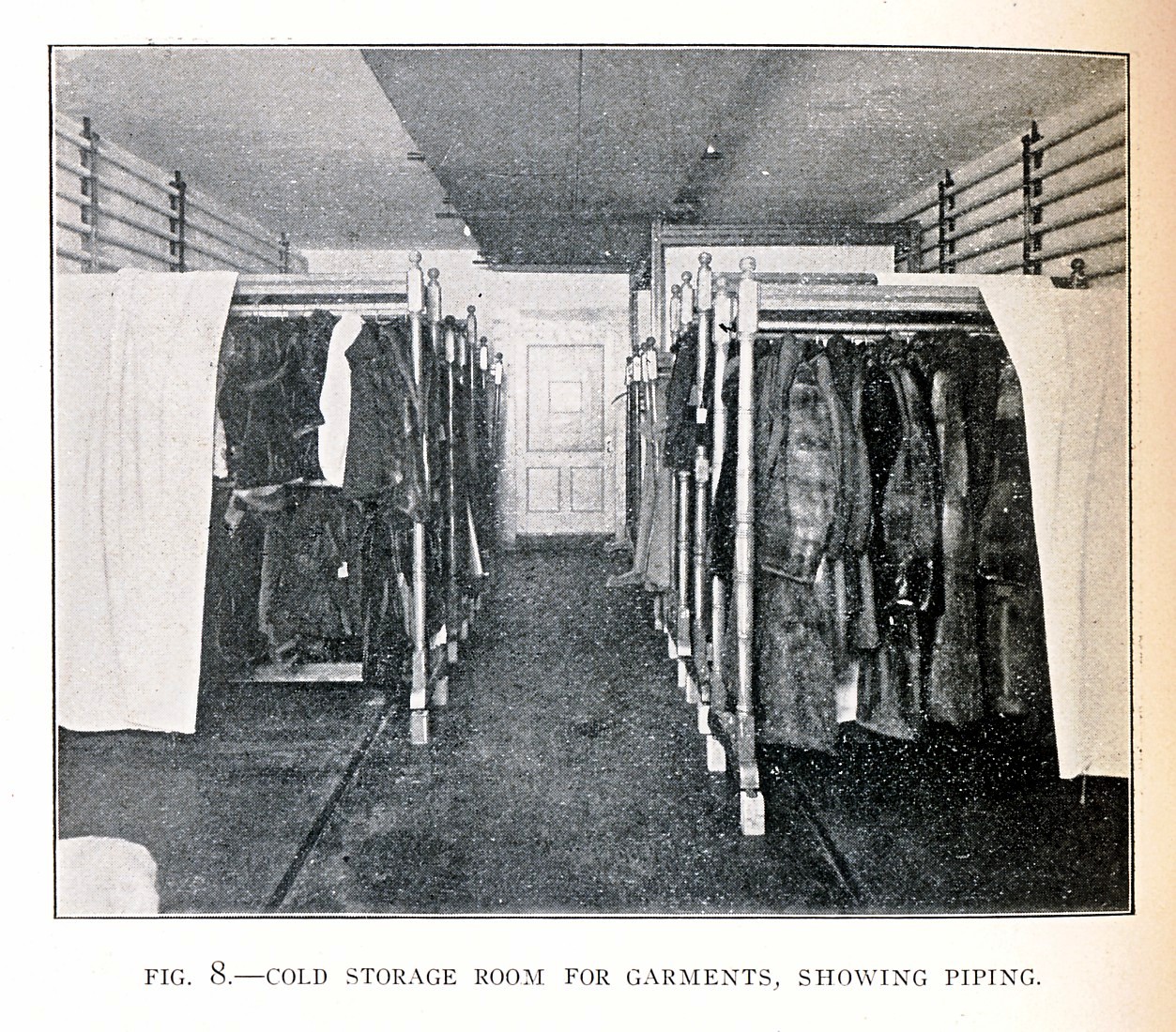
Monday, October 2, 1911: It is beginning to get cold. Am thinking about my hat and coat, which are in the store as yet, but it doesn’t do very much good anyway.

Photo source: Practical Cold Storage (1905)

Her middle-aged granddaughter’s comments 100 years later:

A hundred years ago people sometimes took their winter coats, and other wool and fur garments, to a cold storage facility. This was done to help ensure that the clothes won’t be damaged by moths during the warm weather months.

I don’t understand exactly how cold storage rooms were kept cold, but the rooms probably were cooled by pipes filled with brine or ammonia. Compression machines may have been used.  There were a number of different methods described in a 1905 book, but a common method is described below:

In this system, the ammonia gas is driven off from aqua ammonia under pressure, by heating; the gas is liquefied by cooling, and the refrigerating effect obtained by expanding the liquid ammonia thus obtained though pipes surrounded by the medium to be cooled.

Practical Cold Storage by Madison Cooper

Definition of Outvie

16-year-old Helena Muffly wrote exactly 100 years ago today: 

Sunday, October 1, 1911:

Can the beauty of October be rivaled,

And the glories of summer outvie,

And the scenes of the Autumn forgotten,

Because they are doomed to die.

Oh you dreary days of autumn. It rained almost all afternoon. Papa and Ma went away visiting this morning. Took Jimmie along to be sure. Went to Sunday School this morning. Carrie was over this afternoon.

Her middle-aged granddaughter’s comments 100 years later:

On the first day in each month Grandma included a poem. This poem suggests that summer must be a better time of the year than October (autumn).

Today I learned a new vocabulary word. Outvie  means to be more of a rival than another.

Some words that were commonly used a hundred years ago are now seldom used or in some cases are even archaic.