Found Photo of the Four Muffly Siblings!

17-year-old Helena Muffly wrote exactly 100 years ago today:

Wednesday, May 15, 1912: Besse was out this afternoon. We had sort of a sewing bee. Ma worked on my dress and Sis brought several along.
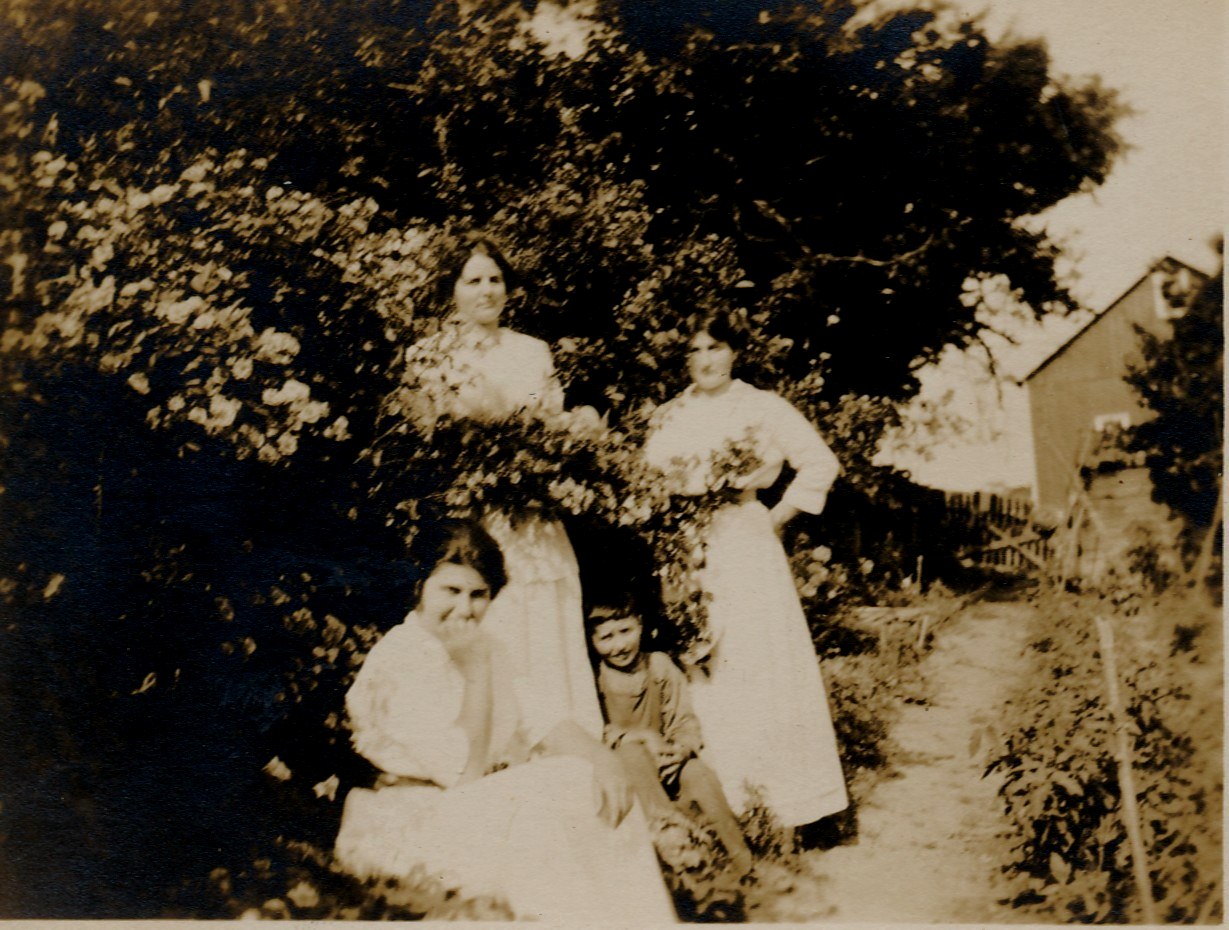
Left to right: Helena (seated), Besse, Jimmie, Ruth (circa 1912)

Her middle-aged granddaughter’s comments 100 years later:

Yeah! I finally know what Besse looked like. I recently found a picture of all four Muffly children.  I think that it was taken about the same time as the diary. In 1912 Jimmie was 6-years-old, and I think that the boy in the photo looks about six.

This is the first picture that I’ve seen of Grandma’s oldest sister Besse. It’s fun to finally be able to picture what she looked like.

It’s also fun to see what the path toward the barn (or maybe some other farm building) looked like–and how the siblings arranged themselves for a group photo. It’s interesting how Jimmie is clinging to Besse, who was married and not living at home. She must have made a fuss over Jimmie when she visited. In April 1912 Besse had a baby who died shortly after birth. Maybe she transferred some of her maternal feelings to her little brother.

It’s also interesting how Ruth is standing a little separate from the others and has her hand on her hips. It reminds me of the times in the diary when Grandma refers to Ruth as “her highness.”

An aside–My brother helped me locate a small group of pictures (including this one), some old newspaper clippings, and related items that had been found in Grandma’s house after she died.

I’ve really been enjoying the newly found items, and look forward to sharing some more of the pictures and clippings over the next few weeks.

Treating Cuts and Wounds a Hundred Years Ago

17-year-old Helena Muffly wrote exactly 100 years ago today:

Tuesday, May 14, 1912:  Wish it would get warmer and quit raining. I just got a long scratch on my thumb awhile ago and it’s rather sore

Her middle-aged granddaughter’s comments 100 years later:

How did people treat scratches and cuts a hundred years ago?

The Compendium of Everyday Wants, published in 1907, recommended:

CUTS AND WOUNDS.—There are two kinds of cuts or wounds—incised, which means cut into, or lacerated, which means  torn.

The first kind are usually not so dangerous and are treated in proportion to their size and depth. These generally heal of themselves. Clots formed on a cut should not be washed away. If there is not much bleeding, wipe away any impurities and bandage. A small piece of adhesive plaster is all that is necessary for household cuts.

Lacerated wounds have ragged edges, and the soft parts about them often will be found bruised and torn. These are most frequently caused by railway accidents, machinery, and falling timbers.

Treatment.—Cleanse the wound with warm water, wet a cloth over it and bandage lightly.

Second Dress is Started

17-year-old Helena Muffly wrote exactly 100 years ago today: 

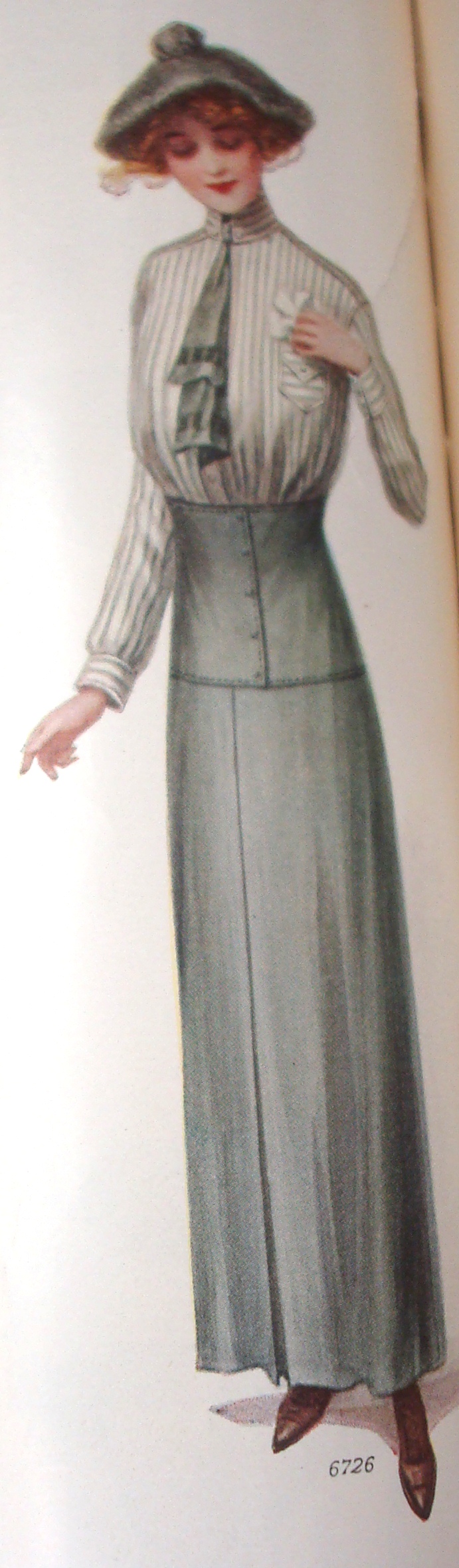
Sunday, May 13, 1912:  Ma got my dress on the go at last and I’ll keep at her until she gets it made.

Source: Ladies Home Journal (June, 1912)

Her middle-aged granddaughter’s comments 100 years later:

Hmm . . This entry obviously is referring to the second dress that was mentioned in previous entries. (It’s not the Indian linen one that a seamstress finished).

Was the plan always for Grandma’s mother to make this second dress or had Grandma originally expected to make it herself?

On May 8, she’d written:

Did some sewing this afternoon. I have so many things to fix over and a dress I want to get made, but it is slow about getting there.

When I look at pictures of dresses from a hundred years ago they look like they would be complex to make. Maybe Grandma and her mother reached consensus that her mother could more skillfully do the sewing task.

“Had a Sorrowful Time Today”

17-year-old Helena Muffly wrote exactly 100 years ago today: 

Friday, May 10, 1912:I seemed to have had a sorrowful time today. I guess it was because I was getting lonesome and wanted to go someplace. Ruth went up to Turbotville to attend the commencement.

Recent photo of the Turbotville Community Hall. The building once was a high school. There is a large auditorium on the second floor and the commencement probably was held there.

Her middle-aged granddaughter’s comments 100 years later:

Turbotville is another small town about 4 miles northeast of McEwensville.  I wonder why Grandma didn’t go with her sister Ruth to the commencement. Maybe someone gave a ticket to Ruth—but not to her.  It’s not fun to feel excluded.

This was the 4th day of summer vacation; and, boredom and loneliness seem to be really setting in.  I wonder if Grandma got into any disagreements with her mother, father, Ruth, or little brother Jimmie—or if she was just quietly moping and feeling down.

Over the Christmas holidays, she and six-year-old Jimmie managed to get into several fights.  For example, on December 26, 1911 she wrote:

Am beginning to get rather tired of this seemingly long vacation. When you don’t have anything interesting to do and you don’t go many places it is not very hard to get lonesome. Jimmie and I are turning into regular fight cats, so Ma thinks. . .

Sunday School Pedagogy a Hundred Years Ago

17-year-old Helena Muffly wrote exactly 100 years ago today: 

Sunday, May 5, 1912: Went to Sunday School this afternoon. Two classes had completed a course they had taken up. They held the commencement before church. It was real interesting. I expect my trial to come off tomorrow.

Her middle-aged granddaughter’s comments 100 years later:

It sounds as if the Baptist Church in McEwensville purchased curriculum that the classes used.

A hundred years ago there was interest in “modernizing” the way instruction was provided in Sunday Schools—though it was controversial.

According to a 1911 book called Practical Pedagogy in the Sunday School:

The function of the Sunday-school is to impart instruction for the purpose of leading to definite results. Since, then, the prime object of the Sunday-school is to impart instruction, pedagogy should have a very important place in the thought of the leaders therein, for, to put it concisely, it is the science and art of teaching.

While this is true, some fears that have been expressed by consecrated Sunday-school teachers must be labeled as groundless. “The introduction of pedagogy into our Sunday-school work will interfere with the position that the Bible now holds.” This is the thought of many. It is, however, entirely erroneous, for the true teaching of the Bible must be in harmony with the principles of pedagogy.

Further, than this, the Bible itself abounds with illustrations of pedagogical principles. It is acknowledged by all thoughtful persons that Jesus of Nazareth was the greatest teacher that ever lived. He was the master of pedagogy, and that He put into operation many of the pedagogical principles which have, in recent years, been advocated by advanced teachers.

Abridged from Practical Pedagogy in the Sunday School

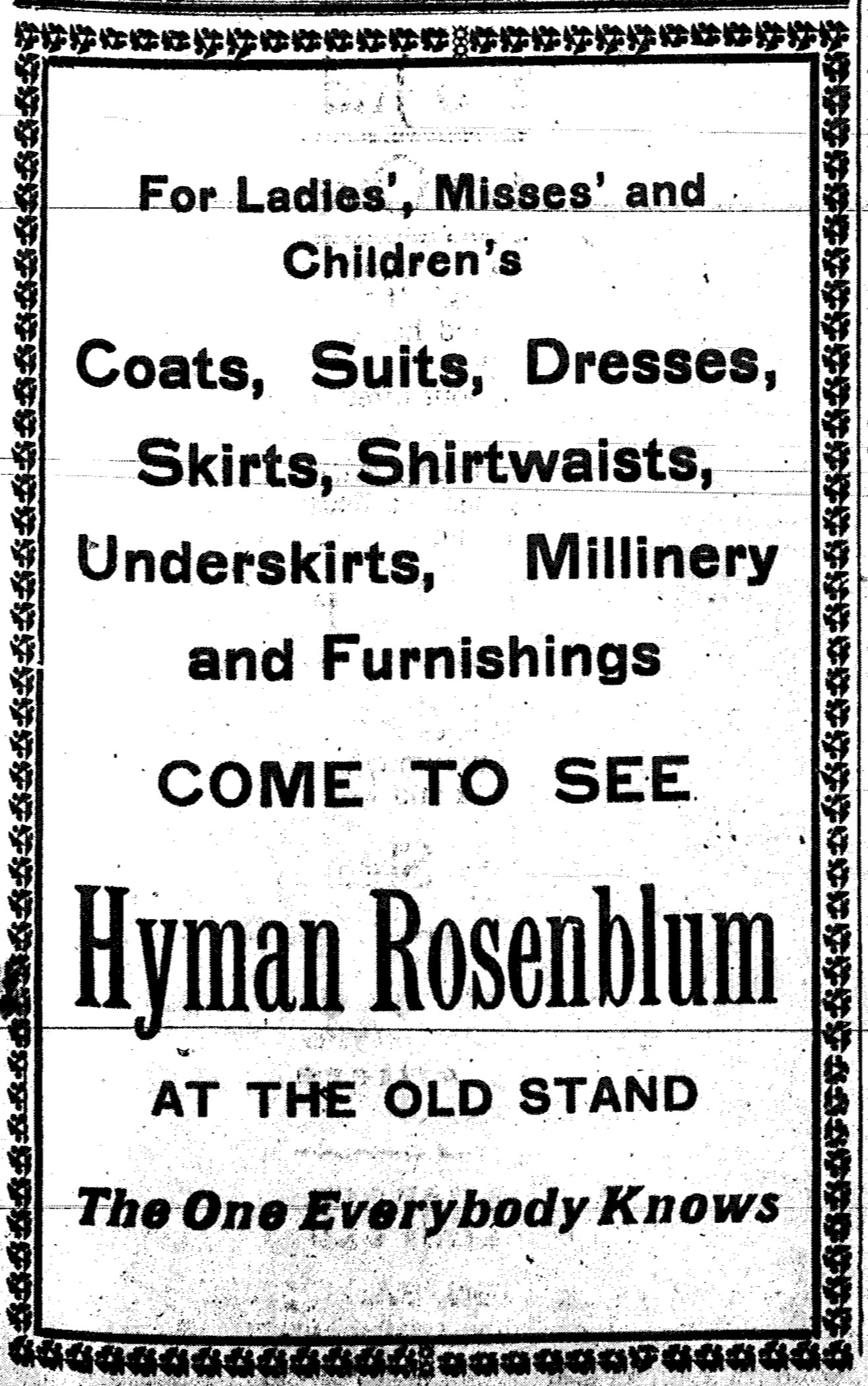
Old Womens’ Clothing Store Advertisement

17-year-old Helena Muffly wrote exactly 100 years ago today: 

Tuesday, April 30, 1912:  Took my dress uptown to get made. Wonder when it will be done. Hope it will be satisfactory. I have a sore fore-finger, but can’t account for the cause.

Her middle-aged granddaughter’s comments 100 years later:

Hmm. . . I’m not sure what Grandma meant when she said that she took her dress uptown to get it made.

Three days earlier, she’d written that she and her mother went shopping in Milton and purchased a hat, several other items, and a white dress:

. . . I got a white dress . . .

Diary entry, April 27, 1912

Advertisement in Milton Evening Standard

Sometime a diary entry raises more questions than it answers.

— Had they really purchased cloth and a pattern, instead of a dress?

— Or did they buy a dress, but it needed alternations?

–Where was uptown?  . . . somewhere in McEwensville?  . . . in Watsontown? . . . (Uptown sounds like such a classy word to describe any section of the little towns near Grandma’s home.)

–And a lingering question—Do I worry too much about the details? In the bigger picture of Grandma’s story, does it really matter whether she bought a dress or had someone make it for her?

The Psychology of Success

17-year-old Helena Muffly wrote exactly 100 years ago today: 

Monday, April 29, 1912:It rained nearly all day. I wish it would get warm and stay so.  Am beginning to think about final.

A recent rainy day in McEwensville

Her middle-aged granddaughter’s comments 100 years later:

I hope that Grandma was thinking positive thoughts about her upcoming finals.  I found some surprisingly modern advice about positive thinking in a hundred year old book:

The Psychology of Success

There is nothing which tends so much to the success of volitional effort as the confident expectation of its success, while nothing is so likely to induce failure as the apprehension of it.  . .

Lack of success may also be caused by indulgence or lack of courage, the individual preferring to sail along the chartered course of mediocrity rather than to strike out a new path for herself, involving risk, anxiety, and endless work . . . .

There are four mental requisites necessary to the achievement of success, namely: a clear view of the end; a judicious indifference to the sentiment around by the sweeping away of obstacles; an indomitable energy; and the power to resist the temptation to rest on the soporific plane of mediocrity.

Personal Hygiene and Physical Training for Women (Anna Galbraith, 1911)

If I could get in a time machine, I’d say, “Grandma—I hope you started to study.  Then think confident thoughts. I’m rooting for your success.”