18-year-old Helena Muffly wrote exactly 100 years ago today:
Friday, March 21, 1913: Seems rather queer to be eighteen. I realize I am getting old. Am tugging away at my old essay. It is almost finished.
Her middle-aged granddaughter’s comments 100 years later:
You might feel old but, you’re still young!
I almost feel like I’ve been growing up with you over the past several years. You were just 15 when you began the diary—and this is the third birthday we’ve celebrated together via this blog.
17-year-old Helena Muffly wrote exactly 100 years ago today:
Thursday, March 20, 1913: Am resting and sleeping like a log from my two nights out. Am glad this is the last day of winter.
Her middle-aged granddaughter’s comments 100 years later:
When I was young, the first day of spring was always on March 21. So when Grandma wrote this diary entry, the 20th was the last day of winter. Now it seems like the first day of spring varies from your to year. This year it is today—March 20.
—
Grandma attended parties on March 17 and 18. They must have really worn her out. My mind often races after exciting events and I struggle to sleep—but it sounds like that wasn’t a problem for Grandma.
17-year-old Helena Muffly wrote exactly 100 years ago today:
Monday, March 17, 1913: The green was in evidence today. Got caught in a blizzard this morning going to school but it didn’t last very long.
Ruth and I went to a party this evening up at McEwensville. It was going to be a surprise party, but it didn’t quite turn out that way.
Her middle-aged granddaughter’s comments 100 years later:
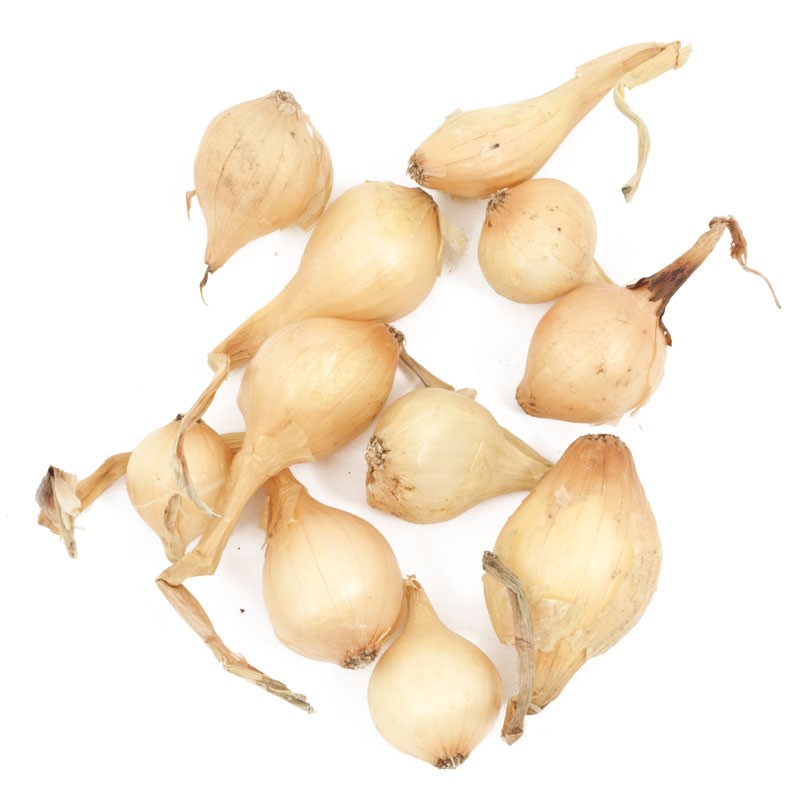
It sounds like they had an “onion snow.” We used to always try to plant our onions by mid-March; and, we’d say that there’d be one more snow storm—the onion snow— after the onions were planted.
—
What was the party?. . . a St.Patrick’s Day party? . . . a birthday party?. . and why didn’t it end up being a surprise party?
17-year-old Helena Muffly wrote exactly 100 years ago today:
Wednesday, March 12, 1913: Am trying to write my essay.
Lewis Hine’s picture of child coal miners (Source: Wikimedia Commons)
Her middle-aged granddaughter’s comments 100 years later:
Hmm… Did Grandma have to write another essay?
During much of February she was working on an essay about the Revolutionary War. Her teacher was going to give the student who wrote the best Revolutionary War essay a two and a half dollar gold piece. . . Grandma hasn’t mentioned it in the diary in quite awhile. I suppose she didn’t win the coin.
What was this essay about? . . .
I find that I want to ask myself: If I lived a hundred years ago, what would I have enjoyed writing an essay about? I know that the lens is all wrong, but here are some topic ideas that I think would have been interesting.
Should child labor be banned? — Child labor was very controversial in 1913. There were many coal mines in the southeastern part of the county where Grandma lived that used a lot of child labor, so this might have made a good essay topic.
The reasons why women should have the right to vote—It seems obvious today, but women’s suffrage was an arguable point in 1913.
The problem of adulterated foods—This was just a few years after the publication of Upton Sinclair’s book, The Jungle—and many people were very worried about the chemicals put into processed foods.
Should alcohol be prohibited? The prohibition movement was gathering steam in 1913, and taking either side of this issue would have made a good essay topic.
Planting trees on clear-cut land to improve the environment. People were worried about the environment in 1913. One concern was all of the erosion that was occurring due to the clear-cutting of old-time forests.
17-year-old Helena Muffly wrote exactly 100 years ago today:
Tuesday, March 11, 1913: We decided tonight to have our play on the fifth of April.
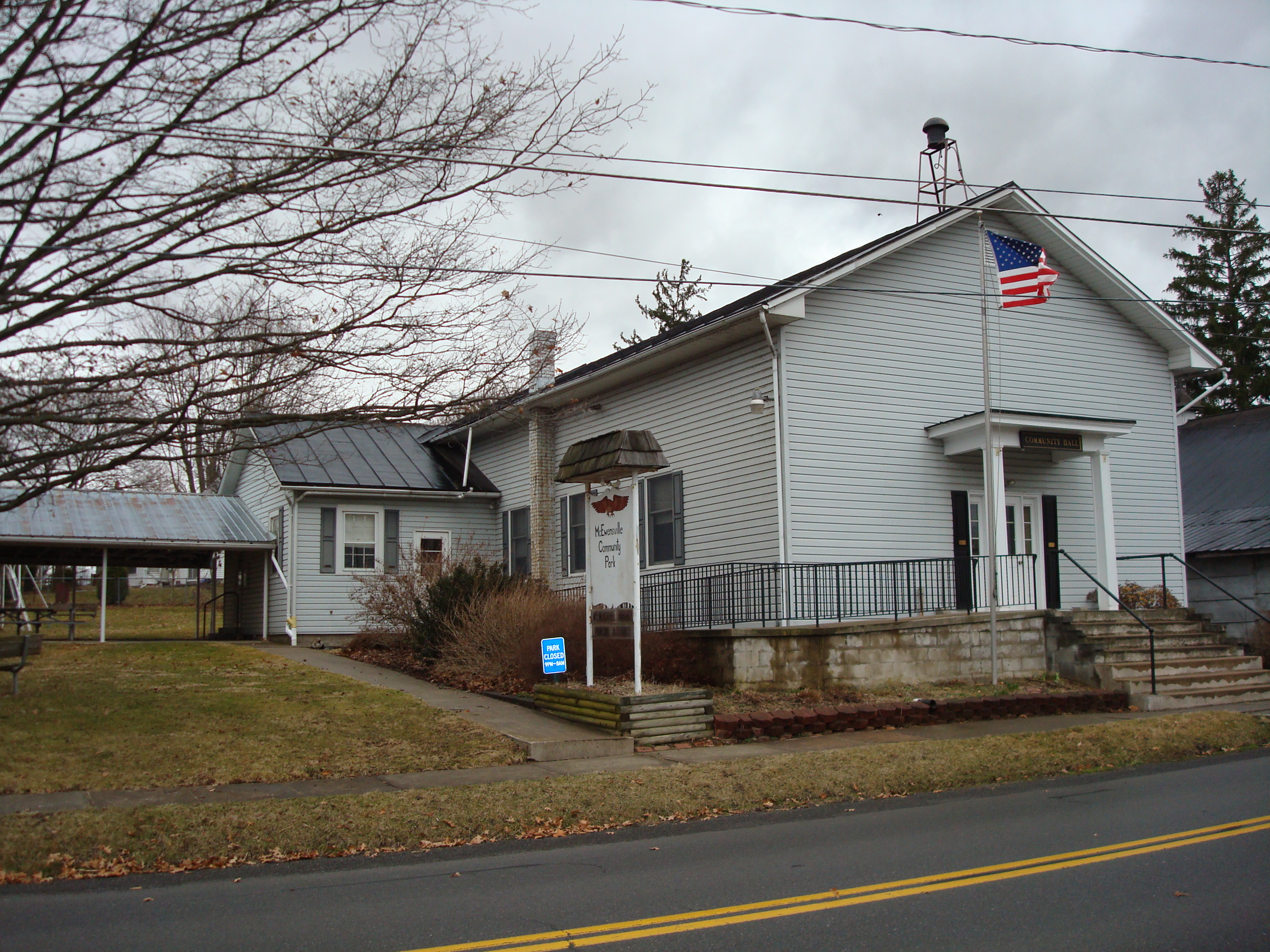
The play was probably was held at the McEwensville Community Hall. The same building has served as the town’s community hall for more than 100 years.
Her middle-aged granddaughter’s comments 100 years later:
The previous evening Grandma did not go to play practice because it was raining. Probably the practice was canceled on the 10th and moved to the 11th due to the inclement weather. In general it seemed play practice only took place once—or maybe twice–a week.
Grandma had been going to play practices since January 27. She had the role of Chloe, the servant. It seems somewhat surprising that the date of the play was only now selected. The cast probably wanted to be confident that they knew their lines and were ready for the play before choosing a date.
I suppose there was no need to rush to select the date since the play was probably the only upcoming event in the small town of McEwensville–and nothing else was vying for the venue.
17-year-old Helena Muffly wrote exactly 100 years ago today:
Monday, March 10, 1913: It rained tonight so we didn’t go up to practice.
A recent rainy day in McEwensville
Her middle-aged granddaughter’s comments 100 years later:
Grandma was in the class play. Did some of the cast members show up for practice? . . or did everyone independently decide that the weather was too bad?
Today we’d text, email, or call if we couldn’t get to a play practice or meeting. A hundred years ago, did people just use their own judgment to determine whether an event was probably canceled due to weather?
17-year-old Helena Muffly wrote exactly 100 years ago today:
Saturday, March 8, 1913: It was kind of dull here today. Nothing much of anything doing.
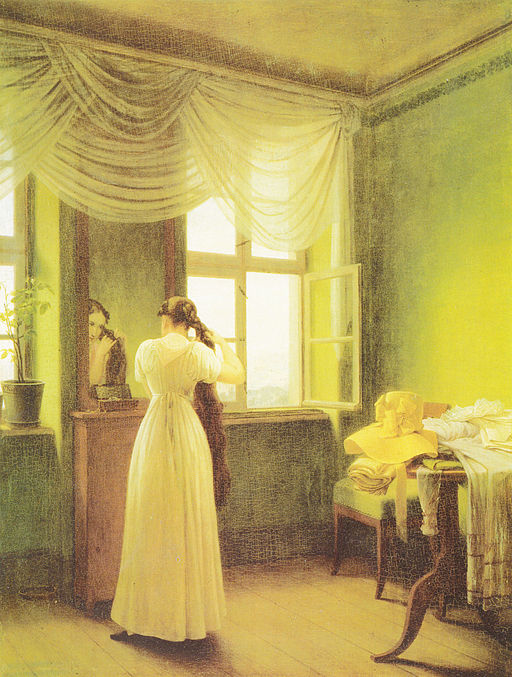
In Front of the Mirror by Georg Friedrich Kersting (Source: Wikimedia Commons)
Her middle-aged granddaughter’s comments 100 years later:
Hmm—What boring chores did Grandma need to do on a dull Saturday in March? ’
When I was a child, a weekly Saturday chore was to wash all the hair brushes and combs. I wonder if Grandma also did this when she was young,
I think that the reason we washed the brushes and combs was to have clean ones after we washed our hair. (We only washed our hair once a week back then.)
Here’s how to wash brushes and combs:
Add two or three tablespoons of baking soda to a small pan filled very hot water. (I use very hot tap water.) Swish the brushes and combs through the water—and “comb” the brushes with the combs. This cleans both the brush bristles and the comb teeth. Rinse with cool water. Lay on counter to air dry.
My sense is that people brushed their hair a lot more in the old days—and that brushing was one way to distribute, or remove, the oil and dirt between washings.
I can remember those old luxurious boar hair brushes that we used to have. Can you still buy them?