19-year-old Helena Muffly wrote exactly 100 years ago today:
Wednesday, October 22, 1914: << no entry>>
Her middle-aged granddaughter’s comments 100 years later:
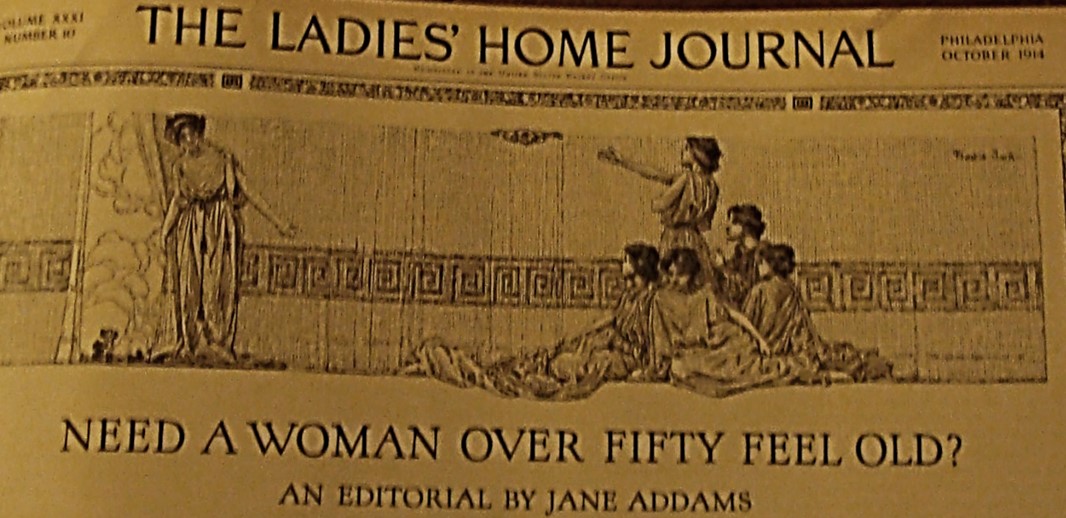
Another silent day. . . But I came across an editorial about women over fifty that resonated with me (probably because I’m a woman over fifty), and I thought you might also enjoy it. Here are some excerpts:
Need a Woman Over Fifty Feel Old?
An Editorial by Jane Addams
One of the most remarkable changes in the lives of women in this country has been the postponement of old age.
Chiefly because they had nothing else to do, our grandmothers, after their children had been reared and safely launched into homes of their own, expected to give their remaining years to a general oversight of the households of their sons and daughters. A vigorous woman, accustomed to the cares of a large household in which her word was law, when deprived of an absorbing occupation could not all at once reduce herself to a negligible quantity, and the traditional “mother-in-law” was quite as much the victim of circumstances as were the cherished family upon whom her unused energies were expended.
Happily there is another type of woman. The Woman’s Club movement has been a great factor in developing the powers of women who are over fifty years old. Many of them learned to write papers, to address audiences, to preside over meetings, to organize committees for the first time after they had passed that age. The women’s clubs also gave to thousands of women their first sense of responsibility in regard to public education and civic reform.
It was largely through the efforts of these club women that kindergarten, manual training, and domestic science were introduced in the public-school system of America.
These same elderly women who, in their youth, had been sheltered from any knowledge of crime and the ways of criminals, and who would have considered it most unladylike even to refer to a disreputable woman, were often responsible for securing matrons in the police stations, teachers in the jails, the establishment of juvenile courts and the abolition of vice districts.
One woman of sixty whom I know is most widely useful in many church activities, not only in the local circles of her denomination but also as the president of a State organization.
A woman over fifty years old is the executive head of a national organization which has for years urged and secured better conditions for working women and children, both through legislation and voluntary efforts. She has moved from one difficult piece of social organization to another until probably no one else in the Unites States is more conversant with the conditions of working women and children, and the laws which have been enacted on their behalf.
That weariness and dullness, which inhere in both domestic and social affairs when they are carried on by men alone, will no longer be a necessary attribute of public life when such gracious and gray-haired women become a part of it, and when new social movements, in which men as well as women are concerned, naturally utilize woman’s experience and ability.
Ladies Home Journal (October, 1914)