17-year-old Helena Muffly wrote exactly 100 years ago today:
Tuesday, April 30, 1912:Took my dress uptown to get made. Wonder when it will be done. Hope it will be satisfactory. I have a sore fore-finger, but can’t account for the cause.
Her middle-aged granddaughter’s comments 100 years later:
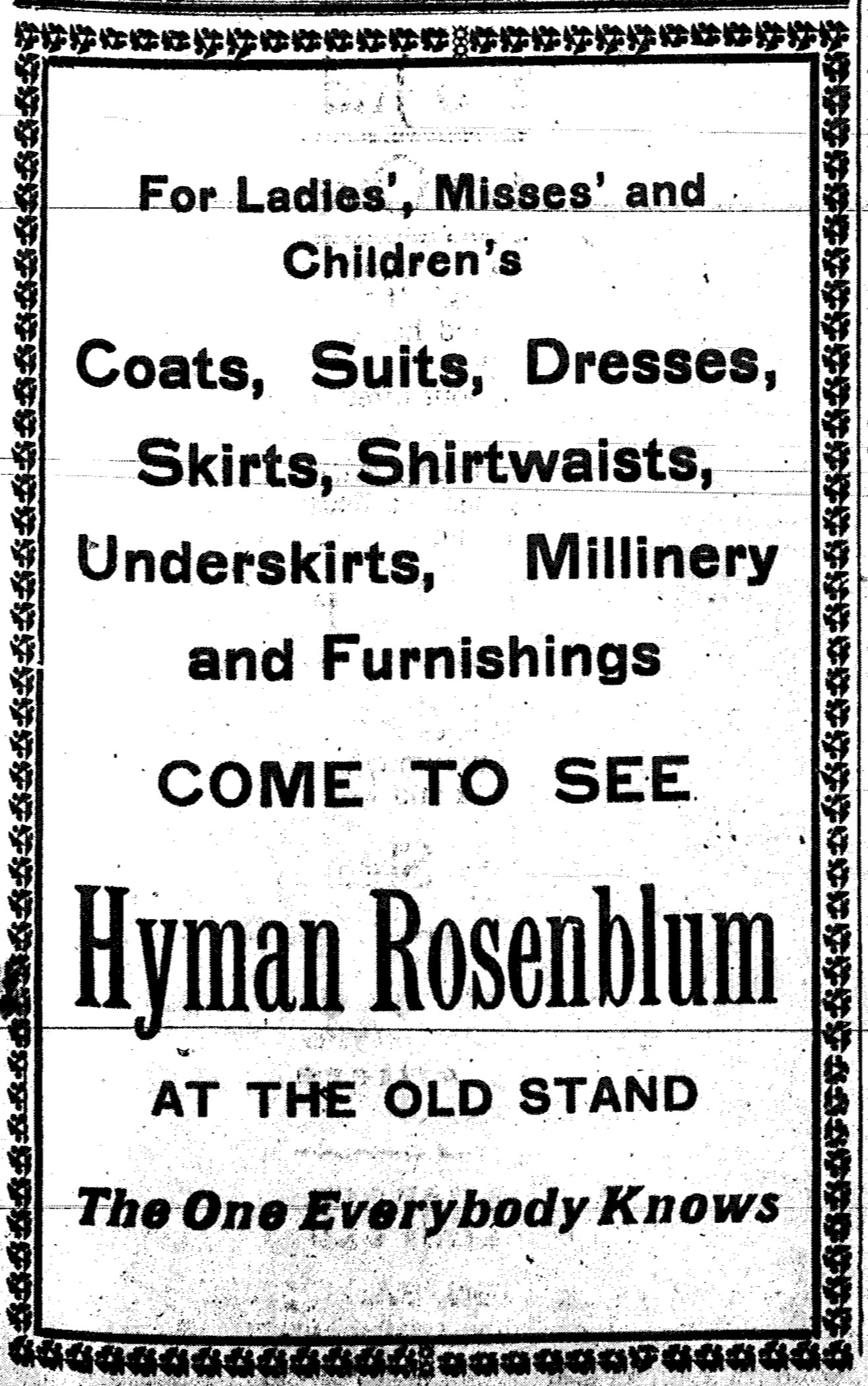
Hmm. . . I’m not sure what Grandma meant when she said that she took her dress uptown to get it made.
Three days earlier, she’d written that she and her mother went shopping in Milton and purchased a hat, several other items, and a white dress:
. . . I got a white dress . . .
Diary entry, April 27, 1912
Advertisement in Milton Evening Standard
Sometime a diary entry raises more questions than it answers.
— Had they really purchased cloth and a pattern, instead of a dress?
— Or did they buy a dress, but it needed alternations?
–Where was uptown? . . . somewhere in McEwensville? . . . in Watsontown? . . . (Uptown sounds like such a classy word to describe any section of the little towns near Grandma’s home.)
–And a lingering question—Do I worry too much about the details? In the bigger picture of Grandma’s story, does it really matter whether she bought a dress or had someone make it for her?
17-year-old Helena Muffly wrote exactly 100 years ago today:
Monday, April 29, 1912:It rained nearly all day. I wish it would get warm and stay so. Am beginning to think about final.
A recent rainy day in McEwensville
Her middle-aged granddaughter’s comments 100 years later:
I hope that Grandma was thinking positive thoughts about her upcoming finals. I found some surprisingly modern advice about positive thinking in a hundred year old book:
The Psychology of Success
There is nothing which tends so much to the success of volitional effort as the confident expectation of its success, while nothing is so likely to induce failure as the apprehension of it. . .
Lack of success may also be caused by indulgence or lack of courage, the individual preferring to sail along the chartered course of mediocrity rather than to strike out a new path for herself, involving risk, anxiety, and endless work . . . .
There are four mental requisites necessary to the achievement of success, namely: a clear view of the end; a judicious indifference to the sentiment around by the sweeping away of obstacles; an indomitable energy; and the power to resist the temptation to rest on the soporific plane of mediocrity.
Personal Hygiene and Physical Training for Women (Anna Galbraith, 1911)
If I could get in a time machine, I’d say, “Grandma—I hope you started to study. Then think confident thoughts. I’m rooting for your success.”
17-year-old Helena Muffly wrote exactly 100 years ago today:
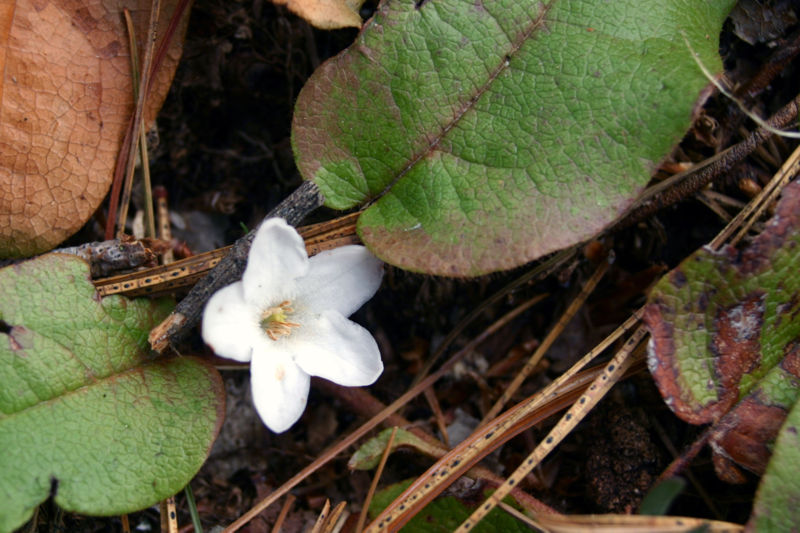
Sunday, April 28, 1912: Went to Sunday School this morning. Jimmie went along. Carrie and I went for arbutus and wound up by taking a walk. Went to church this evening. Sported my new hat.
Trailing Arbutus (Mayflower)
Her middle-aged granddaughter’s comments 100 years later:
Carrie referred to her friend Carrie Stout, and Jimmie was her 6-year-old brother.
Trailing arbutus is a small white flower. A hundred years ago picking trailing arbutus apparently was a popular springtime activity.
I even noticed a short article about arbutus when I was recently looking through microfilms of the local newspaper. The April 8, 1912 issue of the Milton Evening Standard had the following article:
Arbutus must have a relatively long blooming season, since they still were in bloom on the 28th.
In 1911, Grandma also mentioned picking trailing arbutus—that time with her two sisters:
Besse was out this afternoon. We three kids went for arbutus and I got some this time. . .
17-year-old Helena Muffly wrote exactly 100 years ago today:
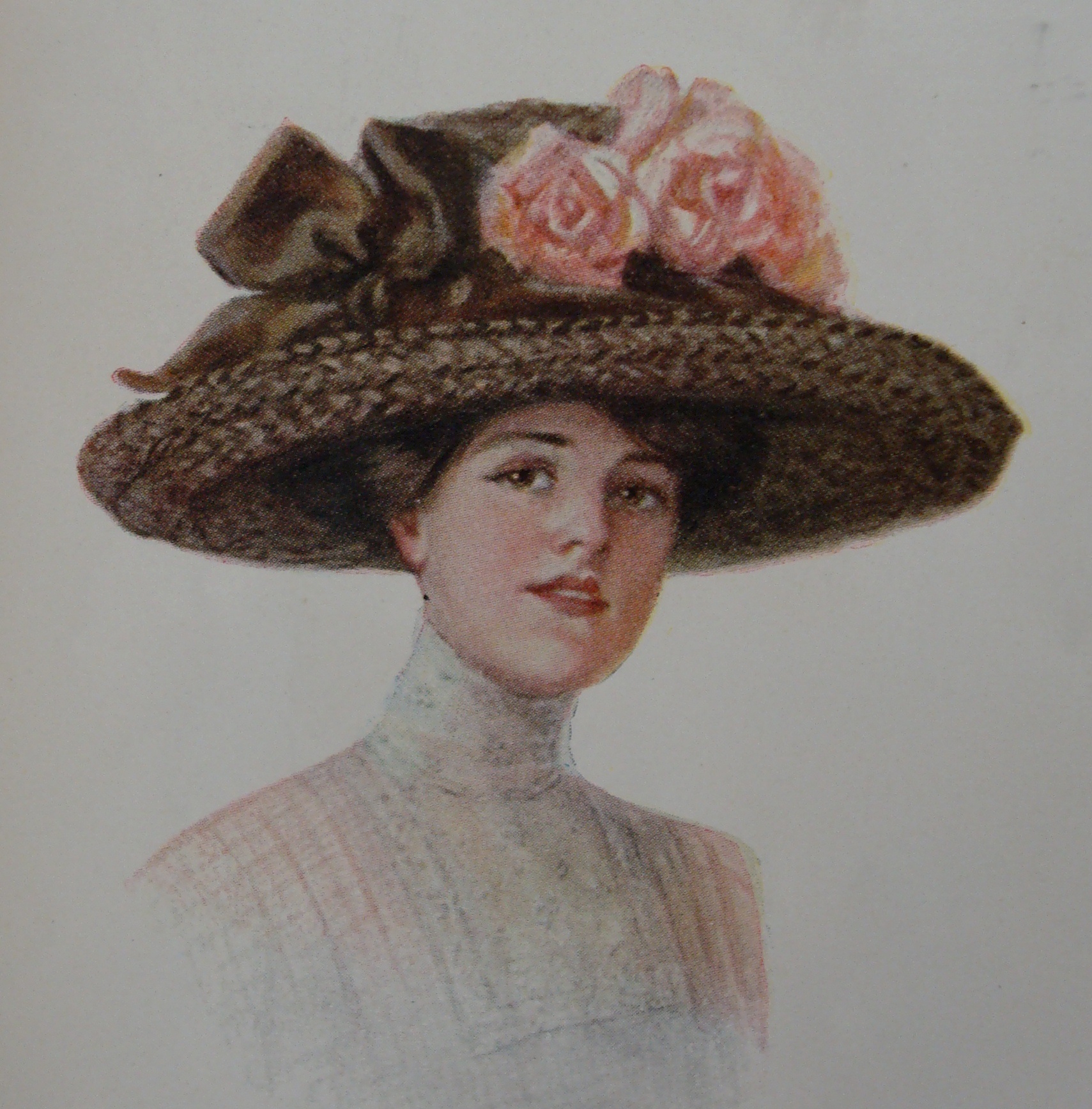
Saturday, April 27, 1912: Yessir, I really went to Milton this morning. Nor did I forget to take my Ma along. After a trying time I got a hat that I thought would do. It is trimmed in light brown ribbon and red roses. I got a white dress, a pair of tans and some other gigger-mer-rows.
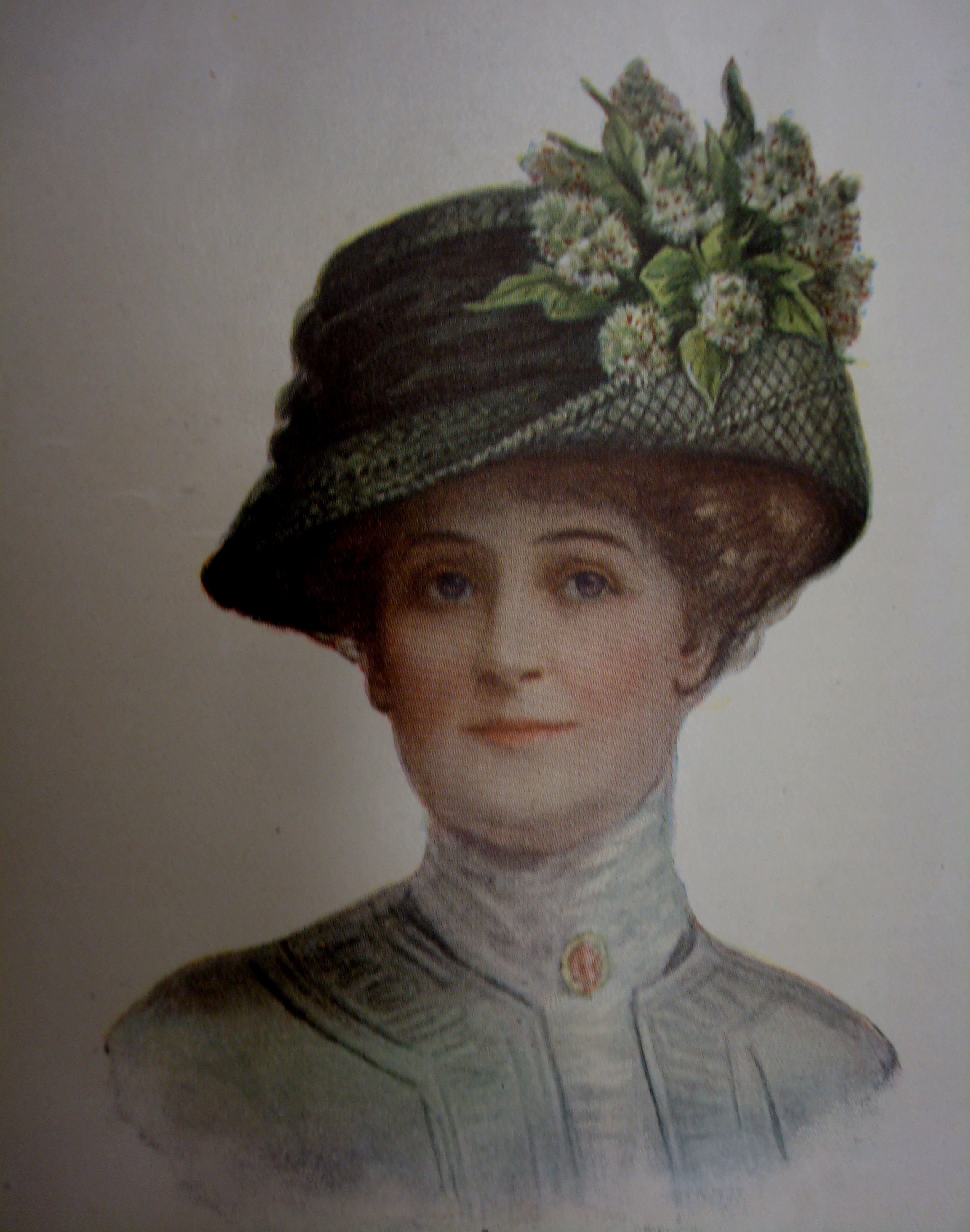
Amazingly, one of the drawings featured in an article on hats in the June, 1911 issue of Ladies Home Journal was a hat with roses and a brown ribbon. Maybe that was just a popular style a hundred years ago.
Her middle-aged granddaughter’s comments 100 years later:
We finally have at least a partial answer to what Grandma was talking about in several recent diary entries—Grandma needed to go hat shopping.
The past Sunday Grandma wrote that she wished she had her new hat; and, the previous day she’d written that she hoped it won’t be raining the next day because “the hat question had become a serious problem.”
My guess is that “a pair of tans” refers to stockings. I think that gigger-mer-rows is archaic slang for small items.
Many things that seem important a hundred years later are only mentioned in passing in the diary (or not mentioned at all). Yet something that seems very minor—buying a hat—was discussed day after day.
Maybe teens haven’t changed–then and now they want to have nice outfits and look good.
17-year-old Helena Muffly wrote exactly 100 years ago today:
Friday, April 26, 1912:I am so anxious about the morrow. It is drizzling tonight and I’m so afraid it will be raining in the morning when I get up. You see the hat question has become a serious problem to me.
Source: Ladies Home Journal (June, 1911)
Her middle-aged granddaughter’s comments 100 years later:
What exactly is the hat problem? This is the second time in less than a week that Grandma mentioned a hat. On April 21, 1912 she wrote:
Went to Sunday School this afternoon. Wish I had my new hat, I’d wear it if I had.
For more pictures of women’s hats a hundred years ago, see previous post:
17-year-old Helena Muffly wrote exactly 100 years ago today:
Wednesday, April 24, 1912: This afternoon was one of the howling kind. The wind certainly did rattle the windows of that old school house.
Recent photo of the building the once housed McEwensville Schools. The high school was on the second floor. I can almost picture Grandma huddled over her desk in a drafty classroom while the wind howled outside.
Her middle-aged granddaughter’s comments 100 years later:
I thought about calling this post—April Showers Bring May Flowers—but wanted to be sure that there had been showers.
Well—it didn’t rain on April 24, 1912 (so I had to come up with another post title). It was just a blustery, raw, spring day. A hundred years ago in nearby Williamsport, the low temperature was 28.9 degrees, the high was 66.9 degrees, and there was no precipitation.
Click on data table to enlarge.
(The forecast for today for Williamsport is–rain; low: 34 degrees, high: 54 degrees.)
An Aside–
I found the temperature information on the National Climatic Data Center website. Last January I explained how to find similar data for other towns and cities across the US. When I went back to the site to get materials for this post, I found that the process had changed, but that I could still find the data I wanted. I added a note to the end of that post which provides an update on the process.
17-year-old Helena Muffly wrote exactly 100 years ago today:
Tuesday, April 23, 1912: What an extraordinary thing for a dummy like I am. I know all of my piece from beginning to end. I learned the larger part of it this evening. There are almost a thousand words in all.
I can picture Grandma sitting in this house a hundred years ago trying to memorize a presentation.
Her middle-aged granddaughter’s comments 100 years later:
Grandma was memorizing a speech that she needed to present on the last day of school. The previous day she indicated that she’d completed writing it.
Assuming that Grandma spoke at about 150 words per minute, a 1,000 speech would take a little less than 7 minutes to present.
Today students don’t generally memorize speeches. Instead it is considered better to use notes to provide reminders about what to say. I wonder if students were encouraged to write and memorize speeches back then, or if it just was something that Grandma decided to do on her own in an attempt to make sure that she said what she wanted to say.