Average Daily Temperatures, 1911 and 2011

16-year-old Helena Muffly wrote exactly 100 years ago today: 

Tuesday, November 14, 1911: The first snow of winter fell today to the depth of an inch or more. James and I got a ride to school this morning. It seems I don’t get as many rides this year as I did last.

1911 = blue line; 2011 = red line

Her middle-aged granddaughter’s comments 100 years later:

This diary entry got me searching for historic weather data.  I found daily data for 1911 and 2011 for Williamsport Pennsylvania which is located about 20 miles northwest of McEwensville on the National Climatic Data Center website.

I wondered if it had been warmer or cooler in 1911 than in 2011. So I found the average daily temperature for the first day of each month for both years.

I discovered that the average daily temperature was higher in 1911 than in 2011 for 6 months of the year; and it was lower for 5. (I could make the comparison for only 11 months, since I don’t have December 2011 data.)

The National Climatic Data Center at the U.S. Dept. of Commerce is an awesome source for historic weather data at individual weather stations across the US. The data go back to the late 1800s for many locations.

Click here find the original handwritten data sheets for individual weather stations.

Click here for more recent data for individual stations.

I started searching for weather data to learn about the November 14, 1911 snowstorm that Grandma mentioned in her diary. I was surprised to discover that it did not snow on November 14, 1911 in Williamsport. The storm must have been very localized.


1911 Green Dress

16-year-old Helena Muffly wrote exactly 100 years ago today: 

Monday, November 13, 1911: A veritable winter day. Gee whiz! But it is cold. I wore my heavy green dress to school, which was oh so comfortable. Rachel was down this evening and Rufus served us with pop corn.

Her middle-aged granddaughter’s comments 100 years later:

I found this drawing of a green school dress in the September 1911 issue of Ladies Home Journal. I wonder if Grandma’s heavy green dress was similar to it.

A hundred years ago Ladies Home Journal  readers could order patterns so that they could make the clothes featured in the magazine:

Patterns for the designs shown on this page can be supplied at fifteen cents for each number, post-free. The amount of material required for the various sizes is printed on the pattern envelopes. Order from your nearest dealer in patterns: or by mail giving number of pattern, bust measure, and age, and including the price to the Pattern Department, The Ladies’ Home Journal, Philadelphia.

Note where readers were directed to send their pattern order. It’s hard to believe that a hundred years ago just putting Philadelphia down as the address would get a letter to the right place.

Rachel and Rufus

In this post Grandma refers to her sister Ruth as Rufus. Rachel was their friend Rachel Oakes. She was the primary teacher at McEwensville.

Sharing Hopes and Fears with Bosom Friends

16-year-old Helena Muffly wrote exactly 100 years ago today: 

Sunday, November 12, 1911: Went to Sunday School this morning. Our Sunday School teacher is sick. This afternoon I gave Caroline a visit. But such a day to go calling. It rained and blew and hailed.

Photo source: Wikimedia Commons

Her middle-aged granddaughter’s comments 100 years later:

Brrr. . . . the weather sounds dreadful.

Caroline refers to Grandma’s friend Carrie Stout. She lived on a farm midway between the Muffly farm and McEwensville.

Friends, then as now, played an important role in adolescents’ lives.  Here’s what a book published in 1911 had to say:

The boy seeks his chum and the girl her bosom friend into whose sympathetic ears hopes, fears, dreams, ambitions, and secrets are poured.

Boy and Girl (1911) by Emma Virginia Fish

I wonder what dreams, hopes, and ambitions Grandma shared with Carrie.  And, if—as the years passed– Grandma fulfilled her dreams, or if they were dashed or forgotten.

1911 Women’s Coats

16-year-old Helena Muffly wrote exactly 100 years ago today: 

Saturday, November 11, 1911: Mater and I went to Milton this morning on a shopping tour. As soon as we got there we went into several cars in which they had many curious things from California on exhibition. A shark was one of these, only he happened to be dead. An ostrich mounted, a live alligator and some monkeys. We each got a souvenir. Mine is some kind of pampas grass. After seeing all this we commenced shopping or mother’s rather since she was getting things for me. I got a chocolate colored coat trimmed with contrasting material, a brown hat with a blue and green feather, simply cute, a skirt for school and kid gloves. Have I not cause to be thankful?

Source: Ladies Home Journal (Sept. 1911)

Her middle-aged granddaughter’s comments 100 years later:

It sounds like train cars had been converted into a traveling museum and animal farm.

I bet that Grandma looked awesome in her new coat, skirt, and gloves.  The September and October, 1911 issues of Ladies Home Journal showed the latest coat styles.

Source: Ladies Home Journal (Sept. 1911)
Source: Ladies Home Journal (Oct. 1911)

Historic Events That Had NOT YET Occurred in 1911

16-year-old Helena Muffly wrote exactly 100 years ago today: 

Wednesday, November 8, 1911: Such stinkers in Algebra as we are having at present is enough to make your head giddy. Of all my six studies Algebra is just about the hardest, excluding geometry, which we commenced to take up several days ago, and General History, which we begin tomorrow. Ma and Ruth are out tonight but I staid in.

Her middle-aged granddaughter’s comments 100 years later:

I wonder what Grandma was going to study in General History.

Think of all the historic events that seem like they happened very, very long ago—but which had not yet occurred a hundred years ago.

Grandma WAS NOT studying the history of:

  • World War I (It began in 1914 after the assassination of Archduke Ferdinand of Austria.)
  • The Soviet Union (The Russian Revolution of 1917 ended the Russian Empire. The Soviet Union was founded in 1922.)
  • Prohibition (The 18th amendment which addressed prohibition was ratified in 1919.)
  • Women’s suffrage (The 19th amendment which gave women the right to vote was ratified on 1920.)
  • How New Mexico or Arizona–or for that matter Alaska or Hawaii–had become states (New Mexico and Arizona entered the Union in 1912; Hawaii and Alaska entered the union in 1959.)
  • The presidency of Woodrow Wilson (He would be elected in 1912 and take office in 1913.)
  • Radio (The first scheduled radio broadcasting was in 1916.)
  • The Panama Canal (It opened in 1914—though Grandma probably read newspaper articles about the building of the canal.)
  • The personal income tax (The 16th amendment which allowed the personal income tax was ratified in 1913.)
  • Insulin (Insulin was discovered in 1922.)
  • The direct election of senators by voters  (Prior to  the 17th amendment being ratified in 1913 senators were selected by state legislators.)

Collar Pins and Other Misplaced Items

16-year-old Helena Muffly wrote exactly 100 years ago today: 

Tuesday, November 7, 1911: I’ve concluded it’s easier to lose things than it is to find them. The other day six one cent stamps disappeared, and now today I lost two collar pins, which I have no hopes of ever recovering them again.

Collar Pins (Photo Source: The Youth's Companion, December 7, 1911)

Her middle-aged granddaughter’s comments 100 years later:

Young people misplace things, too!

I know that Grandma was frustrated, but this entry makes me smile. Sometimes I worry that I misplace things because I’m getting older. This entry reminds me that we all—young, middle-aged,  and old– lose items.

I’m not exactly sure what collar pins were—but they apparently were the rage in 1911. There were directions for making crocheted collar pins in the December 7, 1911 issue of The Youth’s Companion.

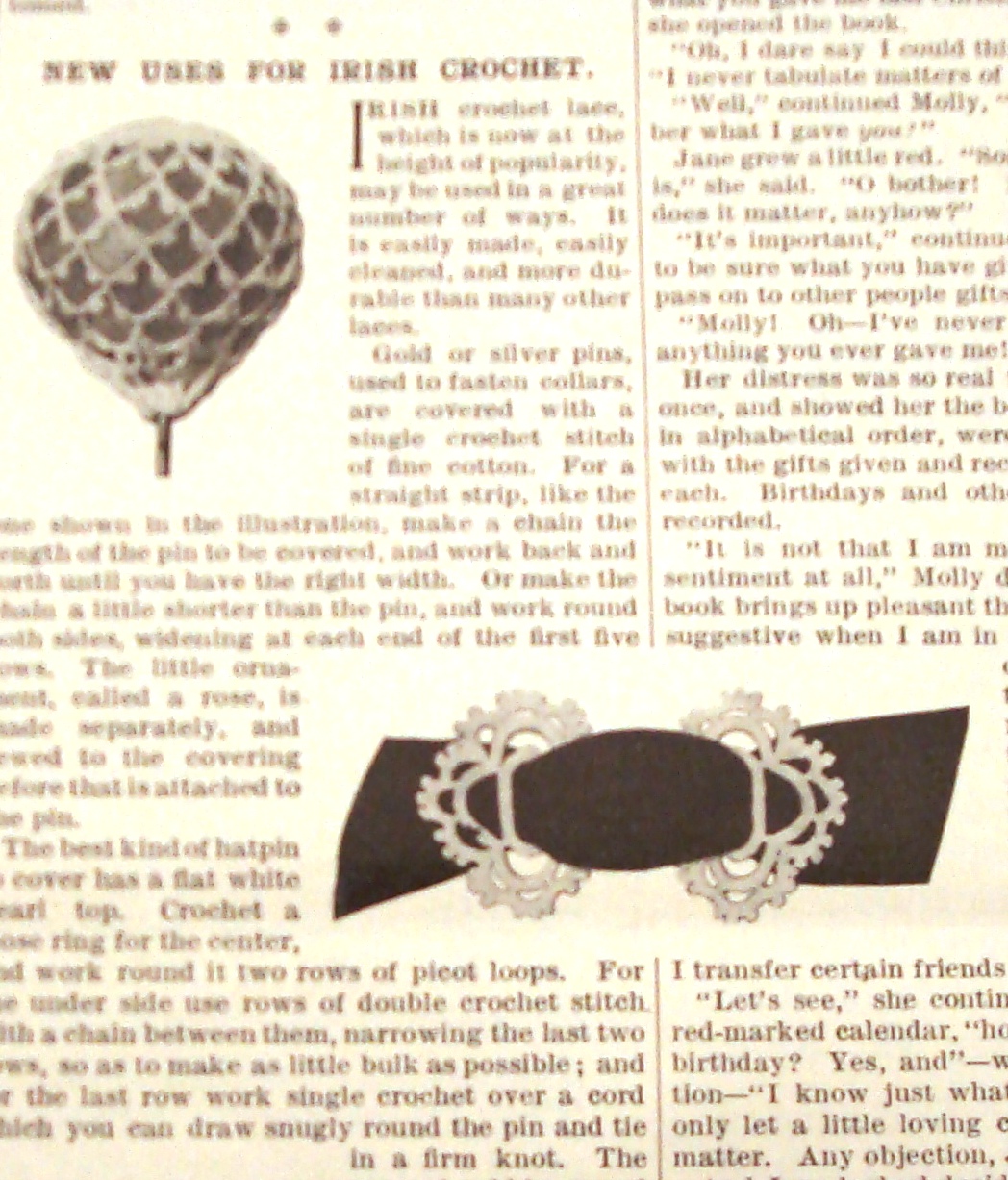
New Uses for Irish Crochet

. . . Gold or silver pins used to fasten collars are covered with a single crochet stitch of fine cotton. For a straight strip like the one shown in the illustration, make a chain the length of the pin to be covered, and work back and forth until you have the right width. .  .

An effective ornament for the neck or for the meeting-point of a Dutch collar is shown in the illustration. This is made in single crochet stitch of coarse cotton; a fine needle is used in order to keep the work as close as possible. Two parts are made; the pattern chosen here is in the form of a square, with loops round each side of the square. These loops are made of the picot stitch. The parts are joined on three picot loops at the back and a strip of black velvet ribbon six inches long by one and one-half inches wide is passed through the opening in the design.

Sometimes I’m amazed at the serendipitous way I find materials for this blog. I’d looked ahead and knew a diary entry that mentioned collar pins was coming up. Since I didn’t know what they were. I googled “collar pins” but had little luck.

I’d pretty much given up on finding anything about collar pins when I was flipping through 1911 issues of The Youth’s Companions a few days ago because Grandma had written about getting a subscription. Suddenly an article on Irish crochet that contained the words collar pins jumped out at me–and I had the material for this post.

Did More Females Than Males Attend Church a Hundred Years Ago?

16-year-old Helena Muffly wrote exactly 100 years ago today: 

Sunday, November 5, 1911: It was simply fine today. Went to Sunday School this afternoon. Carrie walked along home with me. I mean over here.

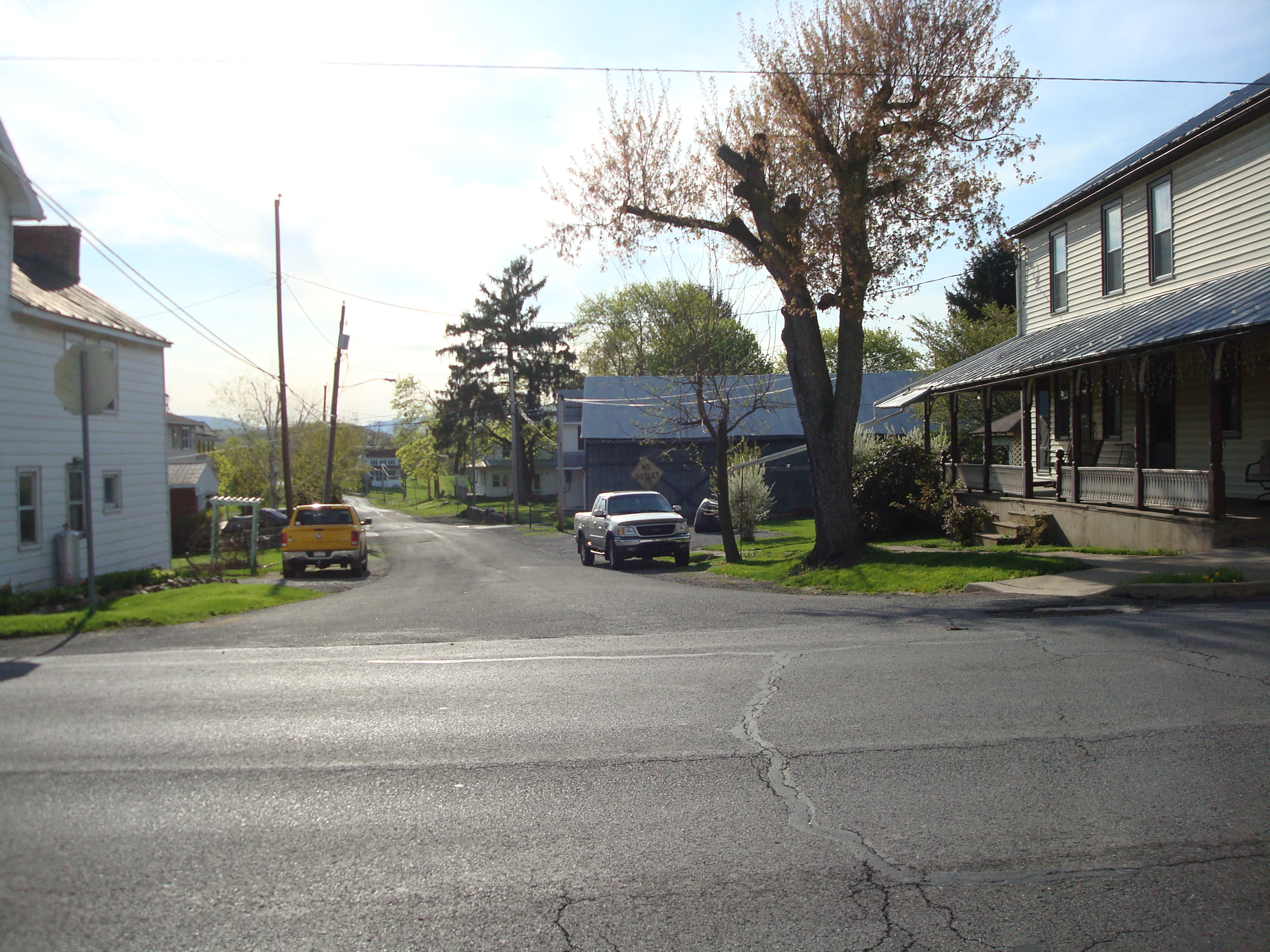
Grandma and Carrie would have walked down this road after Sunday School to get to the Muffly farm.

Her middle-aged granddaughter’s comments 100 years later:

It sounds like Grandma and her friend Carrie Stout enjoyed a nice fall day.

Every Sunday Grandma wrote in her diary that she went to Sunday School or church. Occasionally she mentioned that her sister Ruth went to Sunday School—but I don’t think that she ever mentioned her parents or 6-year-old brother Jimmie going. Didn’t they attend? . . . or did Grandma just not happen to mention them?

According to the March 23, 1911 issue of The Youth’s Companion magazine women were more likely to attend church than men:

Careful compilation of statistics shows that seventy per cent of the audience both in church and theater are women. The only places where men are in the majority, apparently, are the offices and workshops—and even there the preponderance is not what it once was.

An aside–I always enjoy finding statements like this in old magazines, but I often wonder where the statistics came from. Maybe I’m cynical—but I can’t help wondering if the author merely went to a church service and a play, counted the number of males and females, and then calculated a percentage.